Parshat Bereshit6 min read

The Day the Holy One Strips the Sun of Its Sheath

The sun rides sheathed with a pool of water breaking its heat, the sea halts at wet sand, and one day God takes the sheath off.

Curated by Arthur · Told by Maggid ·
Table of Contents
  1. The Second Firmament and Not the First
  2. A Pool of Water Set in Front of the Fire
  3. The Morning No Shadow Could Be Found
  4. The Sea Answers From Behind Its Line of Sand
  5. The Sages Argue Over the Last Fire
  6. The Sheath Comes Off
The Day the Holy One Strips the Sun of Its Sheath Click for full size

The Second Firmament and Not the First

The two great lights were carried up past the first firmament and not set down there, and every creature that would ever breathe owed its life to that decision. God fixed them in the second. Between one floor of heaven and the next lay five hundred years of walking, the floor itself was five hundred years thick, and higher still the host of heaven stood in the firmament above the heavens.

Put the sun in the first firmament, one story above the barley and the wells, and nothing underneath it survives a single afternoon.

The heavens carried that knowledge and said nothing about it for a long time.

A Pool of Water Set in Front of the Fire

Height alone was not enough, so the orb was given a covering. Rabbi Natan called it a pouch and laid the verse down beside it, "He set a tent for the sun in them." A tent pitched inside the firmament, the fire bedded in it the way a blade beds in a scabbard. In front of the opening stands a pool of water, and it has stood there since the fourth day.

Sunrise is the fire coming out of the pouch. The water takes the first of it.

What crosses the pool is weather. What would cross without the pool is a furnace opened onto a world made of straw, and so the Holy One breaks the strength of the sun in that water every morning before one ray reaches a rooftop. The heat that gets through is the heat farmers curse in the field. It is the leftover.

The Morning No Shadow Could Be Found

Once a year the arrangement shows its edge. On the first day of the summer solstice the sun stands square overhead and there is no shade anywhere in the world. A man looks for his own shadow and finds it crushed flat under his feet. The ox tied beneath the terebinth stands in the same white light as the open field, and the psalm says out loud what every body in that field already knows, "Nothing can shelter from its heat."

The Sea Answers From Behind Its Line of Sand

The other great power under orders lies flat along the coast.

It could take the land in an hour. Twice a day it climbs the beach and stops, and the thing that stops it is a strip of wet sand a child could kick apart. From the wall at Tziddon a watchman sees the water refuse a town it could erase before the evening meal is cleared.

Then the fortress of the sea speaks for itself. "I have not labored, and I have not borne, and I have not raised youths or reared maidens." Nothing drives it. It holds the line without a single reason to break it. The voice that drew that line answers with a question it already knows the answer to. "Will you not fear Me, will you not tremble before Me, who have set sand as a bound to the sea, an eternal law, not to be broken?"

The water slides back down the shingle. "Be ashamed, O Tziddon."

The Sages Argue Over the Last Fire

In the study hall nobody disputed that the sheath comes off. Malachi had settled that much. "For, behold, the day is coming, burning like a furnace, and all the criminals and all those who do evil will be straw." What the sages fought over was whether anything else would be burning that day.

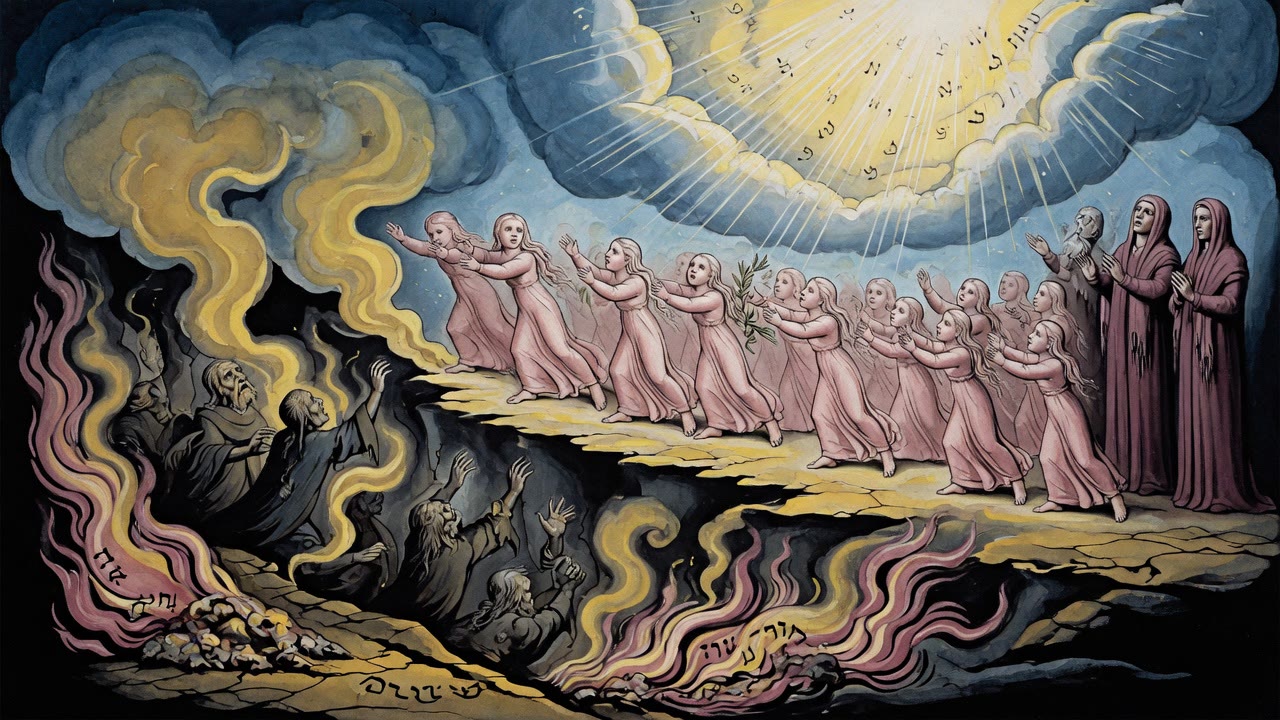
Rabbi Yannai and Rabbi Shimon said there would be no Gehenna (the realm of judgment after death) in the future at all. One day, one open furnace, the sun let out of its pouch, and the wicked gone the way stubble goes when a field fire crosses it.

The Rabbis refused that. Gehenna is a real fire in a real place, they said, and they had their verse ready, "The utterance of the Lord, for whom there is fire in Zion."

Then Rabbi Yehuda bar Ilai put a third thing on the table, worse than either. No scorching day and no pit. The fire comes out of the bodies of the wicked and eats them from the inside, and he read it out of Isaiah. "Conceive stubble, give birth to straw, your spirit is a fire that will consume you." A man walks around carrying his own furnace and never once suspects the load.

The Sheath Comes Off

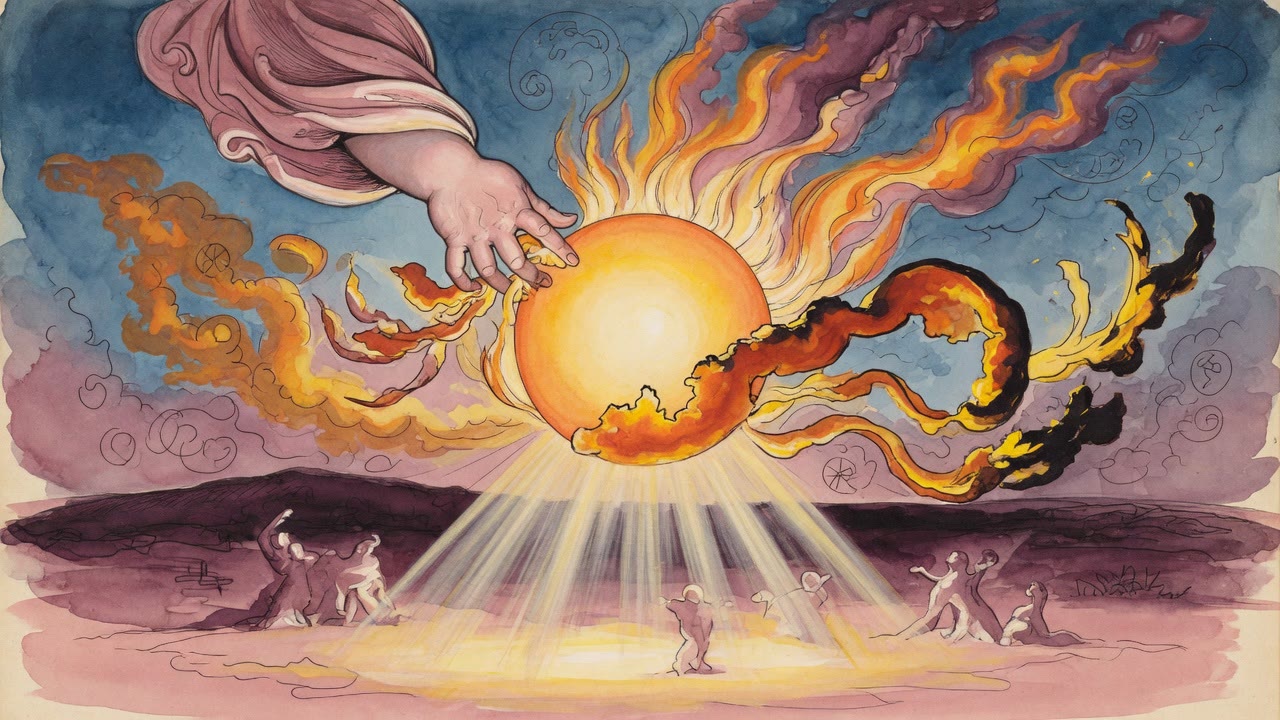
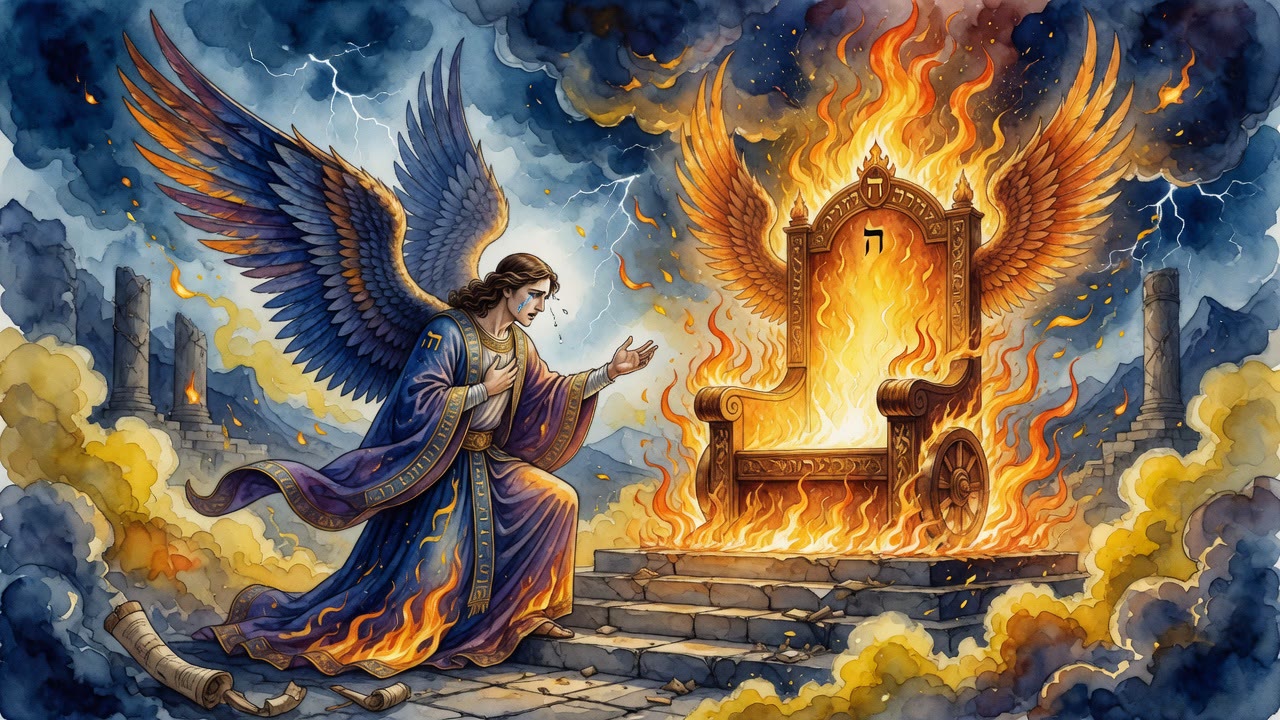
On that day the Holy One strips the sun of its pouch.

There is no pool in front of it. Whatever stands in the light stands in all of it, the whole face of the thing kept at one remove since the day it was hung, and the day that is coming burns them. The straw does what straw does.

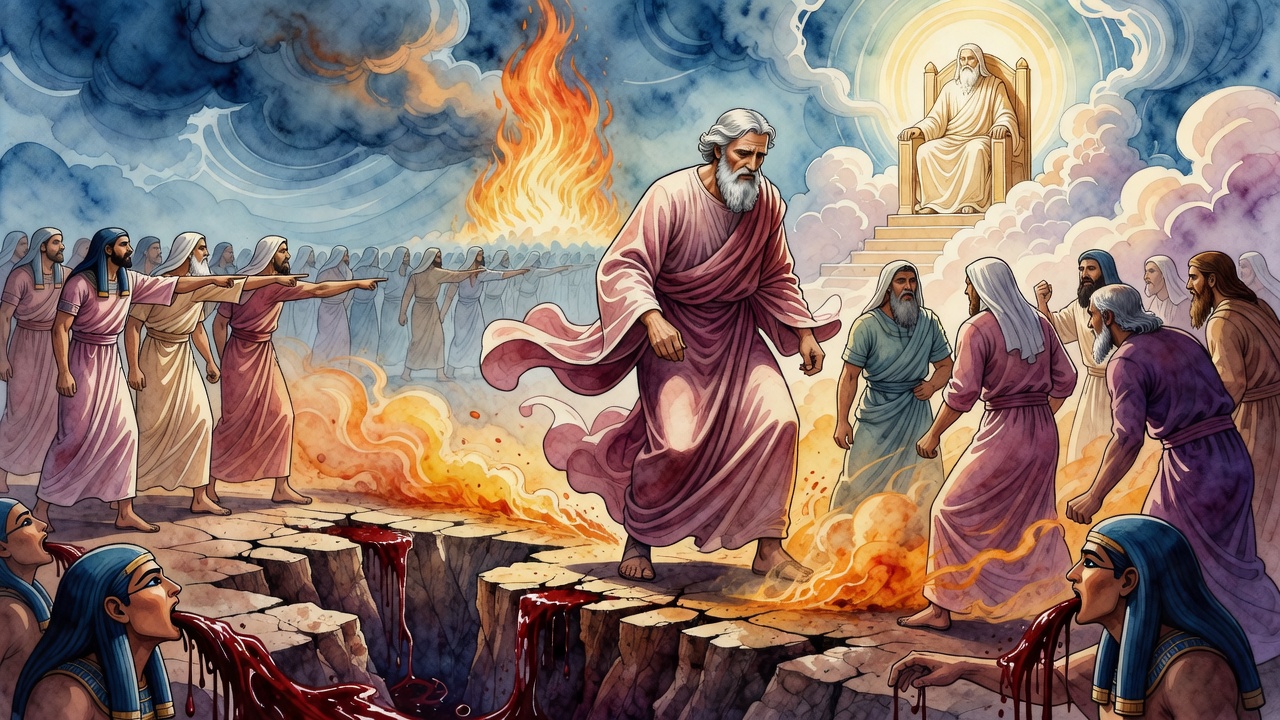
In the same unbottled light, at the same hour, something else happens. For those who feared the Name a sun of righteousness rises with healing in its wings, and they go out and grow fat like calves of the stall. The identical fire. One crop of people goes up as stubble and the other walks out into it unhurt, blinking in all that light.

Above them the heavens, which had held their five hundred years of distance since the fourth day and never once said why, open their mouths and declare His beneficence. They had known from the beginning what a first-floor sun would have done to the world beneath them, and they had carried it at the correct height, with the water standing ready, every morning of the age.


← All myths
From the tradition

Sources

3 sources

The texts behind this telling. Some cards carry a translation of the source; others are our own retelling of it, and each card says which. Every card links out to the original.

Bereshit Rabbah 6:6Bereshit Rabbah

Retold in our words. Read the original at the link below.The Sefaria Midrash Rabbah, 2022 · CC-BY

We look up, we see them... but where are they situated in the grand scheme of the cosmos?

Well, according to Bereshit Rabbah, a classical collection of Rabbinic interpretations of the Book of Genesis, the sun and moon reside in the second firmament. As it says in (Genesis 1:17), "God set them in the firmament of the heavens.” Simple enough. But wait, there's more! Rabbi Pinchas, quoting Rabbi Abahu, goes even further. Referencing (Nehemiah 9:6) – "You, the Lord, alone, You made the heavens, the heaven of heavens, and all their host…" – they ask: where is all that heavenly host actually located? The answer? In the firmament above the heavens! Layers upon layers, a celestial onion, if you will.

These firmaments aren't exactly next door to each other either. And the thickness of that firmament? Another five hundred years’ walk! Then, from that firmament to the next, you guessed it: another five hundred years’ walk. It really makes you think about the sheer scale of it all.

Think about the summer solstice. Bereshit Rabbah notes that on the first day of the summer solstice, there's no shade to be found anywhere. The sun is directly overhead, and as (Psalms 19:7) says, "Nothing can shelter from its heat.” Intense. And here’s an interesting tidbit: the orb of the sun has a sheath, like a protective covering. As (Psalms 19:5) puts it, "In a tent within, He placed the sun.” And there's a pool of water in front of it! The Zohar tells us that when the sun emerges from this sheath, God mitigates its strength with that water, preventing it from incinerating the world.

But, the text hints, things will change in the future. The Holy One, blessed be He, will strip the sun of its sheath and use its full power to burn the wicked, as (Malachi 3:19) prophesizes: "The day that is coming will burn them.” Yikes.

This leads to a debate about Gehenna, often translated as Hell. Rabbi Yanai and Rabbi Shimon argue that there won't be a Gehenna in the future. Instead, there will be a single, scorching day that burns up the wicked, drawing again from (Malachi 3:19): "For, behold, the day is coming, burning like a furnace…"

But the Rabbis disagree. They maintain that there will be a Gehenna, a real fire, pointing to (Isaiah 31:9): "The utterance of the Lord, for whom there is fire in Zion…"

Then Rabbi Yehuda bar Ilai offers a third perspective: there will be neither a scorching day nor a Gehenna. Instead, a fire will emerge from the bodies of the wicked themselves and consume them, citing (Isaiah 33:11): "Conceive stubble, give birth to straw, your spirit is a fire that will consume you.” A rather poetic, if terrifying, image.

Rabbi Yehoshua bar Avin adds a final thought: "The heavens will declare His beneficence" (Psalms 50:6). He suggests that in the future, the heavens will testify to God's kindness in not placing them in the first firmament. Because if they had, no living creature could have withstood the sun's fiery heat.

To consider the delicate balance of the cosmos, the layers of protection, and the sheer power that's being carefully managed. It makes you appreciate the world around us – and perhaps inspires a little bit of awe for the One who created it all.

Full source
Kohelet Rabbah 5:2Kohelet Rabbah

Retold in our words. Read the original at the link below.The Sefaria Midrash Rabbah, 2022 · CC-BY

It paints a vivid picture of the sun, not just as a celestial body, but as a powerful force carefully managed by the Holy One.

Rabbi Natan, as the verse says, taught that the sun actually has a pouch. We find a hint of this in (Psalms 19:5), which states, “He set a tent for the sun in them.” But that’s not all! There's also a pool of water strategically placed before it. Why, you ask? Because when the sun gets ready to do its thing, it gets seriously hot. So hot, in fact, that it could incinerate the entire world! Therefore, the Holy One, blessed be He, weakens its strength with water, acting like a cosmic regulator to keep us all safe.

Pretty wild image. This control isn’t permanent. The text suggests that in the future, things will change.

In this tradition, the Holy One will strip the sun from its pouch. No more cosmic dimmer switch! The sun will be exposed in all its raw power, and it will incinerate the wicked. This idea comes straight from the prophet Malachi (3:19), who declared, “For, behold, the day is coming, burning like a furnace, [and all the criminals and all those who do evil will be straw; the day that is coming will burn them].”

Now, Rabbis Yannai and Yishmael add another layer to this. They suggest that there won't even be a Gehenna (hell) in the future. Instead, the sun itself will become the instrument of both reward and punishment. How can this be?

Well, the righteous will actually benefit from the sun's unleashed power! Malachi (3:20) also says, “It will rise for those who fear My name, a sun of righteousness with healing in its wings.” The wicked, on the other hand, will face the full brunt of its destructive force, as the day will incinerate them (Malachi 3:19).

So, what are we to make of this? Is it a literal prediction of a solar apocalypse? Or is it a metaphorical way of understanding divine justice? Perhaps it's both.

It serves as a powerful reminder that actions have consequences. The very same force that sustains life can also bring destruction, depending on how we live. The sun, in this interpretation, becomes a symbol of ultimate accountability. A source of both healing and incineration.

What kind of world are we building, and what kind of "sun" will rise upon it in the future?

Full source
Sifrei Bamidbar 42:4Sifrei Bamidbar

Retold in our words. Read the original at the link below.Sifrei by Rabbi Shraga Silverstein · CC-BY

The ancient rabbis certainly did, and they found a powerful metaphor for this in the ocean itself. The ocean is vast, powerful, seemingly limitless. It could, if it chose, engulf everything. Yet, it doesn't. Why? Because it obeys a divine decree, a boundary set in place from the beginning. This idea is beautifully explored in Sifrei Bamidbar, where the Rabbis use the sea as a potent example of obedience and awe.

The text brings in a verse from Isaiah (23:4): "Be ashamed, O Tziddon, for the sea has spoken, the fortress of the sea, saying: I have not labored, and I have not borne, and I have not raised youths or reared maidens." Now, The first reading, this might seem a bit cryptic. What's the sea talking about, and why is Tziddon (Sidon), an ancient Phoenician city, supposed to be ashamed?

The Rabbis, with their incredible ability to find layers of meaning, interpret this verse as the sea itself speaking. The sea is saying, "I don't fear the potential hardships of creation – the labor, the loss, the uncertainty. And yet, I remain within my boundaries." It's a profound statement. The sea, this immense force of nature, acknowledges a higher power and submits to its will.

Then comes the real punch: The text quotes G-d, "Will you not fear Me, says the L-rd. Will you not tremble before Me, who have set sand as a bound to the sea, an eternal law, not to be broken?" It's a rhetorical question, of course. The answer is obvious. If the sea, with all its potential for chaos, obeys, then surely we, as humans, should also strive to follow G-d's commands.

The Sifrei continues, driving the point home: if the sea, which doesn't even face the same existential anxieties as humans ("perhaps I will not labor, perhaps I will not bear sons and daughters, perhaps I will bury sons and daughters"), still does the will of its Master, how much more so should we? "Be ashamed, O Tziddon!" is not just a rebuke to a city; it's a call to all of us to recognize our own limitations and to submit to something greater than ourselves.

What boundaries are we tempted to cross? Are we, like the sea, acknowledging a higher power and striving to live within the bounds of what's right and just? The ocean, in its vastness and its obedience, offers a powerful lesson in humility and awe.

Full source