Why All the World's Wealth Flows to Edom
All the rivers run to the sea, Ecclesiastes says. The rabbis read that as Rome, and said the scholars would get the money in the end.
Table of Contents
 Click for full size
All the Rivers and Where They Go
Ecclesiastes writes: all the rivers go to the sea. Most readers take this as melancholy cosmology, the cycle of evaporation and rain and flow, the world endlessly returning to its starting point without arriving anywhere. The rabbis took it as current events.
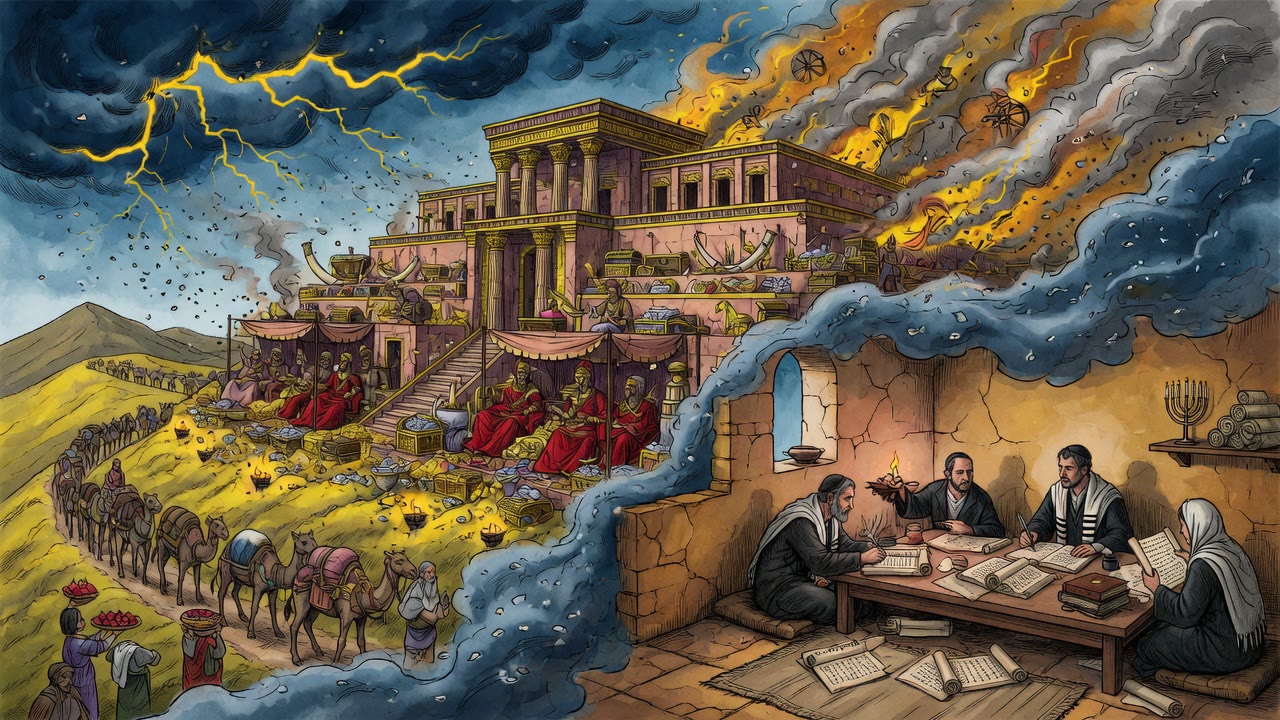
Kohelet Rabbah 7:9, the early medieval rabbinic commentary on Ecclesiastes, decodes the verse with uncomfortable specificity. All property accumulates only to the kingdom of Edom. In the rabbinic literature of late antiquity and the medieval period, Edom means Rome, or more precisely, Edom means whatever empire currently sits on top of the Jewish people, absorbing wealth that once belonged to others, expanding without satisfaction. The eyes of Edom are never satiated, the text says, citing Proverbs: the eyes of man are never filled.
The pattern is the same in any century. Property moves upward. The powerful take and the sea of accumulated wealth never spills back. The cities of the empire grow more magnificent and the villages around them grow poorer and the theology of the arrangement claims this is natural or necessary or divinely ordained.
Why All Wealth Flows to Edom
The rabbis are not surprised by this. They are describing a mechanism, not expressing outrage. The mechanism operates this way: the nations of the world were given their portion at the division of the peoples, and Edom received the portion of worldly dominion. The wealth flows to Edom not because of Edom's virtue but because worldly dominion is Edom's allotted sphere. The rivers go to the sea because that is where rivers go.
But Ecclesiastes does not stop with the rivers reaching the sea. The verse continues: to the place that the rivers go, they go there again. The water comes back. The cycle does not end with accumulation. Isaiah 23:18 announces it explicitly: her merchandise and her fee will be consecrated to the Lord. The empire's wealth, at the end, will be distributed in a different direction than the direction it traveled through all the centuries of accumulation. The sea will not hold it forever.
The question that Rabbi Yishmael ben Rabbi Yosei pressed Rabbi Yehuda HaNasi about was specific: Isaiah says the wealth will go to those who dwell before God and eat to satiety and clothe themselves with ancient garments. Who are those people?
Who Receives the Wealth in the End
Rabbi Yehuda HaNasi answered: Torah scholars. Not the powerful, not the merchants, not the military men who built what they built on the same logic Edom used. The scholars. The ones who sat before God in the sense that they sat with the Torah, whose lives ran along the track of learning and teaching, who clothed themselves with ancient garments in the sense that they wore the traditions of their predecessors, who ate to satiety in the sense that they never stopped finding new sustenance in what they were studying.
This is a remarkable economic prophecy to find in a rabbinic text. It does not argue that the scholars will eventually acquire armies and seize the wealth. It argues that the structure of the messianic age will simply redirect wealth toward the people who spent their lives cultivating the thing the messianic age is about. You cannot accumulate Torah the way you accumulate gold. But in the final accounting, the accumulated Torah is the thing that matters, and everything else will flow toward the people who have it.
Edom's Eyes That Cannot Be Filled
The midrash returns to the image of Edom's insatiable eyes and holds it against the scholars' capacity for satiety. Edom is defined by unsatisfied appetite. More territory, more tribute, more gold, more markets, and none of it fills the hole that the appetite is trying to fill because the hole is not about territory or gold. The scholars are defined by a different relationship to satisfaction. Torah study has the quality of nourishing rather than merely stimulating appetite. The more a person learns, the more they want to learn, but the wanting is not the frantic wanting of deprivation. It is the wanting of something that grows richer as it is consumed.
The sea to which all rivers flow will eventually give back what it has received. The world that has run on Edom's logic, the logic of eyes that cannot be filled, will eventually be organized on a different principle. And the people positioned to receive that reorganization are the ones who spent their lives practicing a different principle all along.
← All myths