Elijah Refused a Fortune to Stay Near Torah
Someone offered Elijah a thousand million gold coins to leave Yavneh. He said no without hesitating. Then he showed a rabbi something luminous.
Table of Contents
 Click for full size
The Offer Made at Yavneh
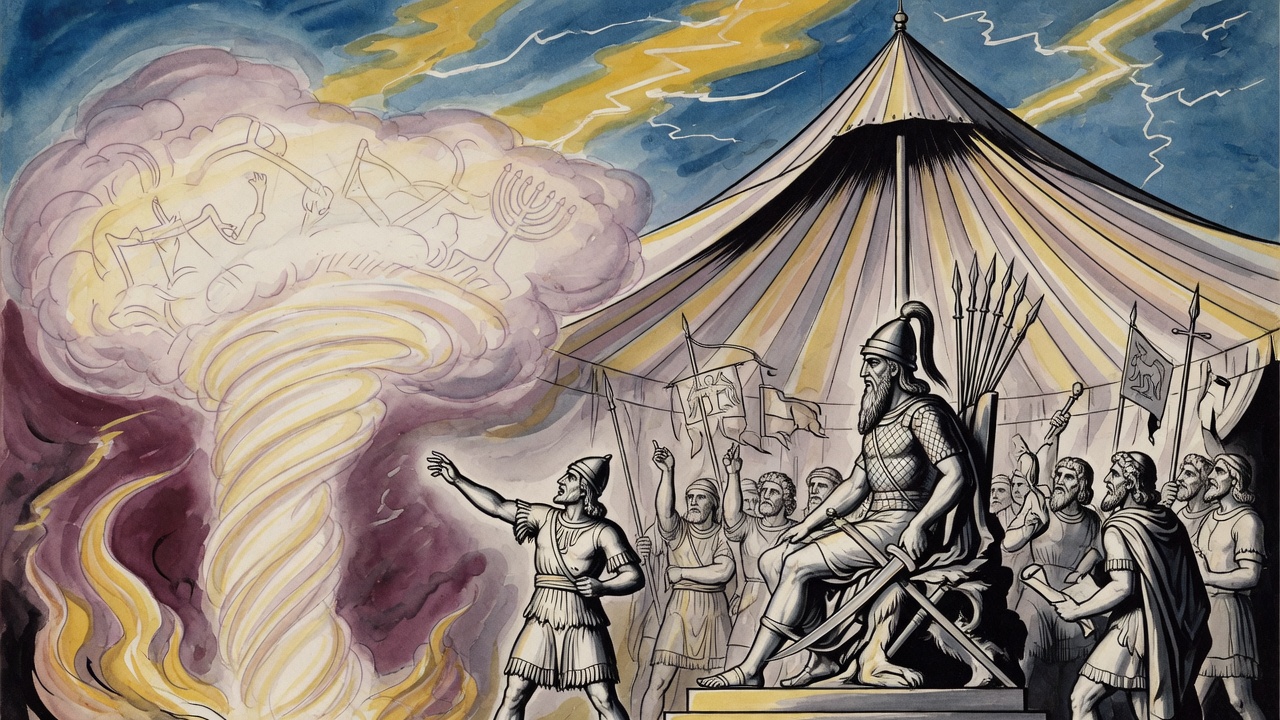
Elijah was in disguise, moving through Yavneh in the form of a rabbi, when someone approached him with a proposition. The offer was a thousand million gold denarii. The condition was simple: leave. Walk away from Yavneh, go somewhere without Torah study, and accept a sum large enough to buy kingdoms.
He said no without hesitation.
The sum in the story is meant to be beyond comprehension, a number chosen to make the refusal absolute. This was not a situation where the prophet weighed the amount against the inconvenience and found it insufficient. The offer was designed to be irresistible, and it was refused instantly, because the thing being offered the money in exchange for was not negotiable at any price.
What Yavneh Was
Yavneh, at the time of this legend, was the center of Jewish legal and spiritual life. When the Temple was destroyed in 70 CE, the sage Rabbi Yochanan ben Zakkai had escaped Jerusalem and reconstituted the Sanhedrin (the supreme rabbinic court) at Yavneh, establishing a new locus of authority for a Jewish world that had just lost its most concrete connection to the divine. The academy there became the place where the Oral Torah was preserved and transmitted, where the legal decisions that would govern Jewish life for centuries were made, where the tradition was kept alive against the weight of destruction and exile.
To leave Yavneh was not to leave a city. It was to leave the living current of the tradition. The offer asked Elijah to exchange presence within that current for material wealth, and the answer was the only answer possible from someone who understood what the current was.
The Stones That Lit the Night
After the refusal, Elijah took a rabbi outside Yavneh and showed him something. The tradition records that he produced two stones, or that he drew the rabbi's attention to stones already lying on the ground, and the stones gave light. They shone in a way that ordinary stones cannot shine, with a luminosity that the physical world did not account for.
The gesture is not explained at length. Elijah showed the rabbi the stones and then the encounter closed. What the rabbi had seen was something that belonged to the world Elijah had access to, a fragment of divine light carried into ordinary space, visible for a moment to someone who had just watched a prophet refuse a thousand million gold coins to stay near a house of learning.
The juxtaposition is the teaching. On one side: an incomprehensible sum of money, the kind of wealth that makes kingdoms. On the other side: two stones that shine in the dark. The refusal and the light were part of the same statement about what was actually valuable and where it actually resided.
What the Prophet Was Protecting
The Elijah tradition across its full length is a portrait of a figure who existed in both worlds simultaneously, who moved between the divine and the human, who returned to the sages with teachings they could not derive on their own. The function required presence. Not physical presence in a single location, but proximity to where the tradition was alive and moving. Yavneh was that place in the generation after the Temple's fall, and Elijah was there not as a visitor but as a guardian.
The offer of money was, in this reading, a test of whether the prophet could be separated from the tradition he guarded. The answer was given immediately, without deliberation, because deliberation would have been an insult to the question. Some things are not weighed. They are simply held.
← All myths