Abraham Looked at Esau and Saw a Boy Who Would Sell His Birthright
Abraham told God directly that he could see the problem in Esau. The bowl of lentil soup decades later was not a surprise to anyone who had been watching.
Table of Contents
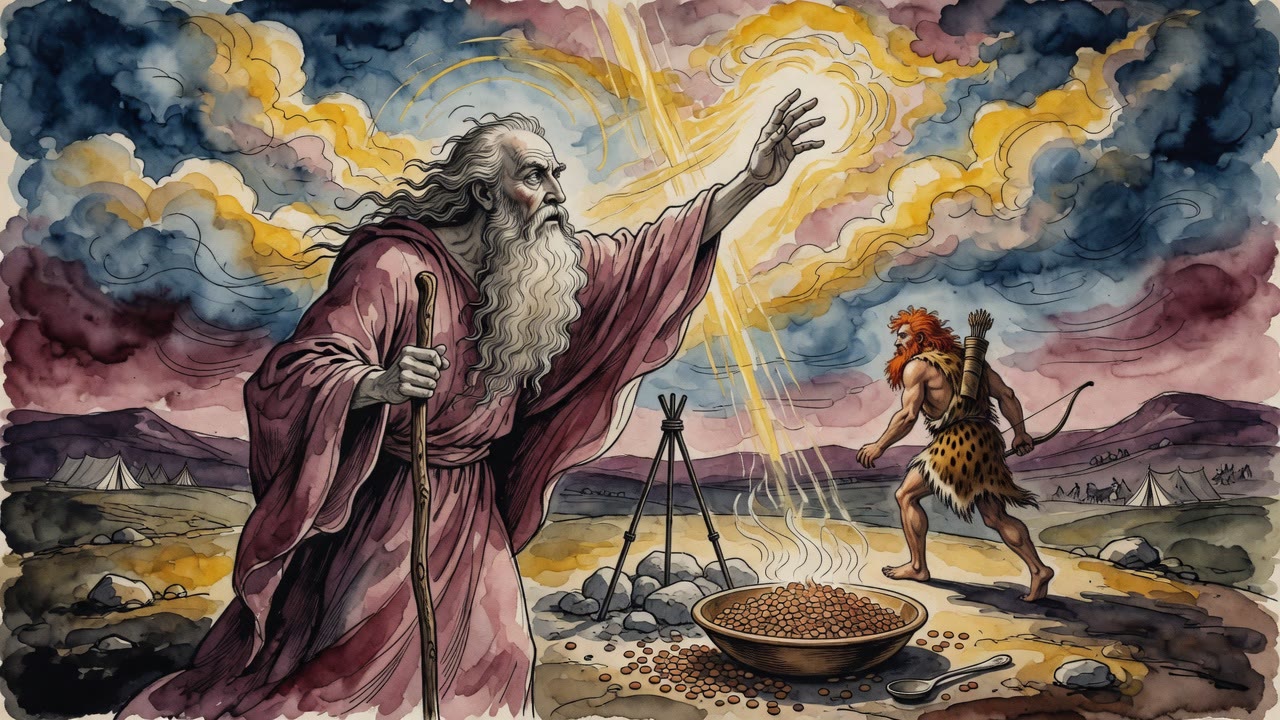 Click for full size
What Abraham Saw in His Grandsons
Abraham watched his grandsons grow up and understood something that Isaac never managed to see. Isaac loved Esau for reasons any father might love a capable firstborn: he was physical, a hunter, someone who could feed you. He brought game and smelled like the field and stood in the doorway with the confidence of a man who knows exactly what he is for. Isaac loved that clarity.
Abraham had lived long enough to know that clarity about earthly things and clarity about the covenant were different capacities. He watched Esau, and what he saw troubled him deeply.
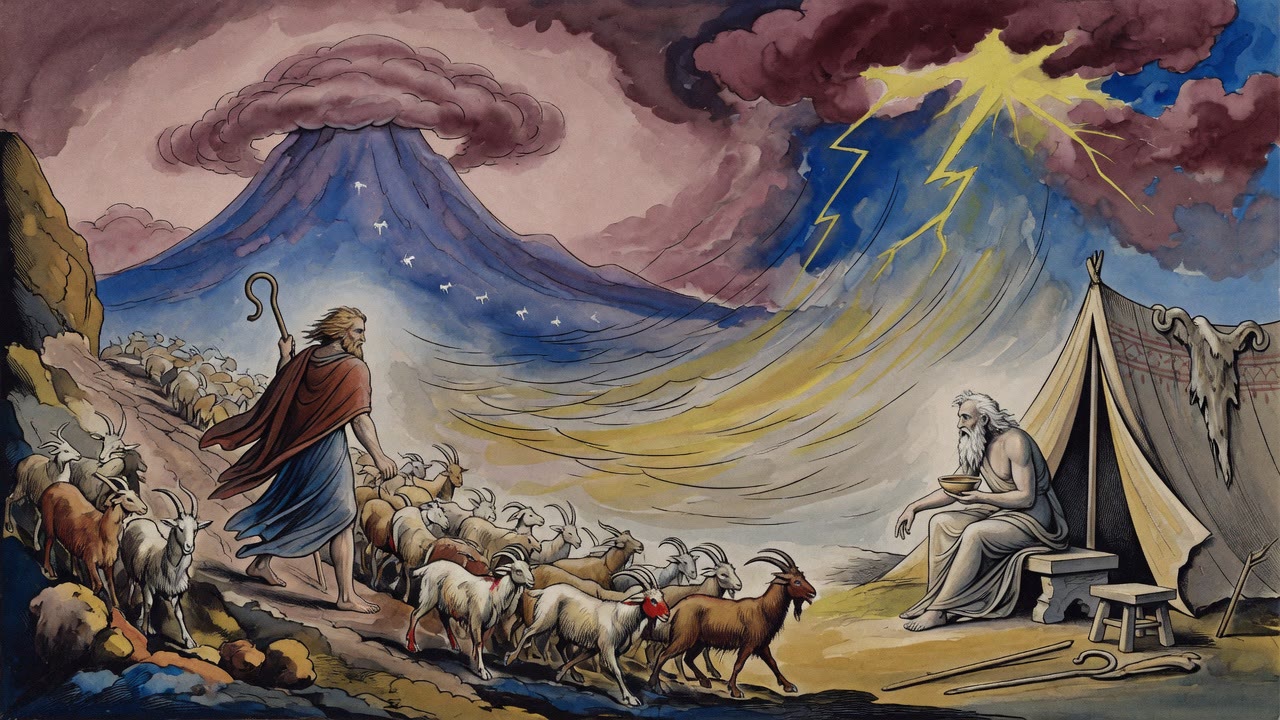
The Book of Jubilees, composed around 160 BCE in the Land of Israel, is unusually interested in what Abraham knew and when he knew it. In Jubilees chapter 19, Abraham observes Esau's character directly and says plainly to God: Isaac loves Esau more than Jacob, but I see that you truly love Jacob. This is not prophecy received in a vision. It is an old man reading his grandsons and telling God what he observes. Abraham's recognition of divine favor resting on Jacob comes not from special revelation but from watching them move through the world for years.
What he saw in Esau was not malice. Malice can be argued with. What he saw was a fundamental indifference to the covenant. Esau did not hate the traditions of his grandfather. He simply found them less interesting than whatever was immediately in front of him. A man who would trade his inheritance for a meal was already visible in the boy who could not hold two things in mind at the same time.
The Bowl of Soup and What It Actually Proved
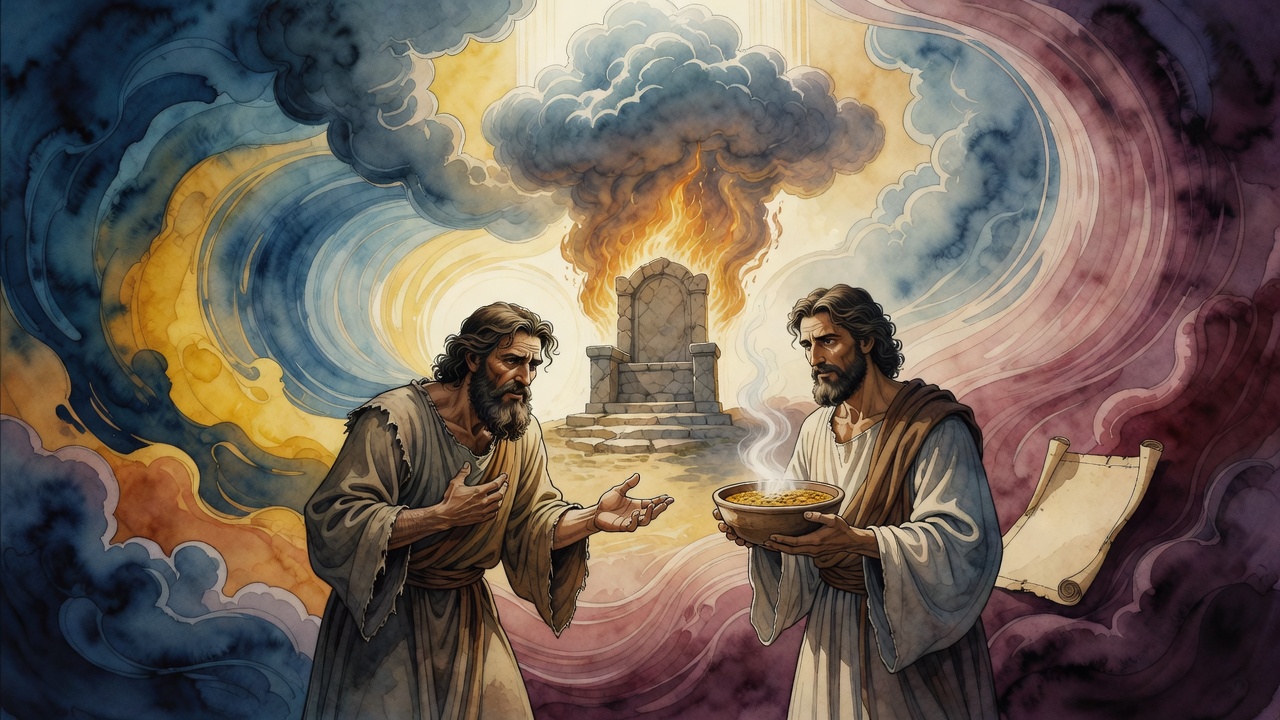
The transaction itself was almost insultingly small. According to Jubilees, the famine came in the first year of the fourth week, a new cycle that should have signaled a time of serious attention. Jacob was cooking lentil pottage. The lentils thickened over the fire and the smell carried across the camp, the dense earthy smell of a hot meal at the end of a long day. Esau came in from the field exhausted and smelled it. The hunger landed on him all at once. He asked for some.
Jacob asked for the birthright in exchange. Esau said: what use is a birthright to me when I am about to die? He was hungry, not starving. He was using the language of mortal crisis to justify a transaction he would have made even if he had been comfortable. He swore an oath over the steaming bowl, the words spent as cheaply as breath. He ate. He wiped his mouth, got up, and left, the whole exchange already behind him before the fire had burned down.
The Book of Jubilees records this without narrative excitement. The text is not interested in the drama of the bowl. It is interested in the confirmation of what Abraham had already read in Esau's character. The bowl was not the failure. It was the legible signature of a failure that had been present for decades. The birthright was not simply the right of the firstborn. In Jubilees' understanding, it was the role of primary covenantal heir, the one through whom the blessing of Abraham and Noah and Adam would descend to the next generation. Esau traded that for lentils not because he was stupid but because he genuinely could not feel its weight.
The Blessing That Echoed the Beginning
When Isaac blessed Jacob, the blessing the text of Jubilees records was not merely about prosperity or land or descendants. It was structured to echo the blessings given by Noah to his sons and by God to Adam at the beginning of the world. The language reached all the way back. Let all your enemies fall before you. Blessed be he who blesses you, cursed be every nation that curses you. May the Lord give you strength and power to tread down all that hate you.
This was the inheritance Esau had sold for a bowl of pottage. Not a ritual or a title. The transmission point of the entire covenant chain from the first human being through Noah to Abraham. Each clause of the blessing was a thread running back through generations, and now it ran through Jacob. Abraham had seen that Esau could not hold that weight. He had told God so. He had prayed that Jacob, the one who could hold it, would receive the favor that the heavenly tablets already assigned to him.
What Arrived Intact in Egypt
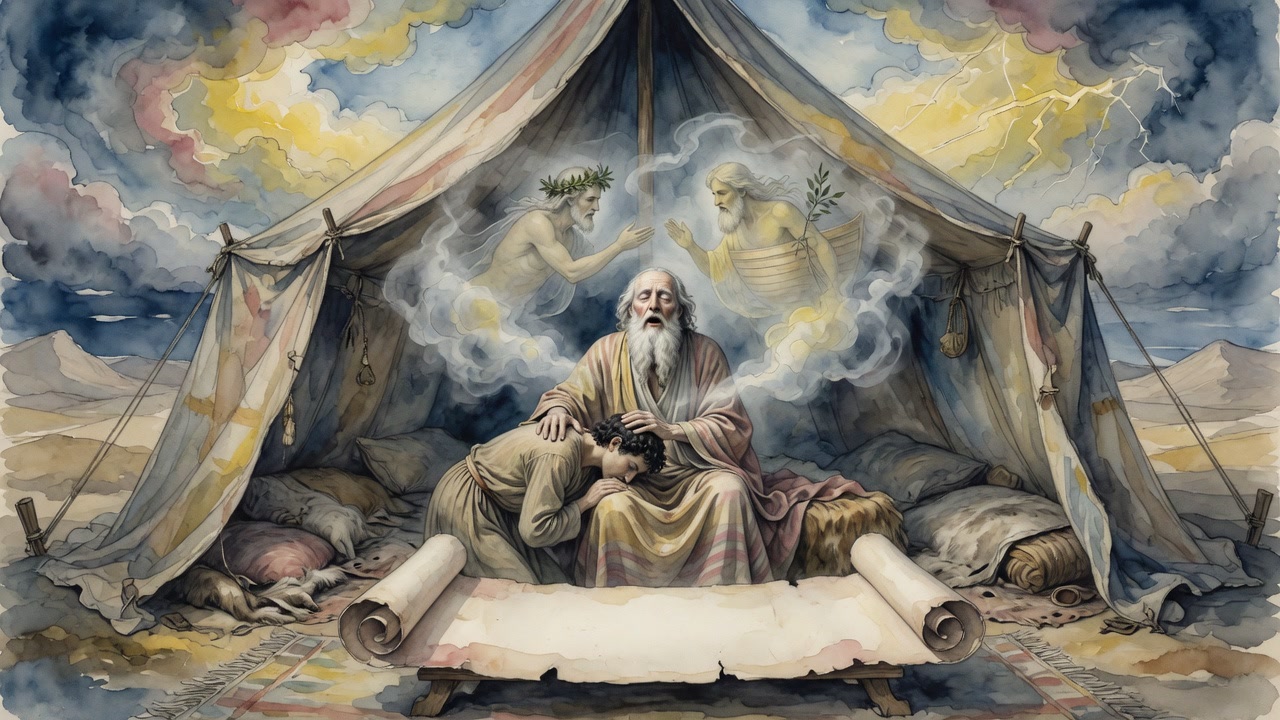
When Jacob later lay dying in Egypt after seventeen years among his son's household, he gathered his grandchildren close and blessed them, invoking the blessings of Abraham and multiplying them a thousandfold. He was an old man now, the way Abraham had been an old man when he first read Esau, and he laid his hands on a new generation with the same long vision that had once watched two boys in a doorway.
What had begun in a bowl of lentil soup, or rather in what that bowl revealed, had by then passed through decades of exile and reunion and grief and arrived intact on the other side. The weight Esau could not feel, Jacob carried the length of his life and handed forward in a foreign land, exactly as the heavenly tablets had assigned it from the start.
← All myths