6 min read

Holofernes Counted the Dust and Called It Conquest

The general led the Assyrian war machine toward Zion, certain no widow or weakling God could break a column that swallowed the horizon like locusts.

Curated by Arthur · Told by Maggid ·
Table of Contents
  1. The Road That Ate the Highlands
  2. The Chorus in the Tent
  3. The One Voice That Did Not Cheer
  4. The General Has the Last Word

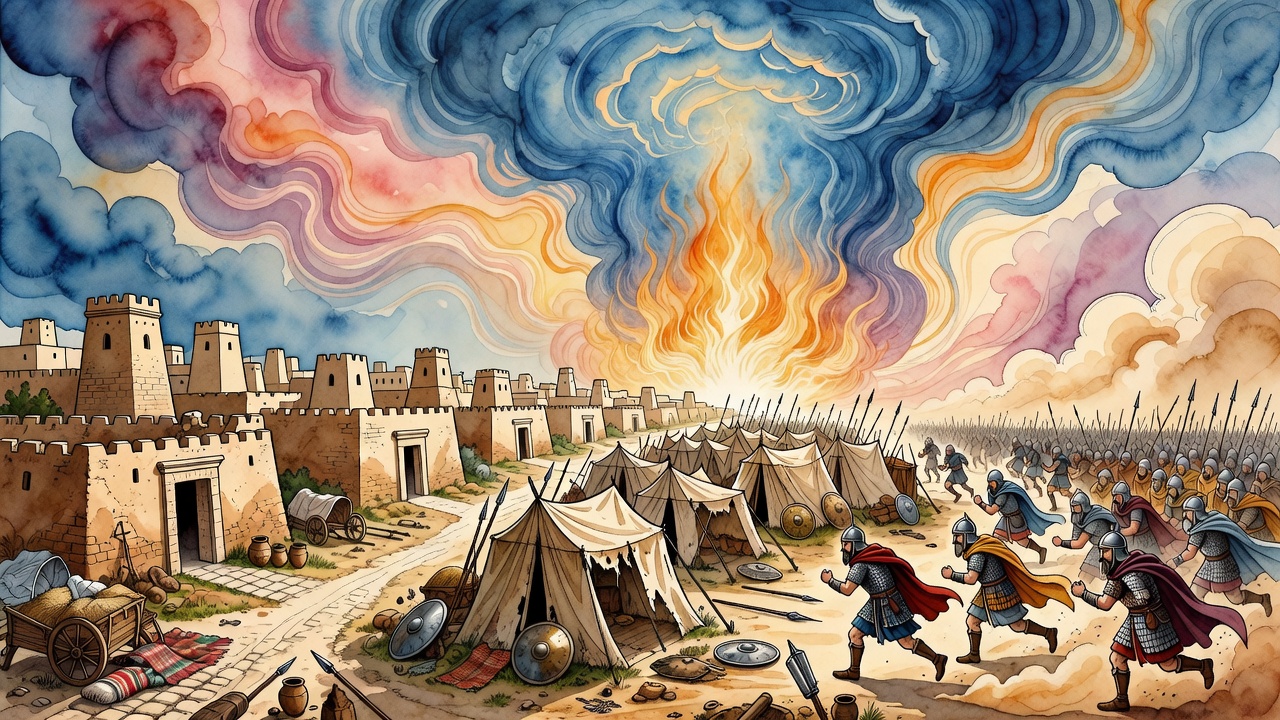
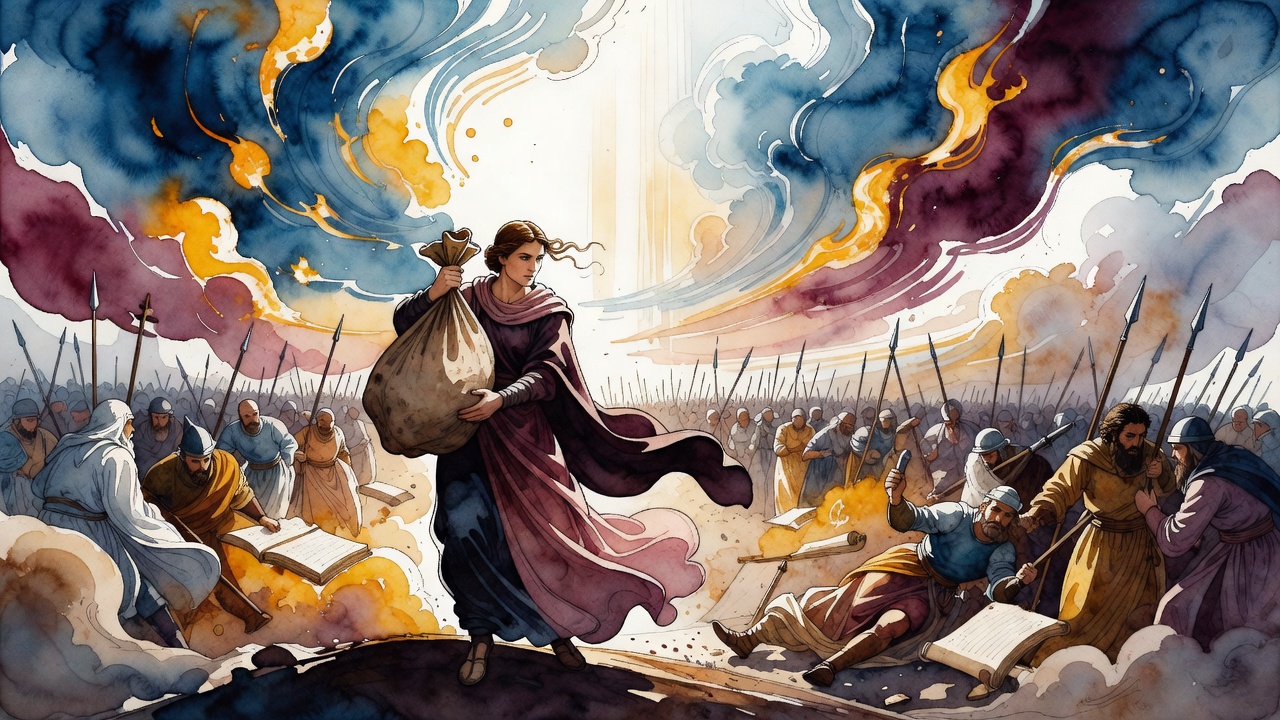
When the chariots first rolled out of Nineveh, Holofernes counted the dust above his column and called it proof. The caravans behind him stretched for miles, sacks of grain and dried fruit and salted meat hauled forward on the king's own gold and silver, and the camp followers swarmed at the column's edges like locusts over the face of the earth. He had seen wealth before. He had never seen wealth that moved, that marched, that ate the road in front of it and left the road behind it stripped to the rock. Three days from the gates he pitched his tents on the plains of Bectileth, under the mountains north of Cilicia, and he looked back along the line of horse and chariot and rider and could not find its end.

This was what Nebuchadnezzar had given him. Not a raiding party. A nation on the move, sent to make every other nation kneel.

The Road That Ate the Highlands

From Bectileth he turned the army into the highlands, and the work began. He overturned Put and Lud. He cut down the children of Tarshish who lived by their ships, and the children of Ishmael who pitched their tents at the edge of the desert, south of Cheleon, and he did not slow for any of them. The horsemen stretched as far as a man could see, and ahead of them the fortified towns shut their gates, and behind them the fortified towns were smoke.

He crossed the Euphrates and pushed west into Padan Aram, breaking the walled cities one after another from the brook of Arnon to the sea. He took the whole length of Cilicia, and every man who stood in the road before him he put to the sword, and the sword did not complain of the work. At the mountains of Japheth, opposite the land of Arabia, he stopped only long enough to count what he had taken. The arithmetic pleased him. He had not lost.

The Chorus in the Tent

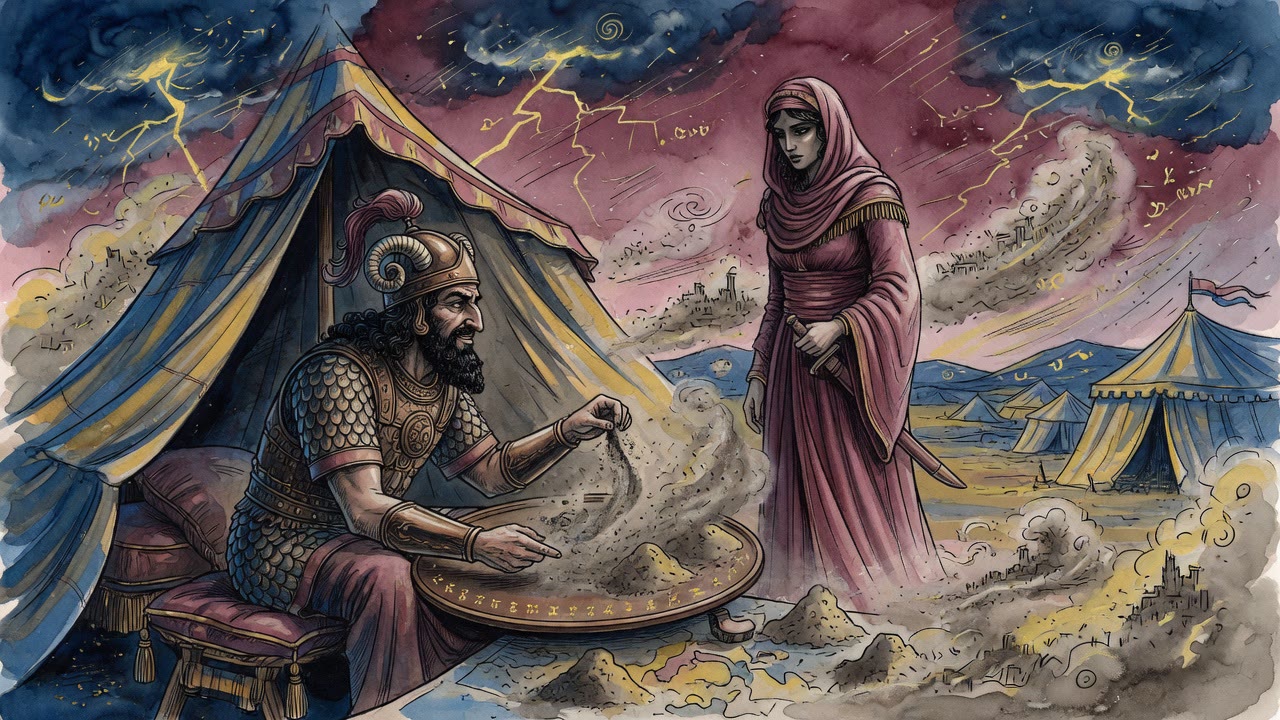
His officers loved him for it, the way men love a winning streak they have bet their lives on. The chief men, the lords of the seacoast, the kings of Moab, they crowded into his tent with their certainty already drawn like a blade. They had heard there was a small people in the hills ahead, a people who tilled their fields and kept their feasts, and the thought of them was almost funny.

"We will not be afraid," they told him. "We have looked at them. They are a people with no strength and no power for a hard fight." They leaned in close. "Lord Holofernes, we will go up, and they will be prey for your whole army to devour." They painted it for him, the swift end, the easy plunder, the hills emptied in an afternoon. Holofernes let them talk. He liked the sound of it. Every campaign he had ever won had begun in a tent that sounded exactly like this one.

The One Voice That Did Not Cheer

Then Achior spoke, and the tent cooled.

He was the leader of the Ammonites, a man who knew the small people of the hills the way a neighbor knows a neighbor, and he had no streak to defend. He told Holofernes their story instead. He told him where they had come from, and how they had been slaves, and how they had walked out of slavery on dry land while a sea closed over the army that chased them. He told him a thing the chorus did not want to hear: that this people could not be beaten while they kept faith with their God, and that they could only be beaten if they first sinned against him. As long as they did no wrong, Achior said, leave them. Their God would shield them, and Holofernes and his miles of caravan would become a byword and a shame.

The tent did not love him for it. A man who has just watched the Euphrates fall behind him does not want to be told that a god he cannot see, in a city he has not reached, is the one fortress his scouts forgot to map. Achior had stuck his neck out, and the neck was very far out now, alone in a room of men who measured strength in chariots.

The General Has the Last Word

The tumult died. The whispers thinned. Every face turned to the man at the center of the tent, the man who held life and death in his hand and had not yet been wrong about either.

Holofernes had crossed a great river and not lost. He had burned the walled cities from the brook to the sea and not lost. He had a column behind him that swallowed the horizon and a chorus in front of him that swore the hills were empty. He had every figure a general could want, the grain and the gold, the horse and the rider, the maps and the kings who carried them. He had accounted for everything a man can account for.

He had not accounted for the one thing that does not fit on a map. And somewhere ahead, in a hill town he had never seen, a widow he had never heard of was already inside the only weakness his logistics could not supply.


← All myths

From the tradition

Sources

3 sources

The texts this telling draws on, in full. Open a card to read inline, or expand it for a wider, quieter read.

Book of Judith 2:20Book of Judith

The Book of Judith, a captivating story of courage and faith, gives us a glimpse into the logistics of ancient warfare. it wasn't just swords and shields. An army needed to eat! And when

So, picture caravans stretching for miles, laden with sacks of grain, dried fruits, maybe even some salted meats. All paid for, of course, with the king's gold and silver. It's a pretty staggering image of wealth and power, isn't it?

This wasn't just a small raiding party. "He traveled with this entire army; horse, chariot and rider before the Viceroy, and they covered the appearance of the land, and went towards the sea." Imagine the sheer scale of it! The dust, the noise, the glint of metal under the sun.. it must have been a truly terrifying sight.

It doesn't stop there. The text continues, "And also camp followers traveled with them like locusts and like sand over the face of the of the earth, which were innumerable." Think about all the non-combatants tagging along. Merchants, cooks, servants, families.. a whole ecosystem of people dependent on the army's success. The comparison to locusts is particularly vivid, isn't it? A swarm that devours everything in its path.

Finally, "he traveled from Nineveh a journey of three days, until the plains of Bectileth and he encamped under the mountains to the north of Cilicia." Three days march. That gives you a sense of the distances involved. And the choice of location – "under the mountains to the north of Cilicia" – strategically important, no doubt, for controlling the region and accessing resources.

What does all this tell us? It tells us that war, even in ancient times, was a complex undertaking. It wasn't just about battles and bravery. It was about planning, logistics, and the sheer force of human will to move massive amounts of people and supplies across vast distances. And it gives us a richer appreciation for the challenges faced by those who opposed Holofernes, and the courage of Judith in standing up to such overwhelming power.

It also makes you think – what are the unseen armies supporting our own lives today? What complex systems are in place to ensure that we have what we need? Food, shelter, security... it's all built on something, isn't it? A thought to ponder as we return to our day.

Full source
Book of Judith 2:24Book of Judith

The story continues with Holofernes, the general of Nebuchadnezzar's army, and his relentless campaign of conquest. After his initial victories "And from there he traveled with all of his camp, and his chariots and horsemen into the highlands." (Judith 2:1)

The scene: a vast army, chariots rumbling, horsemen stretching as far as the eye can see, ascending into the highlands. What highlands are we talking about? The text doesn't specify, but we can picture Holofernes pushing his forces into the mountainous regions, seeking to dominate every strategic point.

The path of destruction continued. "And he overturned Put and Lud and destroyed all of the Children of Tarshish, and the Children of Ishmael who dwell at the edge of the desert, south of Cheleon." (Judith 2:2). These names might sound unfamiliar to us today, but they represented real peoples and places in the ancient world. Put and Lud are often associated with regions in Africa, while the Children of Tarshish likely refer to a seafaring people, perhaps connected to the Mediterranean. The reference to the Children of Ishmael, dwelling at the edge of the desert, south of Cheleon, paints a picture of nomadic tribes inhabiting the arid lands. Holofernes showed no mercy, crushing these diverse populations under his military might.

The narrative then broadens its scope, describing Holofernes's movements across major geographical features. "And he crossed the Euphrates River and went to Padan Aram, and destroyed all the fortified cities from the Brook of Arnon unto the Sea." (Judith 2:3). Crossing the Euphrates, a major river in Mesopotamia, marked a significant step westward. Padan Aram, a region in Upper Mesopotamia, was known as the ancestral homeland of the patriarchs in the Hebrew Bible. And the destruction of fortified cities from the Brook of Arnon (a river in Moab) to the Sea (likely the Mediterranean) indicates a sweeping campaign across a vast territory. Think of the logistics involved: supplying an army, besieging cities, and maintaining control over conquered lands. It's a evidence of Holofernes's military prowess and Nebuchadnezzar's ambition.

The march continued, "And he conquered all of the borders of Cilicia, and all those who stood before him he slew by the sword. And he came to the mountains of Japheth which are opposite the land of Arabia." (Judith 2:4). Cilicia, a region in southeastern Asia Minor, fell under Holofernes's control. The brutal reality of ancient warfare is starkly depicted in the phrase, "all those who stood before him he slew by the sword." Finally, the mention of the mountains of Japheth, opposite the land of Arabia, places Holofernes's army in a region bordering the Arabian Peninsula.

What does this all tell us? The Book of Judith, even in these early chapters, isn't just telling a story. It's painting a geographical picture, setting the stage for the drama to unfold. It's reminding us of the vast empires and the diverse peoples who populated the ancient world – and the constant threat of war that hung over them. And it makes us wonder: what will happen when this unstoppable force meets its match?

Full source
Book of Judith 6:5Book of Judith

The Book of Judith places Holofernes inside a chorus of overconfidence.

Holofernes's inner circle, the chief men, those living by the seaside, and even the Moabites, are a chorus of doubt. They're practically begging him to crush the Israelites. Why? Because, as they see it, the Israelites are weak. "We will not be afraid," they say, "for we see that they are a people who have no strength or power for a strong battle."

Can you feel the arrogance dripping from their words?

It's that moment when everyone thinks they know better, when they're convinced victory is assured. "Lord Holofernes," they urge, "we will go up and they will be a prey to be devoured by all your army." They paint a picture of effortless conquest, a swift and brutal end for the Israelites. It's a chilling display of confidence fueled by perceived weakness in their opponent.

But what about Achior? He's the Ammonite leader who dared to speak up in defense of the Israelites, reminding Holofernes of their history and their God. He's already stuck his neck out, and now, surrounded by this bloodthirsty mob, things are about to get even more tense.

The tumult finally dies down. The whispers fade. All eyes turn to Holofernes. He, the commander, the leader, the man who holds life and death in his hands. He is ready to speak.

And what will he say? We’ll find out soon enough. But you just know, something big is about to happen.

Full source