Lamech Shot Cain With an Arrow and Did Not Know It
Cain built cities and survived the mark, but the count ran to seven generations. His blind descendant Lamech shot him in the dark, mistaking him for an animal.
Table of Contents
 Click for full size
The Mark That Counted Down
Cain had built a city, named it after his son, filled it with family, and still the curse followed him. Not the wandering exactly, though the wandering was real. What followed him was the count. God had warned that anyone who killed Cain would be punished sevenfold, and the legend heard that number as a timer: Cain would live through seven generations of his own descendants. Then the reckoning would arrive from within his own bloodline.
He had survived the first murder investigation in human history. He had built walls and raised children and encouraged them in every practical art: metalworking, music-making, livestock-keeping. The world he made was real and occupied and busy. But the timer was running.
The Blind Hunter
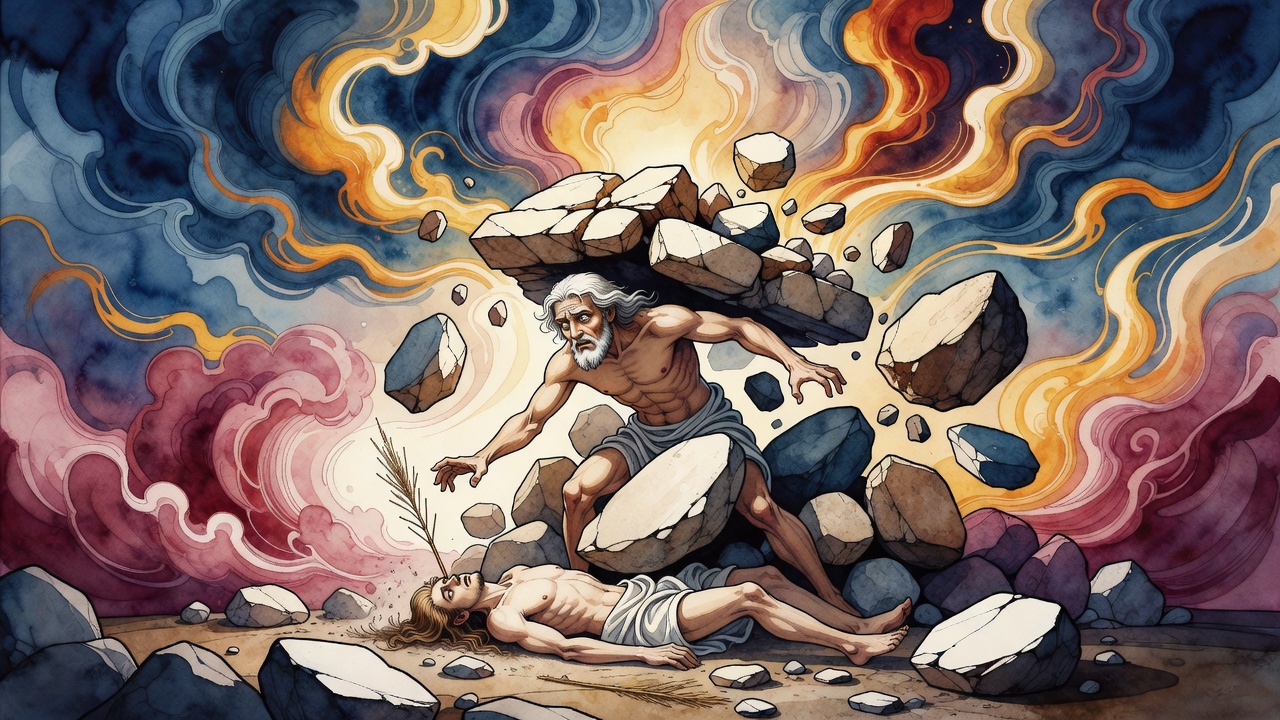
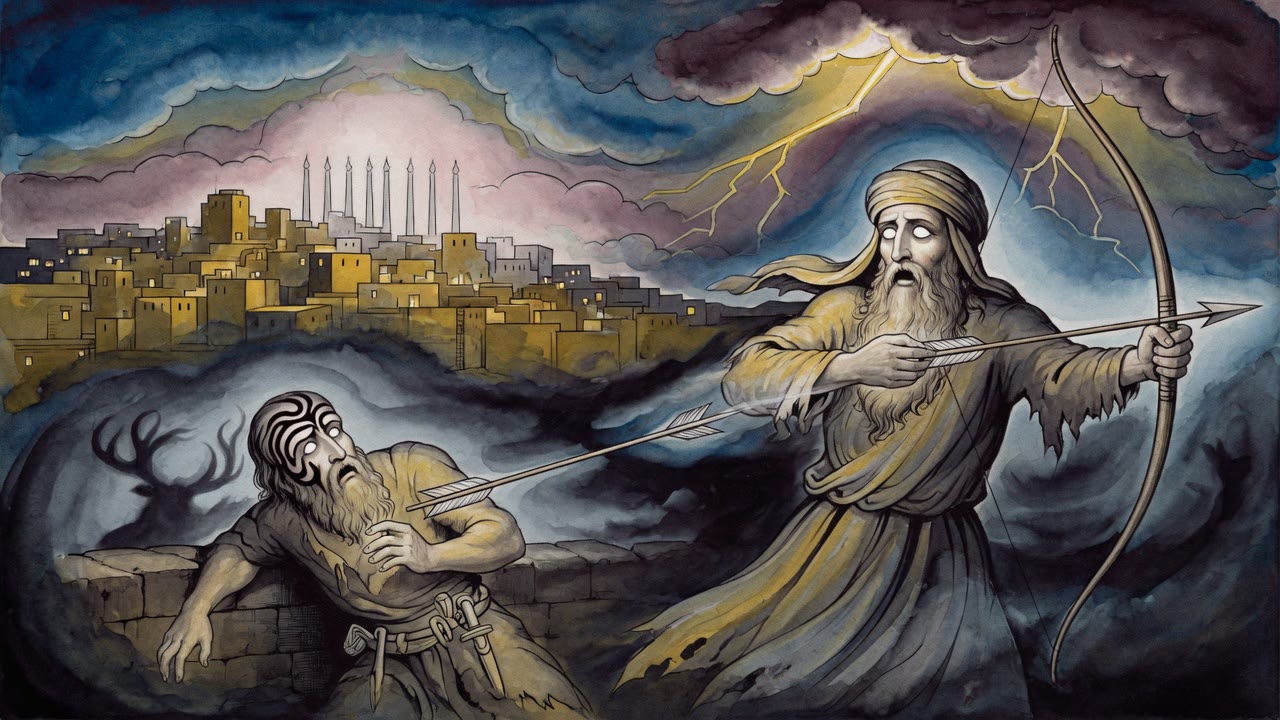
Lamech, Cain's descendant in the sixth generation, was old and nearly blind. He still hunted. His son Tubal-cain, who had mastered the forging of iron and bronze, guided him through the wilderness, pointing the old man's hands toward whatever moved in the brush ahead. It was a practical system. The boy pointed; the man drew and shot.
Cain had survived for so long that he had grown strange. The centuries of wandering and the particular arrangement of his curse had bent his body in ways the legend describes as horn-like, wild, resembling an animal more than a man. He moved through the wilderness the way a large beast moves, and from a distance, in the failing light, through the eyes of an old blind man, he looked like game.
Tubal-cain pointed. Lamech drew. The arrow found what it was aimed at.
What Lamech Did When He Understood
When Tubal-cain ran ahead to see what had been killed and came back white-faced and wordless, Lamech understood before the boy could speak. He looked at his hands. He looked at the bow. The weight of it came down on him not as a sudden shock but as the completion of something long predicted, the final stroke of a story that had been moving toward this moment since the day his distant ancestor stood over Abel's body in the field and looked at what he had done.
Lamech clapped his hands together in the gesture of a man overwhelmed past speech. The clap hit Tubal-cain accidentally and killed him too. One old blind archer, one afternoon, one terrible mistake, and two people dead: the first murderer finally brought to account, and the metalworker who had guided the arrow.
The Sevenfold and the Seventy-Sevenfold
Lamech went back to his wives and wept. He told Ada and Zillah what he had done. His cry to them, preserved in Genesis as a fragment of very old poetry, has puzzled readers for centuries: I have killed a man for wounding me, a young man for striking me. If Cain is avenged sevenfold, Lamech is avenged seventy-sevenfold. The legend reads this not as boasting but as despair. He was not claiming a right. He was calculating the scale of his own doom. If killing Cain earned sevenfold punishment, what would killing Cain's accidental killer earn?
The count that God had placed on Cain's life had also placed a corresponding weight on the life of whoever ended it. Lamech had not chosen this. He had walked into it without seeing, which was, the legend implies, exactly how such things tend to arrive.
← All myths