Israel Trembled as Holofernes Marched on the Temple
When word of Holofernes spread across Judea, every city fell silent. The priests fasted and the people wept, terrified the Temple would burn next.
Table of Contents
 Click for full size
The Name That Traveled Faster Than the Army
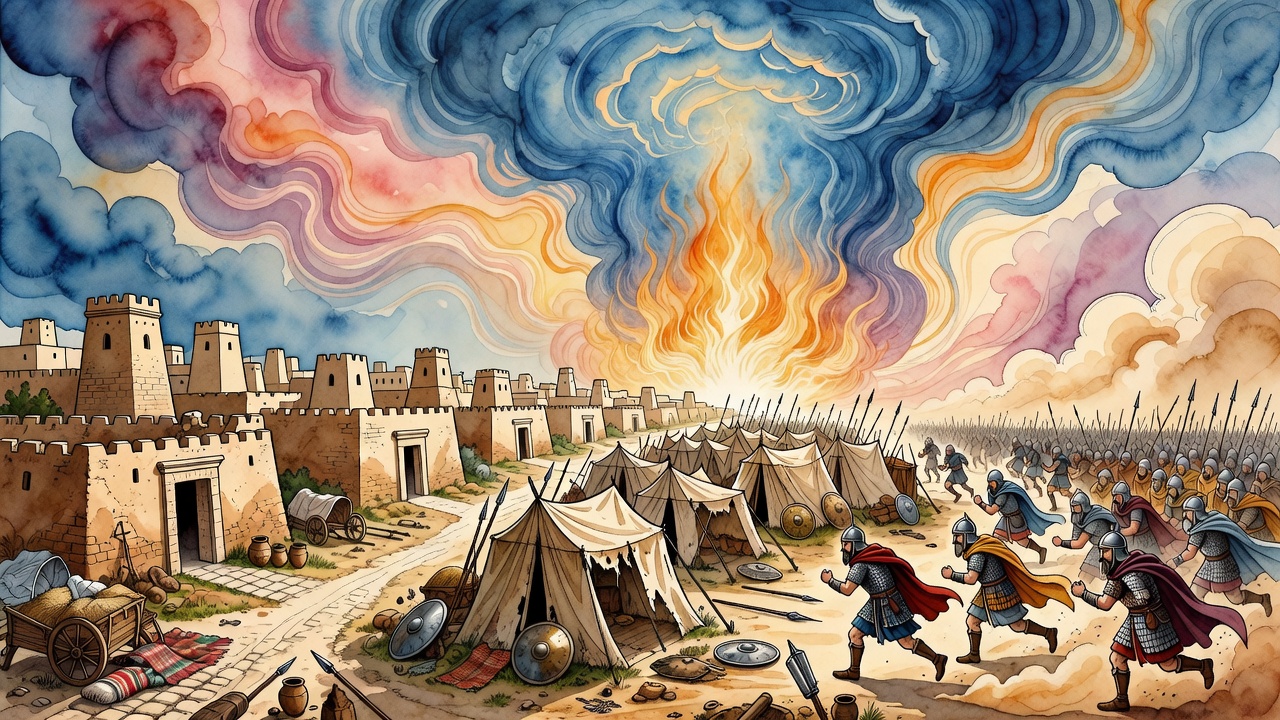
The terror came before the soldiers. A name arrived first, traveling from village to village faster than any horseman: Holofernes. Chief captain of Nebuchadnezzar king of Assyria. The man who had already burned Midian to ash. The man who had turned the cities of the coastlands to rubble, who had torn down the sacred groves of a dozen peoples, who had marched his army across the known world and demanded that every nation it passed through worship Nebuchadnezzar as god.
The coastlands had sent earth and water as tokens of submission before his soldiers even arrived. They had learned that capitulation in advance was cheaper than resistance. But the earth and water had not satisfied Holofernes. He came anyway. He burned the groves. He leveled the sanctuaries. He moved on.
Galilee and the Hill Country Fall Silent
The children of Israel who lived in Judea heard all that Holofernes had done to the nations and were greatly terrified. Messengers ran from village to village through the hill country. Galilee trembled. The cities along the plain sat behind their gates and listened for hoofbeats. The elders gathered in rooms that smelled of cedar and old oil lamps and spoke quietly about what walls could hold and what walls could not.
The answer, for every nation Holofernes had already passed through, was that no wall had held him. No army had slowed him for long. What he had done in the north was already legend by the time the news reached Judea, and the legend had a single shape: he came, he destroyed, he demanded worship, he moved on.
Why the Temple Made Israel Different
But Israel was different from the nations Holofernes had already crushed, and everyone in Israel understood this, and that understanding was what made the terror so specific. Not the fear of death, which the other nations had also feared, but the fear of the Temple. It stood in Jerusalem, the house that Solomon had built, the place where the divine presence had rested and where the altar stood and where the priests still offered the daily sacrifice. If Holofernes reached Jerusalem, the Temple would not merely be damaged. It would be desecrated the way every other holy place he had reached had been desecrated, by a man whose master demanded to be worshipped as a god.
So the priests fell on their faces and scattered ashes on their heads. Every man of Israel put on sackcloth with his wife and his children and the resident aliens and the hired workers. Every soul in Jerusalem prostrated themselves before the Temple and cried out. The high priest Joakim sent letters throughout the hill country telling every city to hold the passes, because the famine had come before the army, and control of the mountain passes was the only tactical advantage Israel possessed.
Bethulia at the Passes
The city of Bethulia sat at the top of the mountain pass that controlled the road south. Whoever held Bethulia controlled the approach to Judea. The men of Bethulia took their positions on the heights and waited. They were not a large force. They were not well-equipped by the standards of Assyrian armies. What they had was the pass itself, the steep ground that negated the numerical advantage of an empire, and the knowledge that if Bethulia fell, the road to Jerusalem was open.
Holofernes and his army were still days away. But their shadow had already arrived, and all of Judea lived inside it, fasting and praying and watching the road from the north.
← All myths