The King Sent Temple Gifts Too Beautiful to Count
Ptolemy asked the Jews how big the Temple table was before he built one. His craftsmen made gold leaves that seemed to move in the air.
Table of Contents
 Click for full size
He Asked Jerusalem What Jerusalem Already Had
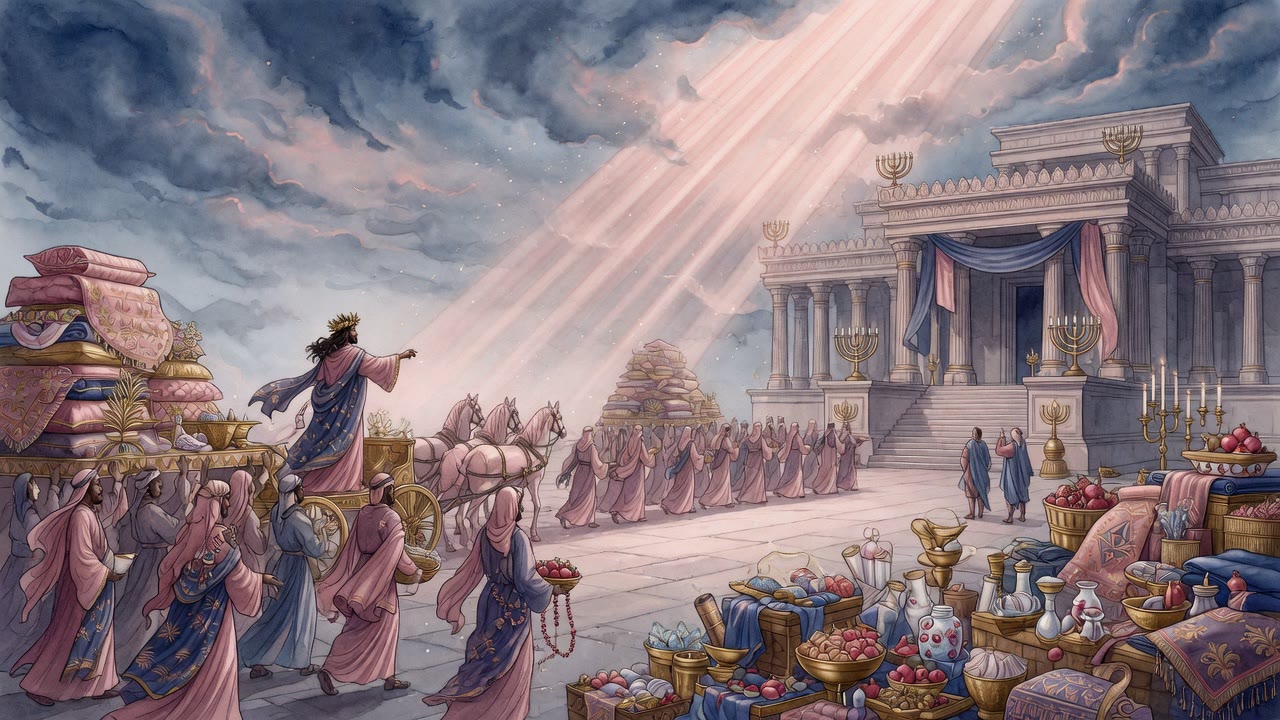
Ptolemy could have sent whatever pleased him. He was wealthy enough to impose his own taste on the order, and no one in Alexandria would have told him the Temple's dimensions were wrong. Instead he sent inquiries to the Jews of the local community, asking about the table already standing in the sanctuary at Jerusalem. He wanted to know the size. He wanted to know what already existed, so that what he was making would be worthy of the place to which it would go.
That detail is the pivot of the story. The gifts became extraordinary because the king began by asking rather than deciding. He personally superintended the craftsmen, one by one, so that no part of the work could be rushed or finished carelessly. He made the table of exceptionally large dimensions, and he asked the artisans to work at a standard higher than anything they had produced before.
Gold Learned the Discipline of Stone
The table's edges were elevated and sharp. Along the sides, precious stones were woven into embossed cord-work and interlaced with one another by a device that Aristeas calls inimitable. Every stone was fixed to the surface with golden needles inserted through perforations, and at the corners fastenings held everything firm against movement. The rim was three-sided, visible from any angle, and the description spirals down into details that suggest the craftsmen were trying to outrun language: the interweaving of stone and metal, the weight of each needle, the precision of each perforation.
The feet of the table were made to look like ivy growing out of ruby stone, interwoven with acanthus and surrounded by a vine bearing clusters of grapes carved from precious stones all the way to the top. When air moved near the table, the leaves appeared to move. Everything was wrought to correspond with the actual reality it represented. The text says it plainly: remarkable skill and knowledge were expended on making it true to nature.
The Bowls Defeated Description
Two golden mixing bowls were made alongside the table. From the base to the middle they were engraved with scales, and between each scale a precious stone was inserted. Above this came a band of inlaid stones in the shape of a rhombus, net-like, rising to the brim, where lilies in bloom and clusters of grapes completed the design. Each bowl held more than two firkins.
The silver bowls were different: smooth, made as if intended for mirrors, so polished that everything brought near them appeared more clearly reflected than in an actual mirror. When the vessels were finished and placed side by side, first a silver bowl and then a golden, then silver again and then golden, the impression they produced is described in words that finally give up trying. It was altogether indescribable. Those who came to see them could not tear themselves away from the sight. When a man looked at the gold, his soul was thrilled with wonder. When he turned toward the silver, everything seemed to flash with light. The spectacle changed character depending on where the eye landed.
The Craftsmen Worked Under His Eyes
Not less than five thousand precious stones were used in the whole commission, all of large size. Ptolemy neglected his official business repeatedly to stay among the artisans while they worked, anxious that everything be finished in a manner worthy of the place to which the gifts were being sent. The cost of the stones and their workmanship came to five times the value of the gold itself.
When it was done, the gifts went to Eleazar. They went from a king who had never set foot in Jerusalem to a high priest who had never been to Alexandria. What passed between the two courts was a table that looked like a living vine and bowls so smooth they showed the viewer back to himself more clearly than his own reflection could.
← All myths