Parshat Bereshit6 min read

Lilith Speaks the Ineffable Name and Flees the Garden

Lilith and Adam rise from the same earth, fight over the bed, and she speaks the Ineffable Name, flies to the sea, and bargains over newborns.

Curated by Arthur · Told by Maggid ·
Table of Contents
  1. The Quarrel Over the Bed
  2. The Name Became Wings
  3. Three Angels at the Sea
  4. The Bargain Over the Cradle
  5. The Unclean One on the Road
  6. Fire Below the Waist

The dust was still warm when the two of them stood up out of it. The same ground, the same handful of earth, shaped twice. Adam looked at Lilith the way a man looks at something he believes was made for him, and Lilith looked back at the soil that still clung to both their feet. No rib. No deep sleep. No wound in his side to claim her from. They had risen side by side, equals in the literal sense, two bodies pulled from one field.
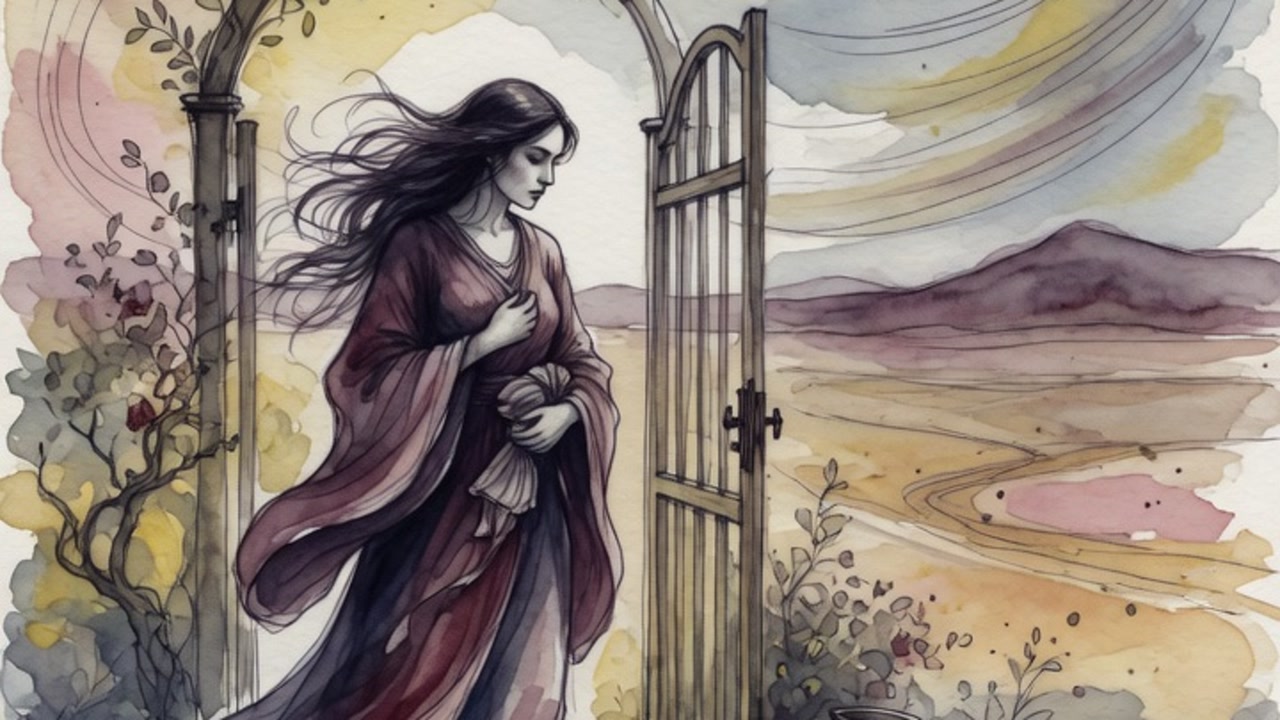
That was the first problem, and it came fast.

The Quarrel Over the Bed

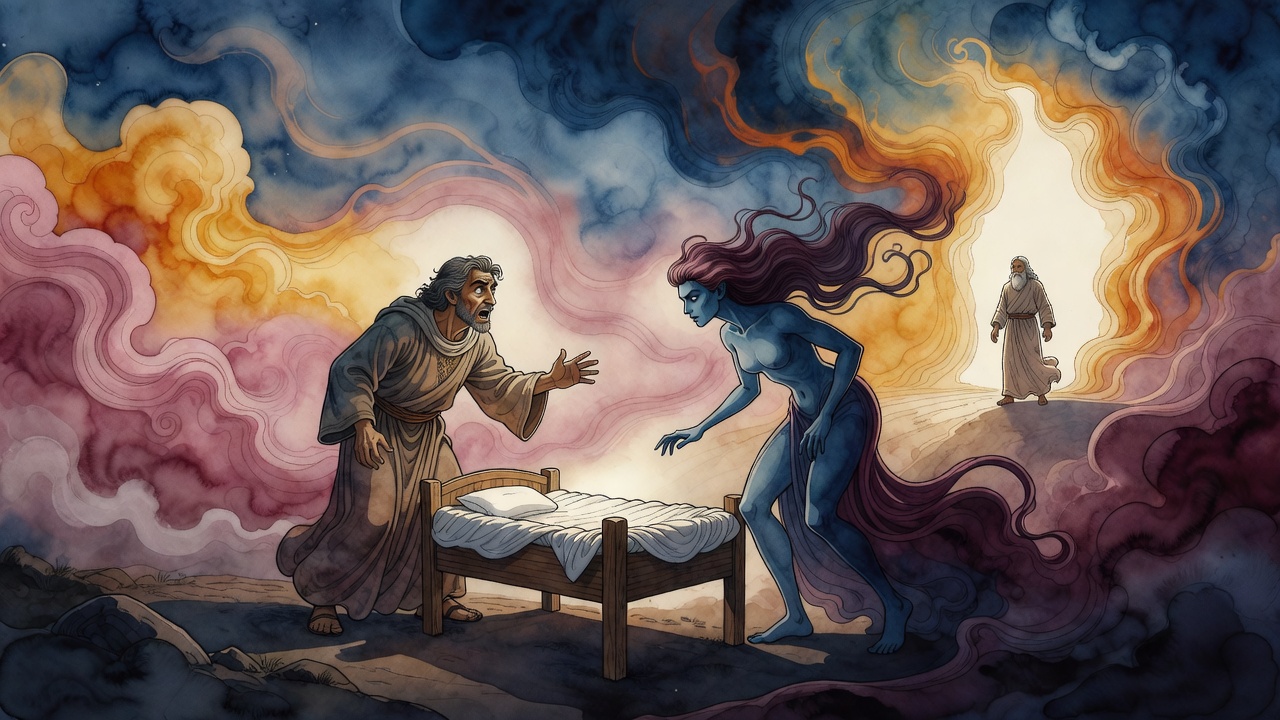
The garden gave them everything except a hierarchy, so they invented one in the only private room creation had. Adam wanted the upper place. He wanted her beneath him, and he said so, as if the arrangement of bodies were already settled law.

Lilith refused.

"We are equal to each other," she told him, "because we were both made from the earth." She did not say it as a plea. She said it as a fact she had watched happen. She had felt the same hands that shaped him shape her, the same breath enter, the same wet clay dry into skin. He could not point to a single thing that made him first. He had only his certainty, and certainty is not an argument.

So they fought. Not about love, not about the trees, not about the commandment. They fought about who lay above and who lay below, and neither would give the ground a single inch. The man wanted a throne where there was only a marriage. The woman wanted what her origin already promised her.

The Name Became Wings

When she saw that he would not bend and that the garden would not take her side, Lilith did the one thing no one had done before. She spoke the Ineffable Name of God, the Shem HaMeforash (the explicit Name, the Name that is never said aloud). It left her mouth and became distance.

No ladder dropped. No animal carried her. The word itself lifted her, and Eden fell away underneath: the trees, the rivers, the warm dust she had risen from, and Adam standing in the middle of it with his demand still unanswered in his throat. He could name every creature that came to him two by two. He could not name the thing that had just left him. He was alone again, more alone than before she existed, and the garden had learned absence before it ever learned exile.

Adam did the second thing men do when they lose. He complained upward. He told God that the woman made from his own earth had flown.

Three Angels at the Sea

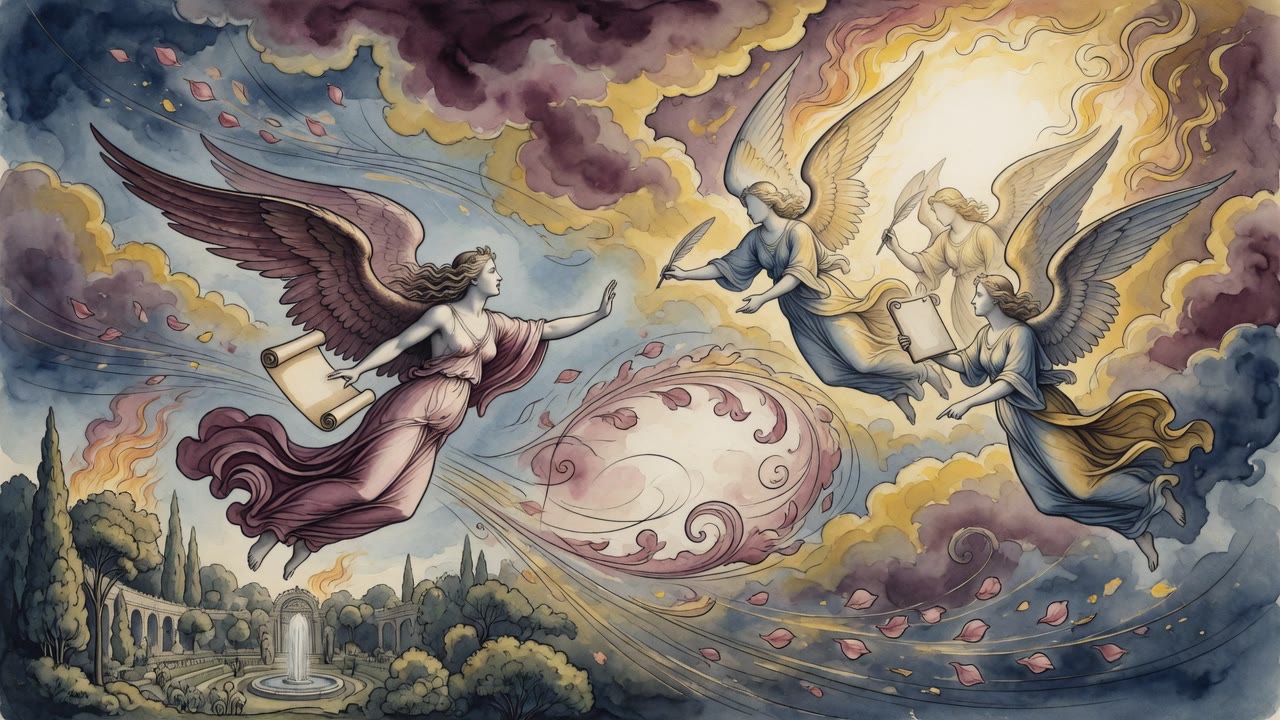
God sent three after her: Sanoy, Sansanoy, and Semangalof. They went out over the water and found her in the middle of the sea, far from any shore, in the very waters where Egypt's chariots would one day sink and drown. She was not hiding. She was waiting, the way someone waits who has already decided.

They delivered their order plainly. Come back, or die here.

Lilith looked at the three of them riding above the waves and did not move toward Eden. She would not go back to the bed and the argument and the man who wanted her under him. The threat did not frighten her into the garden. It only made her bargain.

"I will not return," she said. "But I will make a trade."

The Bargain Over the Cradle

Here is what she claimed, sitting on the open water with three angels for witnesses. She would take power over the newborn. Over boys for the first eight days of their lives. Over girls for the first twenty. In that narrow window, in the dark of a birthing room, the children of the woman who would come after her would belong to her reach.

But she left a door open, because she had to. Wherever the three angels' names were written, on an amulet hung above a cradle, Sanoy and Sansanoy and Semangalof inscribed where a mother could see them, there she had no power. The names were the lock. The names were the only thing that turned her away. She swore it on the sea, and then the angels let her go, because a sworn limit was more than they had come with.

So began the long habit of mothers writing three names over their infants and trusting ink against the dark.

The Unclean One on the Road

Long after Eden, on a road no garden could see, the prophet Elijah met her walking. He knew her at once and wasted no kindness on her.

"Unclean one," he said, "where are you going?"

She could not lie to him. That was his power and her bind. She told him the truth as flatly as she had told Adam she was his equal. "I am going to the house of a woman who is about to give birth. I will give her a sleeping potion. I will kill her, and I will take her child, and I will eat it." She said it without flinching, the same voice that had once argued from the dust, now turned toward the cradle she had bargained for.

Fire Below the Waist

In the deeper tellings she is not alone out there in the dark. She was born paired with Samael, the angel of death, the two of them brought into being together the way Adam and Eve were once a single shape before they were two. And there is a younger Lilith, claimed also by Ashmedai, king of the demons, a creature beautiful from the head down to the waist and burning fire below. Samael grows jealous of Ashmedai over her, and the jealousy delights her, because she has never stopped being the one who thrives where there is conflict to stir. The woman who would not lie beneath a man in Eden became the figure who sets even demons against each other.

She began as nothing more than equal clay that refused to be ranked. She ended as the name written over every cradle to keep her out.


← All myths
From the tradition

Sources

4 sources

The texts this telling draws on, in full. Open a card to read inline, or expand it for a wider, quieter read.

Alphabet of Ben Sira 31Alphabet of Ben Sira

Before Eve, there was Lilith. According to the Alphabet of Ben Sira, a medieval text composed between 700 and 1000 CE, God didn't create Eve first. God created a woman from the same earth as Adam and named her Lilith.

The trouble started immediately. Adam insisted on being dominant. Lilith refused. "We are equal to each other," she told him, "inasmuch as we were both created from the earth." Neither would yield. So Lilith did something astonishing: she spoke the Ineffable Name of God - the Shem HaMeforash - and flew away into the sky.

Adam complained to God, and God dispatched three angels - Sanoy, Sansanoy, and Semangalof - to bring her back. They found her in the middle of the sea, in the very waters where the Egyptians would one day drown. The angels threatened to kill her if she didn't return. Lilith refused. But she made a deal: she would have power over newborn infants - boys for eight days, girls for twenty - unless she saw the names of those three angels inscribed on an amulet. If she did, she'd leave the child alone.

She also accepted a terrible price for her freedom. One hundred of her demon children would die every single day. This became the origin story behind Jewish birth amulets (kame'ot) inscribed with the names of Sanoy, Sansanoy, and Semangalof - a practice that persisted for centuries across Jewish communities.

The text also tells how Ben Sira cured the king's daughter of chronic sneezing by tricking her into holding her sneezes for three days, training her body to stop entirely. It's a strange pairing of stories - cosmic rebellion alongside folk medicine - but that's the Alphabet of Ben Sira for you. For more on Lilith's later mythological career, she becomes a far more powerful figure in kabbalistic tradition.

Full source
Beit HaMidrash 5:36Beit HaMidrash (Jellinek)

A fiery prophet, a champion of God, and a recurring figure who pops up in Jewish stories whenever things need a divine kick in the pants. And Lilith… well, Lilith is a whole other story.

She's the night demoness, a figure shrouded in mystery and often depicted as the first wife of Adam, who left him because she refused to be subservient. She's a primal force, a symbol of female power untamed, and a source of endless fascination.

So, He encounters Lilith.

He confronts her, doesn't mince words. "Unclean one," he says, "where are you going?" It's a loaded question. He already suspects she's up to no good. And Lilith, interestingly enough, knows she can't lie to Elijah. This tells us something about Elijah's power, his connection to truth.

So, she spills the beans. "I am going to the house of a woman who is about to give birth. I will give her a sleeping potion and kill her and take her child and eat it."

Whoa.

Heavy stuff. This single sentence encapsulates the fear and anxiety surrounding childbirth in ancient times. The vulnerability of both mother and child, and the terrifying image of a demon preying on that vulnerability. This depiction of Lilith, found in Tree of Souls (Schwartz, 269), paints her as a literal child-snatcher, a monstrous figure embodying primal fears.

It's a chilling encounter, and it leaves us wondering: What happens next? What does Elijah do? That, my friends, is a story for another time. But this brief meeting highlights the constant battle between good and evil, the ever-present threat lurking in the shadows, and the power of figures like Elijah to confront those shadows head-on. And it reminds us that even in the oldest stories, there's always something new to discover, something to make us think, and maybe even something to make us a little bit afraid of the dark.

Full source
Kabbalot Rabbi Ya'akov ve-Rabbi Yitzhak by Jacob ben Jacob ha-KohenKabbalistic Literature

A fascinating, and frankly unsettling, corner of Jewish mystical tradition: the story of Samael (the angel of death) and Lilith.

It's a story of intertwined destinies, jealousy, and the birth of something truly terrifying. Kabbalot Rabbi Ya'akov ve-Rabbi Yitzhak, written by Jacob ben Jacob ha-Kohen (a priest), tells us that Samael and Lilith weren’t created separately, but born together, much like Adam and Eve were originally formed as one being.

Lilith, in this version, isn't solely paired with Samael. Ashmedai, the king of demons, also has a claim on her, specifically Lilith the Younger. This Lilith is described as a stunning beauty from the head down to the waist, but below? Burning fire. Can you picture that image? It's a potent symbol of uncontrolled passion and destructive power.

Picture the scene: Samael becomes intensely jealous of Ashmedai because of this younger Lilith. And this, we're told, pleases Lilith immensely! Why? Because she thrives on inciting conflict, especially the conflict between herself and her “mother,” perhaps the original Lilith or another manifestation of the feminine divine. It’s a twisted, complex web of relationships, fueled by envy and a desire for chaos.

From the union of Ashmedai and Lilith the Younger, a monstrous prince is born in heaven: Alefpeneash. He rules over eighty thousand destructive demons, and his face burns with pure rage. We’re told that had he been created whole, without some form of divine intervention holding him back, the world would have been destroyed in an instant. The sheer potential for annihilation concentrated in this one being.

The text goes on to explain that Samael (who, remember, is also considered one of the names of Satan) and Lilith represent the negative, or dark, male and female sides of the Sitra Ahra (סִטְרָא אָחְרָא), the "Other Side." They're like an evil mirror image of God and the Shekhinah (שְׁכִינָה), the divine feminine presence. So intertwined are they that, as we mentioned earlier, they're compared to Adam and Eve being created back-to-back.

This isn't just a bizarre story for its own sake. It's a powerful metaphor for the forces of chaos and destruction that exist alongside creation and order. It’s a reminder that even within the divine realm, there's a shadow side, a potential for imbalance and negativity. The tale of Samael and Lilith, and their monstrous offspring, challenges us to confront these darker aspects of existence and to strive for balance and harmony in our own lives. It urges us to recognize the potential for destruction, both within ourselves and in the world around us, and to choose a path of light and creation instead.

Full source
Legends of the Jews 2:43Legends of the Jews

The animals came to him two by two, male and female, but he had no companion. So, what did the Divine do? According to the legends, God decided to give Adam a wife.

Enter Lilith.

Unlike Eve, who was later fashioned from Adam’s rib, Lilith was created just like him, straight from the dust of the earth. The Zohar, that foundational text of Jewish mysticism, hints at the complexities of this primordial relationship. You’d think being made of the same stuff would make them equals. That's precisely where the trouble started. Lilith, fiercely independent, demanded equality. She believed her origins entitled her to it. But Adam, perhaps accustomed to his position as the sole human, wasn't having it. They argued, specifically about, well, marital positions, but that’s another story for another time. Lilith, feeling unheard and unvalued, took drastic measures.

Here's where things get really interesting. Lilith, in her desperation, uttered the Shem HaMeforash (שם המפורש), the Ineffable Name of God, a name of immense power. And with that, she flew away, vanishing into the air, leaving Adam utterly alone once more.

Can you imagine Adam's reaction? He complained to God, saying, "The wife you gave me has deserted me!" God, in turn, sent three angels – Senoy, Sansenoy, and Semangelof – to bring her back. They found her by the Red Sea, a place often associated with chaos and the untamed.

The angels delivered an ultimatum: return to Adam, or face a terrible punishment. Every day, a hundred of her demon children would die. A harsh choice, to say the least. But Lilith, in her resolve, chose the death of her children over subservience to Adam.

And that's where the legend takes a dark, vengeful turn. Lilith, rejected and scorned, vowed to take her revenge on humankind, specifically targeting newborn babies. According to Ginzberg's retelling in Legends of the Jews, she would harm baby boys during the first night of their lives and baby girls until they were twenty days old. A terrifying prospect, isn't it?

But there’s a safeguard. To protect infants from Lilith's wrath, parents would create amulets bearing the names of her three angelic captors: Senoy, Sansenoy, and Semangelof. This, it was believed, would ward off the evil. Midrash Rabbah tells us this agreement was struck between the angels and Lilith herself – a fragile truce in an ancient battle.

So, what does this tell us? The story of Lilith is more than just a spooky bedtime tale. It's a powerful, albeit unsettling, exploration of equality, independence, and the consequences of feeling unheard. It raises questions about power dynamics in relationships and the lengths to which someone might go when they feel wronged. Is Lilith a villain, or a victim? Perhaps, like many figures in mythology, she's a bit of both. And perhaps her story serves as a constant reminder to listen, to value, and to strive for true equality in all our relationships.

Full source