Noah Stitched a Mouse and Punished a Raven
On the Ark, Noah sewed a cat-torn mouse back together with a hair and thread, then sentenced the lying raven to a stranger fate than death.
Table of Contents
 Click for full size
The cat remembered what his father used to eat
The cat had been watching the mouse for three days. Not with interest. With memory. His father used to eat mice. There was no reason the tradition should stop simply because the world was drowning.
He lunged. The mouse ran. There were no crevices on a ship built for saving lives, no gaps in the planking, no holes anywhere a small animal could vanish into. Then a hole appeared in the wall of the Ark, opened by something other than wood and water, and the mouse squeezed through it sideways. The cat could not follow. He reached in with one paw, hooked his claws into the skin of the mouse's cheeks, and tore the flesh half a finger's width below the mouth.
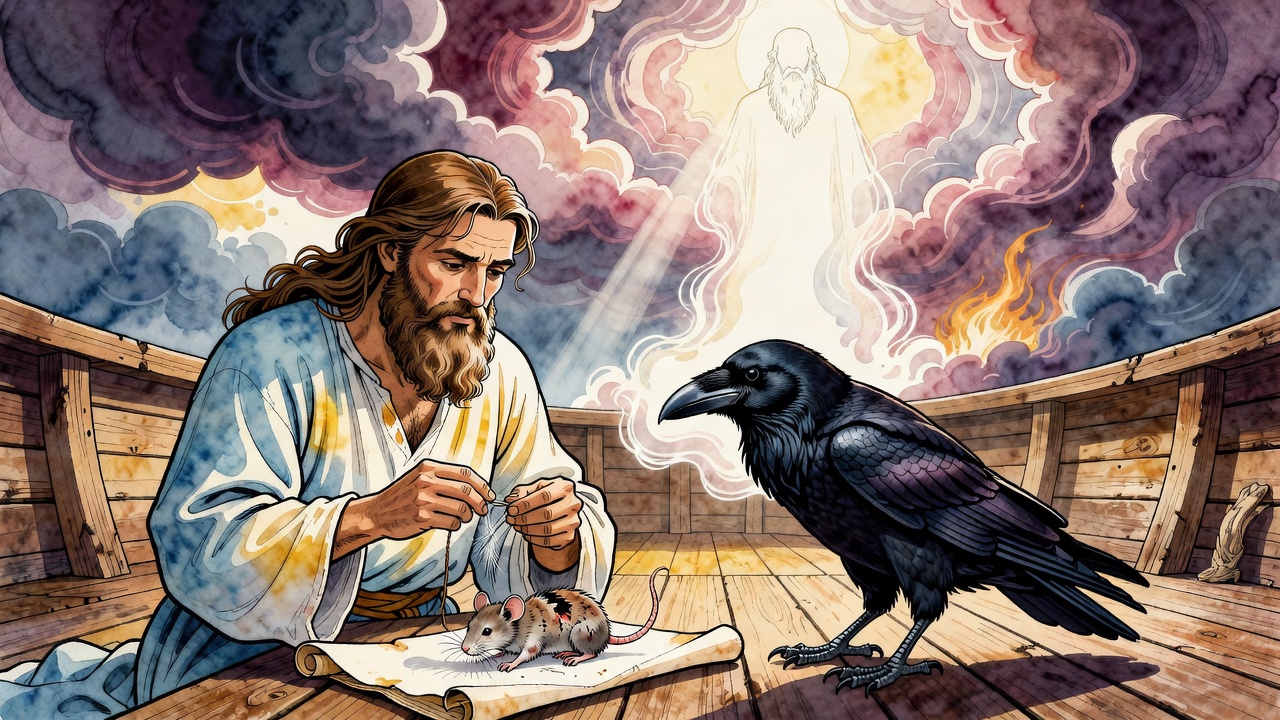
The mouse went straight to Noah, bleeding and upright, speaking like someone who had memorized a petition on the way. Righteous man, it said, do a righteous act for me. Stitch up the cheeks that my enemy tore.
Noah sews the first stitches
Noah had no thread. He looked at what he had and pulled a hair from his own head. He doubled it over. He made a needle from something thin and hard. Then he stitched the mouse's cheeks closed, one pass at a time, working the way a man works when he is the only healer on the only vessel left on earth.
The marks are still there. A mouse's face still carries the faint lines running along the skin below the mouth. They are real stitches, healed over so many generations that they have become part of the species. Noah's repair job never fully disappeared.
The raven hides under the eagle's wing
The second case came after the waters began to recede. Noah needed a scout. He needed a bird willing to fly out over a featureless ocean and come back with information about land. He reached for the raven.
The raven was not where it was supposed to be. Noah found it hiding under the eagle's wing. He pulled it out and ordered it to go. The raven refused, or refused in the way of those who comply while lodging a protest. It told Noah: of all the birds on this Ark, you chose me? There are only two ravens left in the world. If something happens to me over those waters, the species ends. And worse, it added, what will you do without me when the time comes?
The raven was also making a different kind of accusation. Noah had been watching his animals carefully. He had rules about mating during the Flood. No one coupled. The raven claimed Noah had broken this rule himself, and cited the evidence like a witness who had been keeping notes.
The punishment that fit the crime
Noah sent it out anyway. The raven flew in circles over the Ark and came back with nothing. No branch, no sign of land, no honest report. It had chosen slander over service, and a creature that used its mouth for accusation would be made to use that same mouth for everything.
This is why the raven mates differently from all other birds. The punishment was anatomical. The body was rearranged around the sin. Where the dove flew out twice and came back each time, the raven circled once and returned empty, and every raven that has lived since carries the record of what its ancestor did on the Ark.
Two marks, two crimes, one judge
Noah handled both cases without a tribunal. He was not a priest or a king. He was a righteous man on a boat, and the animals brought their grievances to him because he was the only authority the world had left. The mouse was a victim and got stitches. The raven was a slanderer and got a sentence. Both marks outlasted the Flood, outlasted Noah, outlasted every world that came after.
The Ark, in this telling, was not only a vessel for survival. It was the first courtroom, and the verdicts handed down inside it are written into the bodies of the animals alive on the earth any morning since.
← All myths