Translation of the source text.William Davidson Edition - Vocalized Aramaic + William Davidson Edition - English · CC-BY-NC
§ With regard to the Babylonian exile following the destruction of the First Temple, Rabbi Ḥiyya bar Avin says that Rabbi Yehoshua ben Korḥa says: An old man from among the inhabitants of Jerusalem related to me: In this valley that lies before you, Nebuzaradan, captain of the guard of the Babylonian king Nebuchadnezzar, killed 2,110,000 people. And in Jerusalem itself he killed 940,000 people on one stone, until the blood of his victims flowed and touched the blood of Zechariah to fulfill what is stated: “And blood touches blood” (Hosea 4:2).
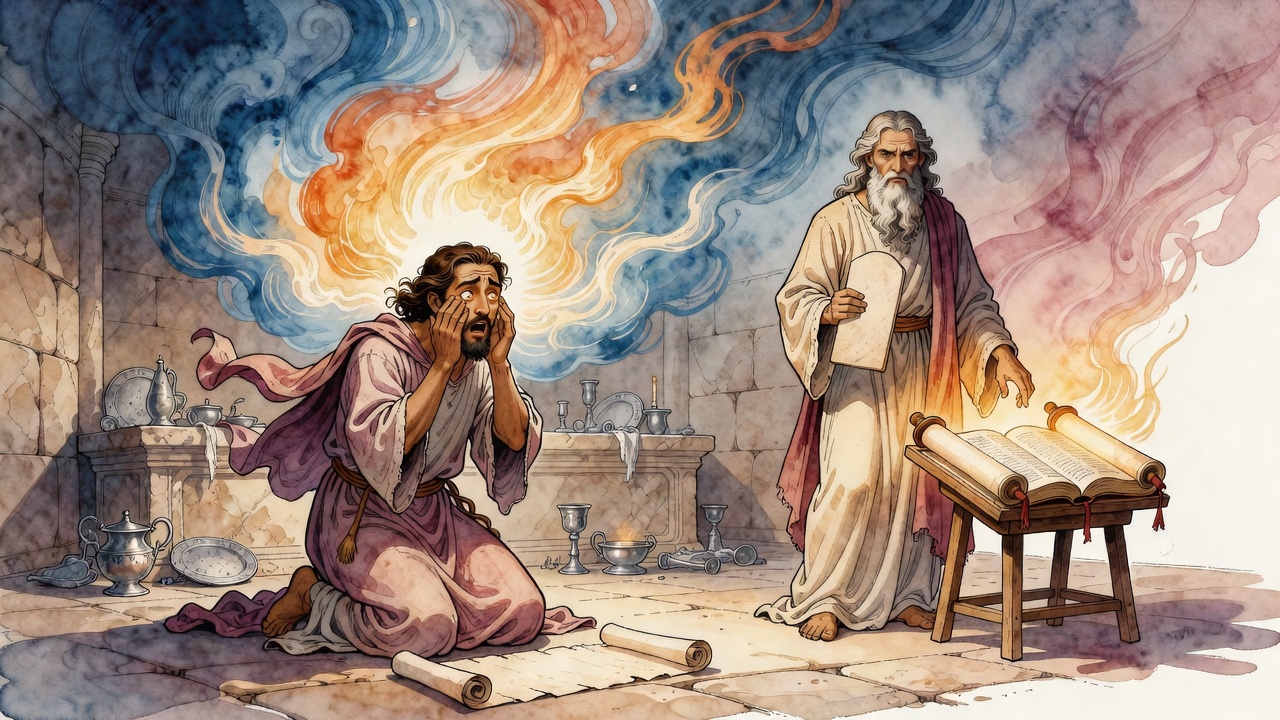
The Gemara clarifies the details of what happened: Nebuzaradan found the blood of Zechariah, the son of Jehoiada the priest, and saw that it was bubbling up from the ground, and he said: What is this? Those in the Temple said to him: It is sacrificial blood that had been poured there. He brought animal blood, compared it to the blood bubbling up from the ground, and saw that it was not similar to it.
Nebuzaradan said to them: If you tell me whose blood this is, it will be well for you. But if not, I will comb your flesh with iron combs. They said to him: What shall we say to you? He was a prophet among us, who used to rebuke us about heavenly matters, and we rose up against him, and killed him (II Chronicles 24:20–22), and for many years now his blood has not settled.
Nebuzaradan said to them: I will appease Zechariah. He brought the members of the Great Sanhedrin and of a lesser Sanhedrin and killed them alongside the bubbling blood, but it still did not settle. He then brought young men and virgins and killed them alongside it, but it still did not settle. He then brought schoolchildren and killed them alongside it, but it still did not settle.
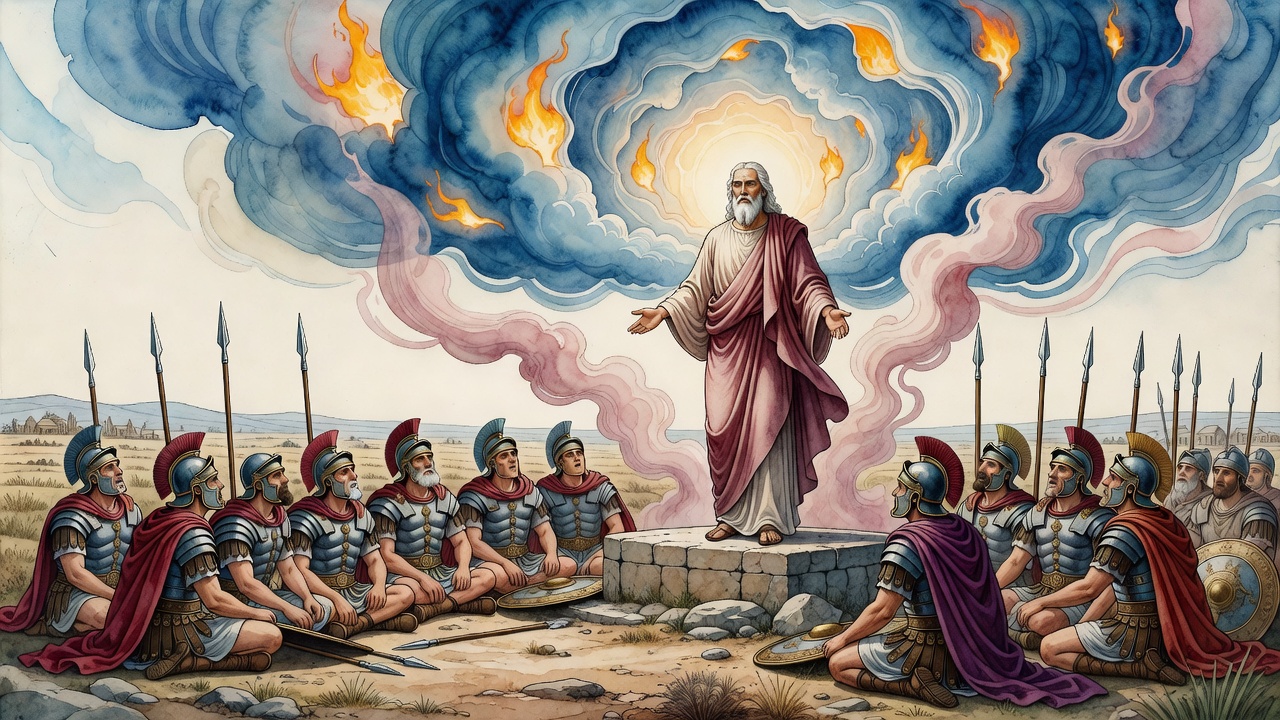
Finally Nebuzaradan said to him: Zechariah, Zechariah, I have killed the best of them. Would it please you if I destroyed them all? When he said this, the blood at last settled. At that moment Nebuzaradan contemplated the idea of repentance and said to himself: If, for the death of one soul, that of Zechariah, God punishes the Jewish people in this manner, then that man, that is to say, I, who has killed all of those souls, all the more so will be I be subject to great punishment from God.
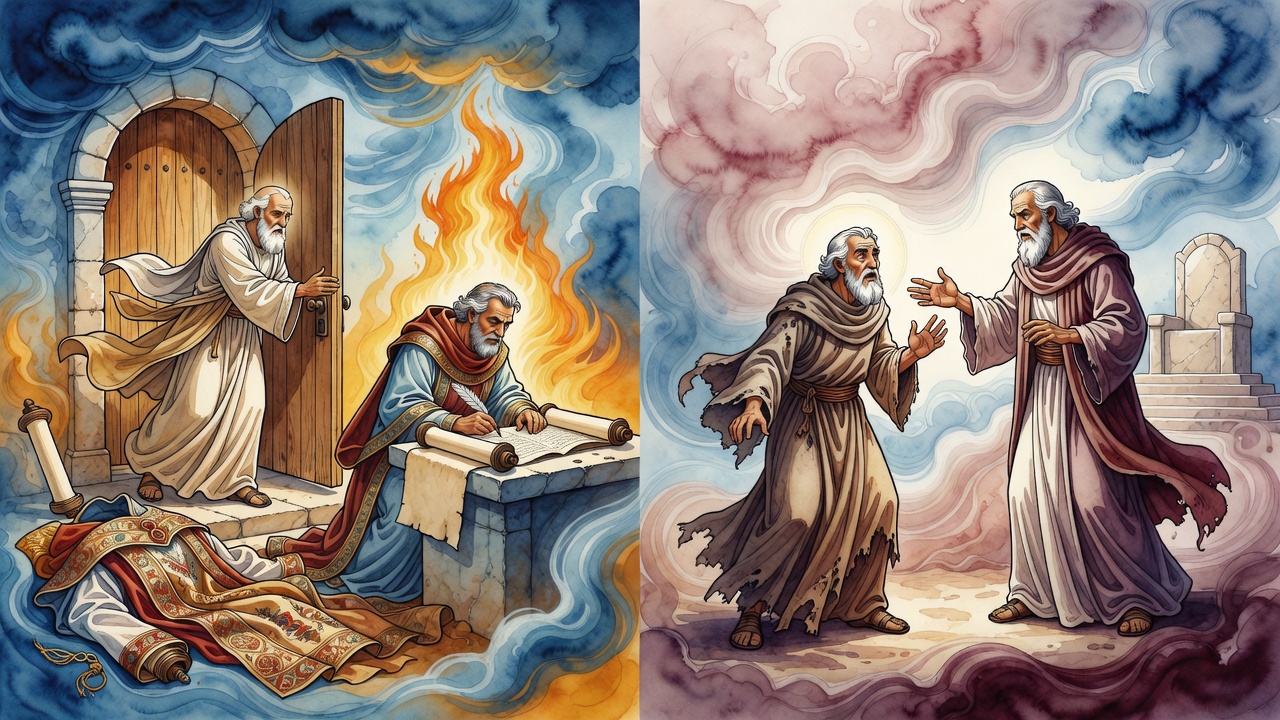
He fled, sent to his house a document detailing what was to be done with his property, and converted to Judaism. A Sage taught a baraita relating to this matter: Naaman, commander of the army of the king of Aram (see II Kings, chapter 5), was not a convert, as he did not accept all of the mitzvot, but rather he was a ger toshav, a gentile who resides in Eretz Israel and observes the seven Noahide mitzvot.
Nebuzaradan, by contrast, was a convert, as explained previously. The Gemara adds that some of Haman’s descendants studied Torah in Bnei Brak, and some of Sisera’s descendants taught children Torah in Jerusalem, and some of Sennacherib’s descendants taught Torah in public. Who are they? They are Shemaya and Avtalyon, the teachers of Hillel the Elder.
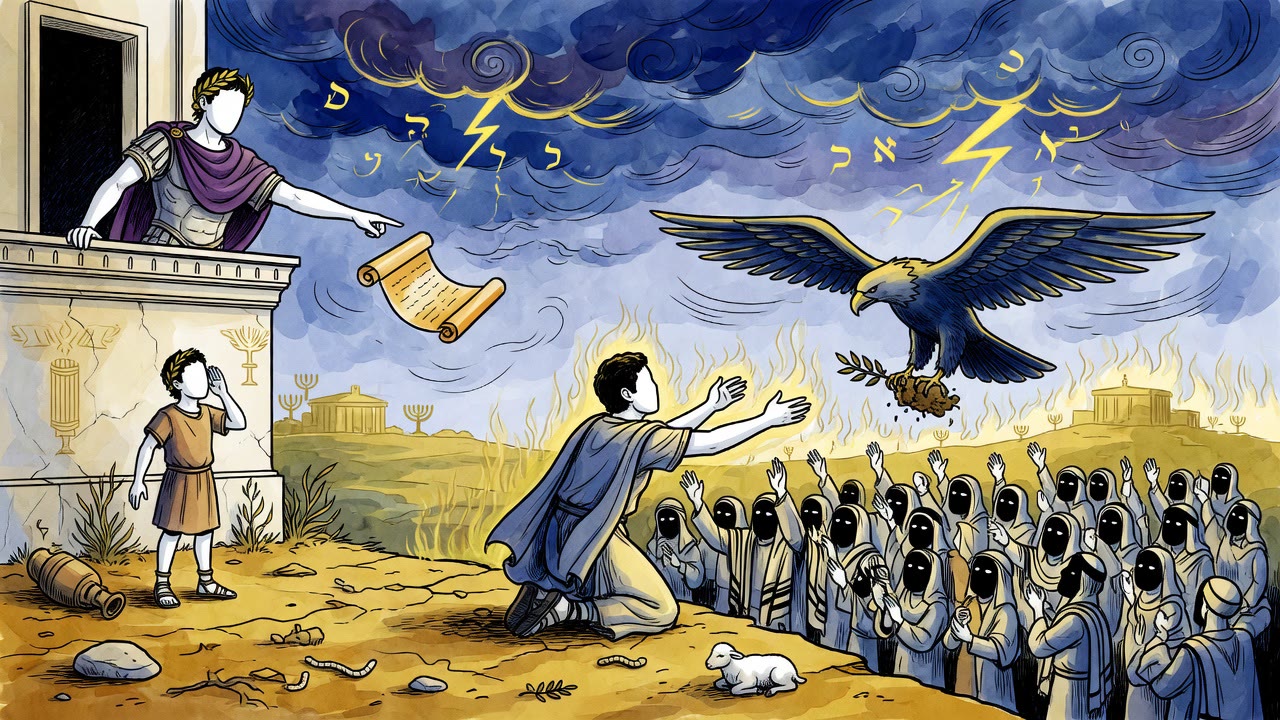
As for the incident involving the blood of Zechariah, this is alluded to by that which is written: “I have set her blood upon the bare rock that it should not be covered” (Ezekiel 24:8). § Apropos its discussion of the destruction of the Temple and the calamities that befell Israel, the Gemara cites the verse: “The voice is the voice of Jacob, but the hands are the hands of Esau” (Genesis 27:22), which the Sages expounded as follows: “The voice”; this is the cry stirred up by the emperor Hadrian, who caused the Jewish people to cry out when he killed six hundred thousand on six hundred thousand in Alexandria of Egypt, twice the number of men who left Egypt.
“The voice of Jacob”; this is the cry aroused by the emperor Vespasian, who killed four million people in the city of Beitar. And some say: He killed forty million people. “And the hands are the hands of Esau”; this is the wicked kingdom of Rome that destroyed our Temple, burned our Sanctuary, and exiled us from our land. Alternatively, “the voice is the voice of Jacob” means that no prayer is effective in the world unless some member of the seed of Jacob has a part in it.
The second clause in the verse, “and the hands are the hands of Esau,” means that no war grants victory unless some member of the seed of Esau has a part in it. And this is what Rabbi Elazar says: The verse that says: “You shall be hid from the scourge of the tongue” (Job 5:21), means: You shall need to hide on account of quarrels provoked by the tongue. Rav Yehuda says that Rav says: What is the meaning of that which is written: “By the rivers of Babylonia, there we sat down and wept, when we remembered Zion” (Psalms 137:1)?
This teaches that the Holy One, Blessed be He, showed David the destruction of the First Temple and the destruction of the Second Temple. He saw the destruction of the First Temple, as it is stated: “By the rivers of Babylon, there we sat down and wept.” He saw the destruction of the Second Temple, as it is written later in that same psalm: “Remember, O Lord, against the children of Edom the day of Jerusalem, when they said: Raze it, raze it, to its very foundation” (Psalms 137:7), as the Second Temple was destroyed by the Romans, “the children of Edom.”
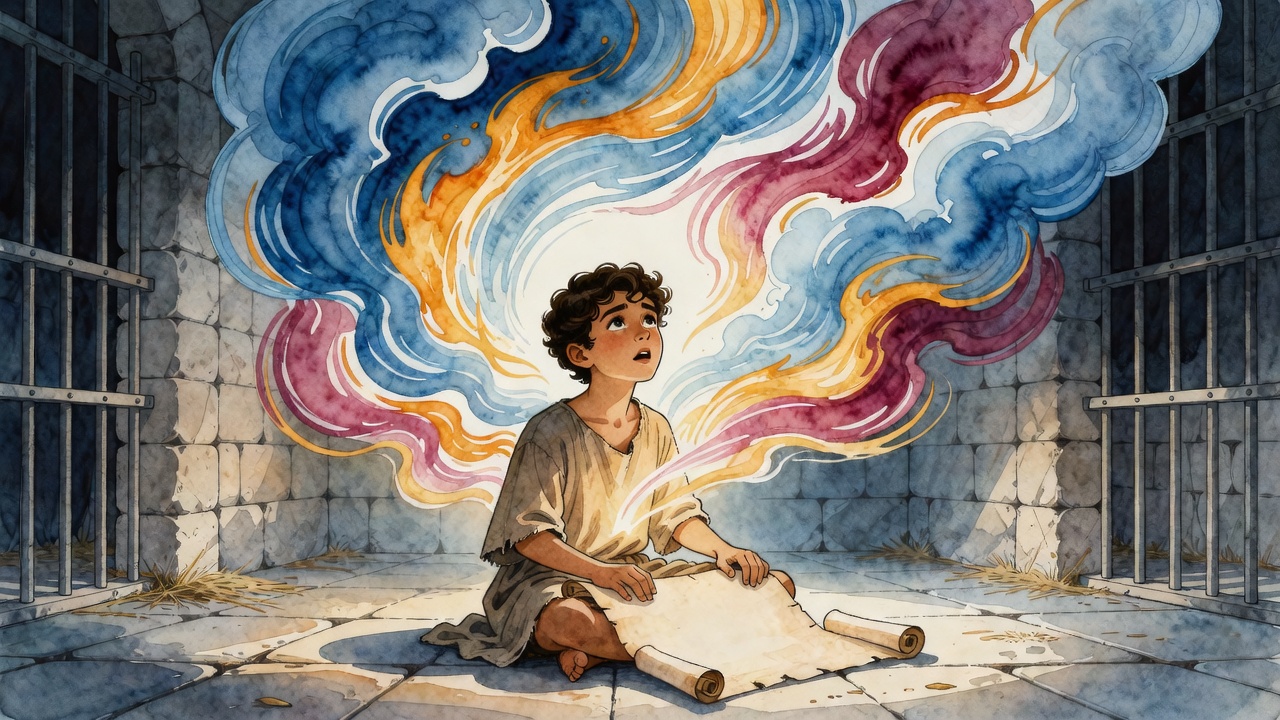
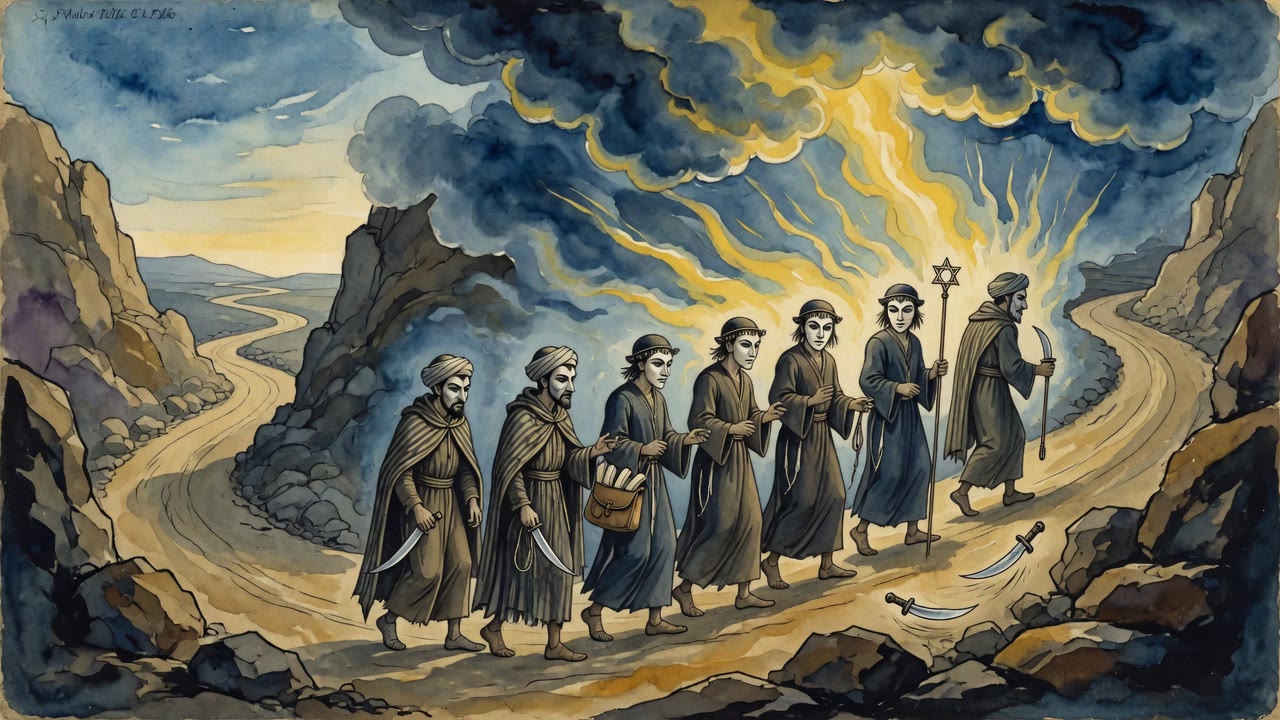
Rav Yehuda says that Shmuel says, and some say that it was Rabbi Ami who says this, and some say that it was taught in a baraita: There was an incident involving four hundred boys and girls who were taken as captives for the purpose of prostitution. These children sensed on their own what they were expected to do, and they said: If we commit suicide and drown in the sea, will we come to eternal life in the World-to-Come?
The oldest child among them expounded the verse: “The Lord said, I will bring back from Bashan, I will bring them back from the depths of the sea” (Psalms 68:23). “I will bring back from Bashan,” i.e., from between the teeth [bein shen] of the lion, and “I will bring them back from the depths of the sea” is referring to those who drown in the sea for the sake of Heaven. When the girls heard this, they all leapt and fell into the sea.
The boys then drew an a fortiori inference with regard to themselves and said: If these girls, for whom sexual intercourse with men is their natural way, act in such a manner, then we, for whom sexual intercourse with men is not our natural way, should all the more so conduct ourselves likewise. They too leapt into the sea. Concerning them and others like them the verse states: “As For Your sake we are killed all the day long; we are reckoned as sheep for the slaughter” (Psalms 44:23).
And Rav Yehuda said: This verse applies to the woman and her seven sons who died as martyrs for the sake of the sanctification of God’s name. The incident occurred as follows: They brought in the first of the woman’s sons before the emperor and said to him: Worship the idol. He said to them: I cannot do so, as it is written in the Torah: “I am the Lord your God” (Exodus 20:2). They immediately took him out and killed him.
And they then brought in another son before the emperor, and said to him: Worship the idol. He said to them: I cannot do so, as it is written in the Torah: “You shall have no other gods beside Me” (Exodus 20:3). And so they took him out and killed him. They then brought in yet another son before the emperor, and said to him: Worship the idol.
He said to them: I cannot do so, as it is written in the Torah: “He that sacrifices to any god, save to the Lord only, he shall be utterly destroyed” (Exodus 22:19). And so they took him out and killed him. They then brought in another son, and said to him: Worship the idol. He said to them: I cannot do so, as it is written in the Torah: “You shall not bow down to any other god” (Exodus 34:14).
And so they took him out and killed him. They then brought in yet another son, and said to him: Worship the idol. He said to them: I cannot do so, as it is written in the Torah: “Hear, O Israel, the Lord is our God, the Lord is One” (Deuteronomy 6:4). And so they took him out and killed him.
They then brought in another son, and said to him: Worship the idol. He said to them: I cannot do so, as it is written in the Torah: “Know therefore this today, and consider it in your heart, that the Lord, He is God in heaven above and upon the earth beneath; there is no other” (Deuteronomy 4:39). And so they took him out and killed him. They then brought in yet another son, and said to him: Worship the idol.
He said to them: I cannot do so, as it is written in the Torah: “You have avouched the Lord this day to be your God…and the Lord has avouched you this day to be a people for His own possession” (Deuteronomy 26:17–18). We already took an oath to the Holy One, Blessed be He, that we will not exchange Him for a different god, and He too has taken an oath to us that He will not exchange us for another nation.
It was the youngest brother who had said this, and the emperor pitied him. Seeking a way to spare the boy’s life, the emperor said to him: I will throw down my seal before you; bend over and pick it up, so that people will say that he has accepted the king’s authority [harmana]. The boy said to him: Woe [ḥaval] to you, Caesar, woe to you, Caesar. If you think that for the sake of your honor I should fulfill your command and do this, then for the sake of the honor of the Holy One, Blessed be He, all the more so should I fulfill His command.
As they were taking him out to be killed, his mother said to them: Give him to me so that I may give him a small kiss. She said to him: My son, go and say to your father Abraham, You bound one son to the altar, but I bound seven altars. She too in the end went up to the roof, fell, and died. A Divine Voice emerged and said: “A joyful mother of children” (Psalms 113:9), as she raised her children to be devoted in their service of God.
Rabbi Yehoshua ben Levi says concerning the verse: “For Your sake we are killed all the day long” (Psalms 44:23), that this is referring to circumcision, which was given for the eighth day, as the blood of our newborn sons is spilled for the sake of the covenant with God. Rabbi Shimon ben Lakish says: This verse was stated in reference to Torah scholars who demonstrate the halakhot of slaughter on themselves, meaning that they demonstrate on their own bodies how ritual slaughter should be performed and occasionally injure themselves in the process.
This is as Rava says: A person may demonstrate anything using himself to illustrate the act except for slaughter and another matter, a euphemism for sexual intercourse. Rav Naḥman bar Yitzḥak says: These people in the verse are Torah scholars who kill themselves over the words of Torah, in accordance with the statement of Rabbi Shimon ben Lakish. As Rabbi Shimon ben Lakish says: The words of the Torah endure only for one who kills himself over them, as it is stated: “This is the Torah, when a man dies in a tent” (Numbers 19:14). Rabba bar bar Ḥana says that Rabbi Yoḥanan says: Forty se’a

 Click for full size