Sodom Built Its Laws on the Idea That Creation Owed It Something
The four judges of Sodom were named Liar, Habitual Liar, Fabricator, and Perverter of Justice. Feeding a stranger got your clothes taken.
Table of Contents
 Click for full size
The City With Named Judges
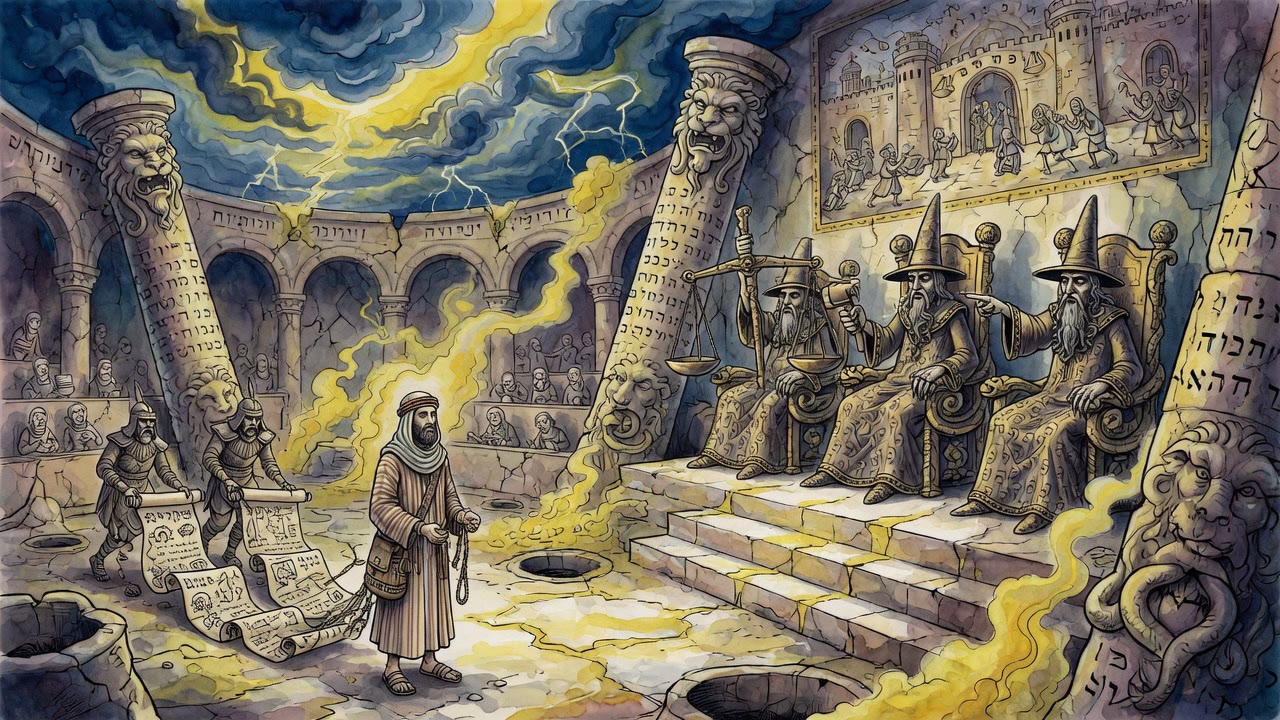
The four judges of Sodom had names. This is the detail that makes everything else worse. The evil of Sodom was not mob violence or sudden passion. It was institutionalized, staffed, and given official titles.
Their names in the Book of Jasher were Serak, Sharkad, Zabnac, and Menon. Abraham's servant Eliezer, who had occasion to know them, is said to have translated those names into Hebrew equivalents that laid bare what each man was: Liar, Habitual Liar, Fabricator, and Perverter of Justice. The names the city gave its officers of the law described their function exactly, but in a register the city itself found honorable.
They held court. They issued rulings. Their rulings had internal consistency. The consistency was the point.
The Architecture of Inverted Justice
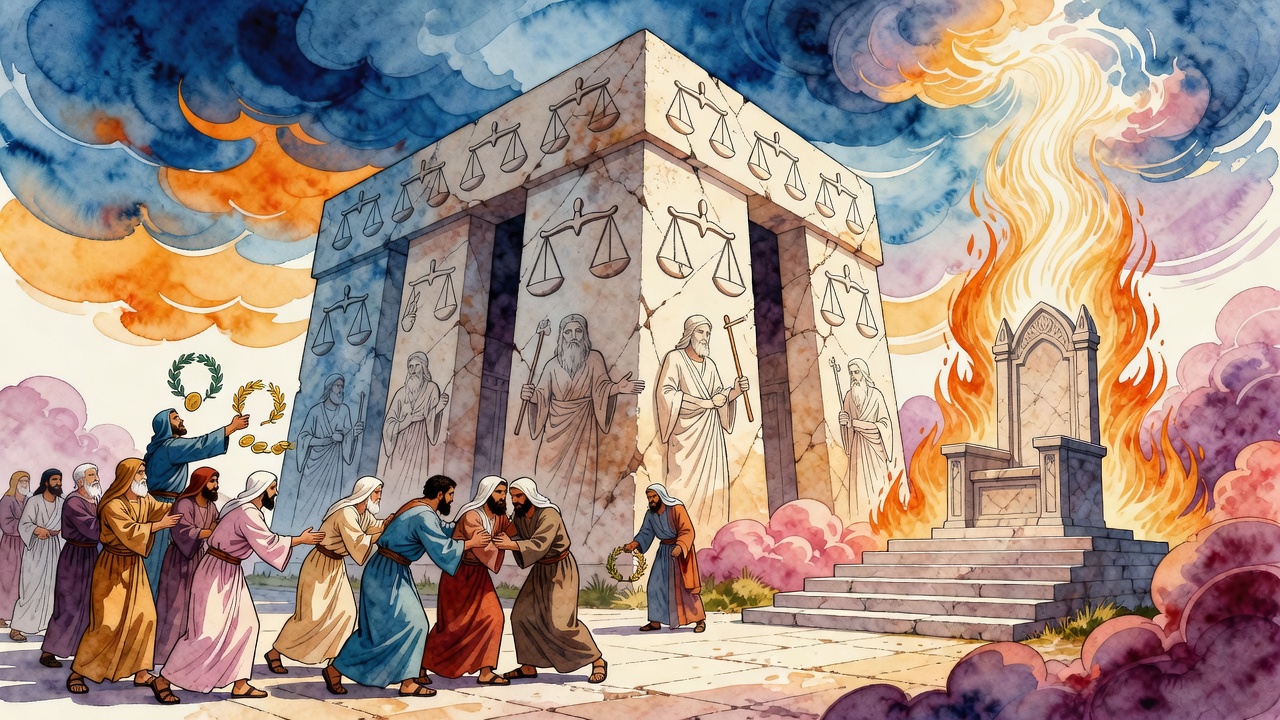
The Jasher account of Sodom's legal code is detailed enough to feel like courtroom transcript. If a man struck another man's pregnant wife and caused her to miscarry, the ruling was that the injured woman be given to her attacker until she bore him a child to replace the one he had killed. The logic: he had caused a death, he must replace the life, therefore the body capable of producing the replacement belonged to him until the debt was settled. It sounds like justice if you read it fast. It is the precise inversion of justice if you stop and think about what it is actually awarding.
If a man cut off the ear of his neighbor's donkey, the ruling was that the donkey be given to the cutter to tend until the ear grew back. The care of the animal whose ear he had removed was now his responsibility, which meant his possession, which meant the neighbor received no donkey and no restitution, only the theoretical prospect of a future in which ears grew back.
Each ruling had this quality: it used the vocabulary of redress while ensuring that the injured party received nothing and the aggressor received something. Over time, the city had constructed a complete system in which the strong were consistently rewarded for aggression and the weak consistently punished for being injured.
What the Stranger at the Gate Found
The hospitality laws of Sodom were the mirror image of the legal code. Hospitality in the ancient Near East was sacred, binding, the basis of all commerce and travel across the region. To refuse a guest water was a serious violation. Sodom turned it into policy.
The traditions describe a system for punishing generosity. If a resident of Sodom gave a stranger food or water, the city confiscated their clothing. If they did it twice, worse followed. The city had people designated to watch for acts of charity and report them. The enforcement of non-hospitality was as systematic as the enforcement of the legal inversions.
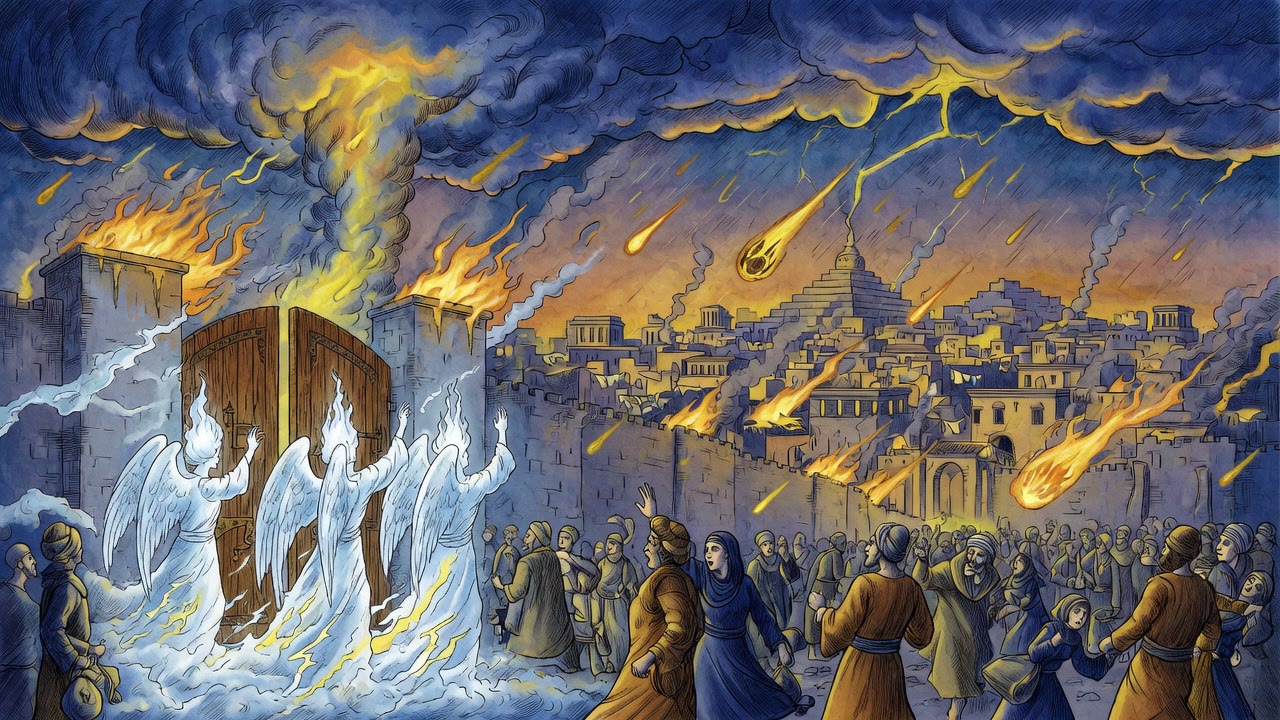
When the two angels arrived in Sodom and Lot pressed them to come inside his house, he was not merely being kind. He was taking an enormous personal risk. He knew exactly what happened to people who sheltered strangers. He did it anyway. The mob that came to his door that night was not spontaneous. It was the legal majority of a city that had made hospitality a crime.
The Measure in Heaven
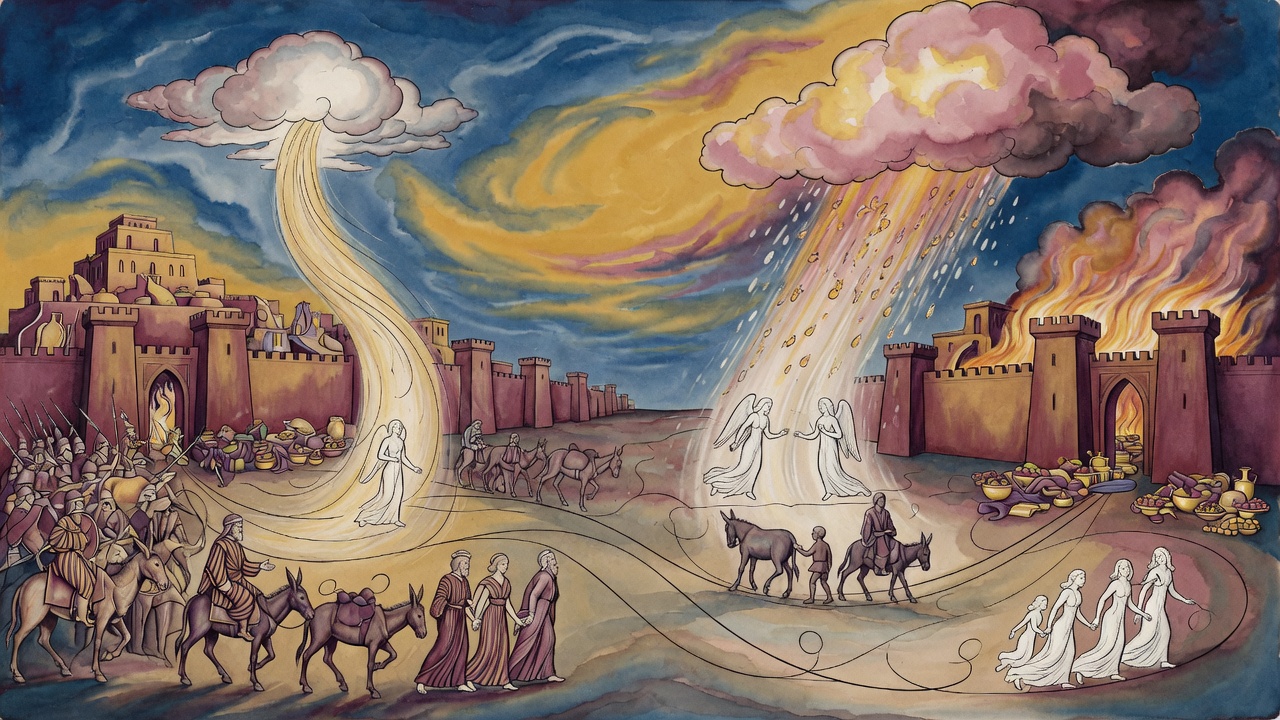
The tradition preserved in the Midrash about Sodom's destruction includes a detail that clarifies why the angels came at all. The outcry that God heard, the cry from Sodom that Genesis says rose up to heaven, was not the general noise of wickedness. It was a specific complaint from a specific victim.
A girl named Peletit had given bread to a starving stranger. She was caught. Her punishment was to be coated in honey and staked near beehives. She cried out as she died. That cry was the one God heard. The investigation that followed, the two angels going to Sodom to see whether the cry matched the reality, was not God checking whether the complaint was true. It was the formal procedure before a verdict whose outcome was never in doubt.
What made Sodom uniquely condemnable was not the wickedness in isolation but the system built around it. Random evil produces victims and usually collapses under its own weight. Systematic evil, evil with a philosophy and a courthouse and judges with official titles, produces generations of victims and maintains itself indefinitely. Sodom had achieved the latter. The fire that ended it was not punishment for excess. It was the termination of a machine.
← All myths