5 min read

The First Letter Opened the Hidden Light of Creation

A mystic begs to see how something came from nothing. Tikkunei Zohar answers with a measuring line in primordial air and the tiny Yod that begins everything.

Curated by Arthur · Told by Maggid ·
Table of Contents
  1. The Door Opened Through Forty-Two Letters
  2. Six Chambers Came From the First Word
  3. Something Came From Nothing Through a Line
  4. Twenty-Eight Letters Powered Every Act
  5. The Ring, the Stone, the Drop
  6. The Yod on Top of Aleph

The Door Opened Through Forty-Two Letters

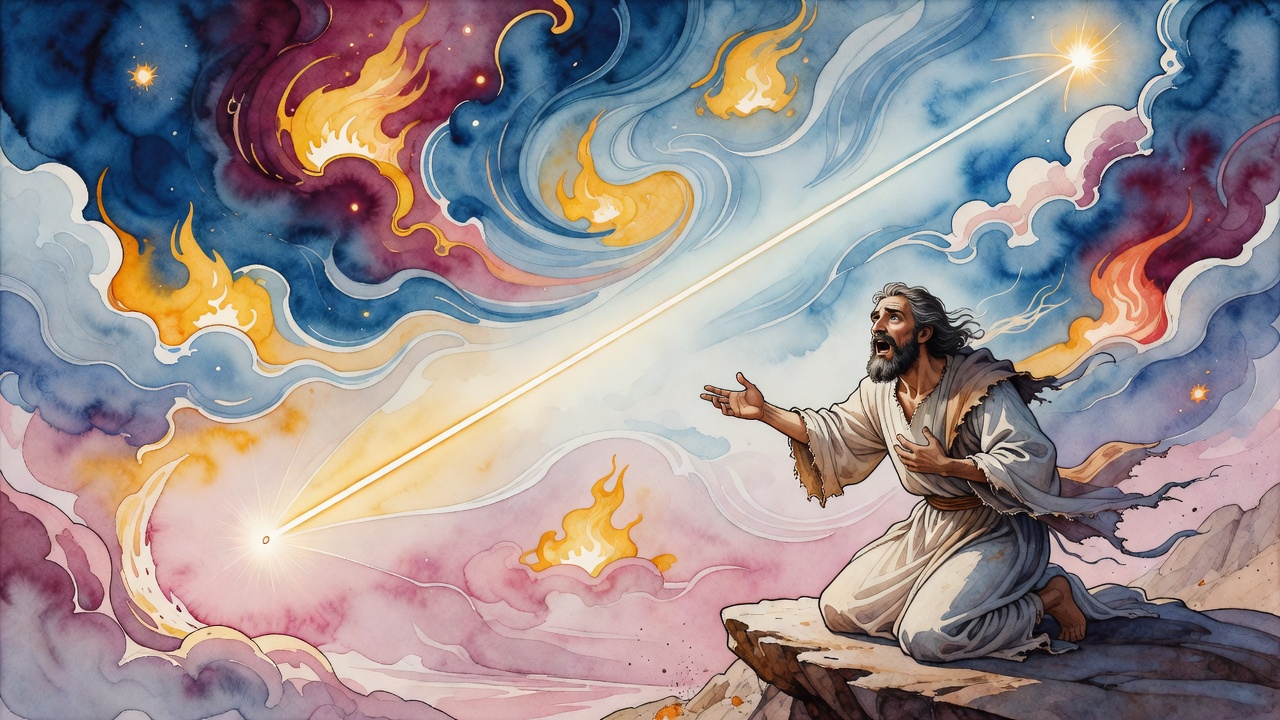
He stood before the world that already existed and asked how any of it had started.

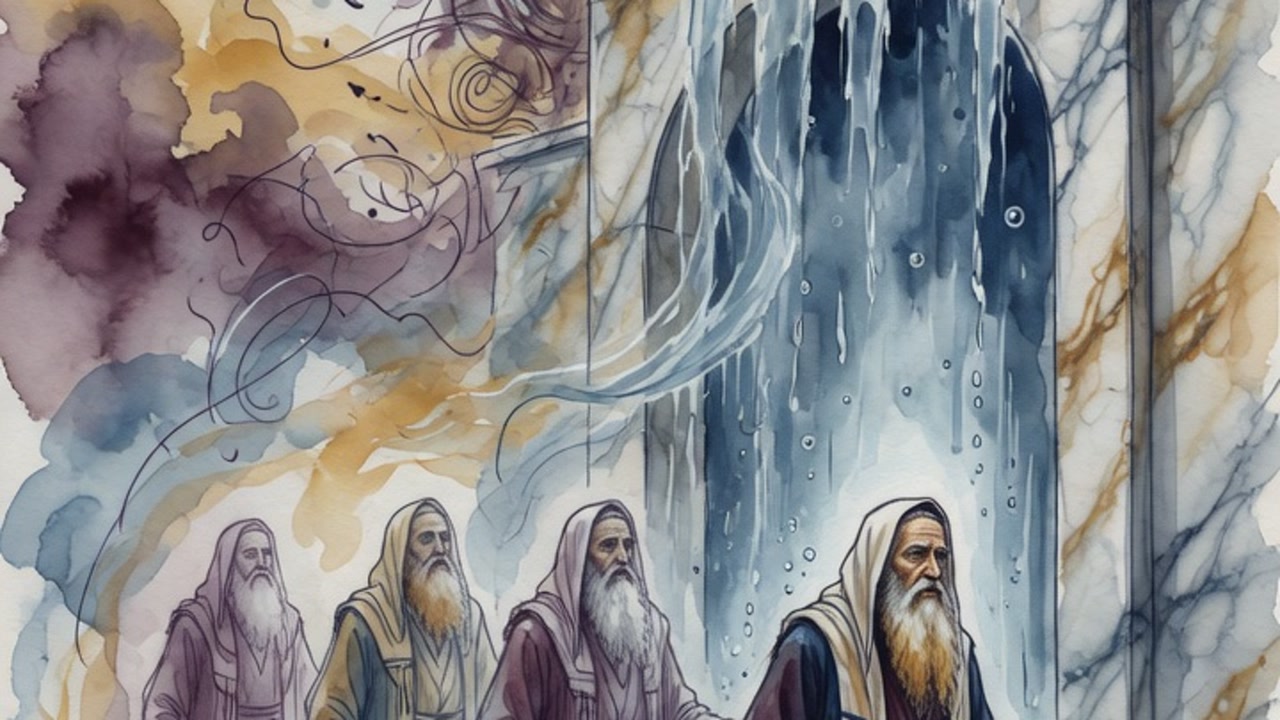
The mystic in Tikkunei Zohar does not ask this question as a philosopher hunting for a first cause. He asks it the way a person asks about something they have already lost track of while it was happening. The world is here, full of bread and stones and bodies and sky. He can see it. He cannot see the seam where it began. So he cries: Master of the universe, open my eyes that I may gaze above.

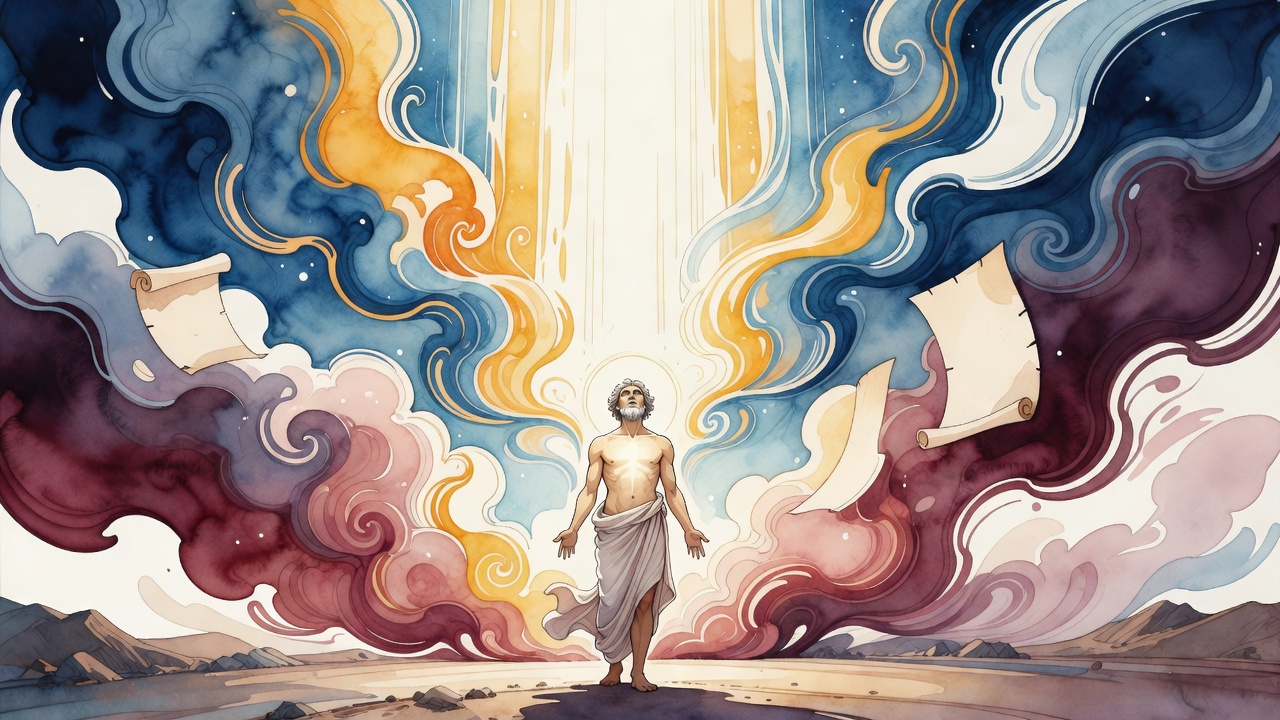
The answer comes through letters. Not through argument or description or proof. The gate to the origin is the forty-two-letter divine Name, a concealed arrangement known to the mystics as a key to the first word of Torah. Each letter is not merely a mark on parchment. In this world of thought, letters carry force. They build. They reveal. They hold back more than they say. The mystic does not ask to escape creation. He asks to read it from the inside.

Six Chambers Came From the First Word

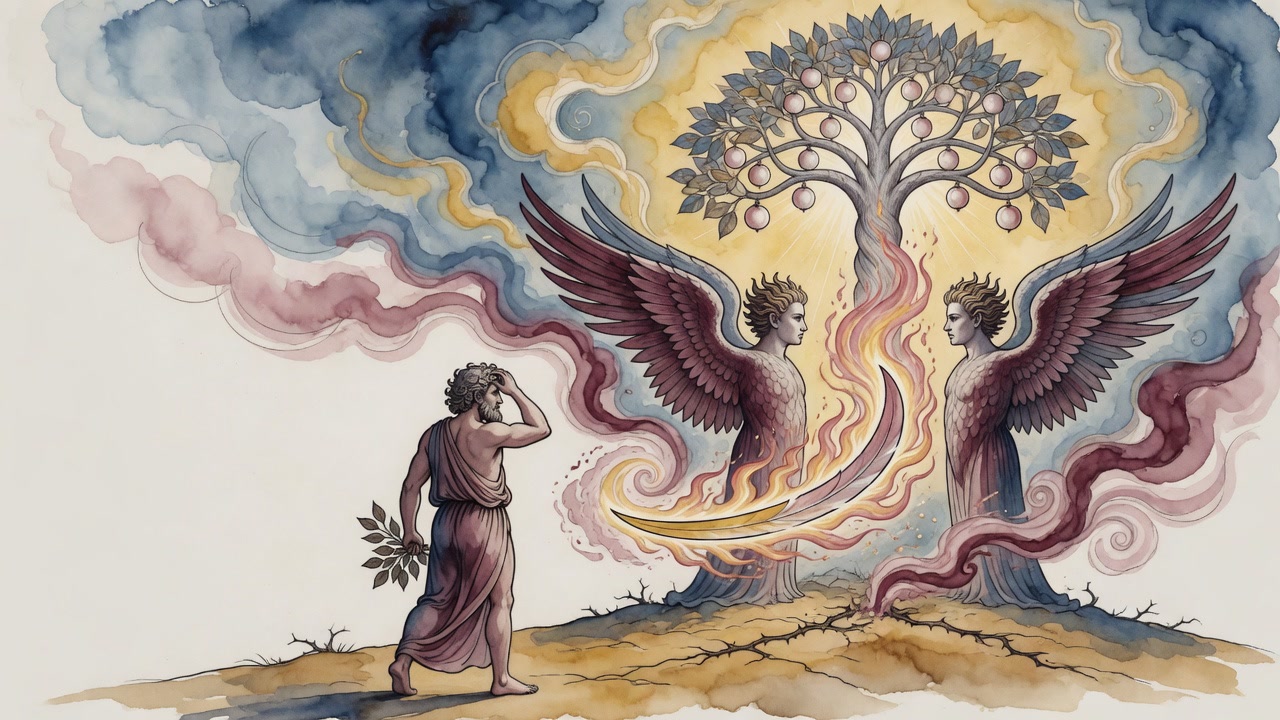
Tikkunei Zohar cracks open the word Bereshit. Read one way, it is the beginning. Read another, it contains bara, He created, and shit, six. Six chambers emerge from the first word like rooms discovered behind a door you had taken for a wall. Creation is not only temporal, a moment in sequence before other moments. It is spatial, a structure of chambers that arranged themselves when the first word was spoken.

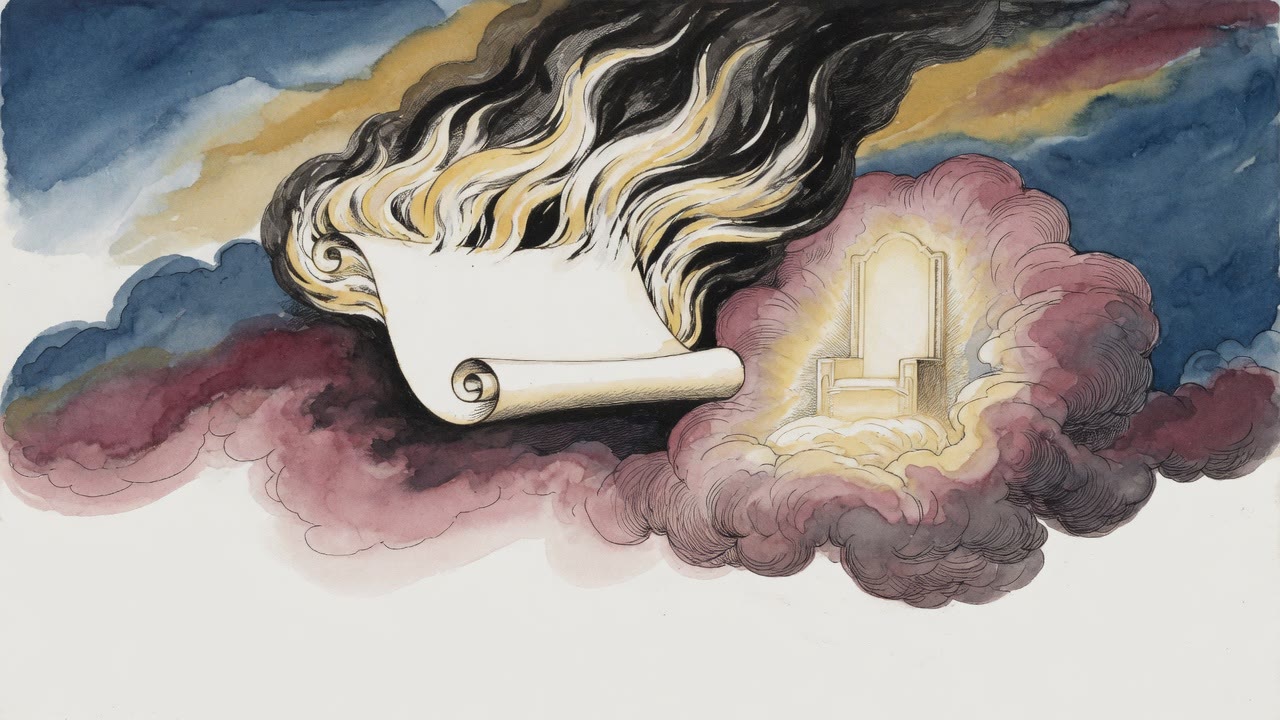
The primordial light, hidden on the first day and withdrawn before the fourth day's luminaries replaced it, was not simply extinguished. It was stored. The six chambers hold it. The world that appears in the visible creation is not the first world but the preserved version of the first world, the one that can be inhabited by creatures who could not survive the original light in its full intensity.

Something Came From Nothing Through a Line

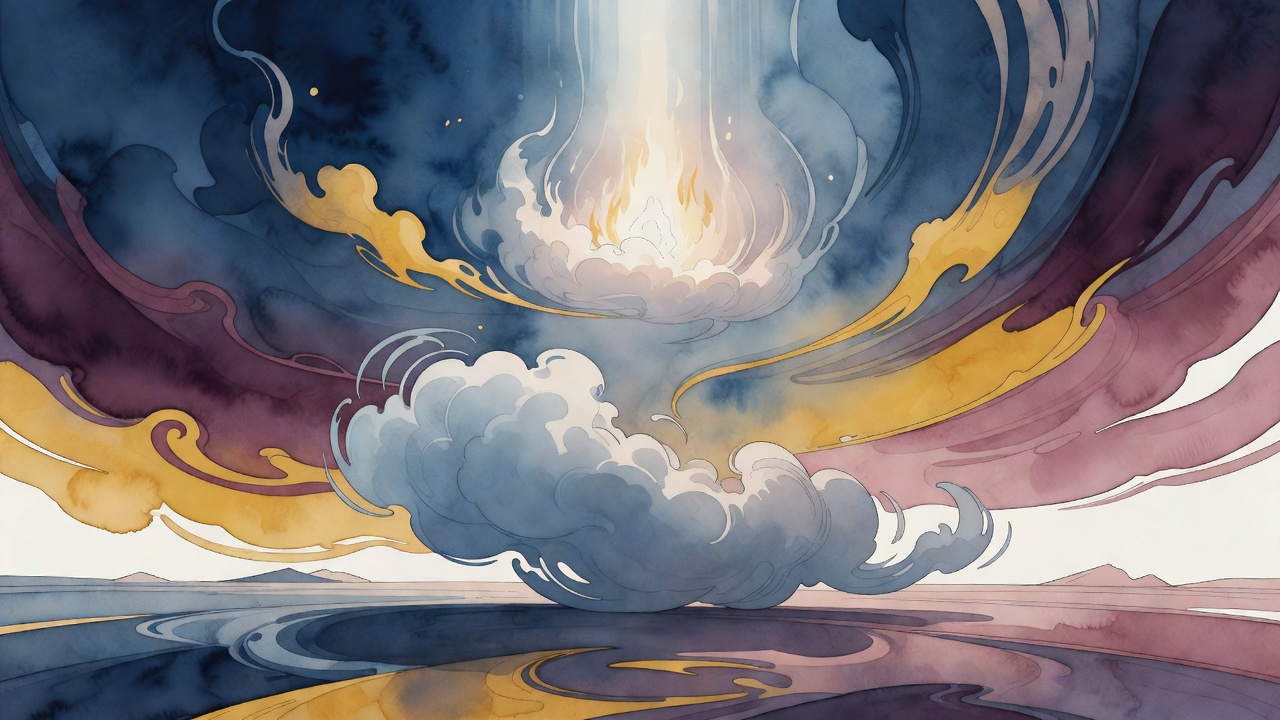
Before the first letter there was only ayin, nothingness, and from it emerged yesh, being. The Tikkunei Zohar traces the mechanism. Not a point of explosion but a line, a cosmic measure hidden in primordial air, a thread drawn from the infinite into the finite that carried within itself the proportions of everything that would follow.

The mystics call this the line of measure, kav ha-midah. It is the device by which the infinite contracted enough that a world could exist beside it. Creation is not a power demonstration. It is an act of precise withdrawal, the infinite pulling back to make room, then extending a single line that carries the measure of what will fill the space.

Twenty-Eight Letters Powered Every Act

The first verse of Genesis contains twenty-eight letters. The Tikkunei Zohar reads this as the fuel of creation. Twenty-eight is the numerical value of koach, power. Before the world had a single particle in it, the power of creation was already encoded in the letter count of the first verse. Everything that would be made was already powered by those twenty-eight signs.

This is not numerological game-playing. It is the Tikkunei Zohar's way of saying that language is not incidental to reality. Reality is made of language, specifically of divine language, and the first verse is not a description of creation but its mechanism. The letters did not report what happened. The letters were what happened.

The Ring, the Stone, the Drop

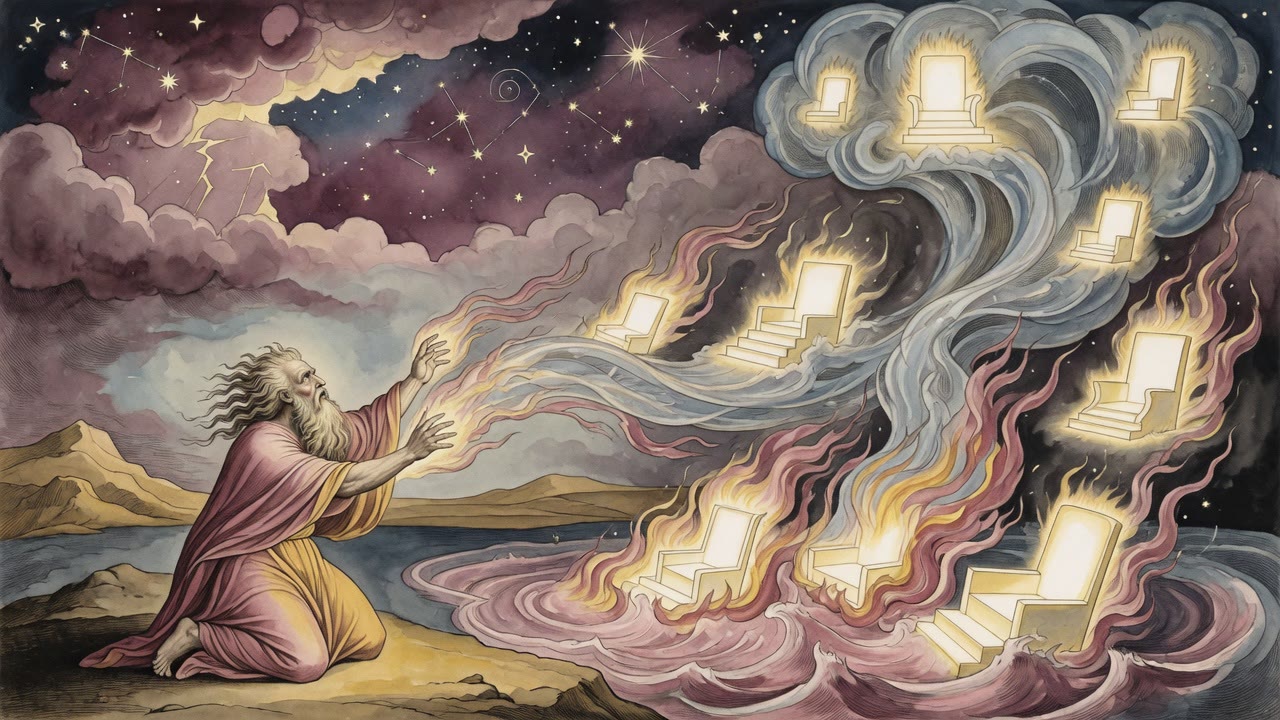
Tikkunei Zohar offers another image for the emergence of something from nothing: a ring, a stone, and a life-giving drop. The ring is the circle of the infinite, closed and perfect. The stone is the point of condensation where the infinite became dense enough to be specific. The drop is the seed, the smallest unit of something, the first particular thing that was not nothingness.

These three images overlap and multiply the same claim. Creation is the moment when the infinite accepted limitation in order to make room for anything else. The ring is the before. The stone is the hinge. The drop is the after. And from that drop, the twenty-eight letters, the six chambers, the measuring line, the hidden light, and finally the world that the mystic is already standing in, asking how any of it began.

The Yod on Top of Aleph

The smallest letter in the Hebrew alphabet is yod, a single mark, a point. The Tikkunei Zohar places it on top of aleph, the first letter, the one that does not begin Torah but precedes everything that begins Torah. The yod on top of aleph is the stone of creation, the first particular compressed into the smallest possible sign.

Aleph is silent. It has no sound of its own. The vowels that speak through it are not its sound. The yod that sits atop it is invisible to the untrained eye, a dot that most readers skip over. Creation began in silence and invisibility, in the smallest mark the alphabet contains, in the letter that precedes the letter that precedes the word that the mystic has been pressing his finger into since he first asked to see.


← All myths
From the tradition

Sources

6 sources

The texts this telling draws on, in full. Open a card to read inline, or expand it for a wider, quieter read.

Tikkunei Zohar 37:2Tikkunei Zohar

He doesn’t just ask for knowledge, he cries out: "Master of the Universe! Open my eyes that I may gaze above through them!" (Tikkunei Zohar 37). He wants to see, to perceive the divine secrets woven into the fabric of reality.

What's the key to unlocking these secrets? According to Rabbi Shim’on, it's found in the phrase "I shall enter ‘through them’" (Ps. 118:19) – and it involves something quite extraordinary: "the forty-two letters of the explicit Name."

What is this "explicit Name"? The text refers to a powerful, concealed name of God, a name not readily spoken or known, comprised of 42 letters. It's said to be a key to understanding creation itself. A tool to "know each-and-every letter upon Be-REiShYT," meaning "In the beginning" (Gen. 1:1). The very first word of the Torah, Be-REiShYT, holds within it the potential to understand the entire creation.

The Tikkunei Zohar then lists a series of seemingly random letters: A-V-G Y-T-Tz Q-R-’A S-T-N N-G-D Y-Kh-Sh B-T-R Tz-T-G Ḥ-Q-B T-N-’A Y-G-L P-Z-Q Sh-Q-U Tz-Y-T. These are those 42 letters!

Now, I know what you might be thinking. What do these letters even mean?

The truth is, their meaning isn't simple or straightforward. Kabbalists see these letters as components of a divine code, a blueprint for the universe itself. They aren't just letters; they're energetic forces, divine emanations that shaped the world.

It's important to remember that in Kabbalah, letters aren't just symbols. They are vessels of divine energy. They are the building blocks of creation. The 42-Letter Name, then, becomes something like the ultimate construction manual for existence.

This passage closes with the declaration, "Blessed be the Name of His glorious kingdom for ever and ever." This liturgical phrase, often recited during the Shm’a prayer, acknowledges the immensity and eternity of God's reign. It serves as a reminder that even as we explore the deepest mysteries, we stand in awe of the Divine.

So, what does this all mean for us? Are we meant to become experts in Kabbalistic letter combinations? Maybe. But perhaps the real lesson here is about the potential for hidden meaning in everything around us. The universe isn't just a random collection of atoms. It's a carefully constructed tapestry woven with divine intention, and maybe, just maybe, the secrets are hidden in plain sight, waiting for us to open our eyes and truly see.

Full source
Tikkunei Zohar 52:3Tikkunei Zohar

The Tikkunei (spiritual repair) Zohar, a companion volume to the Zohar itself, that mystical foundation of Kabbalah, offers us a glimpse into just that. It’s not just about what was created, but how.

It all starts with the very first word of the Torah: Be-REiShYT (בראשית), "In the beginning." But the Tikkunei Zohar isn't content with a simple translation. It wants to crack open the word itself, to see what secrets lie within. It suggests we read Be-REiShYT as two words: BaRA (ברא), "He created," and ShYT (שית), "six."

Six. What's so special about six?

Well, according to this reading, those six represent six chambers, six spaces of creation. Think of them as the building blocks of reality, each one essential. And what's above them all? The ELQYM, or Higher Mother, the seventh chamber, the source from which everything else flows.

It's a fascinating image, isn't it? A layered reality, with the divine feminine, the Higher Mother, as the ultimate origin.

But the story doesn't end there. Just as the Higher Mother produces these six chambers, so too does the Lower Mother. And what does she bring forth? "The heavens and the earth" – the very fabric of our existence (Genesis 1:1).

These heavens and earth, according to the Tikkunei Zohar, are also six vessels. This echoes the familiar line from (Exodus 20:11): "For in six days did Y”Y make the heavens and the earth..." The text plays on the ineffable name of God, יהוה, suggesting a deep connection between the creative process and the divine name itself.

Now, here's where it gets really interesting. The lower chambers, these vessels of heavens and earth, are vessels for the higher chambers. It's a system of interconnectedness, a cosmic flow of energy and influence. The earthly realm, the material world, is not separate from the divine realm, but rather a reflection and a recipient of its creative power.

So, what does it all mean?

Perhaps it's a reminder that creation isn't a one-time event, but an ongoing process. The six chambers, both above and below, are constantly interacting, constantly shaping the world around us. And maybe, just maybe, by understanding this hidden architecture, we can gain a deeper appreciation for the wonder and the mystery of it all.

Full source
Tikkunei Zohar 74:15Tikkunei Zohar

Jewish mystical tradition, specifically the Tikkunei (spiritual repair) Zohar, offers a breathtaking answer.

It all starts with something called "the line of measure." And this line? It's hidden, enclothed within the avyra (אֲוִירָא). What's avyra? It's often translated as "air," but it's more than just the stuff we breathe. It's a primordial, unmanifested space, a realm of pure potential.

The Tikkunei Zohar tells us that when this "line of measure" is in the avyra, it's completely hidden. Invisible. It’s not seen at all. Imagine a canvas before the artist begins, the silence before the music starts. It's there, but its potential is locked away.

Then, something remarkable happens. This hidden line begins to extend, to reach out, to reveal itself. And from this very act of revelation, from this avyra, emerges a single point: the letter Yod (י). The smallest letter in the Hebrew alphabet, the very seed of all language and creation, bursts forth from the hiddenness. And what remains? Aur (אוֹר) – light!

This isn't just any light. This is the primordial light, the very first act of creation. It's the light that existed even before the sun and moon, a pure, unadulterated radiance.

And that brings us to the verse from (Genesis 1:3): “And ELOHIM said, ‘Let there be aur (light).’” But the Tikkunei Zohar gives us a fascinating twist. It reads the verse as "Let there be Yod (י) – so as to make avyra."

Mind. Blown.

The creation of light, according to this interpretation, wasn't just about illuminating the darkness. It was about creating the very space – the avyra – in which everything else could exist. The Yod, that tiny point of potential, is the key.

This teaching, the Tikkunei Zohar emphasizes, is a profound mystery, "transmitted to the wise of heart." It's not something you can grasp with your intellect alone. It requires intuition, contemplation, and a willingness to explore the deepest secrets of existence.

So, what does this mean for us? Perhaps it's a reminder that even in the darkest, most hidden places, there is always the potential for light to emerge. That within every void, every moment of uncertainty, lies the seed of creation, waiting to be revealed. And maybe, just maybe, that seed is within us too.

Full source
Tikkunei Zohar 80:19Tikkunei Zohar

The Tikkunei (spiritual repair) Zohar, that mystical exploration of the Zohar, explores just that. It pulls back the curtain, revealing a fascinating connection between the very letters of the Hebrew alphabet and the act of creation itself.

It all boils down to the number 28, represented by the Hebrew word ko-aḥ (כֹּחַ), meaning "power" or "potential." According to the Tikkunei Zohar, there are 28 ko-aḥ letters involved in every single act of creation! Every time something is made, whether it's written down, crafted by hand, or even conceived as an idea, these 28 forces are at play.

Why 28? The text suggests a connection to our own bodies, specifically our ten fingers. The "28 parts" are somehow reflected in these digits, hinting at a profound link between the human form and the creative process. It's as if our hands are miniature workshops of creation, channeling this potent energy.

The Tikkunei Zohar then unveils the mystery of "from potential (ko-aḥ) to actuality." It’s that leap from a dormant idea to a fully realized thing. And what fuels this leap? Ḥokhmah (חָכְמָה), or wisdom. As (Psalm 104:24) beautifully puts it, "You have made everything with wisdom (ḥokhmah)."

But the text doesn't stop there. It introduces another layer of complexity: there's ḥokhmah from the aspect of the letters themselves, and there's ḥokhmah from the aspect of the vowel points that accompany them. Why this distinction?

The Tikkunei Zohar describes the letters as bat qol (בַּת קוֹל), a "vocal daughter" or an "echo." They are the vessels through which speech, and therefore expounding, becomes possible. Each word, each interpretation, relies on this foundation of letters and their accompanying vowel points.: the letters are the basic building blocks, but the vowel points breathe life and nuance into them. They guide us in how to pronounce and understand the words, opening up layers of meaning. It's through this interplay of letters and vowels that we can truly unlock the power of speech and explore the depths of wisdom.

So, what does this all mean for us? Perhaps it's a reminder to appreciate the incredible power we possess to create, to bring things into being. To recognize the ḥokhmah that infuses every act, big or small. And to be mindful of the words we use, understanding that they carry the potential to shape reality itself. The Zohar teaches us that every act of creation, every word we speak, is imbued with divine energy. Let's use it wisely.

Full source
Tikkunei Zohar 88:1Tikkunei Zohar

Sometimes, just sometimes, we get glimpses of that grand design.

One of those glimpses, found within the depths of the Tikkunei (spiritual repair) Zohar, a foundation of Kabbalistic literature. Specifically, What's it about? It speaks of a ring, a precious stone, and a life-giving drop. Sounds intriguing. The passage begins with a ring, a symbol of cyclical time, of connection, of something whole and complete. This ring, Now, Aleph is the first letter of the Hebrew alphabet, often associated with the Divine unity, with God. ZaRQ-A, while less immediately familiar, hints at a powerful, perhaps even fierce, divine energy. So, picture this ring, rising from the very source of creation, the power of the Divine.

What is the purpose of this ascent? To receive "the precious stone which is the 'drop'." This "drop" is a fascinating image. It’s a singular point pregnant with infinite possibilities. It reminds us of the tzimtzum, the primordial contraction of God, which made space for creation.

Then, the passage bursts forth with imagery: "…and it irrigated all the face of the earth." Immediately! This drop, this potential, doesn't stay contained. It bursts forth, spreading outwards, nourishing and enlivening all of creation. It's a powerful image of divine abundance, a reminder that the creative force isn't a one-time event, but a constant, ongoing process. This echoes the idea of Shefa, divine grace and abundance, constantly flowing into the world.

What does it all mean? Well, like much of Kabbalah, it's layered with symbolism, open to interpretation. But at its heart, it speaks of a profound connection between the divine and the earthly. It suggests that creation isn't just a past event, but a continuous flow of energy and potential, constantly irrigating our world.

And maybe, just maybe, it suggests that we, too, are part of that flow. We are receivers and givers. We, too, have the capacity to be rings that ascend and drops that irrigate. We, too, can participate in the ongoing act of creation.

So, the next time you feel like a small, insignificant piece, remember the ring, the drop, and the irrigation. Remember that you're connected to something vast and ancient. Remember that you have the potential to bring life and abundance to the world around you.

Full source
Tikkunei Zohar 122:7Tikkunei Zohar

The mystical text, Tikkunei (spiritual repair) Zohar, often feels that way to me. It’s a deep dive into the secrets of creation, a journey into the heart of Jewish mystical thought. And in one particularly evocative passage, Tikkunei Zohar 122, we encounter a stone. But this isn't just any stone; it's a symbol loaded with meaning.

The passage begins by stating "And this stone is the Yod ❖י on top of Aleph ❖א". Now, Yod and Aleph are the first two letters of the Hebrew alphabet, the building blocks of everything. The Yod, the smallest letter, sits atop the Aleph. What does it all mean? The text connects this image to the verse from (Isaiah 46:10), "He tells the end from the beginning…" The end is already present in the beginning. The potential is there, waiting to unfold. And this stone, this Yod on the Aleph, represents that very idea. It's the spark of creation, the seed of everything to come.

The Tikkunei Zohar continues, describing this as "YOD QE VAV QE" (or in some versions "YOD QeY VAV QeY"). These letter combinations, comprise the ten sephirot, the emanations of God's light, the structure of the divine realm. These sephirot, the text says, are characterized by the phrase: "'Their end is embedded in their beginning, and their beginning in their end.’” This cyclical nature, the interplay between beginning and end, echoes the idea found in the ancient Sefer Yetzirah (1:7). Everything is interconnected, a constant flow of influence and return.

The scene: "All the Masters of the Academy rose, and they said: ‘O Faithful Shepherd! How powerful you are to throw the stone! For it reaches to a place, where there is no-one who knows its place…"

This isn't a literal stone-throwing competition, of course. It's a metaphor for profound insight, a moment of revelation so powerful it leaves everyone in awe. The "stone" of knowledge, of understanding, is hurled into the unknown, reaching a place beyond comprehension.

Even the angels, those celestial beings, are left to ask, "Where is the place of His glory to praise Him?" (This line echoes the Qedushah prayer in the Sephardi rite). The mystery deepens. No one fully grasps the implications, the full extent of this revelation.

The passage concludes with a powerful image: "Blessed is the glory of Y”Y from His place – and even though it is small below, it has no end above." This echoes (Ezekiel 3:12).

Even something small, seemingly insignificant like the Yod, the smallest letter, holds infinite potential. Its influence extends upwards, beyond our limited perception. It’s a reminder that even in the smallest of things, we can find a connection to the divine, to something vast and eternal.

So, what does this all mean for us? Perhaps it's a call to look closer, to appreciate the hidden depths within the seemingly simple. Maybe it's an encouragement to embrace the unknown, to throw our own "stones" of inquiry into the mysteries that surround us. Or perhaps it's simply a reminder that even the smallest spark can ignite something truly extraordinary. The Tikkunei Zohar invites us to ponder these questions, to explore the endless possibilities that lie within the fabric of creation.

Full source