The Prayer That Needed the Whole Body to Rise
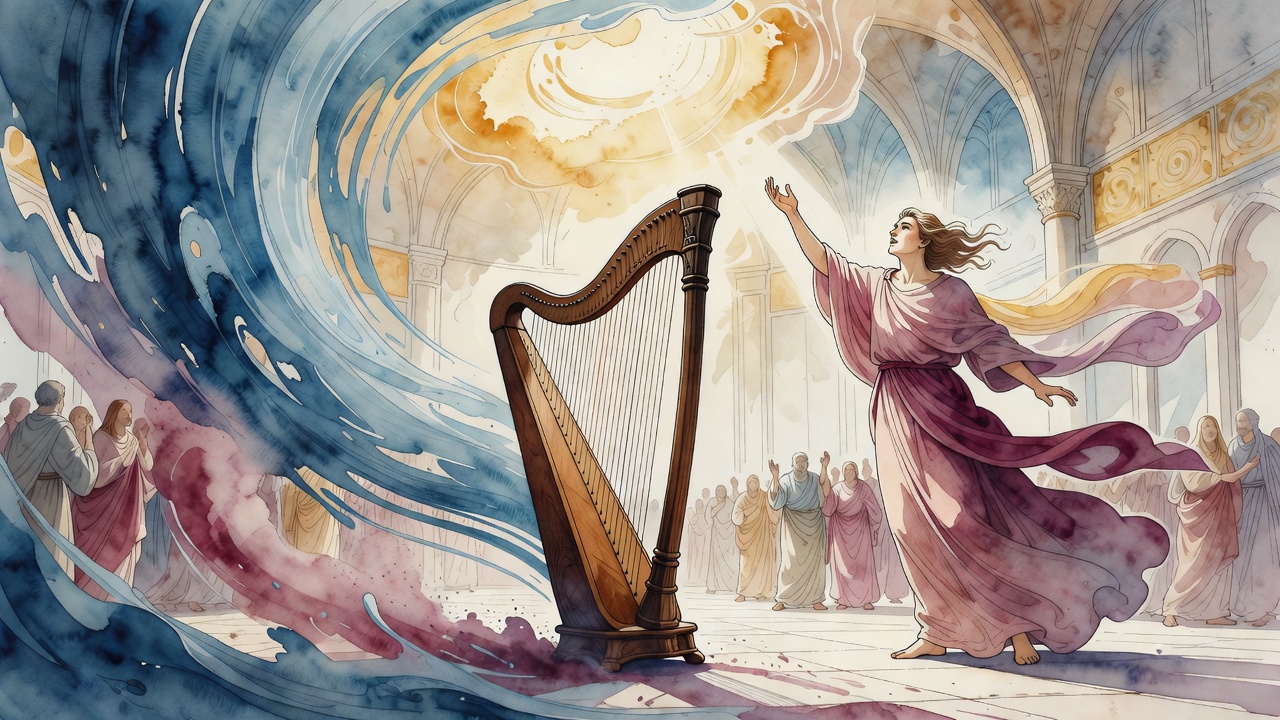
To pray the Amidah is to bow all eighteen vertebrae into eighteen blessings, as weak prayers are lifted by strong ones and rivers raise their force.
Table of Contents
 Click for full size
Eighteen Bones Bent Into Eighteen Blessings
He stood with feet together and took three steps forward to enter the prayer's presence. He had done this every day of his adult life. But the Tikkunei Zohar asked him to do it differently, to notice what was happening in the spine while the words left the mouth. Eighteen vertebrae. Eighteen blessings. The number of life, chai, spelled in Hebrew letters whose sum was eighteen.
When the body bowed at the opening blessing and at the closing blessing, every vertebra was supposed to bend. Not the neck only. Not the upper back in a polite nod toward heaven. The whole spinal column, all eighteen sections of the body's central support, bowing in exact correspondence with the eighteen blessings that named healing, forgiveness, redemption, and the divine name. Prayer was life folding itself before the source of life. The number eighteen was not decoration. It was the spine of the prayer and the prayer of the spine, and they could not be separated.
The Body Could Not Stay Behind While the Mouth Prayed
A person could stand with perfect posture and let the words run by. The eyes could read each blessing while the mind arranged the next day's appointments. The Tikkunei Zohar knew this and refused to make it possible without noticing what had been refused. To stand in the Amidah (the standing prayer recited three times a day) was to stand in a space that demanded total presence, not because heaven was watching for effort but because the prayer itself could not do its work unless the body participated in what the mouth was saying.
The eighteen blessings were not a report sent to a distant recipient. They were a structure designed to carry vitality between the human world and the divine worlds above. A prayer spoken without bodily intention was like a letter put in an envelope but never sealed. The words arrived. But the thing that should have gone with the words, the weight of a living person bowing all the way down into the meaning of what was being said, was absent. The blessings existed. The channel was not open.
Weak Prayers Were Carried by Stronger Ones
Some prayers were too faint to ascend on their own. A prayer offered by a person in grief, or in distraction, or in the aftermath of a failure that left the spirit depleted, might reach the gate and not have strength to pass through. The Tikkunei Zohar did not declare such prayers useless. It described a mechanism of rescue: strong prayers could carry weak ones upward.
This was why communal prayer worked differently than private prayer. A congregation praying together produced prayers of many different strengths, and the stronger ones did not abandon the weaker ones at the gate. They gathered them. The collective utterance could carry what no individual utterance could manage alone. The one who stood in the congregation with a depleted prayer could trust that the person beside her was praying with her full strength, and that full strength was large enough to include both of them.
The Rivers Raised Their Crashing Force in Psalm 93
Psalm 93 said: the floods have lifted up, the floods have lifted up their voice, the floods lift up their crashing. Three times the floods lifted. The Tikkunei Zohar read these three liftings as three levels of prayer's ascent, from the earthly level through the intermediate heavens toward the highest point. Rivers were one of the mystics' images for the flow of divine energy descending into the world. When rivers reversed and lifted upward, they were prayer going back the way blessing had come.
The image was violent: crashing, breaking, the force of water overwhelming what stood in its path. The Tikkunei Zohar was not afraid of powerful prayer. The prayer that broke through the gates, that roared up through the channels like a flooding river, that refused to stay still at the lower levels because the intention behind it was too great for the lower levels to contain, this was not immodest prayer. This was prayer that matched the scale of what it was addressed to.
Morning and Evening Carried Different Light
The Tikkunei Zohar had different things to say about morning prayer and evening prayer. Morning prayer opened the day's channels. Evening prayer sealed them. Morning prayer was oriented toward action, toward the divine energy that would flow through the day's events and choices. Evening prayer was oriented toward accounting, toward the soul's return from its day-long exposure to the world back to the protected space of sleep and near-death, during which the soul would ascend, report, and return.
The Song of Songs, which the Tikkunei Zohar read as the love poem between the Shekhinah (God's indwelling presence) and Israel, had its own contribution here. The body praised in the Song, the beloved whose eyes were doves and whose neck was as a tower, was also the body at prayer: every described feature of the beloved corresponding to a feature of the person standing before God. To pray with the whole body was to stand before God as the beloved stood before the lover in the poem, seen and known and not concealed.
← All myths