7 min read

The Ring of Light Where Souls Forget the World Before Birth

In a ring of light God shows the unborn all of creation, then presses one finger below the nose and they forget it all at birth.

Curated by Arthur · Told by Maggid ·
Table of Contents
  1. The Ring of Light Where the Souls Wait Their Turn
  2. The Drop and the Question Without an Answer
  3. The Soul That Did Not Want to Go
  4. The Touch Below the Nose
  5. Why God Empties the Hands Before the Door

The Ring of Light Where the Souls Wait Their Turn

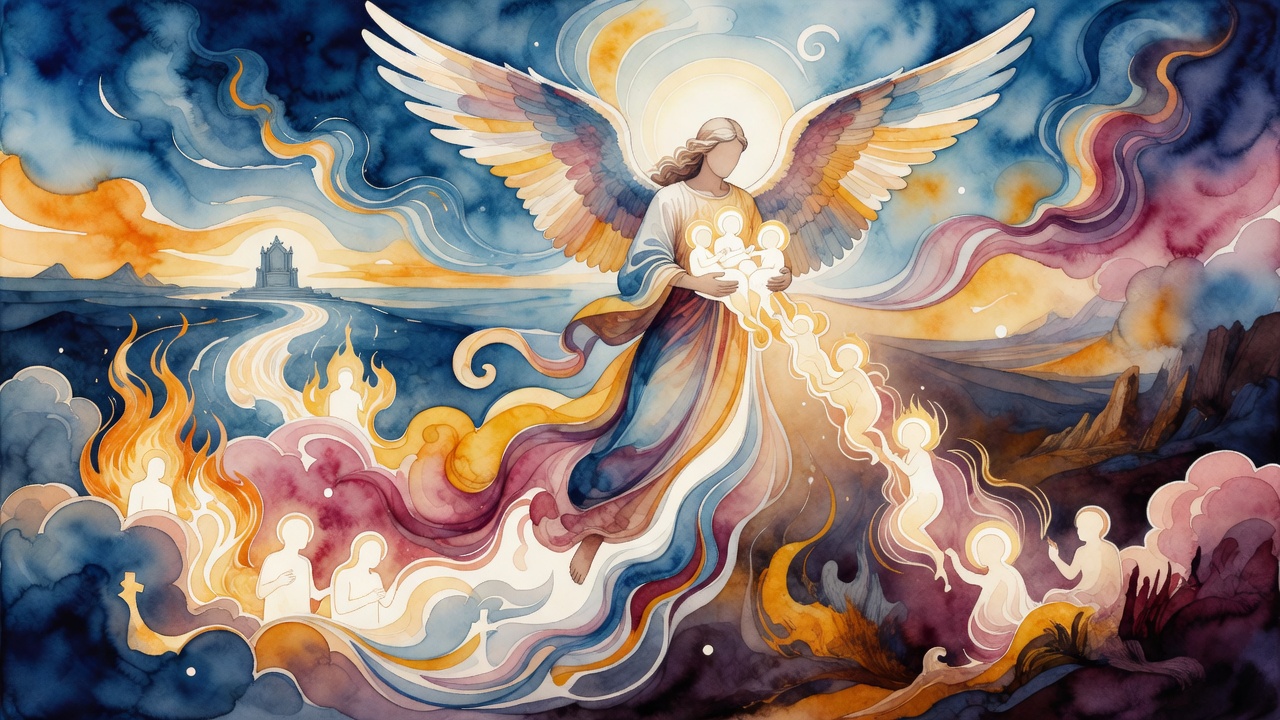
There is a circle of light, and in the center of it sits God, and around the rim, packed shoulder to shoulder and brighter than any of them will ever be again, wait the souls who have not yet been born. They number more than the stars. Every soul that ever lived and every soul that ever will is gathered there, drawn from a storehouse in the seventh heaven, each one holy, each one pure, each one a small severed piece of the glory at the center.

They are not idle. They are shown things. From the rim of that ring a soul can see from one end of creation to the other, the way a sleeper in one country dreams a street in a country a thousand miles off. They are taught the whole of the Torah, every letter of it, the open law and the law folded inside the law. They are walked through the gardens where the righteous sit crowned and shining, and they are walked past the place of fire where the wicked are beaten with staves of flame. They learn the secret of how the world was made and the secret of the world that is coming. For a soul in the ring, nothing is hidden.

The Drop and the Question Without an Answer

When a child is to be conceived below, an angel goes down for the seed and carries it back up and sets it before the Throne. The angel will not decide a thing about it. He only asks.

"Master of the Universe," the angel says, "this drop, what shall become of it? Strong or weak? Wise or foolish? Rich or poor?"

God answers every question but one. Strong or weak, He says. Tall or short. The angel waits for the last one, whether the child will be wicked or righteous, and God does not say it. That single thing is left blank. Everything is in the hands of Heaven except the fear of Heaven. The whole drama of a human life is the one line God refuses to write in advance.

Then God turns to the rim of the ring and calls a soul by its name, the soul hidden in the garden whose shape and name are already fixed, and says, "Enter this drop."

The Soul That Did Not Want to Go

The soul does not want to go. She has seen what waits below. "Master of the world," she says, "I am content here. I am holy. I am pure. I am a piece of Your glory. Why would You push me into that impure vessel?"

God does not argue long. "The world I am sending you into," He says, "is better than the one you have known. I made you for exactly this." Against her will she is carried down into the womb.

It is not a punishment there. It is the last good place. A lamp burns above the unborn head, and by its light the child still sees from one end of the world to the other. Two angels stand guard so the soul cannot slip out or fall. Each morning one of them carries her up to see the crowned righteous, and each evening down to see the burning wicked, and each time the angel says, "These began exactly where you began. These went down and kept the commandments, and these went down and broke them. Now choose which you will be." The folded child holds the whole Torah in its closed mouth, knees drawn up, heels against its own body, eating what its mother eats. There are no days in a human life more blissful than these.

The Touch Below the Nose

Nine months pass, and the angel returns to the womb and says, "Time to go."

The soul refuses a second time. "Now I am comfortable here," she says. "Now I know everything. Why move me again?"

The angel does not bend. "Against your will you were formed," he says. "Against your will you will be born, and against your will you will one day die and give your account." Then comes the moment the whole ring was leaning toward.

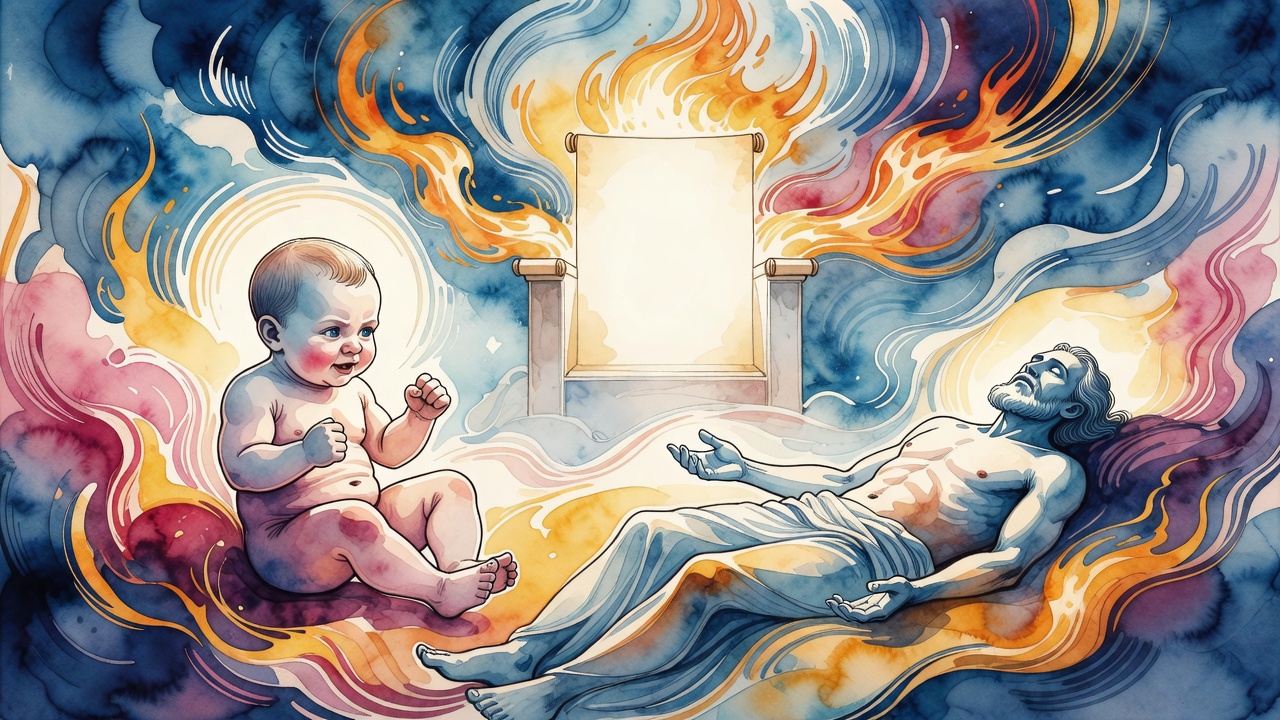
In one telling it is the angel who does it, a single sharp slap to the mouth at the threshold. In another, older to some and stranger, it is no angel at all. It is God who reaches out with a single finger and presses it gently to the place just below the nose, into the soft groove there, and at that touch every secret goes out like the lamp above the head. The whole Torah, the world from end to end, the garden and the fire, the bliss, the name God called her by. Gone. The mark the finger leaves stays on the upper lip of every human face that has ever been, the little channel under the nose, the print of the moment the knowing was taken away.

The light is put out. The child is forced into the cold air, and it does what every newborn does. It cries. It has just lost everything it ever knew and cannot say what. It came into the world already grieving, and it will spend a lifetime unable to name the thing it lost.

Why God Empties the Hands Before the Door

The mercy is in the forgetting. A soul that walked the gardens and saw the crowns and held the secret of the world to come could not bear the small bitter world of bread and grief and waiting. It would stand in a doorway frozen with longing for a paradise it remembered down to the last detail. So God takes the picture at the threshold, not to rob the child but so the child can live, can find the morning bearable, can be surprised by a kindness or a face or a turn of light without measuring it forever against the glory it came from. The ache stays. Only the picture is taken. And the whole work of a life is to walk back toward the one thing that was never decided for it in the ring, to choose to be righteous, and so to earn back the seat among the crowned that it was shown before its mouth was sealed and it forgot it had been shown at all.


← All myths

From the tradition

Sources

5 sources

The texts this telling draws on, in full. Open a card to read inline, or expand it for a wider, quieter read.

Oral version collected by Howard Schwartz from his uncleOral Tradition

There's a story about that. It's a bittersweet tale, really, about beginnings and forgetting, and it goes something like this...

A circle. Not just any circle, but a celestial gathering. In this circle sits God, surrounded by countless tiny spirits, each one on the cusp of being born. Now, these aren't just any spirits; they've known the pure, unadulterated joy of being in God's presence. They know the secrets of the heavens.

God, being all-knowing, understands something profound: earthly life won't hold the same unbridled joy. There will be struggle, hardship, and loss. And God doesn’t want these brand-new souls to be forever comparing their earthly existence to the bliss they once knew.

So, according to this tradition recounted by Maury Schwartz of Chicago, God takes a single finger and gently touches each spirit just below their nose, right where that little indentation will form. That touch… it erases the memory of heavenly joy. It’s an act of compassion, really. A divine act of mercy.

Why? So that these new humans can adapt, can find contentment, and can experience the world without the constant, painful reminder of what they've left behind. It allows them to embrace the challenges and the joys, the bitter and the sweet, without being forever tethered to a memory of perfect bliss.

It's a poignant idea, isn't it?

Other versions of this story exist, of course. The Talmud, in tractate Niddah 16b, for example, mentions an angel named Lailah. Lailah, the angel of conception, accompanies the child throughout the pregnancy, imparting all the secrets of the heavens. But then, just before birth, as we also find in Sanhedrin 6a, Lailah touches the child on the upper lip, causing them to forget everything they've learned.

The Zohar Hadash 68:3, a later Kabbalistic text, and Midrash (rabbinic interpretive commentary) Tanhuma, Pekudei 3 also touch upon this idea of pre-birth knowledge and the subsequent forgetting.

It's fascinating how these different tellings weave together, isn't it? Some attribute the forgetting to an angel, others directly to God. But the core idea remains: a veil is drawn between the soul and its heavenly origins.

This particular version, though, with God as the one bestowing the "forgetting touch," carries a distinct weight. It emphasizes the inherent difficulties of earthly existence. It implies, perhaps, that life is a struggle, a test, and that the memory of pure joy would only make it harder to bear. It's a far cry from the Garden of Eden, isn't it?

You know, it makes you wonder… if we did remember everything, would we even be able to function in this world? Would we be paralyzed by longing for a paradise lost? Or is there something beautiful and necessary in this act of divine forgetting? Maybe it's what allows us to truly appreciate the small joys, the fleeting moments of connection, the unexpected beauty that pierces through the everyday. Perhaps forgetting is what allows us to truly live.

Full source
Niddah 30bTalmud Bavli, Niddah

doesn’t the mishna teach that the woman observes the strictures of a menstruating woman, i.e., she is considered ritually impure every time she experiences bleeding, and does not observe any period of purity at all? The Gemara answers: The mishna mentions that the woman observes the strictures of a woman who gave birth to a male to teach that if she sees blood on the thirty-fourth day after her miscarriage and again sees blood on the forty-first day, her purity status shall be ruined, i.e., she shall be prohibited from engaging in intercourse, until the forty-eighth day.

If she were not observing the strictures of a woman who gave birth to a male, but only those of a menstruating woman and one who gave birth to a female, she would not have to wait seven days after seeing blood on the forty-first day. Instead, she would wait only one day, as her possible seven-day period of menstruation began on the thirty-fourth day and ended on the fortieth. Yet, as she might have given birth to a male, the forty-first day might be the first day after her period of purity, and therefore the first of her seven days of menstruation.

Consequently, she must consider herself impure until the forty-eighth day. And similarly, with regard to the halakha that she observes the strictures of a woman who gave birth to a female, one ramification is that if she sees blood on the seventy-fourth day and again sees blood on the eighty-first day, her purity status shall be ruined until the eighty-eighth day. Although she observes ritual impurity after discovering bleeding on the seventy-fourth day, as perhaps she has the status of a menstruating woman, when she discovers bleeding on the eighty-first day she must begin the count of seven days of menstruation again, in case the seventy-fourth day was during her period of purity after having given birth to a female. § The mishna teaches that Rabbi Yishmael says: A woman who discharges on the forty-first day after immersion observes both the strictures of a woman who gave birth to a male, and those of a menstruating woman, but not the strictures of a woman who gave birth to a female, as the formation of a male offspring takes forty-one days, whereas the formation of a female offspring takes eighty-one days.

It is taught in a baraita that Rabbi Yishmael says, in explanation of his opinion: In the case of a woman who gave birth to a male, the verse deems her impure for seven days and deems her pure for an additional thirty-three days, for a total of forty days; and with regard to a woman who gave birth to a female, the verse deems her impure for fourteen days and deems her pure for another sixty-six days, for a total of eighty days.

It can therefore be inferred that just as when the verse deems a woman impure and then deems her pure for a total of forty days in the case of a male, its amount of time is parallel to the time of the formation of a male embryo; so too, when the verse deems a woman impure and deems her pure for a total of eighty days in the case of a female, its amount of time is parallel to the time of the formation of a female embryo.

Accordingly, the formation of a female ends on the eighty-first day after conception. The Rabbis said to Rabbi Yishmael in response: One cannot derive the amount of time of the formation of an embryo from the extent of a woman’s period of impurity after giving birth. Furthermore, the Rabbis said to Rabbi Yishmael that there is a proof against his opinion from an incident involving Cleopatra, Queen of Alexandria.

Since her maidservants were sentenced to death by the government, she took advantage of the opportunity and experimented on them in order to examine the amount of time it takes for an embryo to develop. She had her maidservants engage in intercourse and operated on them following their execution in order to determine the stage at which an embryo is fully formed, and found that both in this case, when the embryo is male, and that case, when it is female, the formation is complete on the forty-first day after conception.

Rabbi Yishmael said to them in response: I bring you proof from the Torah, and you bring me proof from the fools? The Gemara asks: What proof from the Torah does Rabbi Yishmael bring for his opinion? If we say that his proof is the aforementioned derivation that in the case of a woman who gave birth to a male, the verse deems her impure for seven days and deems her pure for an additional thirty-three days, for a total of forty days; and in the case of a female, the verse deems her impure for fourteen days and deems her pure for an additional sixty-six days, for a total of eighty days, didn’t the Rabbis say to him in response that one cannot derive the amount of time that the formation of an embryo takes from the extent of a woman’s period of impurity after giving birth?

The Gemara answers: Rabbi Yishmael’s derivation is that the verse states: “If a woman bears seed and gives birth to a male…and if she gives birth to a female” (Leviticus 12:2–5). The verse adds another explicit mention of childbirth with regard to a female, besides the mention of childbirth in the case of a male, when it could have simply stated: And if it is a female. Rabbi Yishmael derives from here that not only are the periods of ritual impurity and purity of one who gives birth to a female double those of a woman who gives birth to a male, but the formation of a female embryo also takes twice the time.

The Gemara asks: And for what reason does Rabbi Yishmael refer to the proof that the Rabbis cited from Cleopatra’s experiment as a proof from the fools? The Gemara answers: One can say that the maidservant who was pregnant with a female embryo became pregnant first, forty days before the maidservant who was pregnant with a male embryo. Consequently, it took the female embryo eighty days to be develop, not forty.

The Gemara asks: And how would the Rabbis respond to this claim? The Gemara answers: Cleopatra gave the maidservants a purgative medicine to drink before they engaged in intercourse, which would have terminated any previous pregnancy. And Rabbi Yishmael would respond that there are bodies that are not affected by this medicine, i.e., certain pregnancies are not terminated by the medicine. Consequently, the maidservant who was pregnant with a female embryo might have been pregnant prior to the experiment.

The Gemara cites another baraita that presents a different version of this exchange between Rabbi Yishmael and the Rabbis: Rabbi Yishmael said to the Rabbis that there is a proof for his opinion from an incident involving Cleopatra, the Greek queen, as her maidservants were sentenced to death by the government, and she experimented on them and found that a male embryo is fully formed on the forty-first day after conception, and a female embryo is formed on the eighty-first day.

The Rabbis said to him: One does not bring proof from the fools. The Gemara explains: What is the reason the Rabbis consider this a proof from the fools? They claim that it is possible that this woman who was pregnant with a female embryo did not conceive when Cleopatra had her engage in intercourse; rather, she waited forty days, and then became pregnant when she again engaged in intercourse. Therefore, the embryo was formed in forty days.

And how would Rabbi Yishmael respond to this claim? He would claim that the maidservants could not have conceived on a later date, as Cleopatra transferred them to the custody of a steward, who made sure that they did not engage in intercourse during the experiment. And the Rabbis would say that there is no steward [apotropos] for restraining sexual intercourse, and therefore one can say that the warden himself engaged in intercourse with the maidservant.

The Gemara raises a difficulty with regard to Rabbi Yishmael’s proof: But how can one be sure that the female embryo was formed after eighty-one days? Perhaps if the womb of the woman carrying this female embryo would have been torn open on the forty-first day after conception, the female embryo would have already been found in it, just as in the case of a male embryo. Abaye says in response: It was a case where the indications of the ages of the two embryos, e.g., their hairs and fingernails, were identical.

Evidently, the female embryo developed in eighty days to the same degree that the male embryo developed in forty days. § The mishna teaches: And the Rabbis say: Both the formation of the male and the formation of the female conclude on the forty-first day. The Gemara asks: The statement of the Rabbis is identical to the statement of the first tanna. Why does the mishna repeat this opinion in the name of the Rabbis?

And if you would say that the purpose is to teach that the unattributed opinion mentioned in the first clause of the mishna is in accordance with the opinion of the Rabbis, and therefore it is the halakha, as when there is a disagreement between an individual Sage and many Sages, the halakha is in accordance with the opinion of the many, this cannot be the reason. The Gemara explains: It is obvious that the halakha is in accordance with the unattributed opinion mentioned in the first clause of the mishna, as this is a general halakhic principle.

The Gemara answers: Lest you say that from the fact that the explanation of the opinion of Rabbi Yishmael stands to reason, as the verses apparently support it, the halakha should be in accordance with his opinion, therefore the mishna teaches us that the majority of Sages agree with the unattributed opinion mentioned in the first clause of the mishna. § Rabbi Samlai taught: To what is a fetus in its mother’s womb comparable?

To a folded notebook [lefinkas]. And it rests with its hands on its two sides of its head, at the temples, its two arms [atzilav] on its two knees, and its two heels on its two buttocks, and its head rests between its knees, and its mouth is closed, and its umbilicus is open. And it eats from what its mother eats, and it drinks from what its mother drinks, and it does not emit excrement lest it kill its mother.

But once it emerges into the airspace of the world, the closed limb, i.e., its mouth, opens, and the open limb, its umbilicus, closes, as otherwise it cannot live for even one hour. And a candle is lit for it above its head, and it gazes from one end of the world to the other, as it is stated: “When His lamp shined above my head, and by His light I walked through darkness” (Job 29:3). And do not wonder how one can see from one end of the world to the other, as a person can sleep here, in this location, and see a dream that takes place in a place as distant as Spain [beAspamya].

And there are no days when a person is in a more blissful state than those days when he is a fetus in his mother’s womb, as it is stated in the previous verse: “If only I were as in the months of old, as in the days when God watched over me” (Job 29:2). And the proof that this verse is referring to gestation is as follows: Which are the days that have months but do not have years? You must say that these are the months of gestation.

And a fetus is taught the entire Torah while in the womb, as it is stated: “And He taught me and said to me: Let your heart hold fast My words; keep My commandments, and live” (Proverbs 4:4). And it also states: “As I was in the days of my youth, when the converse of God was upon my tent” (Job 29:4). The Gemara asks: What is the purpose of the statement: And it also states: “When the converse of God was upon my tent”?

Why is it necessary to cite this verse in addition to the previously quoted verse from Proverbs? The Gemara explains: And if you would say that the verse in Proverbs is insufficient, as it is a prophet who is saying that he was taught the entire Torah in his mother’s womb, but this does not apply to ordinary people, come and hear the verse in Job: “When the converse of God was upon my tent.” And once the fetus emerges into the airspace of the world, an angel comes and slaps it on its mouth, causing it to forget the entire Torah, as it is stated: “Sin crouches at the entrance” (Genesis 4:7), i.e., when a person enters the world he is immediately liable to sin due to his loss of Torah knowledge.

And a fetus does not leave the womb until the angels administer an oath to it, as it is stated: “That to Me every knee shall bow, every tongue shall swear” (Isaiah 45:23). The verse is interpreted as follows: “That to Me every knee shall bow”; this is referring to the day of one’s death, as it is stated: “All those who go down to the dust shall kneel before Him” (Psalms 22:30). “Every tongue shall swear”; this is referring to the day of one’s birth, as it is stated in description of a righteous person: “He who has clean hands, and a pure heart, who has not taken My name in vain, and has not sworn deceitfully” (Psalms 24:4), i.e., he has kept the oath that he took before he was born.

And what is the oath that the angels administer to the fetus? Be righteous and do not be wicked. And even if the entire world says to you: You are righteous, consider yourself wicked. And know that the Holy One, Blessed be He, is pure, and His ministers are pure, and the soul that He gave you is pure.

If you preserve it in a state of purity, all is well, but if you do not keep it pure, I, the angel, shall take it from you. The school of Rabbi Yishmael taught a parable: This matter is comparable to a priest who gave teruma, the portion of the produce designated for the priest, to one who is unreliable with regard to ritual impurity [am ha’aretz], and therefore it is suspected that he might not maintain the purity of the teruma.

And the priest said to him: If you keep it in a state of ritual purity, all is well, but if you do not keep it pure, I shall burn it before you. Rabbi Elazar said:


Full source
Niddah 16b, 30bTalmud Bavli, Niddah

And Reish Lakish, this verse of Rabbi Yochanan, what does he expound from it? He requires it for that which Rabbi Chanina bar Pappa expounded, for Rabbi Chanina bar Pappa expounded: That angel who is appointed over conception, "Night" (Laylah) is his name, and he takes a drop and stands it before the Holy One, blessed be He, and says before Him: Master of the Universe, this drop, what shall become of it? Mighty or weak? Wise or foolish? Rich or poor?

But whether wicked or righteous he does not say, in accordance with Rabbi Chanina. For Rabbi Chanina said: Everything is in the hands of Heaven, except for the fear of Heaven, as it is said: "And now, Israel, what does the LORD your God ask of you, but to fear, etc." (Deuteronomy 10:12).

Full source
Chronicles of Jerahmeel IXChronicles of Jerahmeel (Gaster, 1899)

Before every human birth, an angel named Lailah (לילה) receives a direct order from God. According to the Chronicles of Jerahmeel, a 12th-century Hebrew chronicle compiled by Jerahmeel ben Solomon, God tells Lailah, "Tonight a child will be conceived. Take this seed and break it into 365 particles." The angel obeys, then returns to God and asks, "What shall become of it?" God decrees everything: strong or weak, male or female, rich or poor, tall or short.

God then summons a specific soul from the Garden of Eden. The soul protests. "I am holy and pure. I am satisfied with my world. Do not make me enter this impure vessel." God overrules the objection: "The world I am sending you into is better than the one you have known. I created you for exactly this purpose." The soul enters the embryo against its will.

A supernatural light shines above the unborn child's head, illuminating the entire world from end to end. Each morning the angel carries the soul into the Garden of Eden and shows it the righteous sitting in glory with crowns on their heads. Each evening the angel takes it to Gehinnom (the place of spiritual purification after death) and shows it the wicked being beaten with fiery staves. "These had the same humble origins as you," the angel explains. "They went into the world and disobeyed."

When nine months pass, the angel returns and says, "Time to go." The soul refuses again: "Now I am comfortable here. Why move me?" The angel replies, "Against your will you were formed. Against your will you will be born." Then the angel strikes the child, extinguishes the miraculous light, and forces it out into the world. The baby cries because it has lost everything it knew.

Seven stages of life await. In the first year, the child is treated like a king. By forty, burdens weigh on it like a loaded donkey. In old age, everyone in the household wishes for its death. When the final hour arrives, the same angel returns and asks, "What is your name?" The dying person weeps. Only the rooster can hear the sound.

Full source
Legends of the Jews 2:23Legends of the Jews

It’s quite a journey.

All the souls of humanity, not just those alive now, but every soul that ever was or ever will be, all nestled together. Where? In a heavenly storehouse, a promptuary as it's sometimes called, located in the seventh heaven. It's from this incredible reservoir that each soul is drawn, ready to inhabit a new body.

How does it all work? Ginzberg, in his Legends of the Jews, paints a vivid picture of this process. When a woman conceives, an angel – the Angel of the Night, Lailah – presents the seed before God. And it is God who then decides the fate of the being that will emerge: male or female, strong or weak, rich or poor. All these qualities are divinely ordained. Except for one thing: our piety and wickedness. That, my friends, is up to us.

Then comes the really fascinating part. God signals to the angel in charge of souls. "Bring Me," God says, "the soul so-and-so, hidden in Paradise, whose name is so-and-so, and whose form is so-and-so." The angel retrieves the designated soul, who bows down in reverence before the Divine presence.

And then the command: "Enter this sperm."

Now, here's where it gets interesting. The soul, understandably, hesitates. "O Lord of the world!" she pleads. "I am content in the world where I have been, since You called me into being. Why would you have me enter this impure sperm? I am holy, pure, a part of Your glory!"

Can you imagine the soul's reluctance? It's a powerful image.

But God, in His infinite wisdom, reassures her. "The world you are about to enter is better than the one you know. I created you for this very purpose." Despite her reservations, the soul is compelled to enter, carried back to the mother's womb by the angel.

Once there, two guardian angels watch over her, ensuring she doesn't escape or fall out. And above her shines a light, allowing her to see from one end of the world to the other. Each morning, another angel takes her to Paradise, showing her the righteous souls who sit there in glory, crowned and radiant.

"Do you know who these are?" the angel asks. The soul, of course, does not.

"These," the angel explains, "were once like you, formed in their mother's womb. They observed God's Torah (teachings, law) and His commandments. That is why they partake in this bliss. Know also that you, too, will one day leave the world below. If you observe God's Torah, you will be worthy to sit with these pious ones. But if not… you will be doomed to the other place."

It's a powerful lesson, isn't it? A reminder that our choices have eternal consequences. That even before we're born, we're given a glimpse of what awaits us, depending on the path we choose.

So, the next time you ponder the mysteries of existence, remember this incredible journey of the soul, from the heavenly storehouse to the womb, guided by angels, and ultimately, shaped by our own free will. What kind of story are you writing for your soul?

Full source