The Sea Refused Moses and He Went Back to God to Report It
The water said it was three days older than Moses. He did not argue. He walked back to God with a complaint from the sea.
Table of Contents
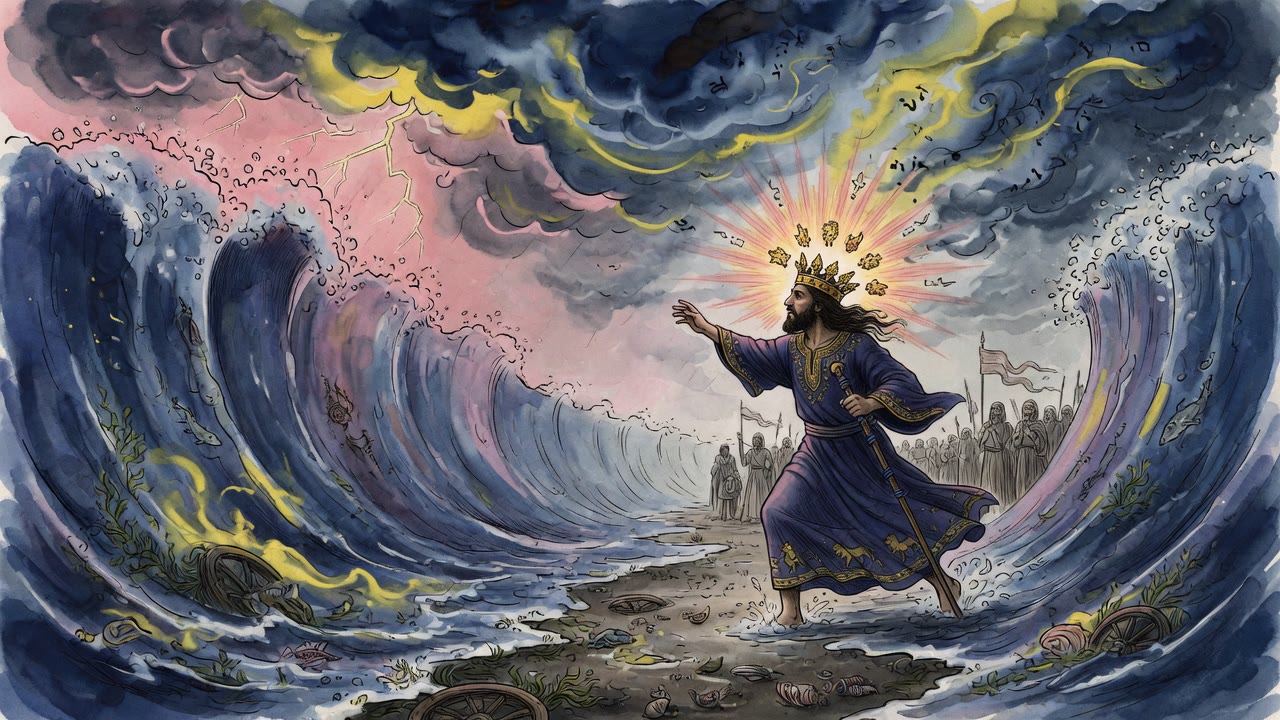
Moses spoke to the sea the way God had told him to speak. Egypt's army closed from behind. Six hundred thousand people pressed forward from every side. The water did not move.
 Click for full size
"I will not do according to thy words," the sea said. "Thou art only a man born of woman. I am three days older than thou. I was brought forth on the third day of creation, and thou on the sixth."
Moses did not argue with a body of water. He turned around. He walked back to God with a complaint from the sea.
The Water Claimed Seniority
There is something almost comic in the picture, if the army were not that close. The greatest prophet who had ever lived, the man who had spoken with God face to face at the bush, coming back like a messenger with news from a servant who would not work.
God asked him what a master does with an intractable servant.
"He beats him with a rod," Moses said.
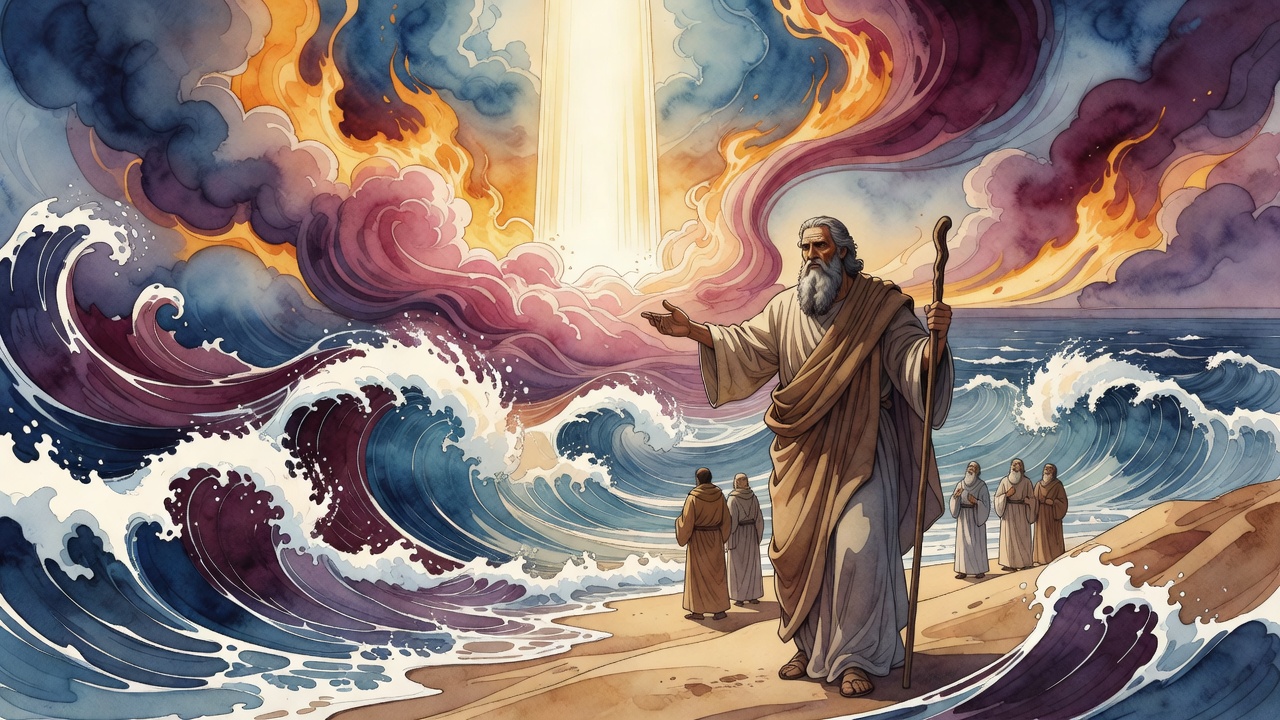
"Do thus," God ordered. "Lift up thy rod, and stretch out thine hand over the sea and divide it."
Moses lifted the staff. The sea split, not because a mortal had seniority, but because the Master had given the order. Moses never confused his own dignity with the task. He had a problem. He brought it up. That was the whole of his method.
Israel Aimed Its Anger at the Top
Years of that method did not make the people gentle. At Rephidim the water ran out. They quarreled with Moses. They did not grumble in their tents for the benefit of the youngest child, the way a suffering man usually keeps a complaint small and pointed downward. They transcended the norm. They aimed at the highest person they could reach.
They confronted him. They did not murmur among themselves and let rumors do the work. Every fear, every reversal, every dry skin of the wilderness landed on one mouth. Moses did not redirect it upward as a complaint about his own burden. He asked what to do next.
He was the target of everything, and he treated that as a fact of the job, not as an insult to be avenged.
Moses Named a Fact to Yithro
When his father-in-law Yithro asked why the people stood around him from morning until evening, Moses said, "Because the people come to me."
Later, in a study hall, Yehudah of Kfar Acco put that sentence in front of Rabban Gamliel as if it were vanity. Doesn't the humblest man on earth sound proud, saying the entire nation depends on him personally?
Gamliel did not flinch. "What else should he say?" Moses was describing a fact, not making a claim about his own greatness. The people did come to him. They had nowhere else to go. Saying so was not pride. It was accuracy. The rest of the verse freed him: they came to enquire of God. Humility is not self-erasure. It is the ability to name your actual situation without inflating it or hiding it.
Moses had already practiced that accuracy at the water's edge. The sea talked back. He reported the talk. He did not dress it up as a failure of his office, and he did not pretend the sea had obeyed him.
He Entered the Mist Where God Was
When he climbed Sinai to receive the Torah, he entered into the mist where God was. Darkness first, the outermost barrier. Cloud within, a second veil. Then mist, the arafel (ערפל), the innermost partition, the one closest to the Presence. Only after all three did he arrive.
The mountain was the original sanctuary. Outer courtyard, inner court, Holy of Holies. What Moses passed through on the way up was what the priests would later pass through on the way in. He did not skip a veil because he was Moses. He walked them in order, the way he had walked back from the sea: one problem, then the next, then the One who could address it.
The Sea Remembered the Staff
At the end of his life he pleaded with the Great Sea to let him cross into the land. He had a history with it. He had split it once.
The sea answered. "Son of Amram, what ails thee today? Art not thou the one who came to me with a staff, beat me, and clove me into twelve parts, while I was powerless, because the Shechinah (שכינה), God's presence, stood at thy right hand? What has happened, that thou comest now pleading?"
Moses burst into tears. "Oh, that I were as in months past, as in the days when God preserved me." He told the water the truth. In those days he had stood beside it as king of the world and commanded. Now he was a suppliant whose prayers went unanswered.
The sea remembered. It did not help. The land of Israel was on the other side, and Moses would not cross into it. The body of water that had refused him once, that he had reported to God, that had split at God's command and not his own, declined a third request because this one had not come from God.
Moses did not argue. He went back to God and pleaded there instead. The method did not change. Even when the answer was no.
← All myths