Translation of the source text.William Davidson Edition - Vocalized Aramaic + William Davidson Edition - English · CC-BY-NC
That which he decreed against himself, as he undergoes the following: Every day his ashes are gathered, and they judge him, and they burn him, and they scatter him over the seven seas. Onkelos then went and raised Balaam from the grave through necromancy. He said to him: Who is most important in that world where you are now? Balaam said to him: The Jewish people.
Onkelos asked him: Should I then attach myself to them here in this world? Balaam said to him: You shall not seek their peace or their welfare all the days (see Deuteronomy 23:7). Onkelos said to him: What is the punishment of that man, a euphemism for Balaam himself, in the next world? Balaam said to him: He is cooked in boiling semen, as he caused Israel to engage in licentious behavior with the daughters of Moab.
Onkelos then went and raised Yeshu the Nazarene from the grave through necromancy. Onkelos said to him: Who is most important in that world where you are now? Yeshu said to him: The Jewish people. Onkelos asked him: Should I then attach myself to them in this world?
Yeshu said to him: Their welfare you shall seek, their misfortune you shall not seek, for anyone who touches them is regarded as if he were touching the apple of his eye (see Zechariah 2:12). Onkelos said to him: What is the punishment of that man, a euphemism for Yeshu himself, in the next world? Yeshu said to him: He is punished with boiling excrement. As the Master said: Anyone who mocks the words of the Sages will be sentenced to boiling excrement.
And this was his sin, as he mocked the words of the Sages. The Gemara comments: Come and see the difference between the sinners of Israel and the prophets of the nations of the world. As Balaam, who was a prophet, wished Israel harm, whereas Yeshu the Nazarene, who was a Jewish sinner, sought their well-being. To conclude the story of Kamtza and bar Kamtza and the destruction of Jerusalem, the Gemara cites a baraita.
It is taught: Rabbi Elazar says: Come and see how great is the power of shame, for the Holy One, Blessed be He, assisted bar Kamtza, who had been humiliated, and due to this humiliation and shame He destroyed His Temple and burned His Sanctuary. § It was previously mentioned (55b) that the place known as the King’s Mountain [Tur Malka] was destroyed on account of a rooster and a hen. The details of what happened are as follows: It was customary in that place that when they would lead a bride and groom to their wedding, they would take out a rooster and a hen before them, as if to say in the manner of a good omen: Be fruitful and multiply like chickens.
One day a troop [gunda] of Roman soldiers passed by there while a wedding was taking place and took the rooster and hen from them. The residents of the city fell upon them and beat them. The soldiers came and said to the emperor: The Jews have rebelled against you. The emperor then came against them in war.
Among the residents of the King’s Mountain there was a certain man named bar Deroma who could jump the distance of a mil, and he killed many of the Romans, who were powerless to stand up against him. The emperor then took his crown and set it on the ground as a sign of mourning. He said: Master of the Universe, if it is pleasing to You, do not give over that man, a euphemism for himself, and his kingdom into the hands of only one man.
In the end it was the words issuing from his own mouth that caused bar Deroma to stumble, as he uttered this verse in complaint against God: “Have You not rejected us, O God, so that You go not forth, O God, with our hosts?” (Psalms 60:12). The Gemara asks: But did not David also say this? The Gemara answers: David uttered these words as a question, wondering whether they were true, whereas bar Deroma pronounced them as a statement of fact.
The Gemara recounts what happened to bar Deroma: He entered an outhouse, a snake came and eviscerated him, and he died. The emperor said: Since a miracle was performed for me, as I had no part in bar Deroma’s death, I will let the rest of the people be this time and take no further action against them. He let them be and went on his way. They leapt about, ate, drank, and lit so many candles in celebration that the image [bilyona] imprinted on a seal [gushpanka] was visible from a distance of a mil.
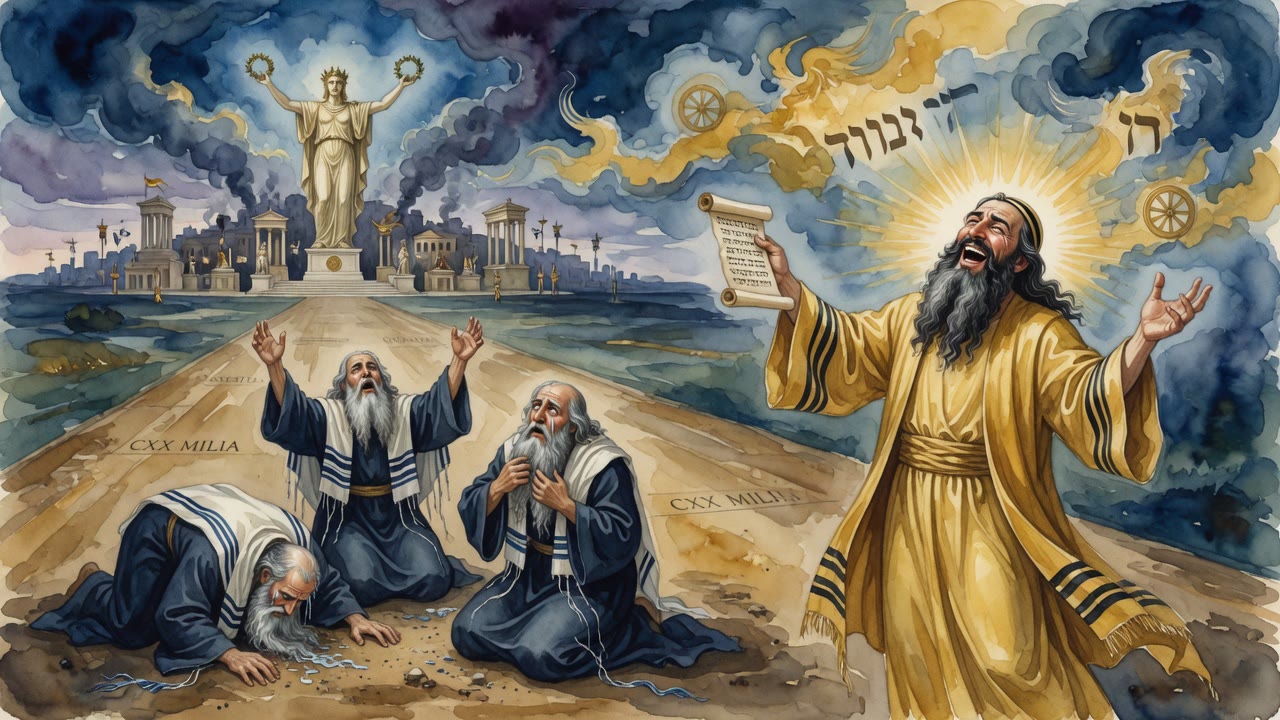
The emperor then said: The Jews are rejoicing over me. So he went back and came against them. Rav Asi says: Three hundred thousand men with drawn swords entered the King’s Mountain and massacred its inhabitants for three days and three nights. And at the same time on the other side of the mountain, weddings and other festivities continued to be celebrated, and they did not know about each other, owing to the enormous size of the place. § Concerning the verse: “The Lord has swallowed up without pity all the habitations of Jacob” (Lamentations 2:2), it is related that when Ravin came from Eretz Yisrael to Babylonia he said that Rabbi Yoḥanan says: This is referring to the six hundred thousand cities that King Yannai had in the King’s Mountain.
As Rav Yehuda says that Rav Asi says: King Yannai had six hundred thousand cities in the King’s Mountain, and each of them had a population as great as the number of those who left Egypt, except for three of those cities, the population of which was double the number of those who left Egypt. These are those three cities: Kefar Bish, Kefar Shiḥalayim, and Kefar Dikhrayya. The Gemara explains the meaning of these place-names.
Kefar Bish, Evil Town, was called by that name because its inhabitants would not open their houses to guests. Kefar Shiḥalayim was referred to by that name because their livelihood was derived from the cultivation of cress [shaḥalayim]. As for Kefar Dikhrayya, Town of Males, Rabbi Yoḥanan says: Their women would first give birth to boys, and afterward give birth to girls, and then they would stop having children.
Ulla said: I myself saw that place, and it could not hold even six hundred thousand reeds, all the more so that number of people. A certain heretic said to Rabbi Ḥanina: You lie with your exorbitant exaggerations. Rabbi Ḥanina said to him: With regard to Eretz Yisrael it is written: Land of the deer (see Jeremiah 3:19). Just as the skin of a deer cannot hold its flesh, for after the animal is skinned, its hide shrinks, so too, with regard to Eretz Yisrael, when it is settled, it expands, but when it is not settled, it contracts.
This explains how a place that is so small today could have been so highly populated prior to the Temple’s destruction. § The Gemara relates that Rav Minyumi bar Ḥilkiya, Rav Ḥilkiya bar Toviya, and Rav Huna bar Ḥiyya were once sitting together. They said: If there is someone who has heard anything about Kefar Sekhanya of Egypt, which was in that region, let him relate it. One of them began the discussion and said: There was an incident involving a betrothed man and woman from there who were taken captive by gentiles and the latter married them off to each other.
The woman said to the man: Please do not touch me, as I do not have a marriage contract from you, and it is prohibited for us to live together without one. And until the day of his death the man did not touch the woman. And when he died without having touched her, the woman said to the Sages: Eulogize this man who conquered [shepitpet] his passion [beyitzro] more than Joseph. As in the case of Joseph it was only for a short time that he had to overpower his inclination and resist Potiphar’s wife (see Genesis, chapter 39), whereas this man struggled with his passion each and every day.
Furthermore, Joseph was not in one bed with Potiphar’s wife, whereas this man was in one bed with his wife. In addition, with Joseph the woman was not his wife, whereas with this man she was his wife, as she was already betrothed to him. Another Sage began his remarks and said: It once happened that the market price of forty se’a of grain stood at one dinar. And then the rate went down one se’a [modeya], so that only thirty-nine se’a were sold for a dinar.
And they checked to see what sin had caused this, and they found a father and son who had engaged in sexual intercourse with a betrothed young woman on Yom Kippur. They brought the offenders to court and stoned them, and the rate returned to its former level. Yet another Sage began his remarks and said: There was an incident there involving a man who set his eyes upon his wife to divorce her, but her marriage contract was large and he wished to avoid having to pay it.
What did he do? He went and invited his friends, gave them food and drink, made them drunk, and lay his friends and his wife in one bed. He then brought the white of an egg, which has the appearance of semen, and placed it on the sheet between them. He then stood witnesses over them so that they could offer testimony, and went to court claiming that his wife had committed adultery.
A certain Elder of the disciples of Shammai the Elder was there, and Bava ben Buta was his name. He said to them: This is the tradition that I received from Shammai the Elder: Egg white on a bedsheet contracts and hardens when heated by fire, whereas semen is absorbed into the sheet by the fire. They checked the matter and found in accordance with his statement that the substance on the sheet was not semen but egg white.
They then brought the husband to court, administered lashes to him, and made him pay his wife’s marriage contract in full. Abaye said to Rav Yosef: But since those in the city were so righteous, what is the reason that they were punished and destroyed? Rav Yosef said to him: It is because they did not mourn for Jerusalem, as it is written: “Rejoice with Jerusalem, and be glad with her, all you that love her, rejoice with joy with her, all you that did mourn for her” (Isaiah 66:10).
The verse teaches that one who mourns for Jerusalem will rejoice in its rebuilding, and one who fails to mourn for Jerusalem is destroyed. § It was stated earlier that the city of Beitar was destroyed on account of a shaft from a carriage. The Gemara explains that it was customary in Beitar that when a boy was born they would plant a cedar tree and when a girl was born they would plant a cypress [tornita].
And when they would later marry each other they would cut down these trees and construct a wedding canopy for them with their branches. One day the emperor’s daughter passed by there and the shaft of the carriage in which she was riding broke. Her attendants chopped down a cedar from among those trees and brought it to her. Owing to the importance that they attached to their custom, the residents of Beitar came and fell upon them and beat them.
The attendants came and said to the emperor: The Jews have rebelled against you. The emperor then came against them in war. It was in connection with the war that ensued that the Sages expounded the following verse: “He has cut off in His fierce anger all the horn of Israel” (Lamentations 2:3). Rabbi Zeira says that Rabbi Abbahu says that Rabbi Yoḥanan says: These are the eighty thousand officers bearing battle trumpets in their hands, who entered the city of Beitar when the enemy took it and killed men, women, and children until their blood flowed into the Great Sea.
Lest you say that the city was close to the sea, know that it was a mil away. It is similarly taught in a baraita that Rabbi Eliezer the Great says: There are two rivers in the Yadayim Valley in that region, one flowing one way and one flowing the other way. And the Sages estimated that in the aftermath of this war these rivers were filled with two parts water to one part blood. Likewise, it was taught in a baraita: For seven years the gentiles harvested their vineyards that had been soaked with the blood of Israel without requiring any additional fertilizer.

 Click for full size