
The Twelve Tribal Princes Refused to Compete — and God Rewarded Them
Twelve tribal princes brought identical offerings for the Tabernacle, same objects, same weight, same measurements. What they got in return changed the rules of Shabbat.
Table of Contents
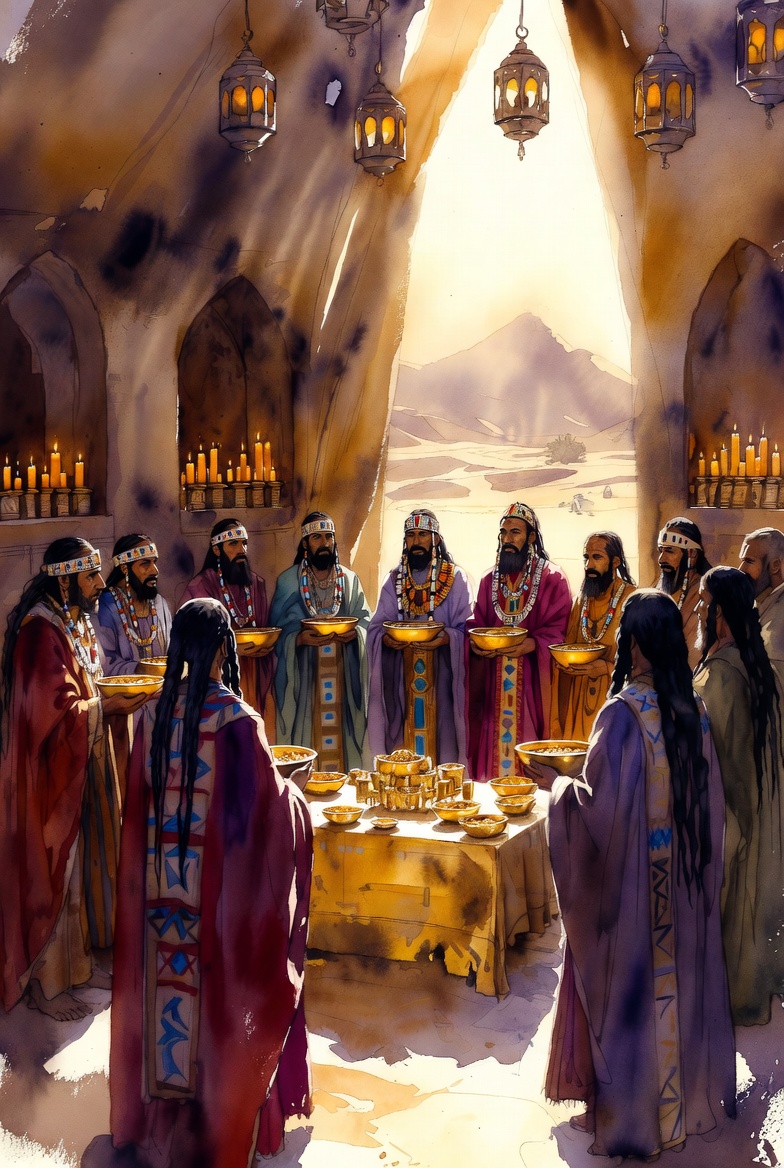
Twelve men walk into a sacred space, each carrying an offering. Each one is a tribal prince, a man of status, with followers, with something to prove. Every gift is identical.
Nobody showed off. According to Legends of the Jews, when the nesi'im (tribal princes, נְשִׂיאִים) brought their offerings for the dedication of the Mishkan, the portable sanctuary Israel carried through the Sinai wilderness, every single gift was identical. Same objects. Same measurements. Same weight. The Midrash records this not as a logistical coincidence but as a deliberate act of coordinated humility that God found so remarkable, it changed the rules.
What the Torah Actually Records
Numbers 7 is one of the longest chapters in the Torah, 89 verses, most of them repetition. Each tribal prince brings his offering. Each offering is described in full. All twelve descriptions are word-for-word the same: a silver plate weighing 130 shekels, a silver basin weighing 70 shekels, both filled with fine flour mixed with oil. A gold pan of 10 shekels filled with incense. Burnt offerings, sin offerings, peace offerings, each one identical.
Modern readers sometimes find this chapter tedious. Why write out the same list twelve times? The rabbis' answer: because God instructed it. Because each prince's offering deserved to be named in full, even when the words were the same. The repetition was the point. You can read the full account in Shabbat Before the Altar.
Why Were the Gifts Identical?
They coordinated. This is the Midrash's claim, and it's a striking one. The spirit of unity among the nesi'im was so complete that no one wanted to outshine the others. No rivalry. No one-upmanship. Each prince looked at what the others were bringing and chose to bring the same thing, not out of laziness, not out of lack of imagination, but out of a conscious refusal to turn the Tabernacle dedication into a competition.
Twelve powerful men, choosing sameness on purpose. In a world where distinction was everything, where tribal identity, ancestral prestige, and leadership rank mattered enormously, they chose to be indistinguishable from one another in this moment. Think about what that costs: you have the resources to go bigger, the status to justify it, and the audience watching. The Tabernacle belonged to all of Israel. The dedication would reflect all of Israel equally or it would reflect nothing worth celebrating.
How God Counted It
God's response was to do something unusual with the accounting. Each prince's offering wasn't counted as one-twelfth of a collective act. It was counted as if that single prince had brought all twelve sets of gifts. Every individual act was multiplied by the unity behind it. One man's silver plate became, in divine reckoning, twelve silver plates, because the intention behind it included all twelve tribes.
This principle runs through much of Jewish thought: the collective act of a unified community is worth more than the sum of its parts. What makes this version striking is the specificity. The gifts didn't need to be unified to be valuable, they were already valuable. The unity transformed something already good into something cosmically amplified.
What Did They Get in Return?
Their reward was extraordinary and, to a modern reader, a little strange. The nesi'im received permission to bring their offerings on Shabbat.
Shabbat is the one day when individual offerings are generally suspended. It's the day of rest, even for the altar. But the tribal princes were granted a dispensation because their unity had demonstrated something beyond ordinary piety. They weren't just making offerings. They were making a statement about what kind of people Israel could be.
Each prince offered on a different day over twelve days. But because the gifts were the same, the entire twelve-day dedication felt like one sustained, unified act. The individuality was preserved, each tribe named, each prince's day recorded for all time, while the unity held everything together. And on whatever Shabbat fell within those twelve days, the princes could continue. The calendar yielded to their harmony.
What This Story Is Really About
Parshat Tzav is about fire, oil, and the ordination of priests, the mechanics of sacred service. The story of the twelve princes, embedded in the weeks surrounding the Tabernacle's dedication, is about something else: what happens when a community decides to be unified not because it has to be, but because it chooses to be.
The rabbis who preserved this tradition in the Legends of the Jews, Ginzberg's compilation drawing on Talmudic and early medieval sources, published 1909–1938 CE, understood that the most dangerous moment for any community is when it has power, status, and the ability to compete. The twelve princes had all of that. They chose not to use it that way.
God noticed. And gave them Shabbat.