The Ant Queen Told Solomon There Was Someone Greater
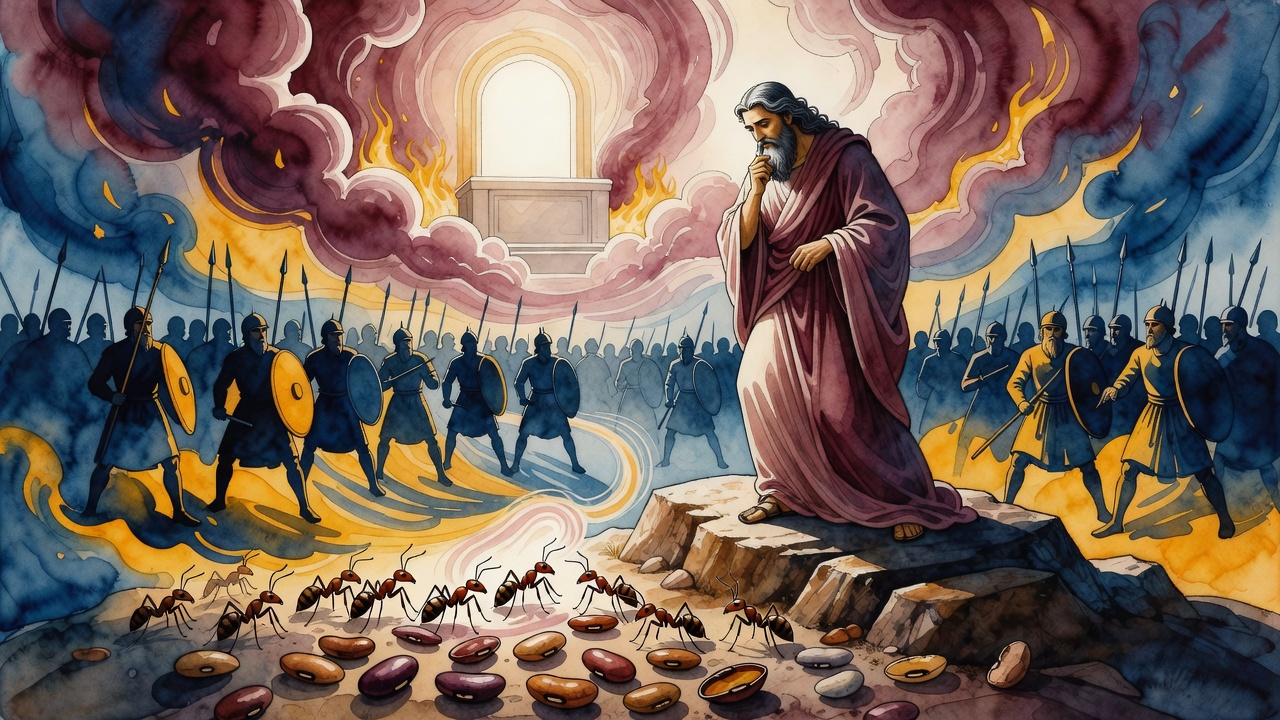
The army filled the valley of the ants. One queen ordered her colony to run, and Solomon halted every horse under him to listen.
Table of Contents
The valley was full of horses when one voice rose from the dust and told a whole city to run.
 Click for full size
The armies of the king were coming. They would crush everything without noticing. A civilization the size of a fist was about to be walked over by an empire that did not know it existed.
Solomon heard the order. He had the language of every creature, one of the gifts that came with his wisdom. He halted the column. The horses stood. He bent down.
The Valley That Halted an Army
He summoned the ant that had spoken. She told him she was queen of the ants, and she gave her reasons for the withdrawal. The danger was ordinary to her and invisible to every man on a horse. Solomon wanted to put a question to her.
She would not answer it from the ground.
She told the most powerful king alive that she would speak only if he took her up and placed her on his hand. She was the size of a small seed. His army filled the valley. She set the terms and waited.
She Would Not Speak from the Dust
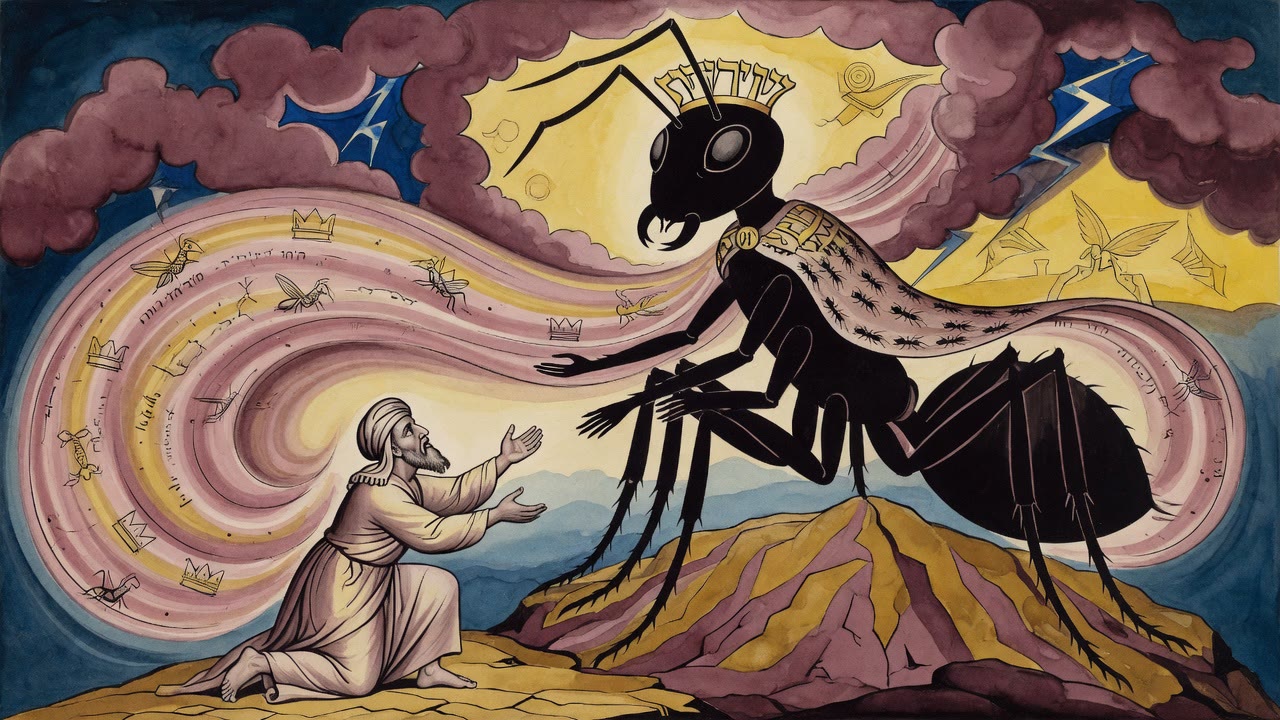
Solomon complied. He reached down, picked her up, and set her on his palm. She stood there, a creature one hoof could have erased, and he waited for her to speak.
He asked his question. "Is there any one greater than I am in all the world?"
"Yes," said the ant.
That was the whole answer she owed him. She did not flatter. She did not name a rival court. She had required the courtesy of his hand, and from that height she told him he was not the ceiling of creation. The one who made the king and the ant both, and who had arranged for the king to need the question, was greater. Solomon already knew the Name. He had not known he needed to hear no from a mouth this small.
Yes, There Is Someone Greater
He kept her on his palm a moment longer. Around them the colony had gone still, waiting to see if the horses would move. Solomon looked at the holes in the dust, the three chambers of each house, the grain stored where a queen had told workers to put it.
An ant does not keep food in the upper room, where water drips. It does not keep food in the bottom room, where the mud is wet. It stores in the middle. It has no commander, no officer, no governor. It lives six months, because a creature without sinews and bones is not given more. Its diet is one and a half wheat kernels. It gathers anyway, wheat and barley and lentils, everything it finds in the summer, in case the Holy One decrees more life than the six months and there is something prepared to eat.
They once opened a hole and found three hundred kor of what one colony had put away from summer to winter. Solomon, who had asked if anyone surpassed him, was looking at a people that stores for a life it has not been promised.
Three Houses and a Dropped Grain
A wheat kernel fell in the dust. The other ants came and smelled it. Not one of them took it. The one it belonged to came back and carried it home.
Solomon watched that too. He had solved the riddles of Sheba. He had commanded demons. He understood every language in the valley. None of that had taught him to stop an army for a queen who would not speak until she was held, or to watch a creature refuse a grain that was not hers.
He had come into the valley in the course of his wanderings, sure enough of his standing to ask the question out loud. He left it with the answer sitting in his palm, and with the sight of a house that has three rooms and no king.
The King Went Back to the Road
He set her down. He gave the column leave to move, wide of the holes. The horses went around. The colony returned to the middle chambers and the grain.
Later he would tell an idler to go to the ant, see her ways, and become wise. Prepare in this world for the world to come, as she prepares in summer for a winter she may not be given. Place judges and officers in your gates, he would say, you who have them, since she keeps the law with none. The sentence in Proverbs came after the valley. In the valley he had to pick her up first, and hear yes, and watch a dropped kernel go untouched until its owner returned.
The army crossed out of the dust. Behind it the queen was already back at the work of a city the king of Israel had almost not seen.
← All myths