5 min read

Bagris Marches to Break Israel's Covenant

Nicanor was dead. King Antiochus sent a man named Bagris to march on Israel and outlaw the Sabbath and the new moons.

Curated by Arthur · Told by Maggid ·
Table of Contents
  1. News That Sours a King's Wine
  2. War on the Calendar of Heaven
  3. Another King, Another Flight
  4. What Bagris Carries
  5. Covenant Under Boot and Under Prayer
Bagris Marches to Break Israel's Covenant Click for full size

News That Sours a King's Wine

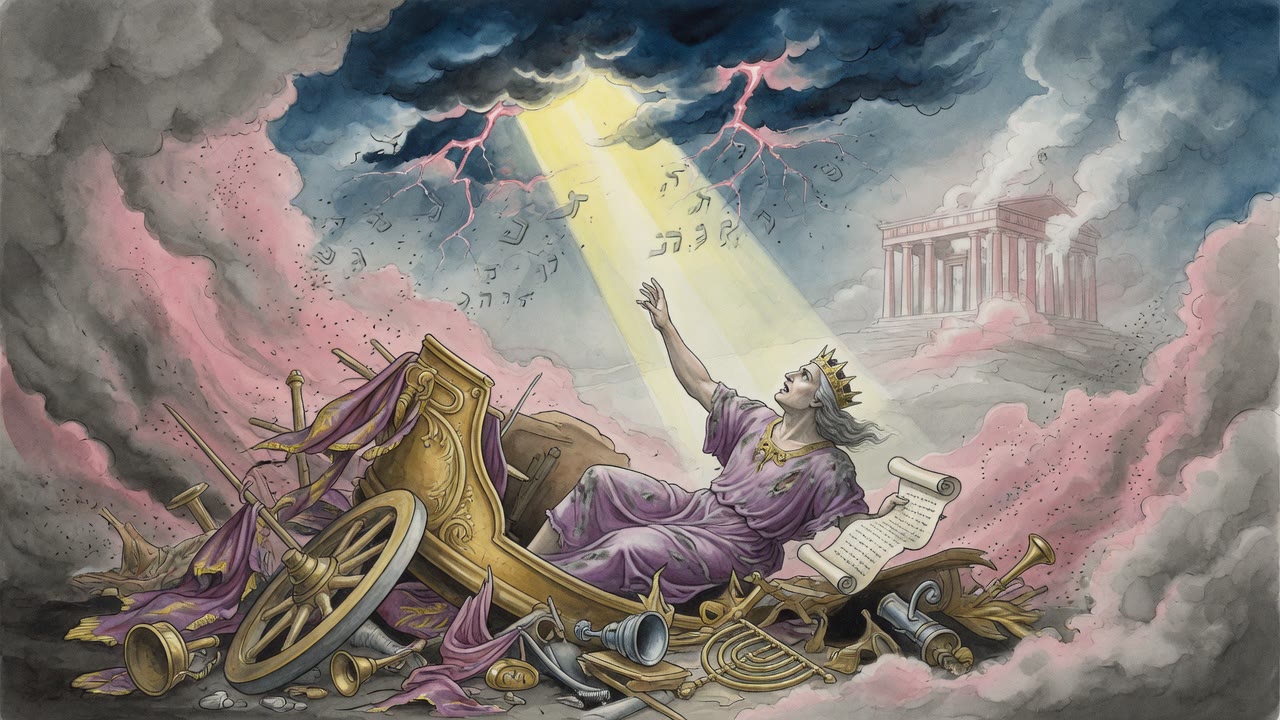
Antiochus heard that Nicanor was dead at Israelite hands and the report landed like a stone in the chest. Hosts slain. Camps spoiled. Officers stripped of their pride. The Seleucid king, used to maps that obeyed him, found a people who would not stay defeated on schedule. He summoned Bagris, called the wicked, a man who led others astray, and poured grievance into strategy.

"You know what the children of Israel have done to me," the king said, listing the dead and the looted prestige. Then the colder question: can you trust your wealth or call your homes your own while they still stand free to strike? Fear became a tool. Insecurity became a license.

Bagris listened as men of that office listen, already measuring roads, already tasting the assignment.

War on the Calendar of Heaven

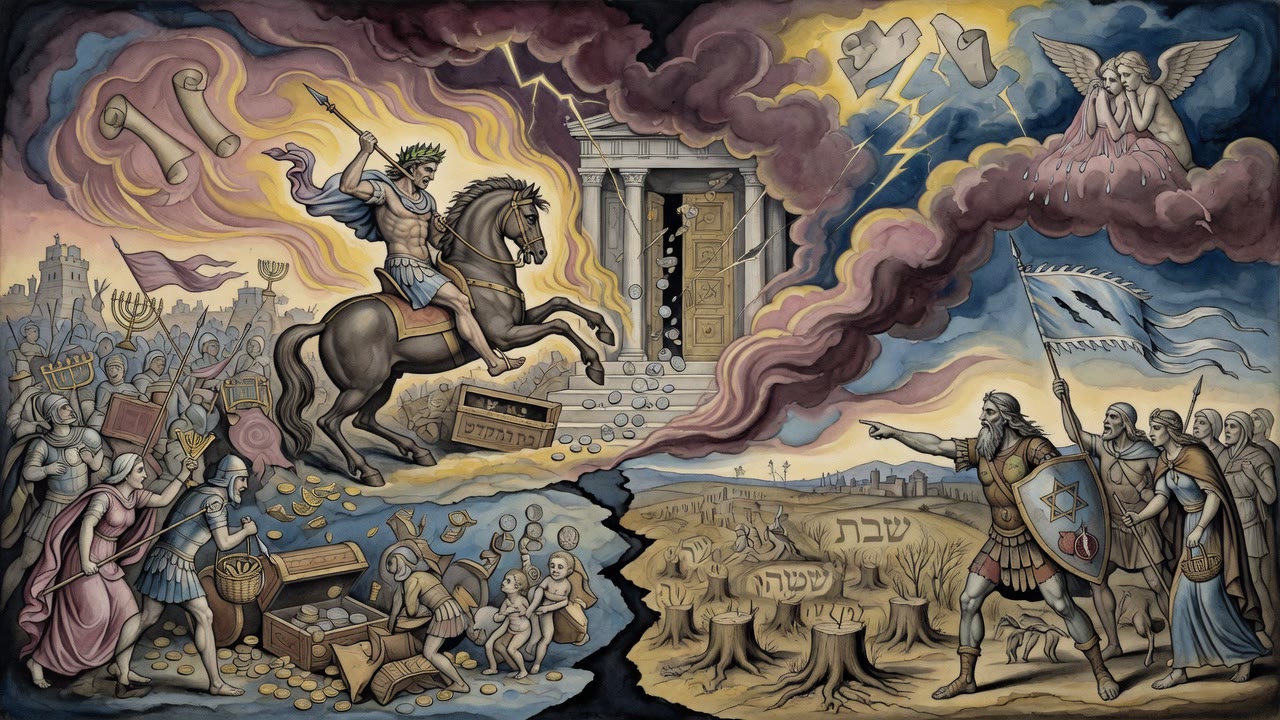
Antiochus did not only want battlefield revenge. He aimed at the covenant itself, the bond marked in Sabbaths, new moons, and the appointed times that made Israel a people under God rather than under Greek rage. "Come, let us go up against them and destroy the covenant," runs the scroll's hunger. Kill the days that make them distinct, and the bodies will follow more easily.

This is a different violence from simple tribute. Tribute takes coin. This plan takes rhythm, rest, and the Name's schedule. An empire that fears a small nation's God will try to outlaw the clock that people pray by.

Bagris marched as the instrument of that theory. Nicanor's death was the spark. The covenant was the forest the king wanted burned.

Another King, Another Flight

In an earlier empire's shadow, Tobit felt a different royal heat. Sennacherib of Assyria kindled anger against him, ordered seizure not only of the man but of his wife Hannah and son Tobiyyah. Tobit fled. The king seized property to finish what flight interrupted. Power chased the household into the thin places where refugees keep breath and little else.

Widows and orphans of Israel cried for Tobit with fasting and weeping. Their voices, the book says, rose until judgment answered from heaven and the God of Israel delivered the tyrant into other hands. Empire blood still ran. The cry still mattered.

Two foreign crowns, centuries apart in story-time, share a reflex. When a Jew's loyalty to God interferes with royal pride, the palace reaches for total measures: family, goods, sacred times, the right to live openly as oneself.

What Bagris Carries

Bagris carries the king's vexation like a sealed order. He is named wicked not for battlefield skill alone but for leading people off the path, for making cruelty feel like policy. Behind him trudge soldiers who may not care about new moons, only about pay and fear of their own sovereign. Ahead of him wait villages that light lamps on the sixth day and refuse to treat the seventh like any other market morning.

Nicanor's corpse, somewhere behind the plot, still teaches the king the wrong lesson. Instead of learning the cost of underestimating Judah, Antiochus doubles the bet against heaven's timetable. Revenge widens until it needs theology to justify itself.

Tobit's older flight answers from the library of memory. Jews have packed hastily before. They have also seen tyrants fall when the bitterness of orphans reached the sky. Neither fact makes Bagris gentle. Both facts keep despair from being the only honest mood.

Covenant Under Boot and Under Prayer

When an army moves to smash Sabbath, the fight is already larger than one general's death. It is about whether Israel may remain timed to God while living inside someone else's map. Antiochus names the target accurately even as he chooses evil. The covenant is the nerve. Bagris is the blade ordered to cut it.

Tobit, hiding from Sennacherib, cannot stop Assyria with a sword in that hour. He can remain a man widows trust enough to mourn in public prayer. That trust is also covenant logic, care that outlasts a king's inventory of seized goods.

Scrolls remember both pressures so that later readers recognize the pattern when new officers arrive with new pretexts and the same appetite for Jewish time. Wealth will not make a home secure if the king has already decided your calendar is rebellion. Flight will not always be avoidable. Cry and fidelity still rise higher than a spear's reach.

Bagris marches. Somewhere a mother hides a child before the next search. Somewhere a man like Tobit counts the cost of burial and mercy under a regime that punishes both. The myth does not soften the march. It refuses to grant the tyrant the last definition of what a people is.


← All myths
From the tradition

Sources

2 sources

The texts behind this telling. Some cards carry a translation of the source; others are our own retelling of it, and each card says which. Every card links out to the original.

Megillat Antiochus 1:30Megillat Antiochus

Retold in our words. Read the original at the link below.Sefaria-hosted English translation · CC-BY

Antiochus, king of the Seleucid Empire, knew that feeling all too well.

You're a powerful ruler, used to getting your way. Then you hear the news: your viceroy, Nicanor, is dead. Slain. And by whom? The Israelites! The Megillat Antiochus, also known as the Scroll of Antiochus, tells us that Antiochus was "sorely vexed." That's putting it mildly, I'm sure.

Antiochus wasn't one to back down from a fight. He summoned Bagris, described as "the wicked, who leads his people astray." Now, Bagris is an interesting character. He seems to have been a kind of advisor, a whisperer in the king's ear. And Antiochus, fueled by rage and perhaps a touch of fear, laid out his grievances.

"You know," Antiochus says to Bagris, "for you have heard, what the children of Israel have done to me, they have slain my hosts, and have despoiled my camps and officers." He's listing his grievances, airing his wounds. He's reminding Bagris (and perhaps himself) of the stakes. This wasn't just a rebellion; it was a direct challenge to his authority, his power.

And then comes the crucial question, dripping with paranoia and a hunger for control: "Can you now put your trust in your wealth, or consider your homes as your own?" In other words, can anyone truly be secure while these troublesome Israelites are allowed to defy him? It's a classic dictator's move – inciting fear to justify oppression.

Antiochus doesn't stop there. He reveals his ultimate goal, the thing that truly seems to terrify him: the covenant between God and the Jewish people. "Come, let us go up against them," he urges Bagris, "and destroy the covenant their god has made with them through their Sabbaths, the new-moon [festival observance], and circumcision." Antiochus isn't just after territory or taxes. He wants to eradicate the very essence of Jewish identity. He targets the Shabbat, the day of rest, the sacred new moon festivals (Rosh Chodesh), and brit milah, circumcision, the physical sign of the covenant. These are the core practices that bind the Jewish people to their God. Destroy them, and you destroy the people.

It's a chillingly familiar strategy throughout history: attacking religious and cultural practices to dismantle a community. Antiochus understood that these weren't just rituals; they were the lifeblood of the Jewish faith.

So, what does this brief passage from the Megillat Antiochus tell us? It's a glimpse into the mind of a tyrant, a man driven by fear and a desire for absolute control. And it sets the stage for the dramatic events of the Maccabean revolt, a story of courage, faith, and the enduring power of a people determined to preserve their way of life. A story that we still celebrate today.

Full source
Book of Tobit 1:10Book of Tobit

Retold in our words. Read the original at the link below.Sefaria-hosted English translation · CC-BY

It’s a story packed with adventure, piety, and a healthy dose of divine intervention. to a particularly intense moment from the beginning of the story. Our hero, Tobit, is in deep trouble. King Sennacherib, remember him? The Assyrian king who besieged Jerusalem? Well, he’s furious with Tobit. We aren't told exactly what Tobit did to anger him, but the result is clear: Sennacherib wants him dead.

"And it came to pass when Sennacherib heard this, that his anger was greatly kindled against me," the verse says. The stakes are immediately high. He doesn't just want Tobit gone; he orders the capture of his wife, Hannah, and his son, Tobiyyah, too.

So, Tobit does what any sensible person would do: he flees. "I fled from his presence," he says. But it doesn't end there. Sennacherib, still seething, orders all of Tobit's possessions to be seized. He's not just after Tobit's life; he wants to destroy everything he has.

Even in the face of such adversity, the story highlights Tobit's goodness. He hides, yes, but he's still very much in the hearts and minds of his community. We read that "the widows and orphans of Israel cried out for me in the bitterness of their soul with fasting and weeping." Their prayers, their genuine distress, ascended to heaven itself.

And here's where the story takes a turn, a rather brutal one, but a turn nonetheless. "His judgment reached unto heaven," the text says, "and was lifted up even to the skies, and the God of Israel delivered him into the hand of his two sons, and they slew him with the sword." Sennacherib is assassinated by his own children! Talk about karma.

Why did this happen? The text gives us a glimpse into the king's mindset. He questions his advisors, asking why the Holy One, Kadosh Baruch Hu (blessed be He), was so protective of Israel and Jerusalem. He remembers the angel of the Lord who destroyed the host of Pharaoh in Egypt, and all the young men used by God to deliver Israel.

The king's wise men offer a chilling explanation: "Abraham, the father of Israel, led forth his son to slay him, peradventure he might thereby obtain the favor of the Lord his God; therefore hath he been jealous for his children, and hath executed vengeance upon thy servants." In other words, Abraham's willingness to sacrifice Isaac created a divine debt, a reason for God to always defend his people.

It's a fascinating, if somewhat unsettling, interpretation. It suggests that even acts of obedience, even those that are ultimately averted, can have lasting consequences. And that, perhaps, the struggles of Tobit, and the downfall of Sennacherib, are all part of a larger, divinely ordained plan.

What does this all mean for us? Perhaps it's a reminder that even when we face seemingly insurmountable odds, our actions, our prayers, and the compassion of others can have a profound impact. And that sometimes, just sometimes, the wheels of justice do turn, even if it takes a little divine intervention.

Full source