Parshat Bereshit5 min read

God Finished the World Like a House Dedication

When creation stood complete, God rested as a builder dedicates a house, then taught Israel to feast, dress, and hurry to mitzvot, the commandments.

Curated by Arthur · Told by Maggid ·
Table of Contents
  1. The Builder Sets Down His Tools
  2. Call It Delight, Not a Weekday Table
  3. Running Toward a Lecture on Holy Ground
  4. Dream Fasts and the Edge of Friday
  5. A Day That Keeps Its Builder
God Finished the World Like a House Dedication Click for full size

The Builder Sets Down His Tools

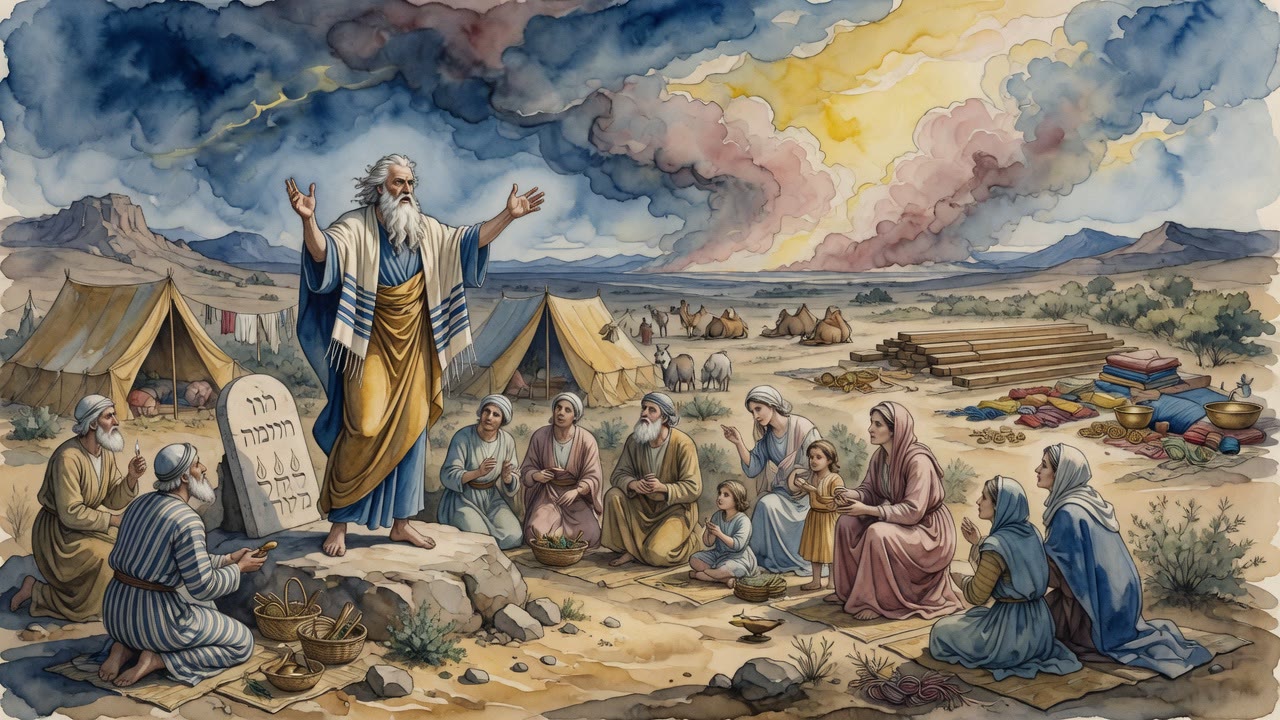
On the seventh day the work stopped. Not because more days were needed, but because the house of the world stood finished. God rested as a builder rests when the last beam sits true, and He blessed the day the way a household marks a hilul, a dedication feast for a completed home (Genesis 2:2). The Merciful One called Israel to the same pause: rest as I rested, delight as I delighted (Exodus 20:11).

Fasting had no place at that table. Clean clothes did. Food and drink did. The day was not an empty hallway. It was a hall filled on purpose. Six days of making had earned a seventh of reception.

Angels who watch borders of time felt the shift. The week bent. Labor lost its claim for twenty-four hours, and joy took the claim instead. Anyone who tries to turn the day into a thinner weekday steals from the builder's feast.

Call It Delight, Not a Weekday Table

Isaiah's voice entered the law of the day: turn your foot from business, call the Sabbath a delight, honor the holy of the Lord (Isaiah 58:13). The sages heard food first. Do not eat as on a weekday. Let the plate itself change the calendar. R. Yohanan named his garments "his honor," because cloth can carry the weight of a day if you let it.

R. Huna said that anyone with a change of clothing should change. If not, at least lower the garments so the body knows the difference. Walk differently. Speak differently. The mother of R. Simeon bar Yohai chattered on a Sabbath until her son said, "It is the Sabbath day." She stopped.

Greetings almost fell under ban until the sages permitted them with difficulty to spare resentment. Even kindness had to learn the day's pace. A word can be mercy and still be too weekday if it drags the market into the hall of rest.

Running Toward a Lecture on Holy Ground

R. Ze'era first saw rabbis hurrying to a lecture on the Sabbath and thought they were trampling the day's honor. Then he heard R. Tanhuma in the name of R. Joshua ben Levi: a person must always hasten to a commandment, even on the Sabbath. Ze'era began to run. Learning rose under his feet.

Personal business was locked. Heaven's business was not. Charity allotments for the poor could be decided. Community needs could be weighed in synagogue or study house. Betrothals, a boy's education, a trade to teach: the living future of the people did not wait for a weekday. Vain talk died. Necessary speech lived.

R. Manasseh taught that talk of a girl's betrothal or a boy's craft may open on the holy day, because a people's tomorrow is not vanity. The prohibition falls on empty chatter, not on the scaffolding of life under God.

Dream Fasts and the Edge of Friday

Self-affliction had no standing on the Sabbath, except when a dream pressed hard enough that a fast could burn it like fire burns flax. Students asked whether a Friday fast may run into Sabbath weakness. R. Akiba once sat on the ninth of Av that fell on Friday and ate an unsalted roasted egg, not for hunger, but to show disciples how to enter the Sabbath without collapse.

The egg was small. The teaching was large. Delight is not gluttony. It is the refusal to greet God's rest already broken. R. Yosé held for completing certain fasts; others refused to let weakness stain the opening of joy.

A student who arrives faint to Kiddush has already spent the feast on yesterday's fear. Akiba's egg taught the opposite: finish grief's claim early enough that rest can stand whole.

A Day That Keeps Its Builder

Elsewhere the tradition insists that God Himself keeps Sabbath shape in the structure of creation, and that humanity was taught the secret so the week would not become a single endless market. The house dedication returns every seventh day. Israel does not rebuild the cosmos. Israel reenacts the pause that made the cosmos a home.

Clean sleeves. A fuller plate. A closed mouth. An open gate toward the house of study. The builder finished. The guests are still learning how to sit at the table without turning it back into a workshop.

In one village a man changes his shirt and feels taller. In another a woman sets a better loaf and hears the week exhale. Somewhere a rabbi still runs to a lecture, sandals slapping holy dust, and the day smiles because the hurry serves heaven.

In a courtyard a father lowered his sleeves as the sun edged low and told his son the world was a house God had finished on purpose. The boy asked if the stars were windows. The father said the stars were lamps left on so guests would not fear the dark between feast and morning.

R. Ze'era's sandals wore a new path to the lecture hall. Other men still strolled as if the day were soft clay. He ran because the commandment was a living guest who hates to be kept waiting at the door while someone checks a ledger of private errands.


← All myths

From the tradition

Sources

3 sources

The texts behind this telling. Some cards carry a translation of the source; others are our own retelling of it, and each card says which. Every card links out to the original.

Midrash Tanchuma, Bereshit 2Midrash Tanchuma

Retold in our words. Read the original at the link below.Townsend 1989 translation of Midrash Tanhuma, S. Buber Recension · CC-BY

A Question. Why are the House of Israel required to rest on the Sabbath day? They do so because when the Holy One, blessed be He, created His world, He completed the work of creation in six days and rested on the Sabbath day; He blessed that day and sanctified it, just as one who completes the building of his home commemorates the event with a celebration called a hilul (a ceremony of dedication upon the completion of a home), as it is written: And on the seventh day God finished (va-yikhal) His work (Gen. 2:2). The Merciful One declares: “Rest on the Sabbath day, just as I rested upon it,” as it is said: And He rested on the seventh day, wherefore the Lord blessed the Sabbath day and hallowed it (Exod. 20:11).

It is forbidden, also, to fast on the Sabbath day. One is required to delight on that day by eating (and) drinking, and to honor it by wearing clean clothes, as it is said: If thou turn away thy foot because of the Sabbath, from pursuing thy business on My holy day; and call the Sabbath a delight, and the holy of the Lord honorable; and shall honor it, not doing thy wonted ways; nor pursuing thy business, nor speaking (vain) words; then shalt thou delight thyself in the Lord (Isa. 58:13).

Our sages declared: Call the Sabbath a delight indicates that you should not eat on the Sabbath day as you do on a weekday, rather you should delight in it. Of its reward it is written: Then thou shalt delight in the Lord.

The words And the holy of the Lord honorable mean that you should not behave frivolously on the Sabbath day but should hallow it and honor it in every respect.

And thou shalt honor it signifies that you should wear beautiful clothes and clean garments on the Sabbath to distinguish it from a weekday. Hence R. Yohanan called his garments “his honor.” R. Huna said: Anyone possessing a change of clothing should change (his apparel), but if not, he should at least lower his garments.

Not doing thy wonted ways implies that your gait on the Sabbath should not be as on a weekday.

Nor speaking (vain) words indicates that you should not converse on the Sabbath day as on a weekday. Once the mother of R. Simeon the son of Yohai was chattering on the Sabbath day, so he reminded her: “It is the Sabbath day.” Thereupon, she ceased talking. R. Hanina declared: With difficulty the sages permitted greetings to be exchanged on the Sabbath (to avoid the harmful consequences caused by resentment, etc.).

However, we must inquire: Is one who desires to go to fulfill a religious obligation or to prayer or to the house of study permitted to trot hastily on the Sabbath? Is the performance of a religious duty superior, or is the honor of the Sabbath superior? Observe what R. Tanhuma stated in the name of R. Joshua the son of Levi: “A man must always hasten to fulfill a commandment, even if it is on the Sabbath.” R. Ze’era said: “When I first observed the rabbis hastening to a lecture on the Sabbath, I was certain that they were guilty of profaning the Sabbath. However, after I heard the statement made by R. Tanhuma (in the name of R. Joshua the son of Levi), I also hastened, and I ascended in learning.” In fact, the merit earned by attending a lecture derives from one’s eagerness to hear it., they insist that the phrase from pursuing thy business indicates that you are prohibited from pursuing your personal interests, but the question remains whether the interests of heaven are a religious duty (mitzvah) or not. Listen to what R. Eleazar said: “We may decide the allotment of charity to the poor on the Sabbath.” And R. Jacob the son of Idi stated that R. Yohanan had declared: “We may go to the synagogue or to the house of study to discuss the needs of the community on the Sabbath.” And R. Yohanan added that matters of life and death may be discussed on the Sabbath.

R. Simeon the son of Nahman, in the name of R. Yohanan, expressed the opinion that we may also go to theaters and places of amusement to discuss community problems on the Sabbath. And R. Manasseh taught that we are permitted to discuss the betrothal of a girl, the education of a boy, or the teaching of a trade on the Sabbath. Hence and speaking (vain) words implies that mere conversation is forbidden but that the discussion of vital matters is permitted.

They say also that it is forbidden to afflict oneself on the Sabbath by a self-imposed fast. However, if one has had a dream, he is permitted to fast in order to negate its effect. Rabba the son of Mehasia stated that R. Hama the son of Guria declared in the name of Rav that fasting is as efficacious for voiding a dream as fire for consuming flax. However, R. Joseph explained that the fast must take place on the day of the dream, and R. Hisda added: Even if it is the Sabbath day.

In any event, we must learn whether one is permitted to complete a fast on a Friday. We might say it is forbidden to complete the fast, for then one would enter the Sabbath in a weakened condition; but, on the other hand, we might contend that it is permitted to complete the fast, since one would not be fasting on the Sabbath. Listen to what Rabba said concerning this matter: “When we were visiting R. Nahman one day, he propounded the question, ‘May students who fast on a Friday complete their fast; that is, may a person begin the observance of the Sabbath while in a weakened condition?’ We were not able to answer this query. When we came to the home of R. Judah, we asked him, and he was unable to answer. Rabba then said: ‘Let us consider this question in relation to the ninth day of Ab. If the ninth day of Ab occurs on a Friday, an unsalted, roasted egg may be brought and eaten, so that one might enter the Sabbath free from hunger.’”

R. Judah expounded the law on this subject in the name of R. Akiba. “Once, we were sitting before R. Akiba on the ninth day of Ab which was the eve of the Sabbath and a roasted egg was brought to him and he ate it without salt. He did this, not because he had any particular desire for the egg, but in order to demonstrate the law to his disciples.”

However, R. Yosé was of the opinion that the fast should be completed. R. Ulla concurred in the opinion that the law permitted the completion of a fast on a Friday.

Full source
Jubilees 2:18-20Book of Jubilees

Translation of the source text.Wikisource 2019 · Public Domain

And the angel of the presence spake to Moses according to the word of the Lord, saying:

Write the complete history of the creation, how in six days the Lord God finished all His works and all that He created, and kept Sabbath on the seventh day and hallowed it for all ages, and appointed it as a sign for all His works.

For on the first day He created the heavens which are above and the earth and the waters and all the spirits which serve before Him

--the angels of the presence, and the angels of sanctification, and the angels [of the spirit of fire and the angels] of the spirit of the winds, and the angels of the spirit of the clouds,

and of darkness, and of snow and of hail and of hoar frost, and the angels of the voices and of the thunder and of the lightning, and the angels of the spirits of cold and of heat, and of winter and of spring and of autumn and of summer,

and of all the spirits of His creatures which are in the heavens and on the earth, (He created) the abysses and the darkness, eventide (and night), and the light, dawn and day, which He hath prepared in the knowledge of His heart.

And thereupon we saw His works, and praised Him, and lauded before Him on account of all His works; for seven great works did He create on the first day.

And on the second day He created the firmament in the midst of the waters, and the waters were divided on that day--half of them went up above and half of them went down below the firmament (that was) in the midst over the face of the whole earth.

And this was the only work (God) created on the second day.

And on the third day He commanded the waters to pass from off the face of the whole earth into one place, and the dry land to appear.

And the waters did so as He commanded them, and they retired from off the face of the earth into one place outside of this firmament, and the dry land appeared.

And on that day He created for them all the seas according to their separate gathering-places, and all the rivers, and the gatherings of the waters in the mountains and on all the earth,

and all the lakes, and all the dew of the earth, and the seed which is sown, and all sprouting things, and fruit-bearing trees, and trees of the wood, and the garden of Eden, in Eden, and all (plants after their kind).

These four great works God created on the third day.

And on the fourth day He created the sun and the moon and the stars, and set them in the firmament of the heaven, to give light upon all the earth,

and to rule over the day and the night, and divide the light from the darkness.

And God appointed the sun to be a great sign on the earth for days and for sabbaths and for months and for feasts and for years and for sabbaths of years and for jubilees and for all seasons of the years.

And it divideth the light from the darkness [and] for prosperity, that all things may prosper which shoot and grow on the earth.

These three kinds He made on the fourth day.

And on the fifth day He created great sea monsters in the depths of the waters, for these were the first things of flesh that were created by His hands, the fish and everything that moves in the waters, and everything that flies, the birds and all their kind.

And the sun rose above them to prosper (them), and above everything that was on the earth, everything that shoots out of the earth, and all fruit-bearing trees, and all flesh.

These three kinds He created on the fifth day.

And on the sixth day He created all the animals of the earth, and all cattle, and everything that moves on the earth.

And after all this He created man, a man and a woman created He them,

and gave him dominion over all that is upon the earth, and in the seas, and over everything that flies, and over beasts and over cattle, and over everything that moves on the earth, and over the whole earth, and over all this He gave him dominion.

And these four kinds He created on the sixth day.
And there were altogether two and twenty kinds.

And He finished all His work on the sixth day--all that is in the heavens and on the earth, and in the seas and in the abysses, and in the light and in the darkness, and in everything.

And He gave us a great sign, the Sabbath day, that we should work six days, but keep Sabbath on the seventh day from all work.
And all the angels of the presence, and all the angels of sanctification,

these two great classes--He hath hidden us to keep the Sabbath with Him in heaven and on earth.

And He said unto us: "Behold, I will separate unto Myself a people from among all the peoples, and these will keep the Sabbath day,

and I will sanctify them unto Myself as My people, and will bless them; as I have sanctified the Sabbath day and do sanctify (it) unto Myself, even so shall I bless them, and they will be My people and I shall be their God.

And I have chosen the seed of Jacob from amongst all that I have seen, and have written him down as My firstborn son, and have sanctified him unto Myself for ever and ever;

and I will teach them the Sabbath day, that they may keep Sabbath thereon from all work."...

And thus He created therein a sign in accordance with which they should keep Sabbath with us on the seventh day, to eat and to drink, and to bless Him who hath created all things

as He hath blessed and sanctified unto Himself a peculiar people above all peoples, and that they should keep Sabbath together with us.

And He caused His commands to ascend as a sweet savour acceptable before Him all the days. There (were) two and twenty heads of mankind from Adam to Jacob,

and two and twenty kinds of work were made until the seventh day;

this is blessed and holy; and the former also is blessed and holy;

and this one serves with that one for sanctification and blessing.

And to this (Jacob and his seed) it was granted that they should always be the blessed and holy ones of the first testimony and law, even as He had sanctified and blessed the Sabbath day on the seventh day.

He created heaven and earth and everything that He created in six days, and God made the seventh day holy, for all His works;

therefore He commanded on its behalf that, whoever doth any work thereon shall die, and that he who defileth it shall surely die.

Wherefore do thou command the children of Israel to observe this day that they may keep it holy and not do thereon any work, and not to defile it,

as it is holier than all other days.
And whoever profaneth it shall surely die, and whoever doeth thereon any work shall surely die eternally,

that the children of Israel may observe this day throughout their generations, and not be rooted out of the land;

for it is a holy day and a blessed day.
And every one who observeth it and keepeth Sabbath thereon from all his work, will be holy and blessed throughout all days like unto us.

Declare and say to the children of Israel the law of this day both that they should keep Sabbath thereon, and that they should not forsake it in the error of their hearts;

(and) that it is not lawful to do any work thereon which is unseemly, to do thereon their own pleasure, and that they should not prepare thereon anything to be eaten or drunk.

and (that it is not lawful) to draw water, or bring in or take out thereon through their gates any burden, which they had not prepared for themselves on the sixth day in their dwellings.

And they shall not bring in nor take out from house to house on that day; for that day is more holy and blessed than any jubilee day of the jubilees:

on this we kept Sabbath in the heavens before it was made known to any flesh to keep Sabbath thereon on the earth.

And the Creator of all things blessed it, but He did not sanctify all peoples and nations to keep Sabbath thereon, but Israel alone:

them alone He permitted to eat and drink and to keep Sabbath thereon on the earth.

And the Creator of all things blessed this day which He had created for a blessing and a sanctification and a glory above all days.

This law and testimony was given to the children of Israel as a law for ever unto their generations.

Full source
Book of Jubilees 2:36Book of Jubilees

Retold in our words. Read the original at the link below.Sefaria Community Translation · CC-BY

A passage from Jubilees that focuses on the Sabbath, that sacred day of rest. The text claims that God said He would teach humankind about the Sabbath, "that they may keep Sabbath thereon from all work." Seems straightforward enough. But it's the reason given that’s so intriguing.

Jubilees says that God created the Sabbath as "a sign in accordance with which they should keep Sabbath with us on the seventh day, to eat and to drink, and to bless Him who hath created all things." The Sabbath isn't just about not working. It's about sharing a sacred meal, offering blessings, and essentially, spending quality time with the Divine.

It goes on, adding that God has "blessed and sanctified unto Himself a peculiar people above all peoples, and that they should keep Sabbath together with us." That word, "peculiar," might strike you. In this context, it emphasizes the special relationship, the unique bond, between God and the Jewish people. The Sabbath, then, becomes a weekly reminder and celebration of this covenant.

There's more! "He caused His commands to ascend as a sweet savour acceptable before Him all the days." Imagine your actions, your observance, rising up like a fragrant offering.

Now, Jubilees is considered pseudepigraphal by many – meaning its authorship is attributed to someone who didn’t actually write it. It's not part of the canonical Hebrew Bible. But it gives us invaluable insight into the beliefs and interpretations of certain Jewish communities in antiquity. Understanding these perspectives helps us appreciate the diverse ways our ancestors understood their relationship with God.

The text concludes by mentioning that "There (were) two and twenty heads of mankind from Adam to Jacob…" This is a genealogical marker, grounding these divine commandments within a specific historical lineage. These 22 generations represent a chain of tradition, passing down the importance of Sabbath observance.

Perhaps it's a reminder that the Sabbath isn't just a day off. Maybe, just maybe, we can all find a bit more "sweet savour" in our own observance.

Full source