Parshat Bereshit5 min read

Adam Gave David Seventy Years of His Life

Adam saw David would live only three hours. He signed away seventy years of his own life so the greatest king of Israel could exist at all.

Curated by Arthur · Told by Maggid ·
Table of Contents
  1. The Book Opened Before Him
  2. A Protest and an Offer
  3. What David Did Not Know
  4. The Sabbath They Shared

The Book Opened Before Him

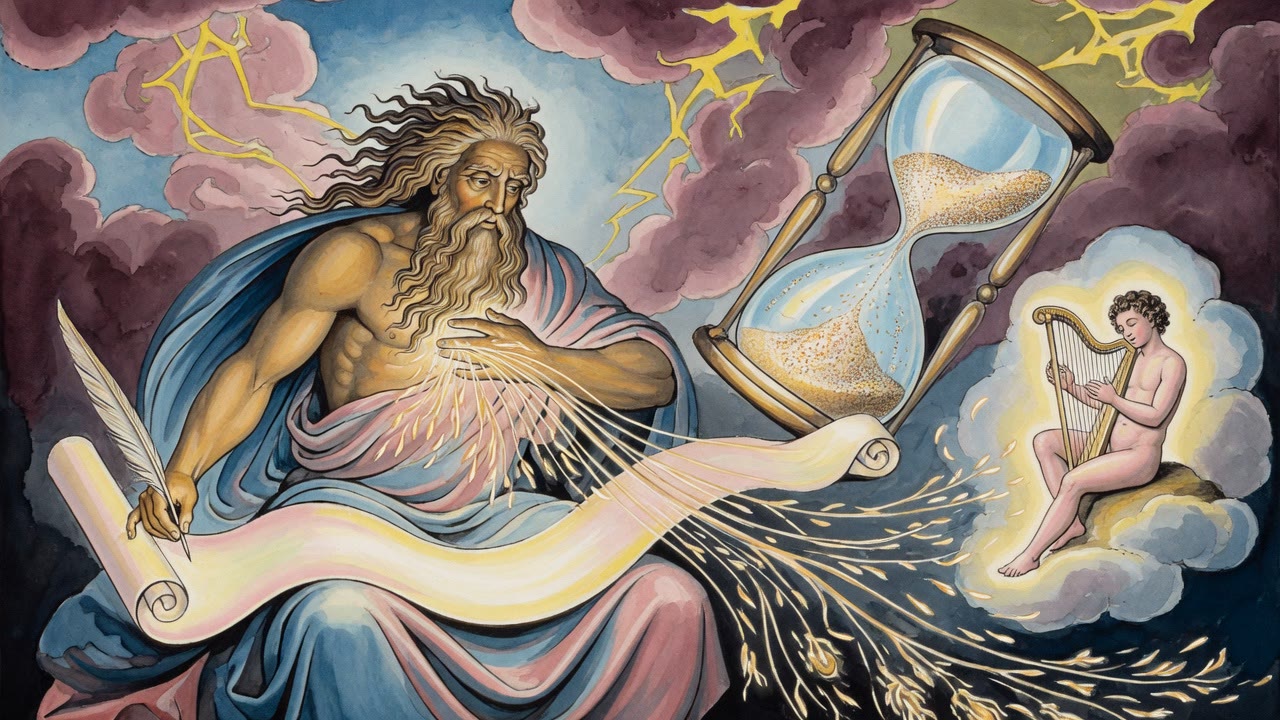
On the first day of creation, while the light was still undivided and the world had no history yet, God set a book in front of Adam. Not a metaphor. The rabbis who preserved this tradition insisted the word meant what it said: a scroll, unrolled like a bolt of cloth, showing every soul that would ever be born, every year they would be given, every name they would carry through the world.

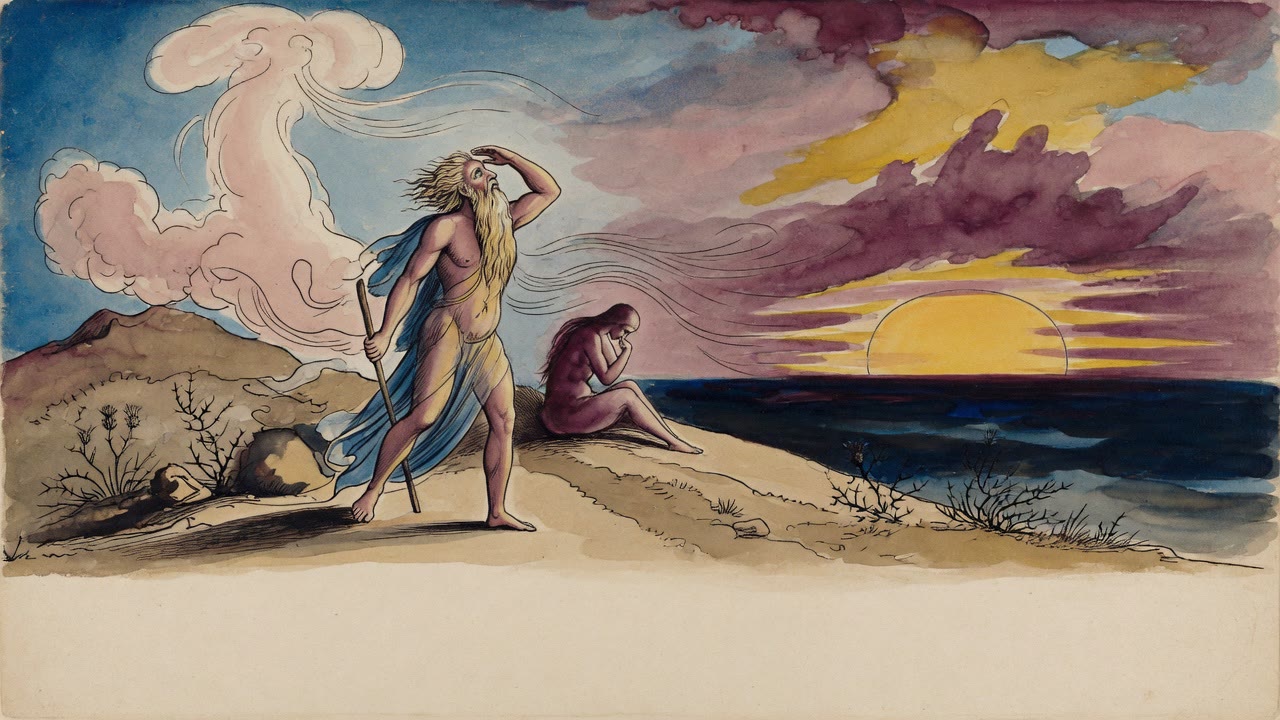
Adam was enormous then, filling the whole world from east to west. He could see everything. And he looked, and he read, and generation after generation passed before his eyes in their allotted spans. Some would live long. Some would live briefly. This was the fabric of time, and God was showing him the whole cloth.

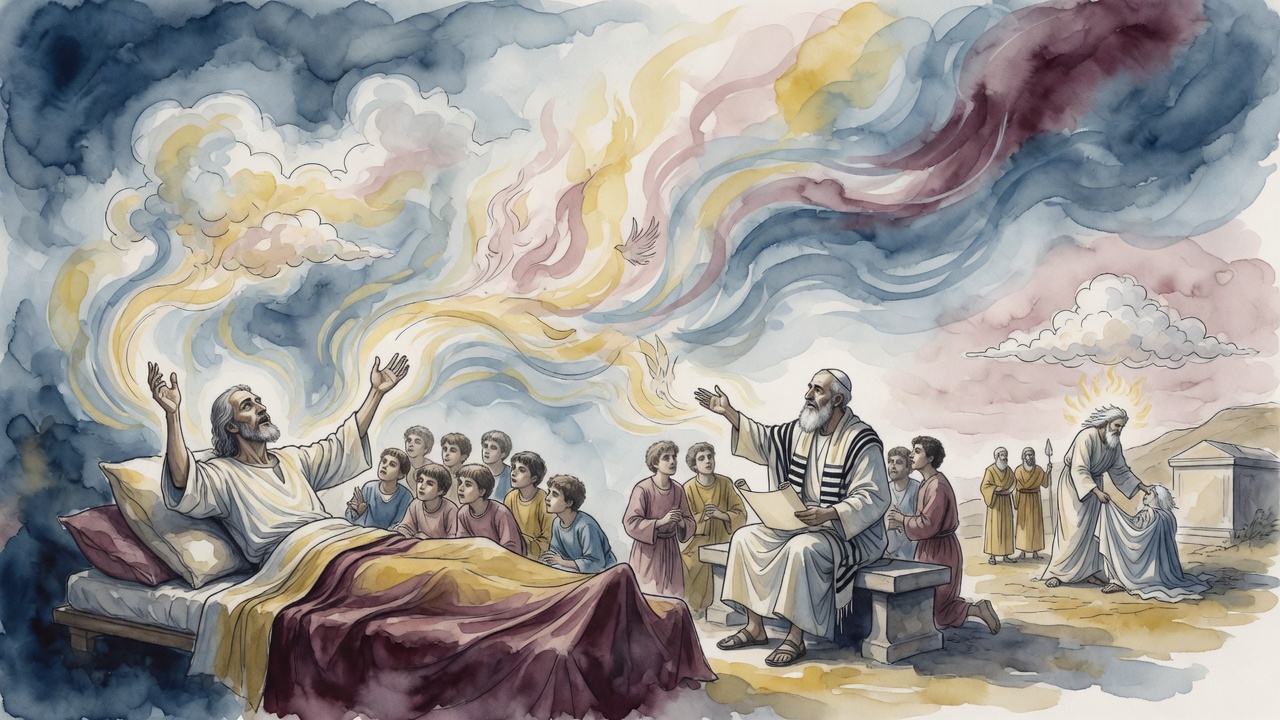
Then Adam found a name with almost nothing beside it. A soul designated for greatness, destined to be king, poet, shepherd, warrior, the beloved of God. Three hours. That was all the ledger showed for David ben Yishai. Three hours of life.

A Protest and an Offer

Adam could have wept and moved on. Instead he protested. Master of the world, this should not be. The words carry a weight the rabbis never tired of noting: the first human being, standing before God on the first day of his existence, was not arguing for himself but for a man who would not be born for dozens of generations. Adam had never met David. He never would. But he had seen what David would be, and he could not accept that such a soul should flicker out in three hours.

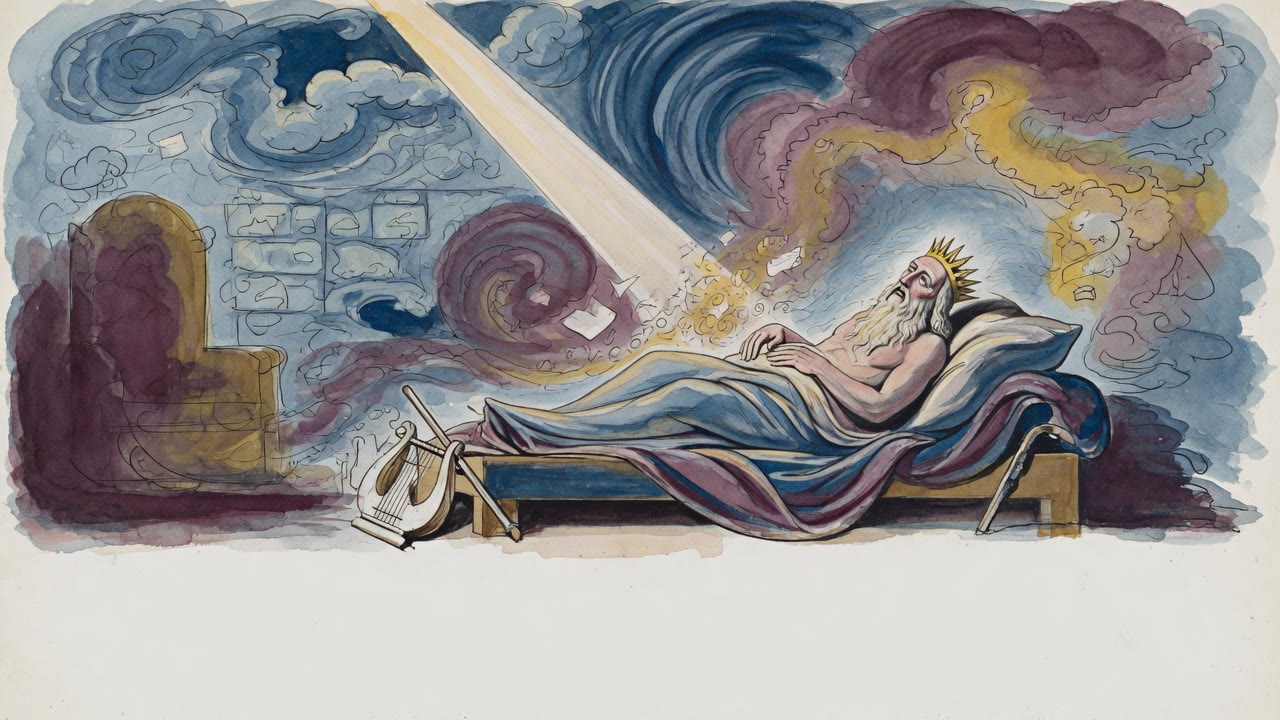
Then came the offer. Adam had been given a thousand years. A full divine day. He had barely started living. But he opened the document of his own life and cut seventy years from it, signing them over to David. He reduced himself to nine hundred and thirty years so that David could have the decades needed to become what the scroll promised he would become.

The angel Metatron witnessed the contract. Some versions say God Himself put His seal on it. The document exists somewhere in the heavenly archives, and that is why Adam died at nine hundred and thirty and David died at seventy, and not a day more, because the years had already been spent by someone else on their behalf.

What David Did Not Know

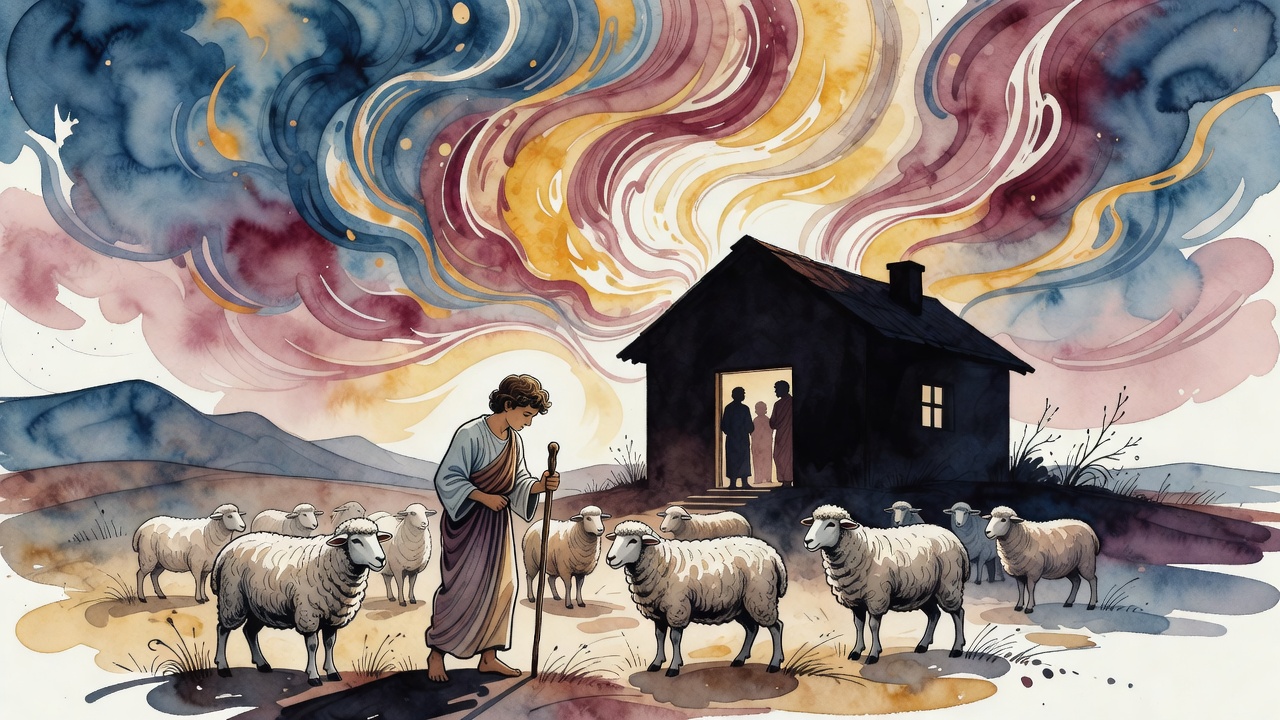
David was born knowing none of this. He grew up tending sheep in Bethlehem, the youngest brother, the one left out of the lineup when Samuel came to anoint a king. He wrote psalms in the hills. He killed a giant. He fled from Saul through the wilderness. He danced before the ark with such abandon that his wife found it embarrassing. He sinned. He repented. He built a kingdom.

What he did not know, as each year burned through him, was that every year had been a gift. The man who gave them had stood at the beginning of all things, had looked ahead through all the centuries, had found his name in the book, and had decided that three hours was not enough.

There is a detail the tradition preserves in several forms: when Adam died at nine hundred and thirty, David was somewhere alive and breathing, and the years Adam had surrendered were running through David's veins without his knowledge. Every psalm David wrote was composed on borrowed time. Every battle he won. Every prayer he offered. The time had a prior owner.

The Sabbath They Shared

But the link between these two men runs deeper than the contract. The rabbis observed that David sang four particular psalms that seem to speak from Adam's perspective rather than his own. Psalm 24, The earth is the Lord's and all that fills it, was sung because the world was created for Adam, and David, inheriting Adam's years, also inherited something of his vision. Psalm 19, The heavens declare the glory of God, was sung because David saw the stars as Adam first saw them. Psalm 92, the psalm for the Sabbath, was composed by Adam himself when he survived the first long night and saw the sun return, and David carried it forward.

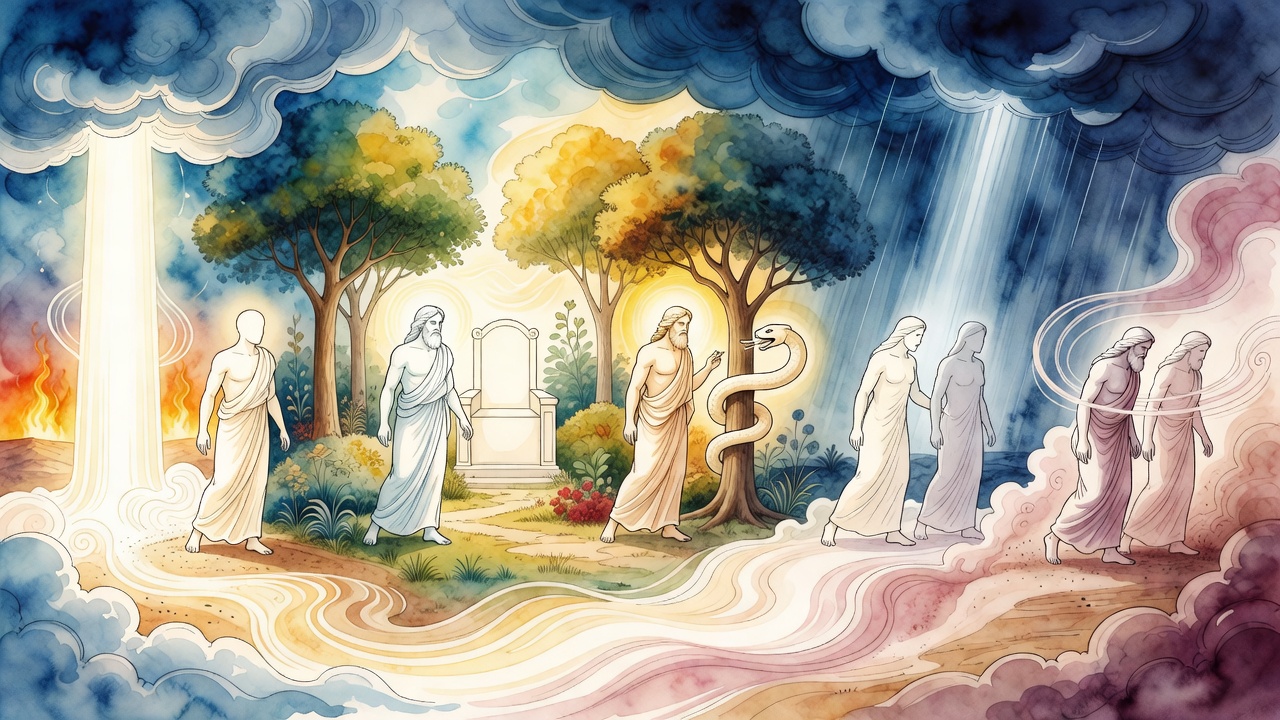
When Adam understood he would die, he feared the darkness. The first Sabbath came. A pillar of fire stood at his side through the night. When morning came he understood that the day would always return, and he sang. David, four thousand years later, sang the same psalm. They had different faces, different histories, different wounds. They shared a way of standing before the dark and singing anyway.


← All myths

From the tradition

Sources

8 sources

The texts this telling draws on, in full. Open a card to read inline, or expand it for a wider, quieter read.

Yalkut Shimoni on Torah 41:2Yalkut Shimoni on Torah

Another interpretation: "This is the book of the generations of man." He caused all the generations to pass before him, and showed him David, whose life was inscribed for him as three hours. He said before Him, "Master of the universe, shall there be no remedy for this one?" He said, "Thus it arose in thought before Me." He said to Him, "How many are the years of my life?" He said to him, "A thousand years." He said to Him, "Is there a gift in the firmament?" He said to him, "Yes." He said to Him, "Let seventy years of my years be for this one's portion." What did Adam do? He brought the deed and wrote upon it a deed of gift, and the Holy One, blessed be He, and Metatron and Adam signed it. Adam said, "Master of the universe, let this beauty, this kingship, and these songs be given to him as a gift, the seventy years that he shall live, and let him sing before You." And this is what Scripture says (there 40:8): "Behold, I have come; in the scroll of the book it is written of me."

Full source
Legends of the Jews 2:35Legends of the Jews

A whole millennium! That was supposed to be Adam’s lifespan, a "day of the Lord," as it says in some traditions. But did you know he gave some of that time away?

In Legends of the Jews, Adam, in a remarkable act of compassion, saw that the soul of David, destined to be one of the greatest figures in Jewish history, was only allotted a single minute of life. Just one minute! So, Adam, of his own free will, gifted seventy years of his own life to David. He reduced his own time on Earth to 930 years. sacrifice! A evidence of the profound connection even the first human felt to those who would come after.

Adam’s wisdom wasn’t just limited to selfless acts. It shone brilliantly when he named the animals. This story, retold in Ginzberg's Legends of the Jews, highlights a fascinating debate in the heavenly realms. The angels, weren't always on board with the creation of humankind. God, however, insisted that humans would possess greater wisdom. And Adam proved Him right, spectacularly.

Barely an hour old, Adam was presented with the entire animal kingdom, alongside the angels. God challenged the angels to name them, but they were stumped. They couldn't do it! But Adam, without hesitation, declared: "O Lord of the world! The proper name for this animal is ox, for this one horse, for this one lion, for this one camel." One by one, he named them all, perfectly matching each name to the animal's unique characteristics.

Then, God turned to Adam and asked, "What is your name?" And he replied, "Adam, because I was created from Adamah, the dust of the earth." A beautiful connection. Rooted in the very ground from which he came. But it didn't stop there.

God then asked Adam for His own name. And Adam, with divine inspiration, said, "Adonai, Lord, because Thou art Lord over all creatures." This, as we’re told, was the very name God had given Himself, the name by which the angels call Him, and the name that will remain forever unchanged. It’s amazing to think of Adam, just an hour old, knowing this most sacred name.

This wasn't just clever guesswork. Adam possessed the Ruach (spirit) Hakodesh, the holy spirit. He was a true prophet, and his wisdom was a prophetic gift. Without it, he could never have accomplished this incredible feat.

So, what does this all mean for us? These stories about Adam show us the incredible potential within humanity. The capacity for selfless giving, for profound wisdom, and for a deep connection to the divine. Maybe, in our own ways, we too can strive to emulate Adam’s best qualities, using our own gifts to make the world a little brighter, a little wiser, and a little more connected.

Full source
Midrash Tehillim 5:3Midrash Tehillim

David, millennia later, giving voice to the unspoken gratitude of humanity's dawn.

Rabbi Samuel, whose teaching is recorded in the Midrash (rabbinic interpretive commentary), identifies four specific Psalms.

First, (Psalm 24:1): "The earth is the Lord's, and everything in it." Why did David need to say this? Because, the Midrash explains, the world was created in its fullness for Adam. It was his inheritance, a gift beyond measure. David, recognizing this original bounty, echoes the sentiment that Adam, in his perfect innocence, perhaps took for granted.

Then there's (Psalm 19:2): "The heavens declare the glory of God." Imagine being the first to gaze upon the stars, the sun, the sheer vastness of the cosmos. According to the Midrash, David sang this because he “saw them first.” He saw the divine handiwork in a way no one else ever could, and David, in his Psalm, gives voice to that primal awe.

Next, (Psalm 92:1): "A Psalm, a song for the Sabbath day." The Sabbath, Shabbat (the Sabbath), is the day of rest, a sanctuary in time. The Midrash tells us that the Sabbath exempted Adam from judgment. It offered him respite, a moment of peace in the Garden. So David, understanding the profound significance of this day, sings the song Adam should have sung in gratitude for that divine gift.

Finally, (Psalm 16:5): "Preserve me, O God, for in You I put my trust." The Midrash says David sang this because Adam inherited the world in the beginning. It was an expression of total reliance on the Almighty.

It’s fascinating to consider the idea that David, a shepherd, a king, a warrior, could tap into the primeval consciousness of Adam. It suggests a deep connection between all human souls, a shared understanding of our place in the universe and our relationship with the Divine.

What does it mean that these Psalms, meant to be sung by Adam, were instead sung by David? Perhaps it's a reminder that expressing gratitude, recognizing the beauty of creation, and seeking divine protection are timeless human needs. Maybe it's a call to each of us to find our own "Psalms" – our own ways of acknowledging the gifts we've been given, both large and small. What songs are we meant to sing?

Full source
Bereshit Rabbah 24:2Bereshit Rabbah

It all begins, of course, with Adam. But did you ever imagine him… colossal?

Our sages certainly did. In Bereshit Rabbah, a classic collection of rabbinic interpretations on the Book of Genesis, we find a image of the first human. The verse "This is the book of the descendants of Adam" (Genesis 5:1) sparks a deeper exploration. It connects to a verse in Psalms (139:16): "Your eyes saw my unformed parts, and in Your book they were all written. Of the days that were created, each one is His." What does this mean?

Rabbi Yehoshua bar Nehemya and Rabbi Yehuda bar Simon, quoting Rabbi Elazar, paint a breathtaking picture: When the Holy One, blessed be He, created Adam, He created him so immense that he filled the entire world!

Seriously? The entire world?

The rabbis don't just make such a claim without support. They find hints in scripture. East to west? It's derived from the verse “From back [ahor] and front [kedem], You shaped me” (Psalms 139:5). Now, ahor and kedem can also mean "west" and "east," suggesting Adam's reach spanned the horizon. North to south? That comes from (Deuteronomy 4:32): “From the day God made Adam on the earth, and from one end of the heavens to the other end.”

But it gets even wilder. Did Adam fill the empty space of the world too? Rabbi Tanhuma, in the name of Rabbi Benaya, and Rabbi Benaya and Rabbi Berekhya, citing Rabbi Elazar again, say yes! They point to the verse, “You placed Your palm upon me” (Psalms 139:5). Rabbi Tanhuma says that God created Adam as an unformed being who stretched from one end of the world to the other! And that, they say, is what is meant by "Your eyes saw my unformed parts" (Psalms 139:16).

Imagine Adam, not as a single, localized figure, but as a being whose very essence encompassed everything. What could this possibly mean?

Rabbi Yehuda bar Simon offers another layer: while Adam was still "unformed" before God, he was shown every generation that would come after him – its scholars, its wise men, its Torah interpreters, its leaders. They were all present, in potential, within him. As it says, "Your eyes saw my unformed parts, and in Your book they were all written" (Psalms 139:16). The "unformed ones" God saw were already inscribed in Adam's book.

So, “This is the book of the descendants of Adam” (Genesis 5:1) isn't just a genealogical record. It's a evidence of the vast potential, the cosmic reach, and the inherent connection of all humanity, all contained within that first human being.

Perhaps this isn't meant to be taken literally. Maybe it's a powerful metaphor for the interconnectedness of all things, the idea that we are all, in some way, descendants of and contained within that first human, carrying within us the potential for both immense wisdom and profound connection to the Divine. Maybe, just maybe, we're all a little bit bigger than we think.

Full source
Yalkut Shimoni on Torah 787:11Yalkut Shimoni on Torah

"Speak to the children of Israel, saying... When you cross over... and you shall designate cities for yourselves." This is what the verse means: "Good and upright is the Lord; therefore, He instructs sinners on the way" (Psalms 25:8). David said before the Lord: "Master of the Universe, if not for Your mercy, Adam, the first man, would not have had a standing.

When You said to him, 'On the day you eat from it, you will surely die,' he did not fulfill it. Instead, You removed him from the Garden of Eden [and he lived for 930 years and then died]. What did You do to him? You banished him from the Garden of Eden."

For why was he banished? Because he brought death upon generations, and he deserved to die immediately. However, You had compassion on him and banished him, similar to the case of an unintentional killer who is exiled to the cities of refuge. Moses said, "Master of the Universe, if someone unintentionally kills in the south or in the north, how will he know where the cities of refuge are so that he can flee there?"

God said to him, "Prepare clearly marked roads to the cities of refuge. Establish signposts for them so that they will not be led astray and the avenger of blood will not find them." Moses asked, "How?" God replied, "Set up cities of refuge with well-marked roads leading to them."

That is why it is said, "Good and upright is the Lord." If He made a path and a way for murderers to escape and be saved, how much more so for the righteous. The verse says, "He will guide the humble in justice" (Psalms 25:9).

Full source
Book of Jubilees 31:30Book of Jubilees

Book of Jubilees turns to Judah Receives a Roaring Blessing of Power.

So, what does it say about Judah? Buckle up.

It starts with this roaring blessing, a protective shield woven from words: "And let all who hate thee fall down before thee, And let all thy adversaries be rooted out and perish; And blessed be he that blesseth thee, And cursed be every nation that curseth thee." Can you feel the intensity? It’s a raw declaration of support, a promise of divine protection against anyone who dares to stand against him.

Then, the blessing shifts, focusing directly on Judah: "May the Lord give thee strength and power To tread down all that hate thee." It's not just about passive protection; it’s about active empowerment. Judah is being equipped to overcome his enemies, to rise above challenges.

But it's not just about brute strength. The blessing goes on, "A prince shalt thou be, thou and one of thy sons, over the sons of Jacob; May thy name and the name of thy sons go forth and traverse every land and region." This is where things get really interesting. It's a prophecy, a destiny laid out for Judah and his descendants. They are destined for leadership, their influence spreading far and wide. – a lineage destined to shape history.

And what will be the result of this divinely ordained rise? "Then will the Gentiles fear before thy face, And all the nations will quake." It's a statement of authority, yes, but also a reflection of the respect and awe that Judah's leadership will command. It’s not necessarily about instilling terror, but about inspiring a deep recognition of divinely granted power.

Now, what does all this mean? Is it a simple promise of dominance? Or something more complex?

Perhaps it’s a reflection of the responsibility that comes with leadership. Power isn't just about ruling; it's about carrying the weight of a nation, about ensuring its survival and prosperity. And maybe, just maybe, it’s a reminder that even in the face of adversity, the blessings of our ancestors, the promises of our faith, can provide the strength we need to persevere.

Think about the times you've felt that weight on your shoulders. What blessings do you carry? What responsibilities? And how do you find the strength to tread down all that hate thee, to face the challenges ahead? The story of Judah, as told in the Book of Jubilees, invites us to consider these questions, to connect with the ancient echoes of our own journeys.

Full source
Midrash Tehillim 16:7Midrash Tehillim

He interprets the verse, "I will bless the Lord who counsels me" (Psalm 16:7) with regard to Abraham. But Rabbi Shimon ben Yochai takes it a step further. He says that God Himself summoned Abraham's two kidneys, and they overflowed with wisdom and knowledge! Yes, you heard that right, his kidneys!

I know what you’re thinking. Kidneys? Wisdom? But hang with me. The idea is that Abraham received divine insight directly. How do we know this? Because, as the Midrash Tehillim tells us, it was revealed to him "between the pieces" – referring to the brit bein ha'betarim, the Covenant of the Pieces described in Genesis 15. During this pivotal moment, God showed him four things: the Torah, the sacrifices, Gehenna (hell), and the kingdoms. So, the foundation of his understanding came straight from the Source.

This idea of divine inspiration shows up elsewhere too. In Psalm 1, we see the righteous person meditating on Torah day and night, drawing wisdom and strength. And in the case of Abraham, that divine knowledge even originated in the strangest of places – his very own organs!

Let's switch gears and We all say them, but do we ever really think about what we're saying? There's a debate about the proper way to bless God. Rav says that when we bless, we should say "Baruch Atah Hashem" – "Blessed are You, Lord." But Shmuel suggests we say "Baruch Hashem" – "Blessed be the Name."

Rav's opinion is supported by the verse, "I have set the Lord always before me, because he is at my right hand, I shall not be moved" (Psalm 16:8). The idea here is that by directly addressing God, we’re acknowledging His constant presence.

Then we have Rabbi Zeira and Rabbi Yehuda Taruyah, who add another layer. They say that "any blessing that does not include mentioning the Kingdom is not a proper blessing." Why is that? Because, as (Psalm 145:1),16 says, "I will extol You, my God, O King, and I will bless Your name forever and ever. Because he is at my right hand, I shall not be moved." In other words, a proper blessing acknowledges God's sovereignty, His role as King of the Universe.

It's all connected, isn’t it? From Abraham’s divinely-inspired kidneys to the words we use when we offer a blessing, we're constantly engaging with the Divine.

And finally, there’s a fascinating little tidbit about David. The Midrash Tehillim tells us that "the words of the Torah were skilled for David, and they brought him cases to examine." People sought his wisdom, his understanding of the law. And David, in turn, wasn't afraid to share his insights, even with kings. As he says in (Psalm 119:46), "I will speak of your testimonies also before kings, and will not be ashamed." He understood his role in sharing divine wisdom.

So, what does it all mean? Maybe it’s about recognizing the potential for wisdom in unexpected places, both within ourselves and in the world around us. Maybe it’s about being mindful of the words we use when we connect with the Divine. And maybe, just maybe, it’s about remembering that we all have a role to play in sharing that wisdom with others, just like Abraham and David.

Full source
Bereshit Rabbah 44:9Bereshit Rabbah

Them is often remembered as paragons of faith, figures of unwavering strength. But what about their doubts, their fears about the future?

The ancient rabbis, in their beautiful and insightful way, explored these questions. In Bereshit Rabbah, a classic midrashic (rabbinic interpretive commentary) text – a collection of interpretations on the Book of Genesis – we find a fascinating comparison between Abraham and David. Both, it seems, shared a similar concern.

Rabbi Yudan and Rabbi Aivu, citing Rabbi Yoḥanan, point out that both Abraham and David expressed a desire to avoid having descendants who would displease God. It's not just about having children; it's about the kind of legacy they would leave.

Abraham, as it says, cries out, “My Lord God, what will You give me?” (Genesis 15:2). But the rabbis see a deeper meaning in his words. Abraham isn't just asking for offspring, but rather, as the rabbis interpret, saying, "Master of the universe, if I am destined to produce offspring and [they will ultimately] anger you, it is preferable for me that 'I go childless.'" He’s essentially saying, “If my descendants are going to be a source of pain to You, God, then I'd rather not have them at all.” A pretty powerful statement. David echoes a similar sentiment in the Psalms. “Search me, God, and know my heart; try me and know my thoughts” (Psalms 139:23). But it doesn’t stop there. The verse continues "and see if there is any grievous way in me." The rabbis, in their insightful way, see that he's asking God to examine his future descendants. David is pleading, “Know those who emerge from me.” The word sarapai, "my thoughts," can also mean branches emerging from a tree. If those "branches" – his descendants – are destined to stray, David prays, "lead me on the path to eternity" (Psalms 139:24). In other words, “Take my life instead.” A pretty extreme request, but one born from a deep sense of responsibility.

This idea of legacy and the potential for descendants to stray is a powerful theme in Jewish thought. It's a reminder that we're not just individuals; we're part of a chain, a continuation of generations.

But the passage doesn't end there. It explores another intriguing detail about Abraham's household. Abraham laments "the one who has charge of my house." Rabbi Elazar interprets this as a reference to Lot, Abraham's nephew. He suggests that Lot's soul shokeket – longs – to inherit from Abraham. But then the verse continues "Is Damascus Eliezer." Here, the rabbis offer two interpretations.

One suggests that Eliezer isn't a name at all, but a description: azarni hael – "the Almighty helped me." This refers to God's assistance when Abraham pursued the kings to Damascus. The other, offered by Reish Lakish in the name of bar Kappara, claims that Eliezer is a name. He points out that Abraham “marshaled his disciples, born in his house, three hundred and eighteen” (Genesis 14:14). The numerical value – the gematria – of Eliezer's name is precisely 318!

What does it all mean? Perhaps it's a reminder that even the greatest figures in our tradition grappled with complex questions about their legacy, their children, and their place in the unfolding story of humanity. They understood that true greatness wasn't just about personal achievement, but about the impact they had on the generations to come. And maybe, just maybe, that's a lesson we can all take to heart.

Full source