Jonah Was Too Comfortable in the Fish So God Sent a Crowded One
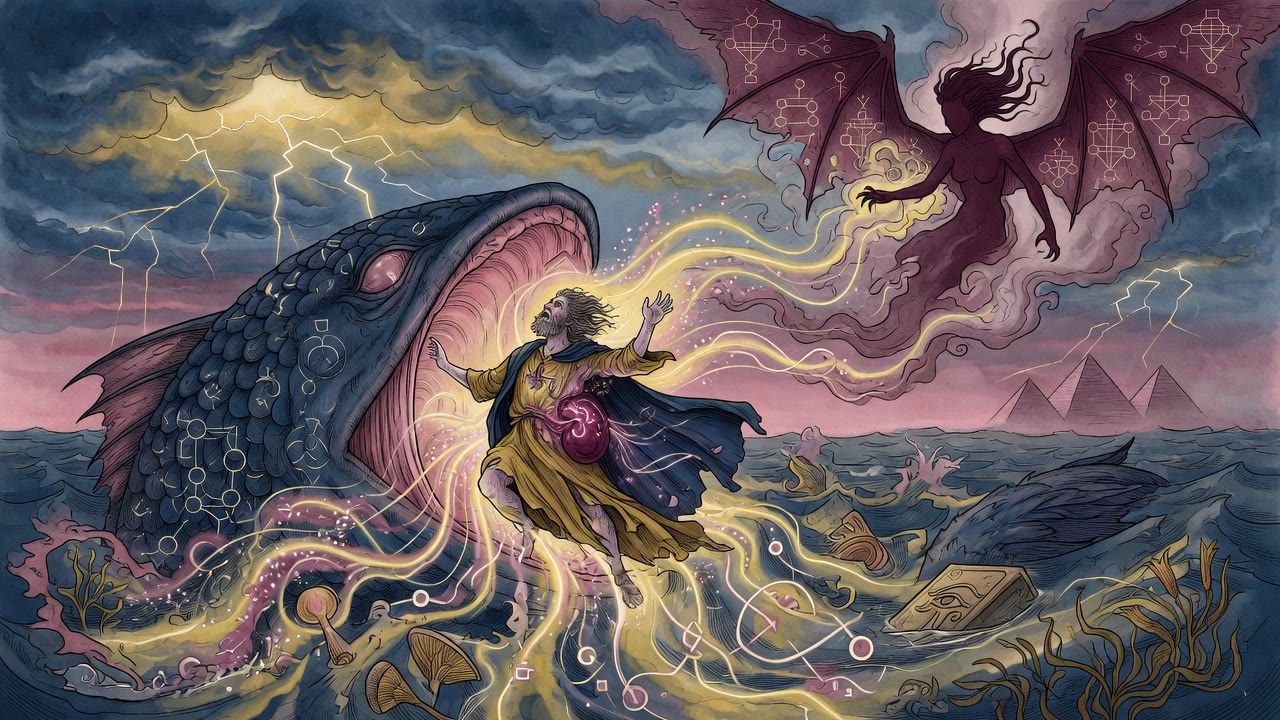
The first fish had room to stand in and a pearl for light. Three days went by and the prophet still had not prayed, so the arrangements changed.
Table of Contents
 Click for full size
The Ship That Came Back for Him
Twice already Jonah had been sent, and twice it had gone badly for him.
The first time God sent him to the towns of Israel and they listened and were saved, and that was fine. The second time God sent him against Jerusalem to announce its destruction, and Jerusalem repented, and God had mercy and did not destroy it, and everyone turned around and called Jonah a liar. Now he was being sent to Nineveh.
He worked it out for himself. Foreigners repent faster than anyone. Nineveh would fold in a week, the decree would be cancelled, and this time it would not just be Israel calling him a false prophet, it would be the nations too.
"I will go somewhere His glory is not," he said.
He went down to Yaffo and there was no ship in the harbor. The one he wanted had sailed two days earlier and was well out at sea. So God sent a wind after it, and the wind turned that ship around and drove it all the way back to the dock at Yaffo, and Jonah stood on the quay and watched it come in and was overjoyed.
"Now I know the road is open in front of me," he said. He paid the fare in advance, which nobody does, and went aboard.
They Lowered Him to the Knees
The storm came in on both sides of the ship at once. Every other vessel on that water was moving along in flat calm and theirs was the only one about to break apart.
There were men of seventy languages on board and every one of them had brought a god. They took them out and set them up and bowed to them and said, "Whichever one answers and saves us is the real one." Nothing answered. They threw the cargo over to lighten her and it did not help. They tried to put back to land and could not.
Jonah had gone below and fallen asleep.
The captain came down and found him. "We are hanging between life and death and you are asleep. What people are you?"
"I am a Hebrew," Jonah said. "This is because of me. Pick me up and throw me into the sea."
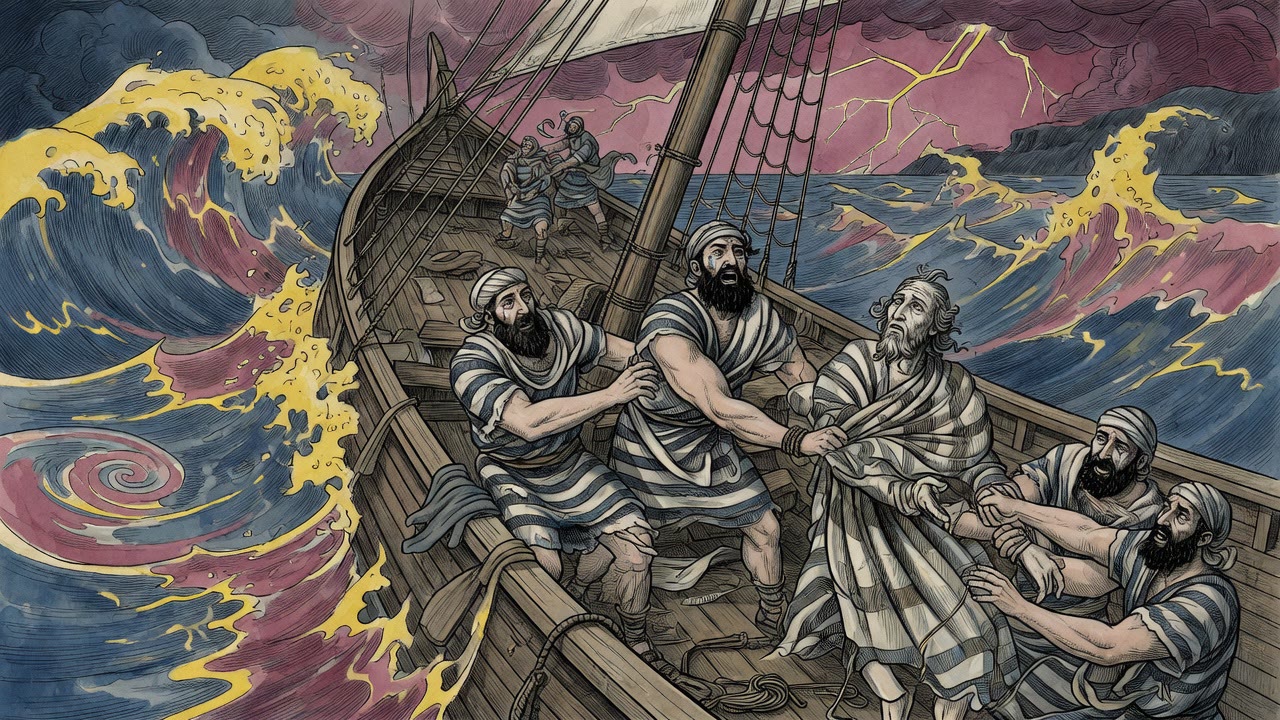
They would not do it on his word alone. They cast lots, and the lot came out on him, and even then they could not do it cleanly. They stood him at the rail and said, "Master of the World, do not put innocent blood on us. We do not know what this man has done."
Then they lowered his legs into the water, and the sea went smooth. They pulled him back up and it came apart again. They put him in to the waist, and it went smooth. Up, and it raged. Down to the neck, smooth. They stopped pretending and let go.
A Pearl Was Hanging in the Belly
The fish had been assigned to him since the six days of creation.
He went in through its mouth the way a man walks into a great synagogue. The place had height to it. Its two eyes stood in the wall like windows with daylight in them, and Jonah looked up at them and said, they have lit lamps for me. Hanging in the middle of the belly was a pearl that gave off light like the sun at noon, and by that light he could see out through the sides of the fish into the whole ocean.
Then the fish spoke to him. "Do you know that today is the day I get eaten by Leviathan?"
"Take me to him," Jonah said. "I will get us both out of this."
The fish carried him over. Jonah looked at the thing filling the water in front of him and said, "I came down here for you. I came to see where you live. And in time to come I will come down again and put a rope through your head and serve you at the feast for the righteous."
Then he showed Leviathan the seal of Abraham cut into his own flesh.
Leviathan turned and fled two days' distance.
Show Me Everything Down Here
Jonah went back to the fish. "I saved you. Now show me the whole thing."
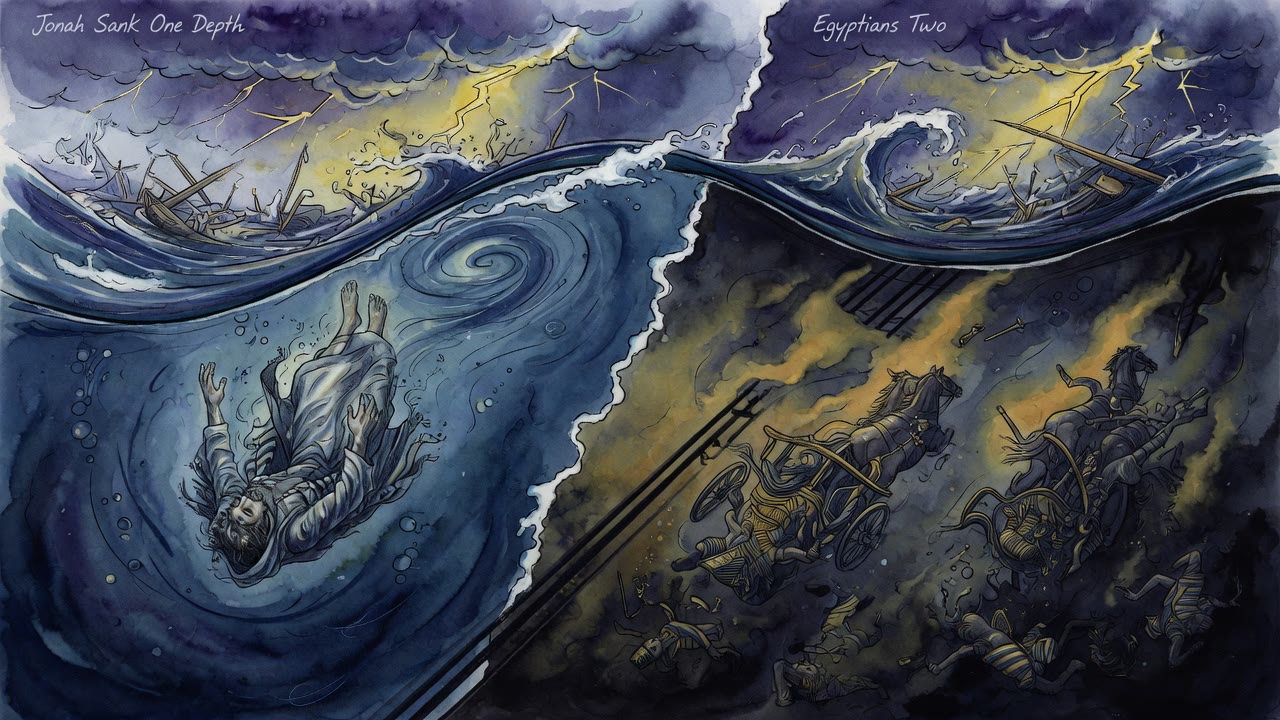
So it took him around. The great river of the ocean that goes all the way around and closed over his head. The dry paths through the Red Sea where Israel had walked across, the same water where the Egyptians who came after them went down two depths while Jonah, riding above the sand, went down only one. The exact place where the waves are manufactured and sent out. The pillars the earth stands on, planted in their sockets. The lowest floor of the netherworld. Gehinnom (the realm of judgment after death). And, up above it all, the palace of the Lord standing on its seven mountains.
Last of all it brought him to the foundation stone, fixed in the deep water at the bottom of everything.
The sons of Korah were standing there beside it. Their father had gone down alive into the earth and they had not, and they were still down there, praying.
The Fish Full of Spawn
Three days and three nights, and Jonah did not pray once.
God said, "I gave him a wide roomy fish so he would not be uncomfortable, and he is not praying. Bring the other one."
She was pregnant with three hundred and sixty-five thousand young, and she came alongside and said, "The Holy One sent me to swallow the prophet in your belly. Spit him out and there is no trouble. Refuse and I take you with him."
"How do I know that is true?" the first fish said.
"Leviathan."
They swam to Leviathan and asked him. He said yes, he had heard it himself, in the last three hours of the day, when the Holy One comes down to play with him.
The first fish spat Jonah out immediately and she took him in, and now there was no room and no light and no clean place to put a hand, only the crush and the filth and the moving of hundreds of thousands of small bodies against him in the dark.
He started praying inside the minute.
"Where can I go from Your spirit. If I climb to heaven You are there. Your throne is the height of the sky and the ground is Your footstool, and the secrets of every man are spread out flat in front of You. Answer me out of the belly of Sheol (the underworld of the dead). You are called the one who lifts up and casts down, so lift me. You are called the one who kills and gives life, and I have got as far as dying, so give me the other one."
Nothing came back.
Then he said the last thing. That business about hauling Leviathan up and setting him before the righteous. I will do it, on the day Israel is saved.
God nodded at the fish and she threw him nine hundred and sixty-eight parasangs onto dry land.
Back on the ship, the sailors had watched the water go flat the instant he went under, and had seen what followed. Every man on that deck picked up the god he had carried aboard and dropped it over the side. Then they sailed to Yaffo, walked up to Jerusalem, and were circumcised there.
← All myths