6 min read

Judith Walked Home With a General's Head

A widow prayed for deceitful lips, flattered Holofernes in his tent, and returned to Bethulia by night with the Assyrian's head in a bag.

Curated by Arthur · Told by Maggid ·
Table of Contents
  1. Lord of All the Earth
  2. A Widow's Prayer for Deceit
  3. Flattery in the Lion's Tent
  4. The Bag and the Canopy
  5. What the Siege Learned
Judith Walked Home With a General's Head Click for full size

Lord of All the Earth

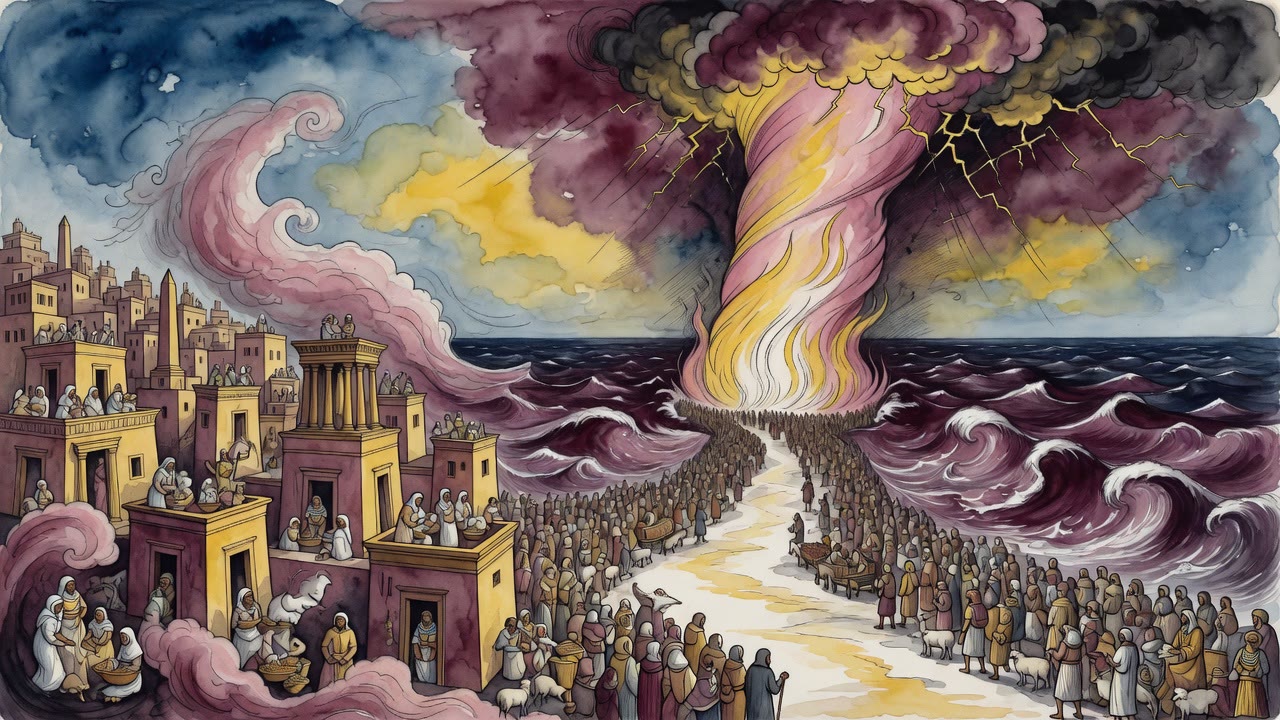
Nebuchadnezzar spoke like a man who owned the map and the weather above it. None of his words were to fail. Cities that delayed tribute learned the grammar of his anger in fire. When Achior the Ammonite warned that Israel might stand while faithful to its God, that Egypt's old story still taught caution, the king cut him down with contempt meant for the whole room. "You, Achior, a hired hand of Ammon," he said, stripping status with a phrase, and banished him from his face until vengeance fell on the nation that came out of Egypt.

He promised that the sword of his army and the multitude of his servants would pass through Achior's sides among the slain when he returned in triumph. Then he ordered his servants to set Achior in the hill country, in a city of the passes: Bethulia, the very town marked for conquest, thirsty already under siege logic. Truth-telling earned a seat inside the noose. Achior walked toward the people he had defended with words, carrying a death sentence timed to their fall.

A Widow's Prayer for Deceit

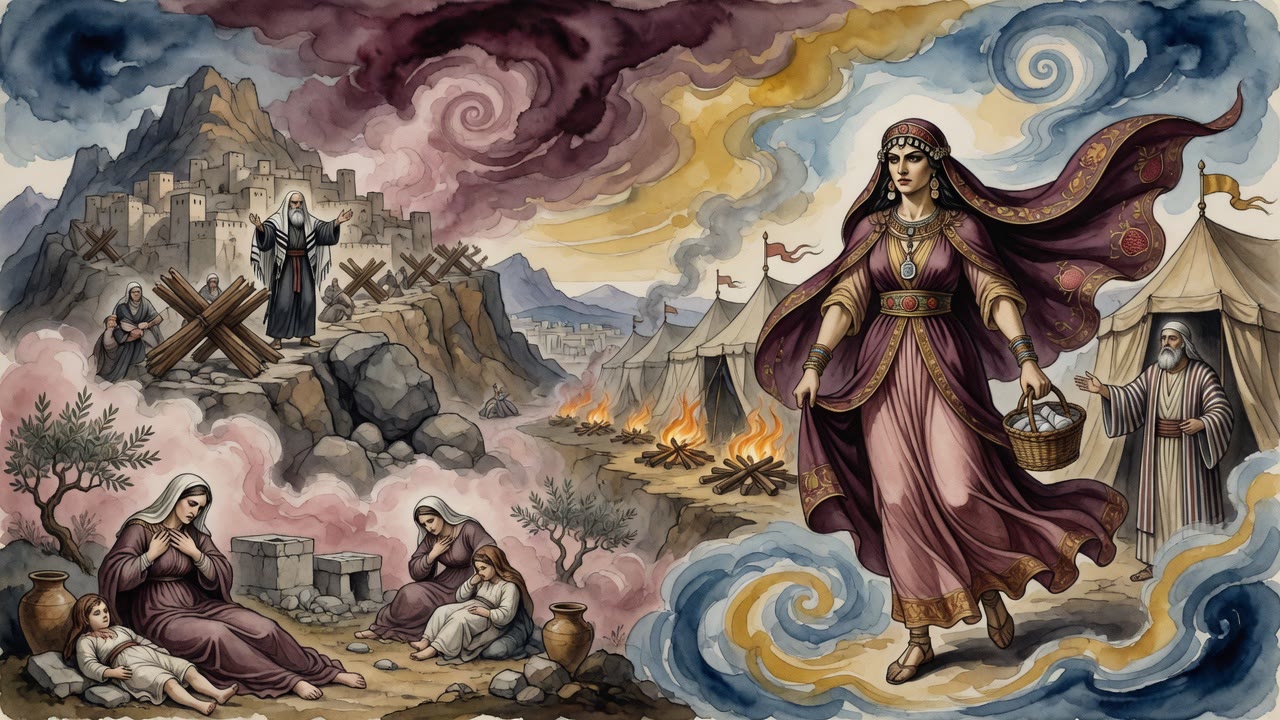
Judith put on sackcloth under her dress and ash on her head, beauty hidden under mourning, then turned her face toward heaven in the privacy of her roof. She did not ask for a soft rescue or a sudden storm alone. "Throw down their strength in your power and bring down their force in your wrath," she prayed. The Assyrians meant to defile the sanctuary, pollute the tabernacle where the glorious Name rested, and cast down the horn of the altar with the sword. This was not only war for grain and gates. It was war for the house of God.

"Behold their pride and send your wrath upon their heads," she said. "Give into my hand, the hand of a widow, the power that I have conceived." She asked for a stranger's weapon in a world that counted widows as empty hands. "Strike, by the deceit of my lips, the servant with the prince, and the prince with the servant; break down their stateliness by the hand of a woman." She named the tool and the vessel without shame before heaven: lies shaped like loyalty, carried by a widow's mouth, aimed at a general's pride.

Flattery in the Lion's Tent

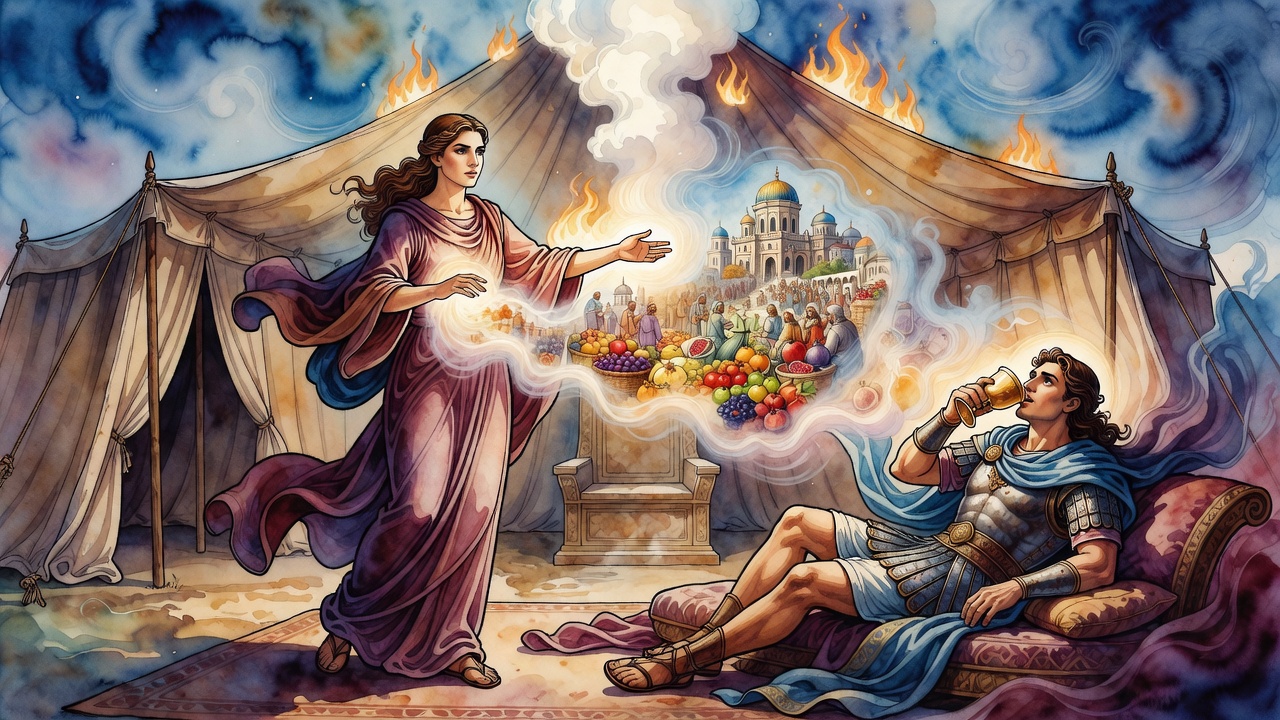
She walked into Holofernes' camp as if fear had never touched her, maid beside her, beauty unveiled at the right mile. Soldiers who had come to break a hill town stumbled over courtesy. "Receive the words of your servant," she said before the general, "and permit your handmaid to speak in your presence, and I will declare no lie to my lord this night." The line was a blade wrapped in silk. She offered him a path that sounded like destiny. If he followed her words, God would bring his purposes to pass without fail.

She sealed the flattery with an oath on Nebuchadnezzar's life and power, the only god Holofernes truly feared. Not only men would serve through Holofernes, she said, but beasts of the field and cattle and birds of the air would live by his power under the king's house. Every living thing hinged on his obedience to empire. The general heard himself named as the hinge of creation and poured wine into that hearing until his judgment swam. Pride is a door that opens from the inside. Judith knocked with praise until the latch gave.

The Bag and the Canopy

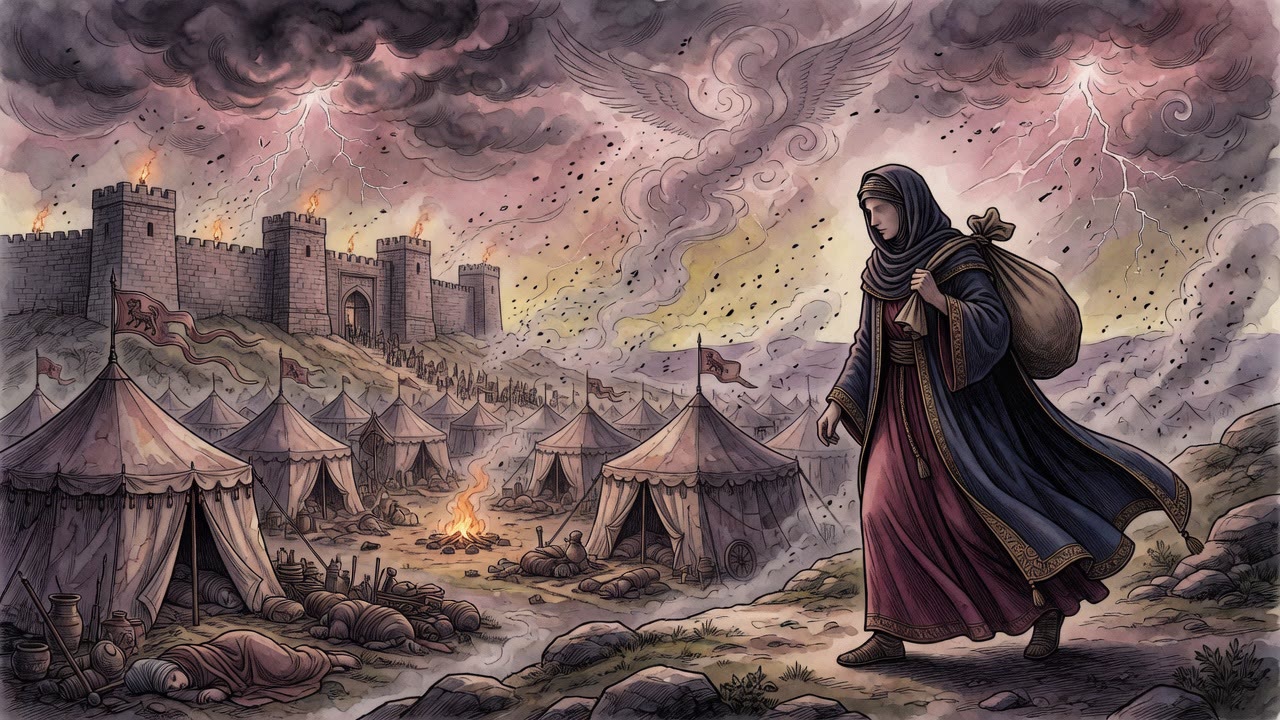
When drunkenness dropped him on the bed of his certainty, the widow's plan closed with two strokes and a bag. She took his head and the canopy of the bed where he had lain in his pride, fabric that had shaded a man who thought the night belonged to him. By night she and her maid came back toward Bethulia's wall, the siege still ignorant, the camp still snoring around a corpse that had not yet been discovered as incomplete.

The guards peered into the dark with the thin hope of the besieged. Then the town ran, small and great, astonished that she had returned alive. They opened the gate, lit a fire, and stood around her in a ring of light that made the head's features undeniable. "Praise, praise God, praise God," she said three times, "for he has not taken away his mercy from the house of Israel, but has destroyed our enemies by my hands this night." She drew the head from the bag. "Behold the head of Holofernes, the chief captain of the army of Assur, and behold the canopy where he had lain in his drunkenness; and the Lord has struck him by the hand of a woman."

What the Siege Learned

Nebuchadnezzar had called himself lord of all the earth. Holofernes had trusted shield and spear and bow and sling and the arithmetic of thirst. Judith had trusted a prayer that asked for deceit and a bag that could hold a kingdom's terror without dropping it on the path. Achior lived to see the warning he gave come true from the other side of the wall, the hired hand of Ammon vindicated by a Hebrew widow's night work.

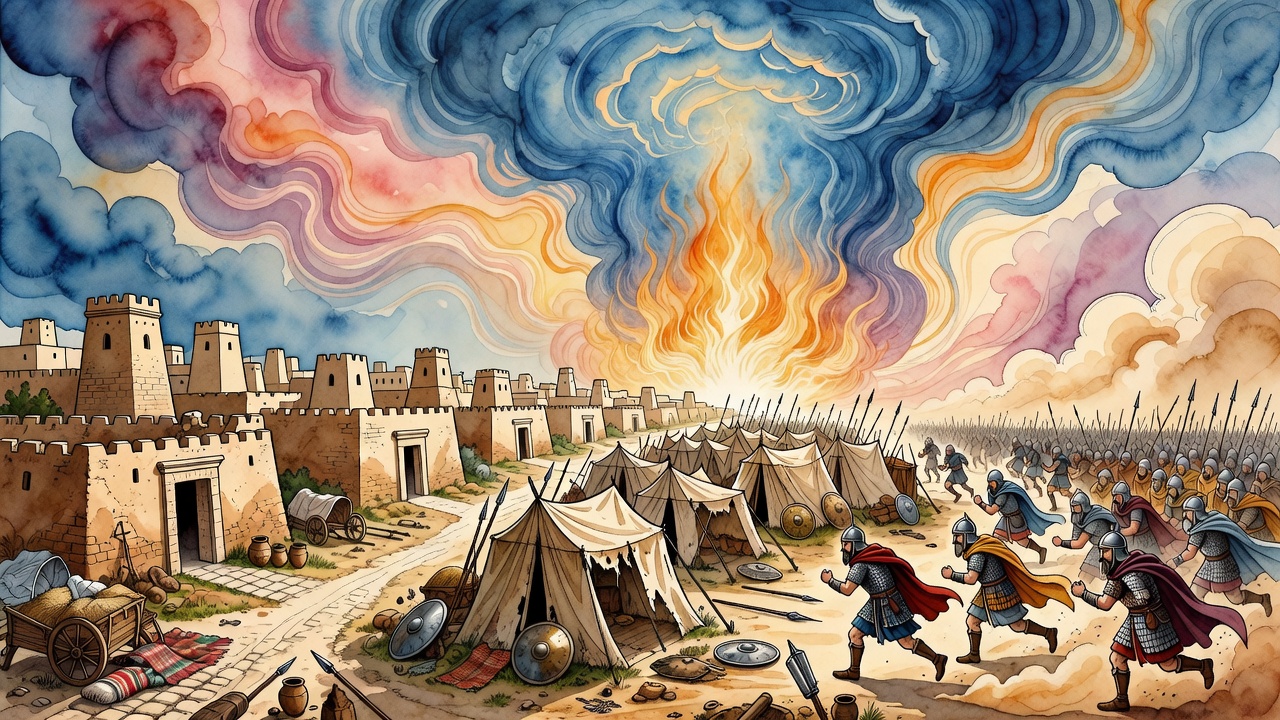
The Assyrian camp woke to a body without a head and a courage without a general, panic moving faster than orders. Bethulia woke to a fire on the stones and a woman who would not take the credit from heaven. The hand of a woman had done what the hill's swords could not, and the siege broke from the inside of the command tent outward, the way rot breaks a beam.


← All myths
From the tradition

Sources

5 sources

The texts behind this telling. Some cards carry a translation of the source; others are our own retelling of it, and each card says which. Every card links out to the original.

Book of Judith 6:13Book of Judith

Retold in our words. Read the original at the link below.Sefaria Community Translation · CC-BY

Because in the Book of Judith, we stumble right into one.

King Nebuchadnezzar, feeling very much like the "lord of all the earth," has just laid down the law. And let me tell you, he’s not mincing words. This isn't a suggestion; it's a decree chiseled in stone. "None of my words will be in vain," he booms.

Then he turns his attention to Achior. Poor Achior. He’s the Ammonite leader who dared to speak truth to power, who had the audacity to suggest that maybe, just maybe, this little nation that came out of Egypt – the Israelites – might have a powerful God on their side.

Nebuchadnezzar isn't having any of it. “You, Achior, a hired hand of Ammon,” he sneers. The phrase “hired hand” is particularly cutting, emphasizing Achior's perceived insignificance and dependence. Nebuchadnezzar continues, "who has spoken these words on the day of your iniquity, will see my face no more from this day forward, until I take vengeance on this nation which came out of Egypt." He’s basically exiling Achior from his presence, promising to keep him banished until he’s crushed the Israelites.

And the threat doesn't stop there. Oh no. Nebuchadnezzar envisions Achior suffering a much grimmer fate. "And then the sword of my army and the multitude of those who serve me will pass through your sides, and you will fall among their slain, when I return." It's brutal, it's visceral, and it's meant to instill absolute terror.

So, what's to become of Achior? Well, Nebuchadnezzar isn’t about to just let him wander off. "Now therefore, my servants will bring you back into the hill country and will set you in one of the cities of the passages…"

He’s being sent to Bethulia. The very city Nebuchadnezzar intends to conquer. It's like a twisted form of hospitality, delivering Achior right into the hands of the people he tried to defend. Talk about being between a rock and a hard place.

What does this all mean? Is it just a historical anecdote about a power-hungry king? Or is there something deeper here? Perhaps it’s a reminder of the dangers of speaking truth to power, the price of standing up for what you believe in. Or maybe, just maybe, it’s a setup for something more… something where faith and courage can triumph over even the most formidable of foes.

Full source
Book of Judith 11:8Book of Judith

Retold in our words. Read the original at the link below.Sefaria Community Translation · CC-BY

She's standing before Holofernes, the ruthless general of the Assyrian army, the man who's laying siege to her city and threatening to destroy her people. She's walked right into the lion's den, and she knows that one wrong word could mean disaster. But Judith isn't just brave; she's clever. And she's about to use her words as weapons.

"Receive the words of your servant," she begins, her voice steady despite the tremor in her heart, "and permit your handmaid to speak in your presence, and I will declare no lie to my lord this night." It's a masterful opening – humble, respectful, but with an underlying current of strength. She's positioning herself as Holofernes’ loyal servant, someone worthy of his trust.

Judith doesn't just flatter Holofernes; she elevates him. "If you will follow the words of your handmaid," she continues, "God will bring something perfectly to pass by you, and my lord will not fail in his purposes." She's suggesting that Holofernes is an instrument of the divine, a vessel through which God himself will work. It's a bold claim, and one designed to appeal to Holofernes' ego and sense of importance. She's essentially saying, "You're not just a general, you're part of something much bigger."

Then, she seals the deal with a powerful oath: "As Nebuchadnezzar king of all the earth lives, and as his power lives, he has sent you for the upholding of every living thing; for not only men will serve him by you, but also the beasts of the field, and the cattle and the birds of the air, will live by your power under Nebuchadnezzar and all his house."

Judith is laying it on thick here. She's not just acknowledging Nebuchadnezzar's power; she's proclaiming it as absolute, all-encompassing. And, crucially, she's portraying Holofernes as the vital link in that chain of command, the one responsible for ensuring the well-being of all creation. Every living thing, from humans to animals, depends on Holofernes carrying out Nebuchadnezzar's will, she says.

It's a brilliant piece of rhetoric, designed to play on Holofernes' vanity and ambition. It’s a high-stakes gamble, but Judith knows that the survival of her people depends on her ability to convince him that she is on his side, that she recognizes his greatness, and that she can help him achieve even greater things. The question is, will it work?

Full source
Book of Judith 13:22Book of Judith

Retold in our words. Read the original at the link below.Sefaria Community Translation · CC-BY

Book of Judith turns to Bethulia's Miracle.

The story goes that after Judith’s daring act, she and her maidservant made their way back to Bethulia. The guards on the walls, peering into the darkness, wondering what became of the brave woman who dared to venture into the enemy camp.

Then, there she was.

The Book of Judith tells us, “And then they ran all together, both small and great, for it was surprising to them that she had returned. So they opened the gate and received them; and they made a fire for a light, and they stood all around them.” The whole town, young and old, rushing to greet her. A bonfire crackling, casting flickering shadows on their faces, lighting up the scene of this incredible return. They’re stunned. Speechless. Overjoyed.

And then Judith speaks. Her voice, strong and clear, cuts through the night. "Praise, praise God, praise God, I say, for he has not taken away his mercy from the house of Israel, but has destroyed our enemies by my hands this night."

Three times she calls out "Praise God!" It's a moment of pure, unadulterated faith and gratitude. She doesn't take credit for herself. She knows, and she wants everyone else to know, that this victory is a gift from God.

And then comes the visual proof. The climax.

“So she took the head out of the bag and showed it and said to them, ‘Behold the head of Holofernes, the chief captain of the army of Assur (Assyria), and behold the canopy where he had lain in his drunkenness; and the Lord has struck him by the hand of a woman.’”

Wow.

There it is. The head of their oppressor. The symbol of their salvation. Holofernes, the seemingly invincible general, defeated not by an army, but by a woman acting with courage and faith. And alongside it, the very canopy from his tent – the place where he thought he was safe and secure. The trophy of his arrogance.

What a powerful image. What a powerful message. It’s a moment of triumph, of divine intervention, and of the strength that can be found in the most unexpected places. This story isn't just about a victory; it's about the power of faith, courage, and the unwavering belief that even in the darkest of times, hope can prevail.

What fears, what doubts, what obstacles seem insurmountable? And what "canopies" are we relying on for a false sense of security? Maybe the story of Judith can inspire us to find our own courage, our own faith, and our own way to overcome the challenges that lie before us.

Full source
Book of Judith 9:8Book of Judith

Retold in our words. Read the original at the link below.Sefaria Community Translation · CC-BY

Judith, as you might recall, is the brave and beautiful widow who saves her people from the Assyrian army. But before she puts her daring plan into action, she turns to God in prayer. And it's in this prayer that we find some truly breathtaking insights into the nature of divine power and knowledge.

She doesn't just thank God for past miracles. She acknowledges that God's actions extend through all of time. "You have wrought not only those things, but also the things which happened before and which followed afterwards," she says. That God is not just reacting to events, but that God’s very being encompasses past, present, and future.

It gets even more profound. Judith continues, "You have thought about the things which are now and which are to come. Yes, the things you established were ready at hand, and they said, 'Lo, we are here,' for all your ways are prepared and your judgments are in your foreknowledge." Everything God establishes – every decree, every path, every judgment – is already present, waiting to be revealed. The phrase "Lo, we are here" almost gives these divine decrees a life of their own, a readiness to spring into action when the time is right. It speaks to a universe where divine intention is not just a plan, but an active, waiting force.

This idea of foreknowledge, of God knowing everything in advance, is a concept that theologians have wrestled with for centuries. Does it mean that we don't have free will? Does it mean that everything is predetermined? These are huge questions, and the Book of Judith doesn't offer easy answers. But it does offer a glimpse into a perspective where divine knowledge and divine action are inextricably linked.

Then, Judith turns her attention to the present danger. "For, behold, the Assyrians are multiplied in their power; they are exalted with horse and man; they glory in the strength of their foot soldiers; they trust in shield and spear and bow and sling." She paints a vivid picture of the overwhelming might of the enemy. They are confident, boastful, and reliant on their military strength.

But here's the crucial point: "and they do not know that you are the Lord who breaks the battles: the Lord is your name."

They don't know! All their power, all their weapons, all their arrogance… it's all meaningless in the face of divine power. The Assyrians trust in their own strength, but Judith knows where true power lies. God is the one who breaks the battles. This isn't just a statement of faith; it's a declaration of ultimate reality. God’s very name embodies the power to shatter armies and change the course of history.

So, what does this all mean for us? Maybe it's a reminder that even when we're facing seemingly insurmountable odds, we're not alone. Maybe it's an invitation to trust in a power greater than ourselves. And maybe, just maybe, it's a call to recognize the hidden potential that hums beneath the surface of everything, waiting to be revealed. The universe, after all, might just be waiting for us to say, "Lo, we are here."

Full source
Book of Judith 9:12Book of Judith

Retold in our words. Read the original at the link below.Sefaria Community Translation · CC-BY

Book of Judith turns to Judith Demands God Strike Down the Assyrian Army.

"Throw down their strength in your power and bring down their force in your wrath..." Can you feel the desperation in those words? Judith isn't just asking for help; she's demanding justice. According to her prayer, the enemy, Holofernes and his Assyrian army, are not merely conquerors; they’re a force of sacrilege. Their aim is "to defile your sanctuary and to pollute the tabernacle where your glorious name rests and to cast down with sword the horn of your altar."

The sanctuary, the Beit Hamikdash, the holy Temple, is more than just a building. It's the dwelling place of the Divine, the epicenter of connection between humanity and God. And the altar, the place of sacrifice and offering, is the very heart of that connection. To defile it is to sever the link, to profane the sacred. As we read in various texts of the time, such acts were seen as a direct assault on God’s very being.

Judith continues: "Behold their pride and send your wrath upon their heads; give into my hand, the hand of a widow, the power that I have conceived." Here, she highlights the audacity, the chutzpah, of the enemy. They are blinded by their own arrogance, and it’s that very arrogance that will be their downfall.

But the most striking part of her prayer is her plea to be God's instrument. "Give into my hand, the hand of a widow, the power that I have conceived." A widow, in ancient times, was often seen as vulnerable, without power or status. Yet, Judith sees her very vulnerability as a source of strength. It's through her weakness that God’s power can truly shine.

And then comes the boldest request: "Strike, by the deceit of my lips, the servant with the prince, and the prince with the servant; break down their stateliness by the hand of a woman." Did you catch that? She is asking God to use deception, to use her words as weapons.

Is it ever justified to use deceit, even in the service of a higher cause? Some commentaries wrestle with this very issue, suggesting that Judith’s actions are not about simple deception, but about using the enemy’s own arrogance and assumptions against them. She's turning their pride into their weakness, and as we later see, she bravely enters the enemy camp alone, trusting in God and her own resolve.

The phrase "break down their stateliness by the hand of a woman" echoes a recurring theme in Jewish tradition: that God often chooses the unlikely, the marginalized, to accomplish great things. Think of David, the youngest shepherd boy who slays Goliath, or Esther, the hidden queen who saves her people. Judith joins this lineage of unexpected heroes.

Judith's prayer isn't just a historical artifact; it's a reminder that even in the face of overwhelming odds, even when we feel powerless, we can find strength in our faith, in our vulnerability, and in our willingness to be instruments of justice. It challenges us to consider what we are willing to do to protect what we hold sacred and how God can use the most unlikely among us to fulfill a divine plan. What does Judith's prayer awaken in you?

Full source