Miriam Returned Moses to His Mother the Day the Princess Found Him
Pharaoh's daughter had a Hebrew infant who would not nurse and a line of Egyptian women who had all failed. A girl was watching from a distance.
Table of Contents
 Click for full size
The Girl Who Told Her Father He Was Worse Than Pharaoh
When the decree came down against the Hebrew boys, Amram sent his wife away, and because he was the most respected man in the community, every married man in Israel did the same.
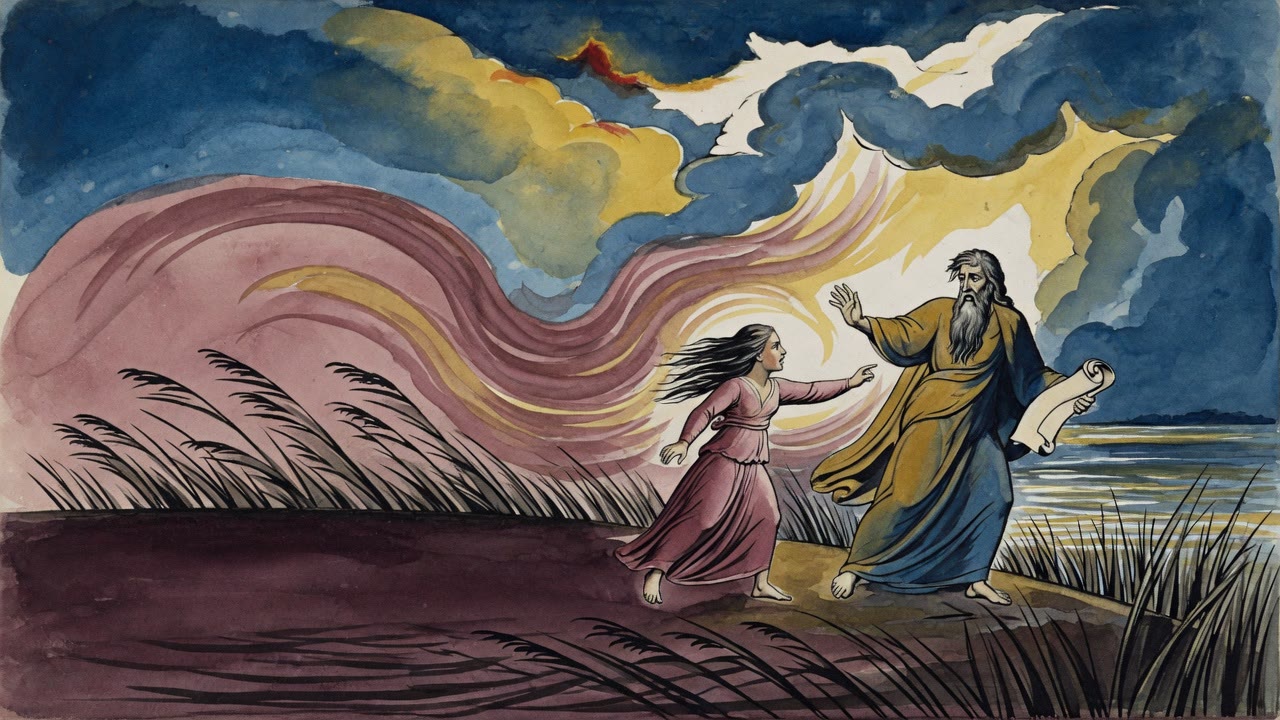
His daughter came to him about it. Miriam was a child.
"Father, your decree is harsher than Pharaoh's. He is only going after the boys. You are taking the girls too. He takes life in this world. You are stopping children from being born at all, which takes the world to come away from them as well. And he is wicked, so there is a chance his decree collapses. You are righteous. Yours will stand."
Amram had no answer. He carried it to the Sanhedrin, and the court told him that the man who had separated the couples was the man who had to unseparate them. He suggested everyone quietly take their wives back at home. The court refused. Who would ever hear about it?
So Amram stood under a wedding canopy in public and remarried Jochebed, and Aaron and Miriam danced circles around the canopy while angels called out over it, "Let the mother of children be joyful." Every man who had copied him the first time copied him again. And Jochebed, who was old, got her youth back that day. The lines went out of her face, her skin softened, the color came back, and within a short time she was pregnant.
The Man in Fine Linen
Miriam dreamed. A man in fine linen stood over her and gave her a message for her parents: the child coming to them would be thrown into the water, and through him the water would go dry, and he would carry Israel out and lead them.
Her father had his own dream and woke up shaking.
Jochebed carried the child without pain and delivered him without pain. The moment he arrived, the whole house filled with light like the sun and the moon had come indoors. He was not a day old when he stood up and walked and talked with his parents like a grown man, and refused his mother's breast.
He came at six months. The Egyptian officers who tracked every pregnant Hebrew woman had him marked down for three months later, which bought the family three months of hiding a baby in a house with two Egyptian women posted on it, one inside the door and one outside.
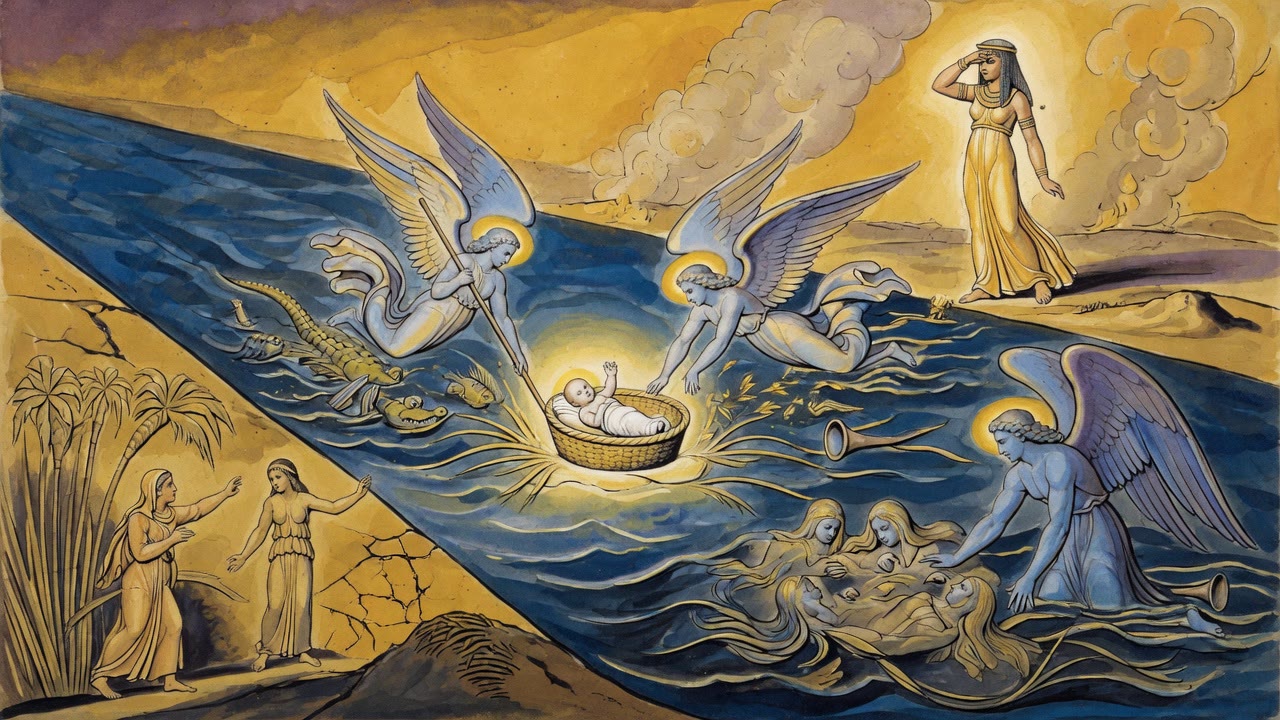
At the end of the three months Amram put him in the river rather than wait to be caught with him.
The Row of Nurses at the Riverbank
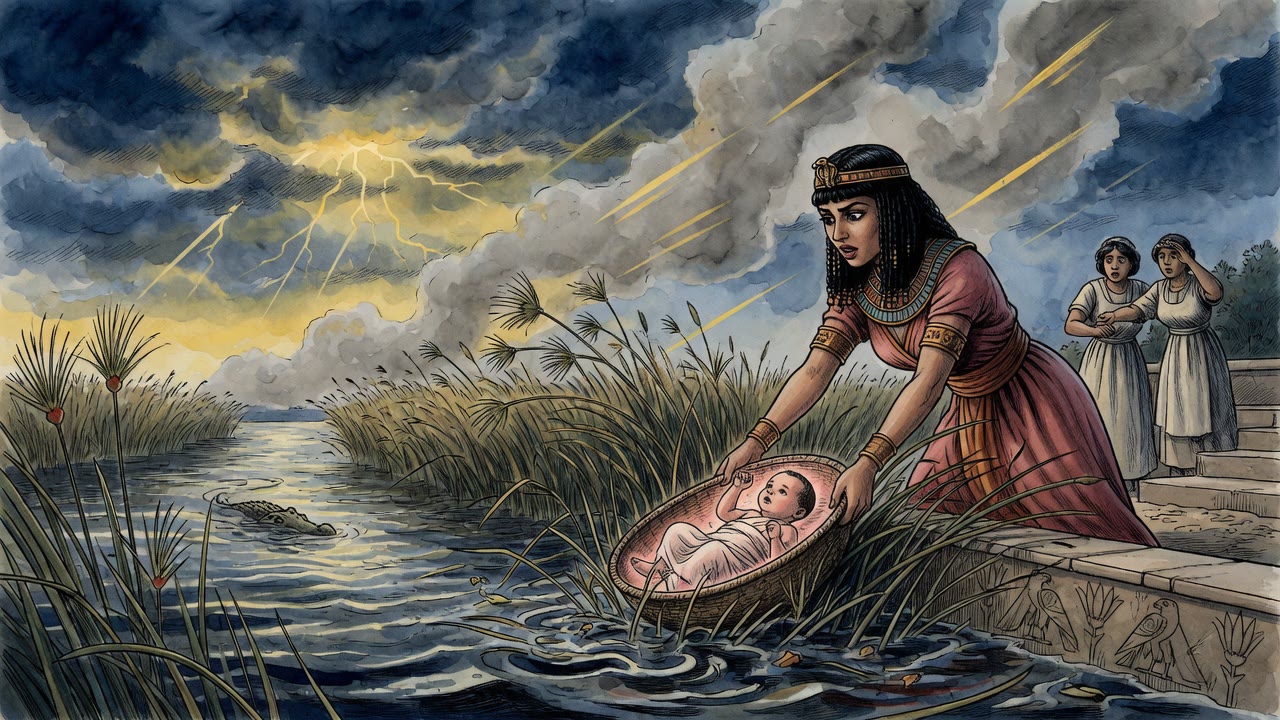
Thermutis, the daughter of Pharaoh, pulled the basket out of the Nile and kept the child.
Then she tried to feed him. Egyptian women were brought down to the water one after another, and the infant turned his head from every one of them. He would not take a single Egyptian breast.
The refusal was not his idea. The mouth that was going to speak with God was not going to take in something unclean first. And there was the other reason, the one about credit: some Egyptian woman would spend the rest of her life saying she had nursed the man who talks with the Divine Spirit.
So the princess of Egypt stood on the riverbank with a starving Hebrew baby, a line of failed wet nurses, and no idea what to do next.
What Miriam Said and What She Did Not Say
Miriam had been standing at a distance the whole time. She walked up as though she had wandered over to look at the baby like anyone else.
"It is no use, my queen, calling for nurses who are no relation to the child. If you send for a Hebrew woman, he may take her breast, since she is of his own people."
Every word of it was true. None of it was the whole truth. She did not say she was the child's sister. She did not say whose house she was about to walk into. Thermutis told her to go and fetch one, and she went, fast, running like a strong young man, and came back with her own mother, because nobody standing on that bank knew Jochebed's face.
The baby who had refused every woman in Egypt took his mother's breast and held on to it.
Here Is What Is Yours
Thermutis handed him over. "Here is what is thine," she said. "Nurse the boy from now on, and I will give you two silver pieces for your wages."
She was prophesying and did not know she was doing it. The words she used to hire a stranger meant, exactly, this one is yours, take him.
Jochebed got her son returned to her the same day she gave him up, and got paid Egyptian wages to raise him.
Forty years later, on the far side of a sea Moses had opened, the women of Israel came out of the water with timbrels in their hands. They had packed instruments before they left, because they expected there would be something to play about. Miriam went out in front of them and started the singing.
← All myths