4 min read

Moses Learned All Torah and Needed a Menorah

Moses learned all Torah on Sinai, then struggled to picture the menorah. Heaven answered with fire, patience, and a craftsman.

Curated by Arthur · Told by Maggid ·
Table of Contents
  1. Forty Days of Impossible Learning
  2. The Lamp He Could Not Hold in Mind
  3. The Voice Between the Wings
  4. The Fire Became Gold
  5. The Prophet and the Craftsman

Moses learned everything and still needed to see the lamp.

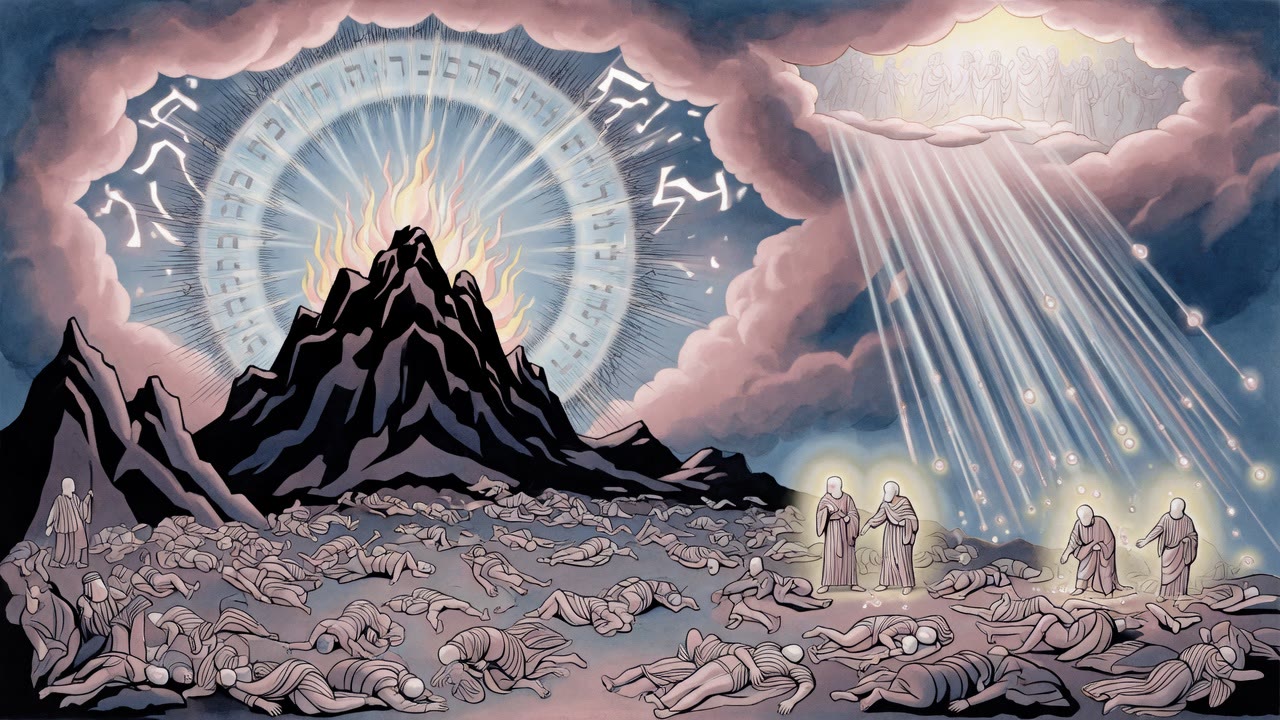
For forty days and forty nights, he stood on Sinai without bread or water. Heaven poured Torah into him: written law, oral law, argument, story, future question, future answer. A scholar not yet born would one day ask his teacher a hard question, and Moses received that answer on the mountain before the scholar's family had a name.

Then God described the menorah, and Moses could not picture it.

Forty Days of Impossible Learning

The mountain did not teach at human speed.

Moses received more than commandments. He received the shape of a civilization's learning: Mishnah, Talmud, narrative, law, dispute, memory, the future voices of students bending over words. Forty days held centuries. The human mind should have shattered under the weight.

But Moses remained there, empty of food and full of speech. The people below counted days and grew afraid. Above them, their teacher was being made into a living archive. When he came down, he carried not only tablets but the seed of every house of study Israel would ever build.

The Lamp He Could Not Hold in Mind

The menorah stopped him.

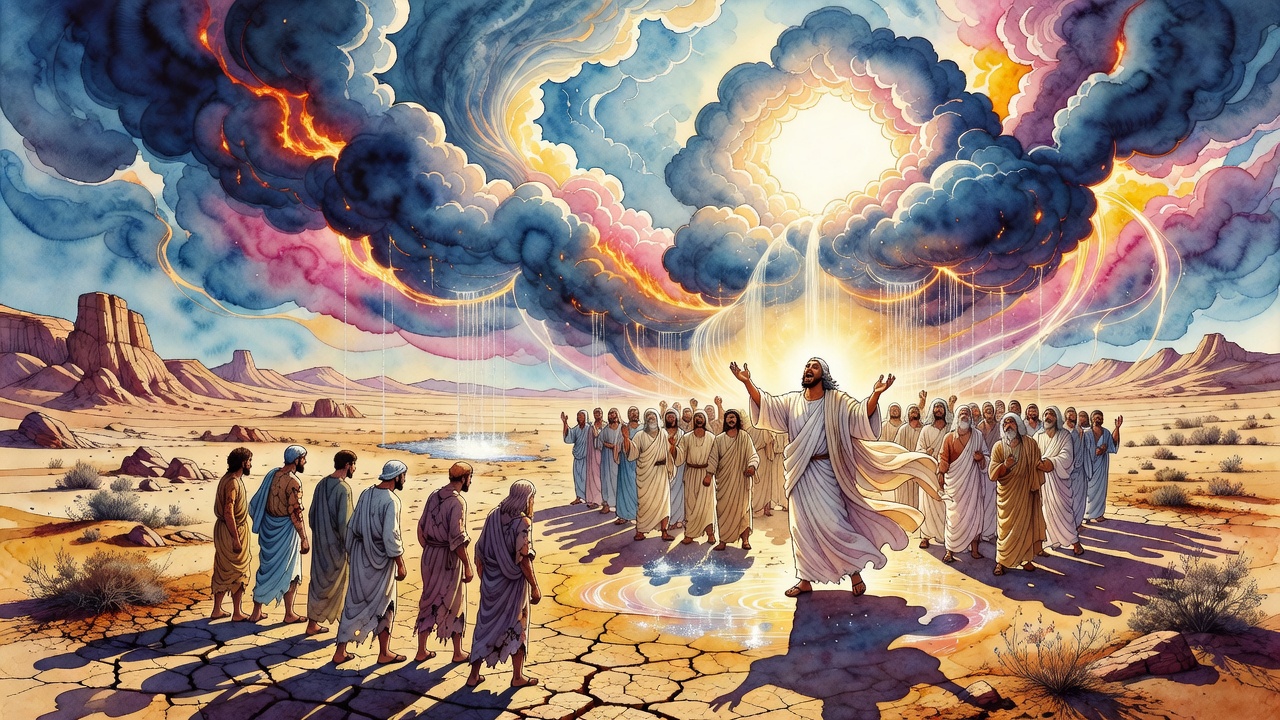
God said it should be made of pure gold, hammered from one piece, with branches, cups, knobs, flowers, and lamps. Moses listened. The form would not settle. Instruction entered his ears and dissolved before his imagination could hold it.

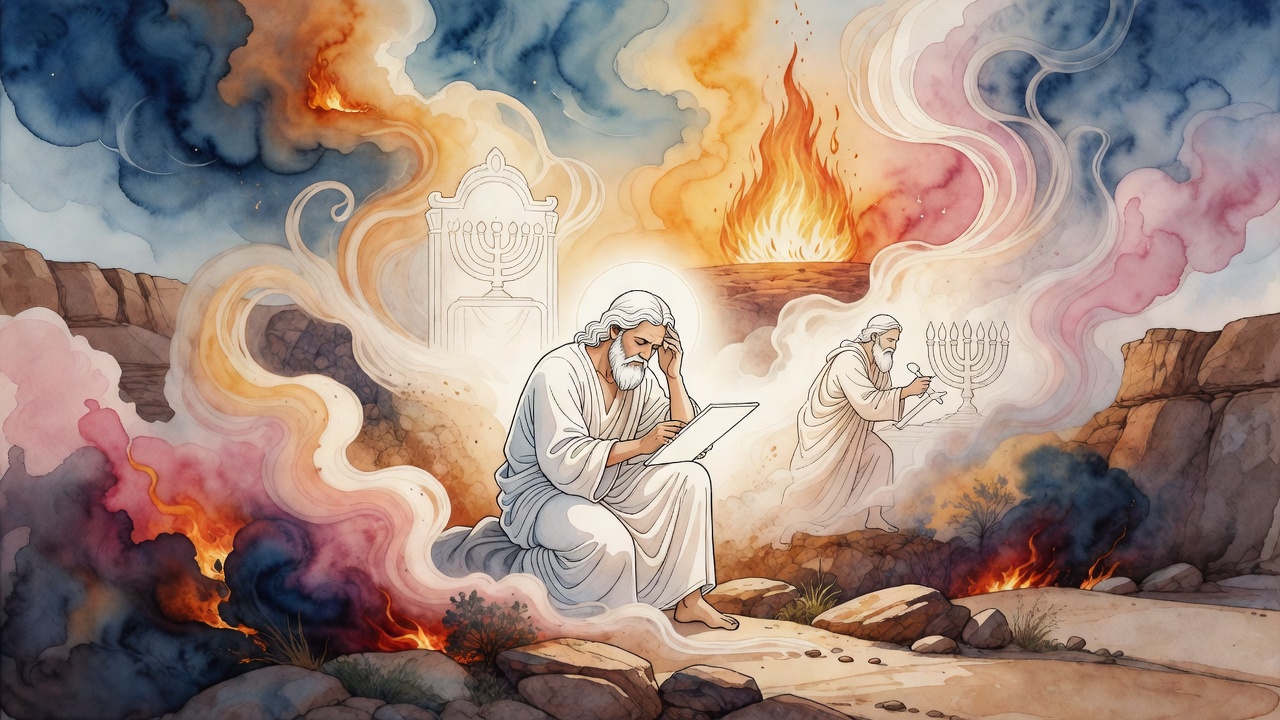
So God showed him a menorah of fire.

Even that did not end the difficulty in every telling. Some knowledge can be spoken. Some must be seen. Some must be watched as skilled hands bring it into matter. The greatest prophet could receive all Torah in forty days and still need a visual pattern for one sacred object.

The branches mattered. The cups mattered. The flowers mattered. A lamp for the sanctuary could not be mostly right, because mostly right light is still a distortion when it stands before God. The object had to teach by shining, and a crooked teaching would have entered the holy place every morning. Moses had to learn not only the law of the lamp, but its posture, balance, and silence.

The Voice Between the Wings

Moses' difficulty was not stupidity.

He stood at the border where invisible form becomes visible work. The same mystery surrounded the divine voice. Did God speak to him from the Tent of Meeting or from the Ark? The answer was both more precise and stranger: the voice came from between the cherubs, focused in the holy place, heard by Moses and not leaking outward to those beyond the entrance.

Revelation was exact. It did not spill like noise. It arrived where it was meant to arrive, to the person appointed to hear it, from the place where heaven chose to narrow itself into speech.

The Fire Became Gold

The menorah of fire was not the Tabernacle lamp.

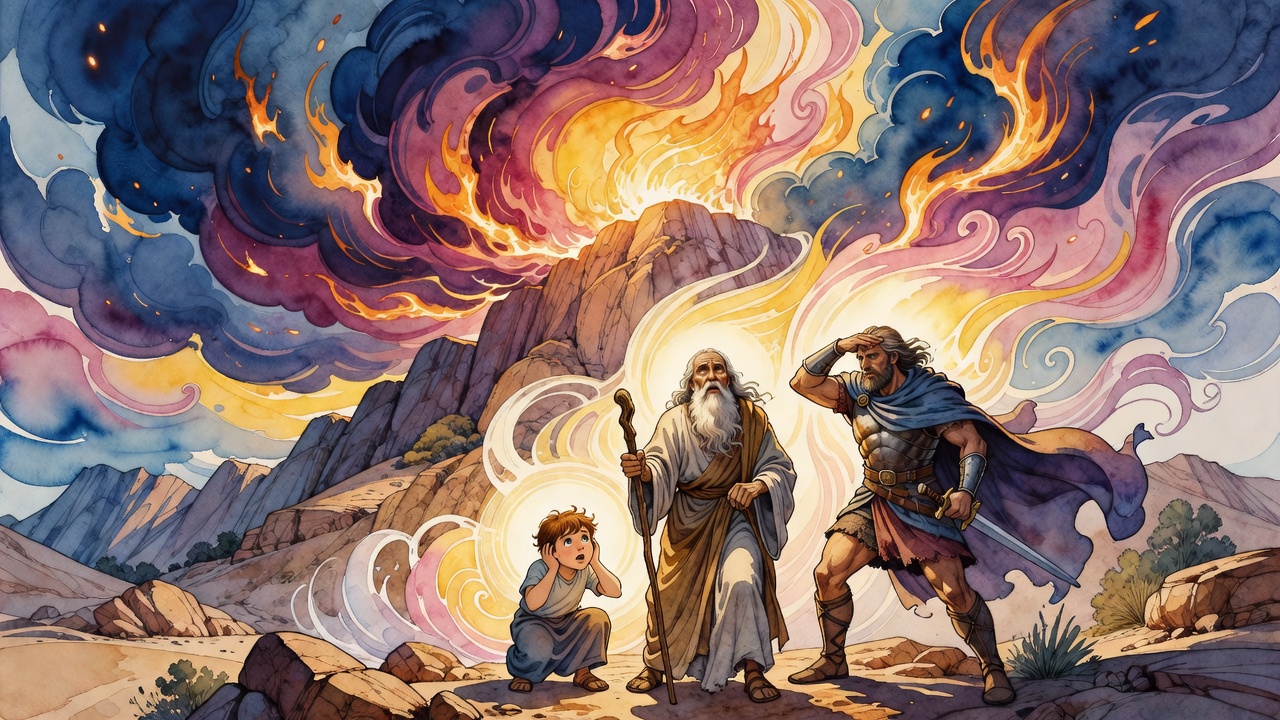
It was the pattern. Gold had to answer fire. The earthly object would be hammered, shaped, lifted, and lit, but its first form belonged above. Moses was not inventing a ritual instrument. He was receiving a heavenly shape and bringing it down far enough for craftsmen to make it without destroying its meaning.

That is why the failure to picture it matters. A thing from heaven may exceed the mind before it enters the hand. Moses' humility lay in asking again. God's patience lay in showing again.

The Prophet and the Craftsman

At the end, the menorah needed workmanship.

Sinai gave the command. Fire gave the pattern. A craftsman gave the object its final earthly body. Moses did not become less because he had to watch. Prophecy and craft met in the gold. The lamp that would stand in the Tabernacle needed both heavenly instruction and human skill.

That is the strange comfort of the story. Even Moses did not receive revelation as a simple download. He listened, failed to see, asked, saw fire, watched work, and learned. The Torah could enter him whole. The menorah had to be shown.

The light in the sanctuary came from that partnership: God speaking, Moses straining, fire revealing, hands hammering gold until the form finally held.


← All myths

From the tradition

Sources

5 sources

The texts this telling draws on, in full. Open a card to read inline, or expand it for a wider, quieter read.

Legends of the Jews 2:132Legends of the Jews

Those forty days and nights were a whirlwind education. Ginzberg’s Legends of the Jews tells us that Moses received it all up there: not just the Torah – the Five Books of Moses – but also the Mishnah, the Talmud, and the Haggadah (non-legal rabbinic narrative). Basically, everything! Even all those questions future scholars would ask their teachers – Moses got the answers in advance. It’s mind-boggling, isn't it?

So, with all that knowledge downloaded into his brain, Moses naturally asked God, "Shouldn't we just write this whole thing down and give it to the people?" Makes sense. But God, in his infinite wisdom, had a reason for saying no. A fascinating reason, actually. God foresaw a future where other nations would translate the Torah into Greek and claim, “We are the true Israel, the children of God!”

How would God respond? According to this legend, he'd say, “Oh really? You claim to be my children? Do you even know my secret? I entrusted the Oral Torah to my true children – it’s their inheritance!”

That's why, the legend explains, Moses only received the Pentateuch – the Five Books – in written form. The rest, the Oral Torah, was transmitted by word of mouth, generation after generation. This Oral Torah, things like Mishnah and Talmud, it’s the ongoing interpretation, the lively debate, the living heart of the tradition.

The covenant God made with Israel, therefore, included both a written and an oral Torah. As we find in Midrash Rabbah, it came with a pretty serious warning: “I gave you a written and an oral Torah. My covenant with you says that you shall study the written Torah as a written thing, and the oral as an oral; but in case you confound the one with the other you will not be rewarded.” It’s not just about knowing the words, but understanding the way they're meant to be studied and lived.

And the stakes were high! "For the Torah's sake alone have I made a covenant with you," God says. "Had ye not accepted the Torah, I should not have acknowledged you before all other nations." Before accepting the Torah, they were just like any other nation, but through the Torah, they were elevated.

Even Moses himself, the greatest prophet, owed his distinction in this world and the next to the Torah. Had Israel not accepted the Torah, the legend concludes, God would have dissolved the upper and lower worlds into chaos. Whoa.

So, the next time you think about the Torah, remember it's not just a book. It’s a living, breathing tradition – a conversation that’s been going on for thousands of years, with both a written and an oral component. It’s a secret entrusted to a people, a source of distinction, and, according to this powerful legend, the very foundation of the world. What a responsibility, what a privilege!

Full source
Bamidbar Rabbah 15:10Bamidbar Rabbah

The story of the menorah, the candelabrum in the Tabernacle, as told in Bamidbar Rabbah 15, is a wild ride about just that. It's a reminder that even Moses, the ultimate receiver of divine wisdom, had his moments of "Wait, what?"

Rabbi Levi bar Rabbi starts us off: This wasn't just any menorah. A pure candelabrum, already perfect, descended from Heaven! God tells Moses, "Craft a candelabrum of pure gold" (Exodus 25:31). Simple. Moses asks, "Okay, how exactly?" God replies, "The candelabrum shall be crafted hammered" (Exodus 25:31).

Moses comes down from on high, and poof! He's forgotten the instructions. He goes back up. "How do I craft it?" he asks again. Same answer: hammered.

This happens multiple times. Up, down, forget, repeat. Finally, Moses throws his hands up (metaphorically, of course). "Master," he says, "I forgot it again!"

God, in His infinite patience, even shows him a fiery menorah, a visual aid straight from the source. Still, Moses struggles.

Can you imagine the frustration? You're Moses! You parted the Red Sea! You received the Ten Commandments! And you can't figure out a candelabrum!

Finally, God has an idea. "Go to Betzalel," He says, "and he will craft it."

Betzalel, the artisan, takes one look and immediately crafts it. No problem!

Moses is understandably bewildered. "I saw it multiple times, shown to me by God Himself, and I couldn't do it. But you, who didn't even see it, crafted it on your own? Betzalel, were you standing in God’s shadow [betzel El] when the Holy One showed me its crafting?" (There's a beautiful play on words here, as Betzalel's name literally means "in the shadow of God.")

What does this all mean? Was Moses just having an off day? Was Betzalel divinely inspired in a different way? Maybe it's a reminder that even the greatest leaders need help, that different people have different gifts. Or perhaps, as some commentators suggest, it highlights the importance of practical skill alongside divine revelation. Some things just need a craftsman's touch.

The story doesn't end there. It also tells us that when the Temple was destroyed, the menorah was sequestered, hidden away. Along with the Ark, the fire, the Divine Spirit (Shekhinah), and the cherubs. These five items, the very heart of the Temple, were taken out of our reach.

But there's hope. The story concludes with a promise. When God, in His mercy, rebuilds His Temple, He will restore these treasures to their place, bringing joy to Jerusalem. As the prophet Isaiah says, "Wilderness and wasteland will be glad; the desert will rejoice" (Isaiah 35:1); "It will blossom and rejoice" (Isaiah 35:2).

So, next time you're struggling with something, remember Moses and the menorah. Even the most brilliant among us need help sometimes. And remember that even in times of darkness, there's always the promise of restoration, of light returning to its rightful place.

Full source
Tikkunei Zohar 56:20Tikkunei Zohar

Jewish mysticism grapples with these questions constantly, and sometimes, the answers are found in the most unexpected places.

Like, say, a single letter.

The passage starts with a head-scratcher: what caused a certain unnamed event? The answer, according to the Tikkunei Zohar, lies in the Yod (י), the smallest letter in the Hebrew alphabet. But not just any Yod. This is the Yod from ShaDaY (שדי), one of the names of God, often translated as "Almighty." Here, it's described as the "impression of the covenant" – referring specifically to the covenant of circumcision, Brit Milah.

What does this have to do with Moses? The text claims that Moses gave this Yod, this symbol of the covenant, to the "mixed multitude" – those non-Israelites who left Egypt alongside the Israelites.

And that's where the trouble begins.

The Tikkunei Zohar suggests that this act – giving the symbol of the covenant to those who weren’t necessarily ready for it, or perhaps weren’t meant to receive it in that way – caused Moses to be lowered from his spiritual level. Ouch.

The text then quotes (Exodus 32:7), where God tells Moses to "Go! Descend! For your people have corrupted..." Notice the shift? God refers to them as "your people," not "My people." The implication is clear: Moses’s actions created a distance between God and the people. A single act, even one seemingly done with good intentions, can have profound consequences. It's a heavy idea, isn't it?

But here's the kicker. The Tikkunei Zohar doesn't leave us in despair. It offers a path to redemption. It states that by Moses's hand – the very hand that, according to this interpretation, caused the separation between the Shekhinah (the divine feminine presence) and the Holy One – the blessed Holy One is destined to be reunited with the Shekhinah. Because he separated them, he needs to unite them - to fix what he had done wrong.

In other words, Moses has the power to rectify his mistake. To bring wholeness back to the divine.

The passage ends with a powerful image: "All the companions rose and kissed him, and they each said: ‘If we had not come to the world except to hear this, it would have been enough.’"

This reaction emphasizes the profound impact of this teaching. The idea that even our greatest leaders can make mistakes, but also have the potential to repair them, is incredibly comforting. It reminds us that tikkun olam – repairing the world – is an ongoing process.

So, what can we take away from this intriguing passage? Perhaps it's a reminder to be mindful of the impact of our actions, even the smallest ones. To consider the potential consequences of our choices. And most importantly, to remember that even when we stumble, we have the power to make amends, to heal, and to bring the divine back into wholeness.

Full source
Sifrei Bamidbar 58:1Sifrei Bamidbar

Sifrei Bamidbar turns to Where Did God Speak to Moses - the Tent or the Ark.

This seeming contradiction is addressed in Sifrei Bamidbar, a collection of rabbinic legal interpretations on the Book of Numbers. It grapples with the verse, "And when Moses came to the tent of meeting..." (Numbers 7:89). Why does the Torah even need to tell us this? We already know God spoke to Moses from the Tent! As we see in (Leviticus 1:1), "And the Lord spoke to him from the tent of meeting.”

The text highlights the apparent conflict: (Exodus 25:22) states, "And I will be appointed for you (to speak to you) there, and I will speak to you from above the kaporet (the ark cover)." It seems impossible to reconcile these verses. How can it be both from the Tent and from above the Ark?

The Sifrei explains that this is a classic case of seemingly contradictory verses. "Two verses which contradict each other are to 'remain in their place' until a third verse comes and reconciles them." And that third verse? (Numbers 7:89) itself: "And when Moses came to the tent of meeting."

This verse, according to the Sifrei, reveals the process. Moses would enter and stand in the Tent of Meeting. Then, the Divine Voice would descend from the highest heavens, all the way down to the space between the two cherubs on the Ark cover. And there, in that holy space, Moses would hear God's voice. Think of it! The voice traveling from the highest heaven to this specific point.

It’s a powerful image, isn’t it?

But the Sifrei isn’t done yet. Rabbi Yehudah ben Betheira offers another layer of understanding. He points out thirteen instances where God speaks to Moses, using language that seems to include Aaron, but in reality, only addresses Moses. These thirteen "exclusions," as he calls them, teach that while the communication happened in their shared presence, the message was specifically for Moses to then relay to Aaron.

Consider (Exodus 25:22): "And I will be appointed for you there, and I will speak with you, all that I shall command you." Sounds like both Moses and Aaron. But Rabbi Yehudah ben Betheira says, no. This, and twelve other similar instances – including verses from Exodus, Leviticus, and Numbers – highlight Moses’ unique role as the primary receiver of divine instruction.

These exclusions, scattered throughout the Torah, underscore the unique relationship between God and Moses, a relationship of direct communication and divine instruction. Other examples include (Exodus 30:6) ("where I will be appointed for you") and (Numbers 7:89) ("And when Moses came to the tent of meeting to speak with Him").

So, what do we take away from all of this? Perhaps it's a reminder that even seemingly contradictory texts can hold profound truths. That by delving deeper, by exploring the nuances and layers of meaning, we can gain a richer understanding of the divine-human relationship, and especially the unique role of Moses as a prophet. It also reminds us that sometimes, understanding requires recognizing who is not being addressed, as much as who is.

Full source
Pirkei DeRabbi Eliezer 46:2Pirkei DeRabbi Eliezer

Rabbi Joshua, son of Ḳorchah, gives us a powerful image in Pirkei DeRabbi Eliezer 46. He recounts the story of Moses on Mount Sinai. Forty days and nights, he was there, absorbing the Torah, both the Written Law we find in the Tanakh (Hebrew Bible) and the Oral Law, the interpretations and traditions passed down through generations.

Can you imagine the weight of that moment when Moses descended? He carried the tablets, the very words of God etched in stone. But what awaited him? A heartbreaking betrayal – the Golden Calf. In a moment of righteous anger and profound disappointment, Moses broke the tablets on the 17th of Tammuz. The day is still remembered each year as a day of tragedy and mourning.

The story doesn't end there. Moses didn't just give up. According to Pirkei DeRabbi Eliezer, he spent another forty days in the camp, cleansing it of idolatry. He destroyed the Calf, grinding it to dust, and re-established order, placing each tribe in its rightful place. A monumental task of spiritual and communal repair.

Then, on the New Moon of Ellul – the month preceding Rosh Hashanah (the Jewish New Year) – God called Moses back up the mountain. But this time, there was a crucial difference. God commanded that a shofar be sounded throughout the camp. Why? To announce Moses' ascent and, more importantly, as a warning: "…so that they do not go astray again after the worship of idols." A sonic fence, if you will, a constant reminder of the covenant and the consequences of straying.

Pirkei DeRabbi Eliezer tells us that God was "exalted with that Shofar," referencing (Psalm 47:5), "God is exalted with a shout, the Lord with the sound of a trumpet." The sound of the shofar wasn't just a signal; it was an expression of God's presence, a call to repentance, a sonic beacon guiding the people back to the path.

And that's why, according to the sages, we blow the shofar every year on the New Moon of Ellul. It's a powerful act of remembrance, a call to introspection, and a renewal of our commitment to the covenant. It's a chance to shake off the dust of our own "golden calves" – the distractions and temptations that lead us astray – and to prepare our hearts for the High Holy Days. It’s an invitation to climb our own metaphorical mountain and reconnect with the Divine.

Full source