Why Dan Marched Behind Naphtali and Not Alone
Dan was prone to idolatry and placed at the rear of the camp. The tribes beside them were not chosen at random to fill a gap in the formation.
Table of Contents
 Click for full size
The Camp That Was Also a Therapy
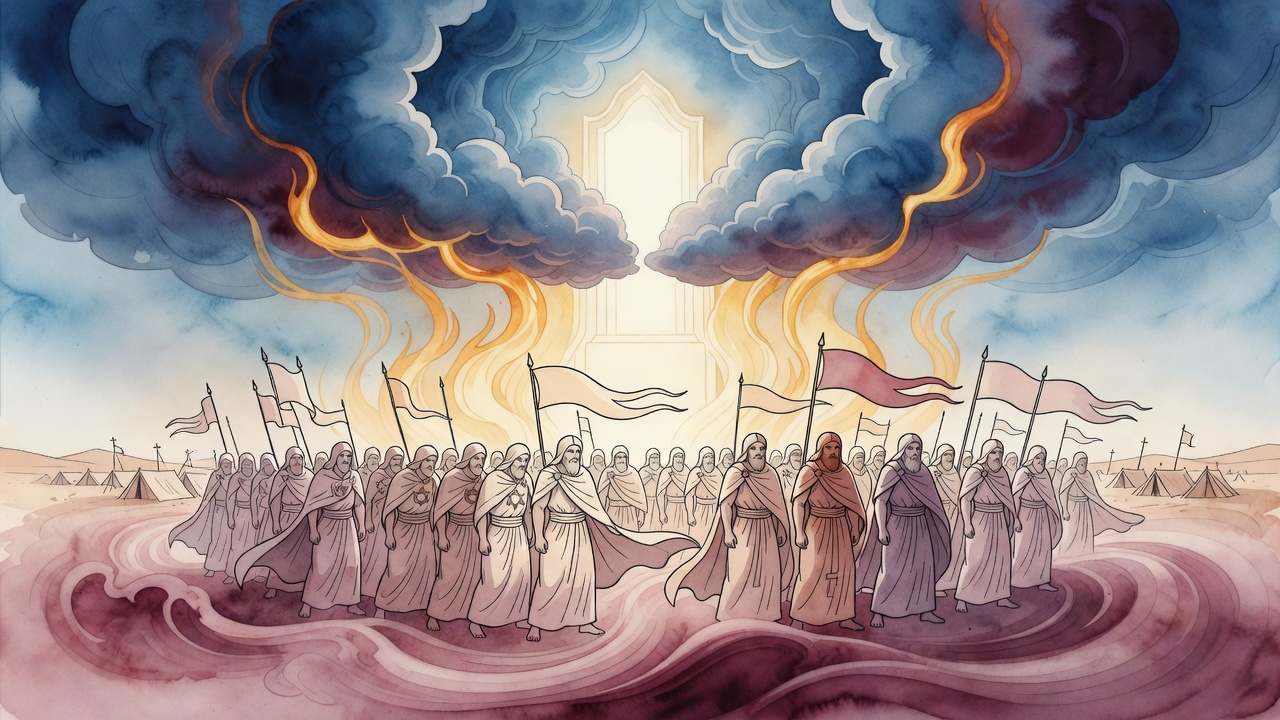
When God arranged the Israelite camp in the wilderness, the placement looked like military organization: four great banners, three tribes to each banner, compass points assigned, marching order fixed. It was orderly. It was also something else.
The rabbis who studied the groupings could not accept that the assignments were purely tactical. Twelve tribes, four banners, and every pairing deliberate. Some tribes were placed beside others because their proximity would be strengthening. And the rear banner, the last standard to leave camp and the last to arrive, was a specific kind of arrangement. The tribe at its center needed its neighbors.
What Dan Carried That the Sages Recorded
Dan was the problem tribe of the rear banner. The tradition was plain about this. Even before leaving Egypt, Dan had harbored idolatrous instincts, a pull toward making something concrete and visible to stand in for the God who could not be seen or touched or carried in a pocket. This was not a charge leveled against a few individuals. It was described as a tribal disposition, something in Dan's collective character that made the Golden Calf understandable and the later shrines at Bethel and Dan historically predictable.
The tradition also held that from Dan's line would eventually come a figure whose leadership would mislead Israel, a false shepherd who would appear convincing enough to draw people after him. The stone on the High Priest's breastplate for Dan showed an inverted face. The tribe of judges, with a genuine gift for ruling and discernment, had a tendency to apply that gift in the wrong direction.
Dan was not abandoned in the camp. Dan was positioned so that the failure, if it came, would be contained.
Who Was Placed Beside Dan
Asher and Naphtali flanked Dan in the rear banner. Neither placement was accidental. Asher's calling was intercession, the tribe that spoke for the condemned after the sentence had been rendered. Placed beside a tribe prone to drawing others toward transgression, Asher occupied the position of the one who could still make a case for mercy when things had already gone wrong.
Naphtali was the tribe of the swift messenger, the bearer of good news, the deer let loose that could run ahead of any army. Ahira son of Enan, Naphtali's prince at the time of the dedication, carried in his own name the dual character of the tribe: Ahira meant desirable meadow, and Enan meant clouds, the source of rain on that meadow. Naphtali's land was fertile because it received what came down from above. Placed beside Dan, a tribe that looked downward toward the tangible, Naphtali offered the habit of looking up.
What Eliasaph and Gad Added
The broader camp arrangement connected Dan's rear banner to the other standards through a principle the tradition found consistent. Gad marched with the same banner in some configurations, and Gad's prince was named Eliasaph, meaning God multiplied, and his father was Deuel, meaning God is a witness. The tribe of Gad had proven itself at the Jordan, promising to cross and fight even after they had already received land east of the river. They were the tribe that made and kept the commitment when they had no material reason to do so. Their proximity to Dan was therapeutic in the same way Naphtali's was: a tribe that looked upward for confirmation placed beside a tribe that kept looking at the ground.
← All myths