5 min read

Noah Built the Ark From Cypress and Waited

Noah built with cypress, carried the drowned world's future, waited for God to reopen the ark, and watched the dove stop returning.

Curated by Arthur · Told by Maggid ·
Table of Contents
  1. The Wood Had to Fit the Command
  2. Wisdom Held More Than Ten Generations
  3. The World Was Handed to Noah
  4. The Dove Found a Place to Stay
  5. The Ark Did Not Save Noah From Waiting

Noah did not choose the wood.

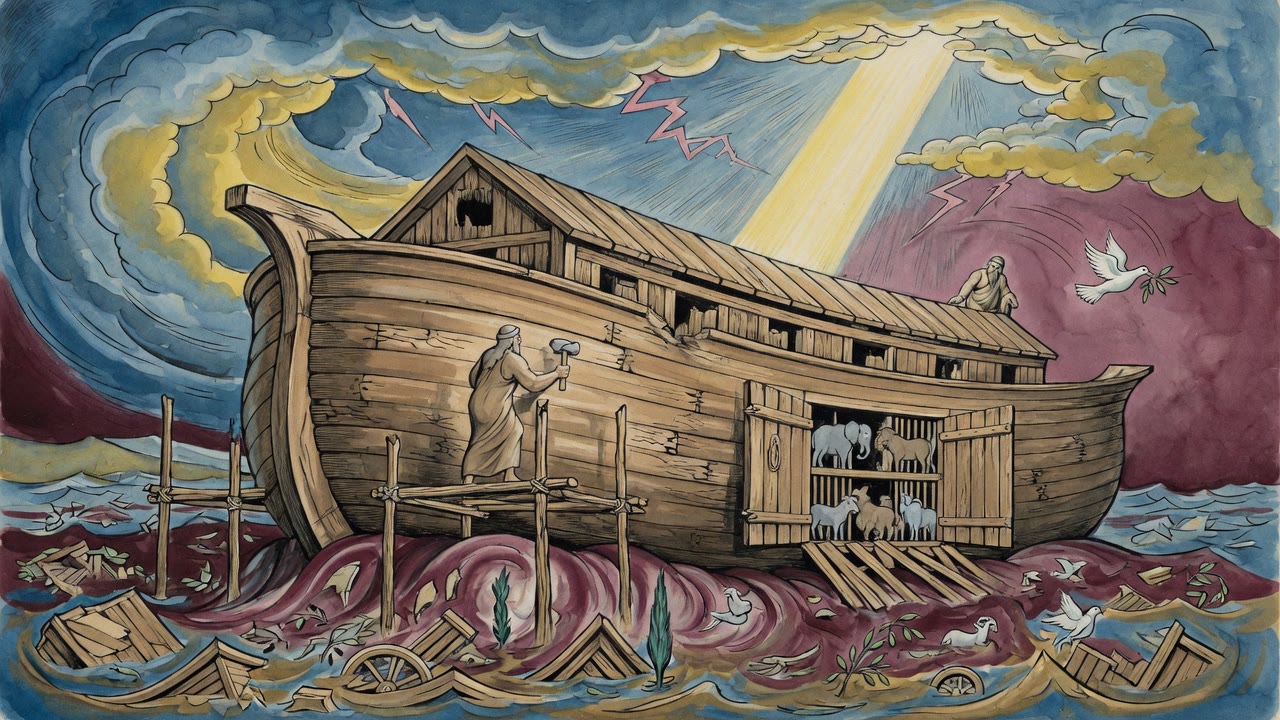
The command came with a material inside it: make an ark of cypress, gofer wood. The word appears like a sealed plank in the Torah, rare and stubborn. A generation was going under water. The future would be built from one named material, board by board, while the world outside kept laughing or rotting or both.

Noah built what he was told.

The Wood Had to Fit the Command

Bereshit Rabbah notices that not every command names its material.

Sometimes Torah says only make, and wisdom must infer the substance. When God later tells Moses to make a serpent, Moses reasons from the word itself and chooses copper, because nachash and nechoshet belong together. A wise person hears the command and learns what the command is asking to become.

For the ark, God names the material from the start.

Cypress is not left for Noah to infer. The vessel that would carry human and animal life through judgment needed its own commanded body. The ark was not Noah's invention. It was obedience shaped as architecture, a house of wood sealed with pitch while the sky prepared to open.

Wisdom Held More Than Ten Generations

Kohelet Rabbah calls wisdom stronger than ten rulers in a city, and then points to Noah.

Ten generations stretched from Adam to Noah. They had names, years, children, cities, violence, and all the ordinary weight of human history. But when corruption filled the earth, God spoke to Noah.

Wisdom held one man more firmly than ten generations held the world.

That is not a compliment to Noah's charm. It is a measure of survival. The many had numbers. Noah had instruction. The many had momentum. Noah had a command with dimensions, wood, pitch, compartments, animals, food, and a door that would close before the water came.

The ark began as wisdom obeyed in public long before wisdom looked useful.

The World Was Handed to Noah

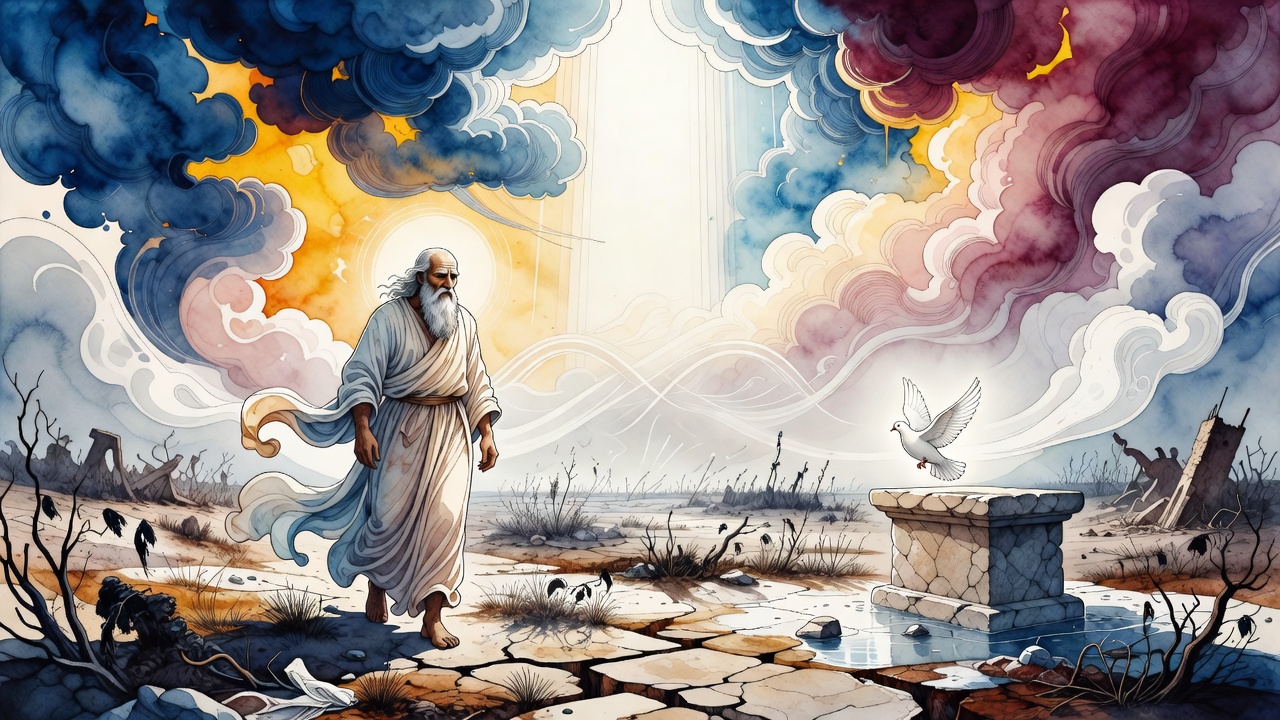
After the waters receded, God told Noah to go out.

Bereshit Rabbah hears dignity in that command. During the flood, the world had been entrusted to Noah like a post given temporarily to a steward. He fed, guarded, endured, and waited inside a floating remnant of creation. When the Master returned the world to dry ground, the steward had to be released.

Noah did not burst out simply because land appeared. He had entered by command, and he left by command.

The door mattered. The flood had turned the ark into the only habitable place under heaven. Leaving it required more than impatience. The world outside had to become world again.

The Dove Found a Place to Stay

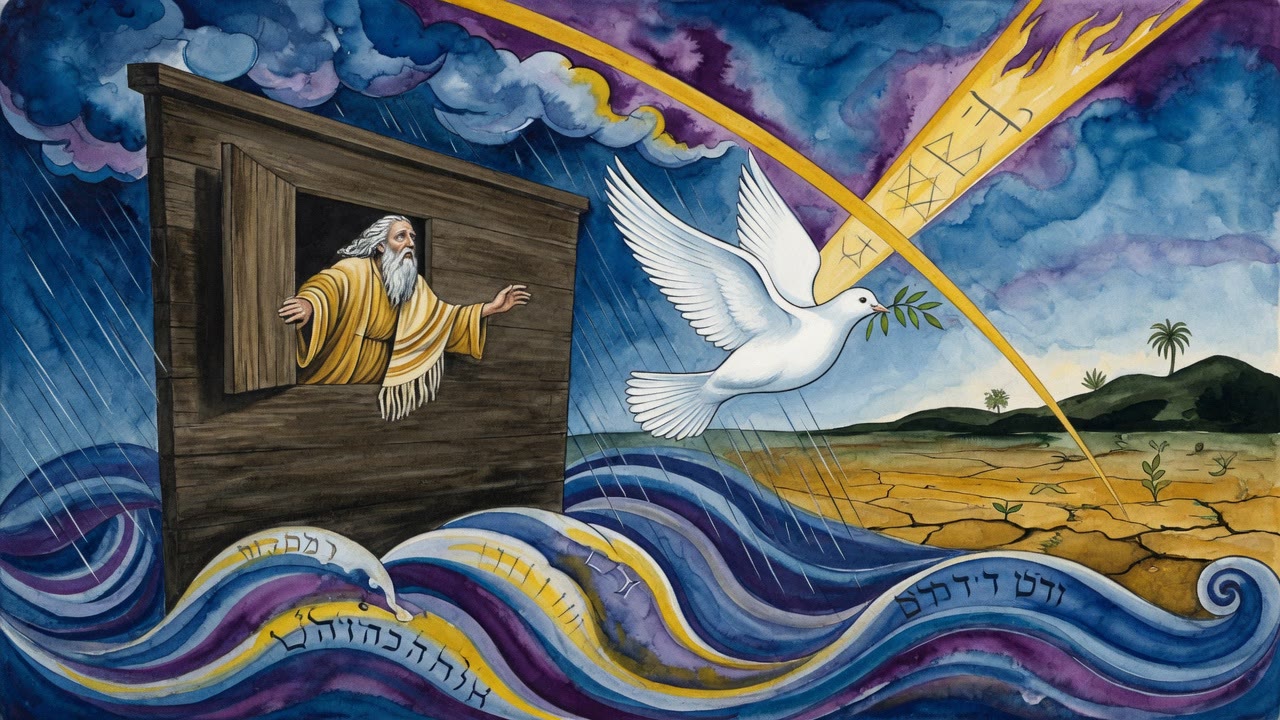
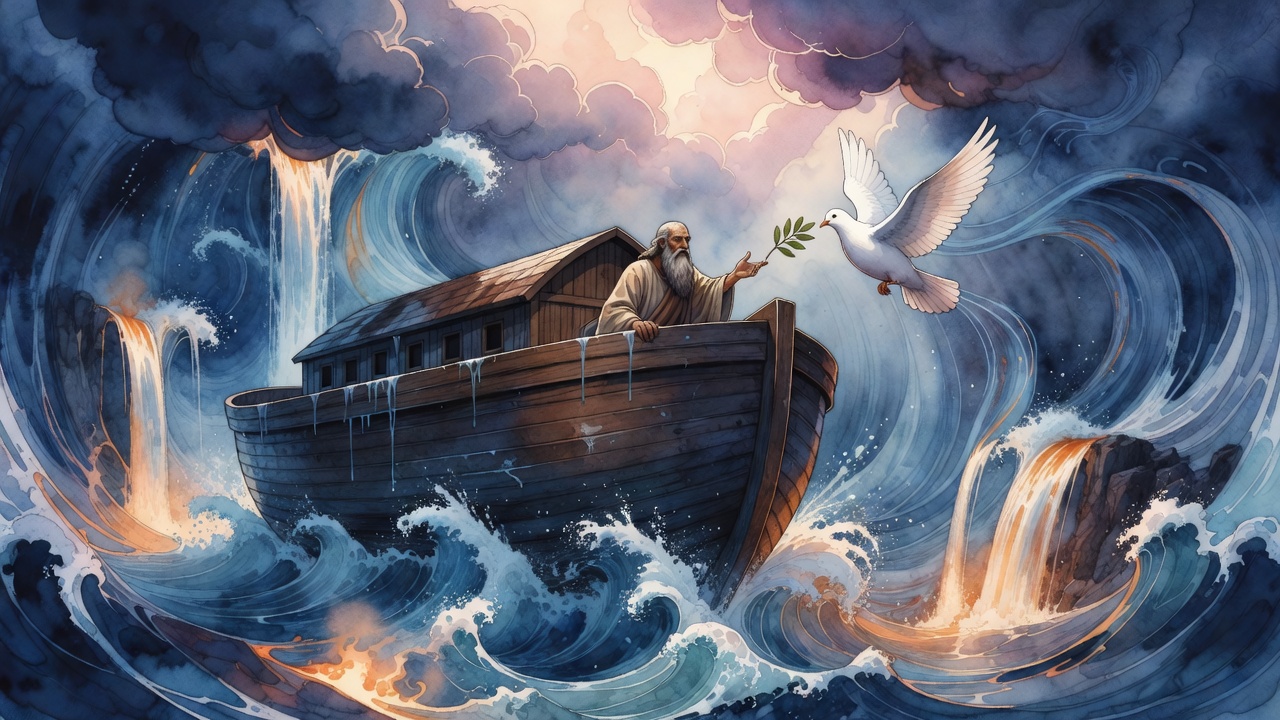
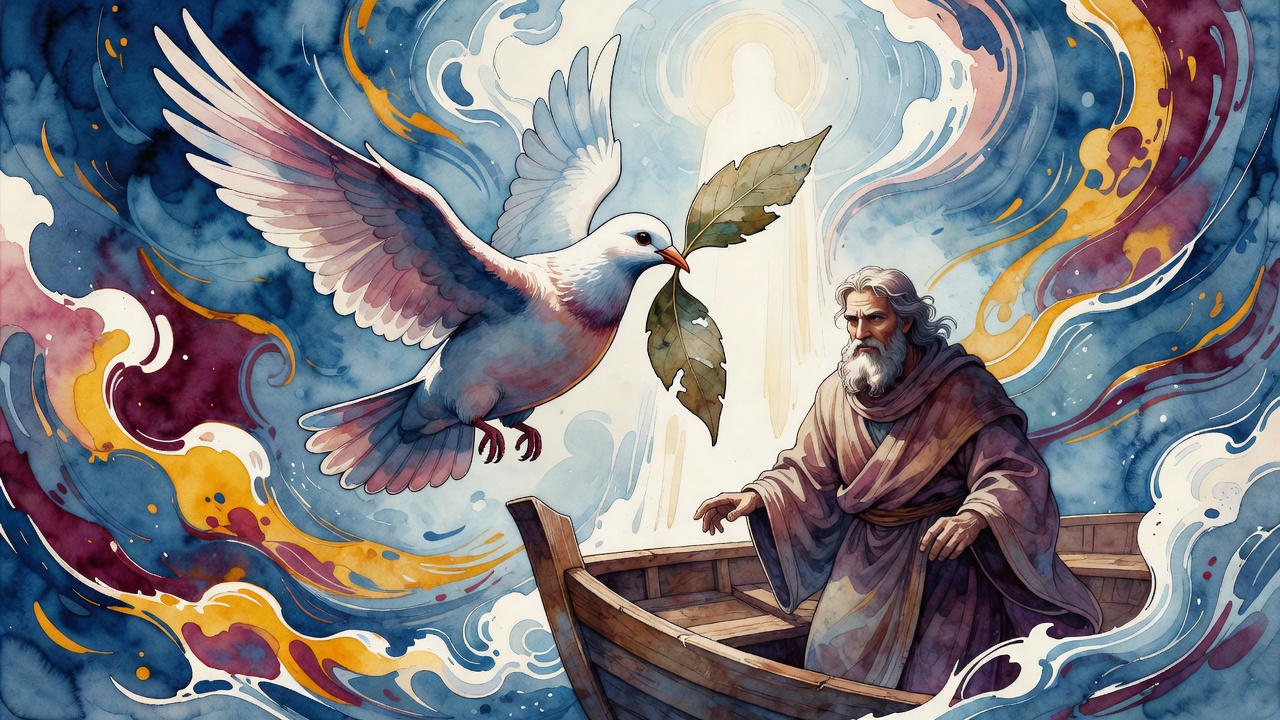
The raven went. The dove went. The dove returned with an olive leaf, and hope entered the ark in its beak.

Then Noah waited seven more days and sent the dove again. It did not return.

The Midrash of Philo asks why. The fragment leaves room rather than locking the door. Seven days suggest completion, a creation cycle turning again after destruction. The dove may have found rest and food on the recovering earth. It may have done its work and stayed where new life could begin.

That silence was a sign too. The first return said the earth was almost ready. The second non-return said the world no longer needed every living thing to retreat back into the ark.

The Ark Did Not Save Noah From Waiting

Survival is not the same as arrival.

Noah survived the rain, but he still had to wait for the ground, the bird, the command, and the courage to step into a washed world. The ark that saved him also confined him. The wood that obeyed God became walls around every sound of animal hunger, human fear, and water striking the roof.

Then came the door.

Noah left because God told him to leave. Behind him stood cypress, pitch, stalls, darkness, and the smell of survival. Ahead of him stood earth not yet steady under human feet. The dove had already chosen the outside. Noah followed more slowly, carrying the terrible wisdom of the man who knew that a world can end, and that a command can still ask a person to build.

The first step was as commanded as the first plank.


← All myths
From the tradition

Sources

4 sources

The texts this telling draws on, in full. Open a card to read inline, or expand it for a wider, quieter read.

Bereshit Rabbah 31:8Bereshit Rabbah

The verse in Genesis (6:14) states: "Craft for you an ark of cypress wood; you shall craft the ark with compartments, and you shall coat it within and without with pitch." Now, Rabbi Isi points out something interesting: the word "craft" (aseh in Hebrew) appears four times in the Torah, but only three times is the material specified. Why this variation?

Rabbi Natan offers a clarification: The ark was to be made of kardinon wood, which is another way of understanding the Hebrew word gofer (cypress). We do get specific materials in other instances, like when God commands "Craft for you flint knives" (Joshua 5:2) or "Craft for you silver trumpets" (Numbers 10:2). So what about the time when the material isn't specified?

That's where the story gets really interesting. In (Numbers 21:8), God tells Moses, "Craft for you a serpent." But of what? Rabbi Yudan, citing Rabbi Aivu, uses this as a lesson, drawing from (Proverbs 1:5): "Let the wise man hear and gain a lesson." God doesn’t tell Moses what to make the serpent out of. Why?

In Rabbi Yudan, Moses reasoned, "If I craft it of gold, the word 'serpent' [naḥash] has no connection to 'gold' [zahav]. If of silver [kesef], no connection either." But, he continues, "I will craft it of bronze [neḥoshet], as the words are related." And that’s exactly what happened: "Moses crafted a bronze serpent [neḥash]" (Numbers 21:9).

Isn't that remarkable? The connection between "serpent" and "bronze" exists only in Hebrew. This leads to a profound conclusion: the Torah was given in the sacred tongue, Hebrew. As Rabbi Pinḥas and Rabbi Ḥizkiya state in the name of Rabbi Simon: Just as the Torah was given in the sacred tongue, so, the world was created in the sacred tongue. The very fabric of reality, the building blocks of creation, are intertwined with the Hebrew language.

The passage goes on to illustrate this point further with the words for "man" and "woman." Have you ever heard anyone using related terms in Greek (gyne/anthropos) or Aramaic (gavra/itta)? No! They're completely different words. But in Hebrew, it’s different. We have ish (man) and isha (woman). As (Genesis 2:23) says, "This one shall be called Woman [isha], because this was taken from Man [ish]." The relationship is inherent in the language itself.

So, what does all this mean? It suggests that the Hebrew language isn't just a tool for communication; it's a key to understanding the very structure of creation. It’s a reminder that the words we use, especially the words of Torah, are imbued with a deep and resonant power. They connect us not only to each other, but to the divine blueprint of the universe itself. Next time you encounter a seemingly simple word in the Torah, remember the story of Noah's Ark and the bronze serpent. Ask yourself: what deeper connections might be hidden within? You might be surprised at what you discover.

Full source
Bereshit Rabbah 34:6Bereshit Rabbah

The familiar story is this: the flood, the animals, the ark bobbing along on a chaotic sea. But what happened after? The waters receded, the dove returned with the olive branch… and then what? God tells Noah to "go out of the ark" (Genesis 8:16). Simple enough. According to Bereshit Rabbah 34, there’s a fascinating layer beneath the surface.

The Midrash (rabbinic interpretive commentary) interprets this as referring to Noah himself. Noah, it says, possessed a wisdom greater than the ten generations that came before him, from Adam onward. Of all those generations, God only spoke directly to Noah. "God spoke to Noah," the text emphasizes. That’s a powerful statement about his unique position.

Why the hesitation to leave the ark? Bereshit Rabbah uses a compelling analogy. It’s like a leader who leaves their post and puts someone else in charge. When they return, they naturally say, "Okay, my turn again. You can step down now." Or think of a scribe who temporarily replaces another. Upon the original scribe's return, the replacement yields their position.

The Midrash suggests God essentially ceded control of the world to Noah for the duration of the flood. Noah was responsible for the survival of all living creatures. But now, God was back, ready to resume that control. Hence, the command: "Go out of the ark."

But here’s the twist: Noah didn’t immediately obey. He didn’t accept the command. Why? He worried! As the text explains, Noah feared going out and repopulating the earth, only to have his descendants face another catastrophic flood. He wondered, "Shall I go out and resume normal life, and procreate, only to bring my children into a curse?" He believed, the Midrash tells us, that humanity would eventually be destroyed by another deluge.

Imagine the weight of that concern. He had just witnessed unimaginable destruction. He had seen the world cleansed by water. The trauma must have been immense.

So, what changed his mind? That Noah maintained this attitude until the Omnipresent – a beautiful way to refer to God – swore an oath, promising never to bring another flood. As (Isaiah 54:9) states, "For, this is for Me like the waters of Noah; as I took an oath that the waters of Noah would no longer pass over the earth."

Only with this divine assurance, this unbreakable promise, did Noah finally feel safe enough to leave the ark and begin again.

It makes you wonder, doesn't it? Sometimes, even after the storm has passed, we need a powerful promise, a deep reassurance, to truly step out of our own "arks" and embrace the future with hope.

Full source
Kohelet Rabbah 19:2Kohelet Rabbah

Kohelet Rabbah, a fascinating collection of rabbinic interpretations on the Book of Ecclesiastes, wrestles with this very question. Specifically, it digs into the verse: "Wisdom will bolster the wise more than ten rulers who are in a city" (Ecclesiastes 7:19). But what does that mean? The Rabbis, in their insightful way, offer several possibilities, each illuminating a different facet of this idea.

One interpretation focuses on NOAH. The world was drowning in corruption, literally. Yet, "wisdom will bolster the wise" – that's Noah, righteous Noah. He possessed a unique understanding, a connection to the Divine that allowed him to see beyond the moral decay of his time. He was more powerful, in a spiritual sense, "than ten rulers..in a city." In fact, more than the ten generations from ADAM until Noah, because God spoke to him. It was Noah alone who received the divine instruction to build the ark and save humanity and the animal kingdom from utter destruction.

The story doesn't end there. The Rabbis then turn our attention to ABRAHAM. Again, we see this pattern emerge. Abraham, with his radical monotheism and unwavering faith, stands out against the backdrop of his generation. He had such powerful faith that he was willing to sacrifice his son, Isaac, for God. Kohelet Rabbah suggests that Abraham's wisdom bolstered him "more than ten rulers" – even more than the ten generations from Noah to Abraham. Out of all those generations, the Holy One, blessed be He, chose Abraham and made a covenant only with him, as it says: "On that day the Lord made a covenant with Abram" (Genesis 15:18). Abraham's covenant changed the course of history.

Finally, we arrive at JACOB. This interpretation offers a slightly different angle. Here, the focus isn't so much on moral superiority as on insight and knowledge. Jacob, even in his old age, possessed a wisdom that eluded his own sons. That Jacob had more wisdom than the ten tribes that went down to Egypt and ascended back to Canaan. They didn't even know that JOSEPH was alive, but Jacob knew. How? Because "Jacob saw that there were provisions [shever] in Egypt" (Genesis 42:1). But there's a clever play on words here. Shever can also mean "hope" or "expectation." So, the Rabbis suggest that Jacob knew that his "hope [shivro]" was in Egypt. He saw beyond the surface, understanding the deeper meaning of events.

So, what's the takeaway? Kohelet Rabbah, through these three examples, seems to be telling us that wisdom isn't just about intellect or knowledge. It's about a deeper connection, a unique understanding that allows certain individuals to rise above the limitations of their time and circumstances.

It begs the question: what kind of wisdom are we cultivating? Are we seeking the kind of understanding that allows us to see beyond the superficial, to connect with the Divine, and to make a real difference in the world?

Full source
The Midrash of Philo 12:1The Midrash of Philo

The Torah tells us Noah sent it out not once, but twice. The first time, it came back with an olive branch – a sign of hope! But the second time… nothing. It just... didn’t return.

So, what's the deal? Why did Noah send it out again after just seven days? And why didn't it come back?

It's a fascinating little puzzle, isn't it?

Well, the Midrash of Philo tackles this very question. Now, Philo, or Philo of Alexandria, was a Jewish philosopher who lived way back in the first century. He tried to harmonize Greek philosophy with Jewish thought, and his writings give us some incredible insights into how ancient Jews understood the Torah.

Philo, in his unique style, asks, “Why, in the third place, after seven other days, did he again send forth the dove, which did not again return to him?” It’s a straightforward question that opens a door to a wealth of interpretations.

The key here is the number seven.

Seven days passed between the first and second sending of the dove. In Jewish tradition, seven is a number loaded with meaning. It represents completion, perfection, and the natural cycle of time. Think of the seven days of creation, or Shabbat, the seventh day of rest.

So, Noah waits seven days. What's he waiting for? Perhaps he's giving the earth a chance to further dry and for life to regenerate.

But the dove doesn’t return. Why?

The Midrash (rabbinic interpretive commentary) doesn't explicitly tell us why in this particular fragment, but it invites us to consider the possibilities. One interpretation, drawn from other sources, suggests that the dove, finding a place of rest and sustenance, simply decided to stay. It had found a new home on the (partially) recovered earth. The flood was devastating. Everything was destroyed. The dove's return with the olive branch was a sign of hope, but it also signified that the dove hadn’t yet found a suitable place to settle. But the second time? Maybe it found that perfect tree, that little haven, and thought, "Yep, this is it. I'm staying."

Maybe it's a simple explanation.

But there could be a deeper symbolic meaning, too. Perhaps the dove's departure signifies a new beginning, a release from the past. The dove had done its job, delivered its message of hope, and now it was time to move on. Its non-return symbolizes the transition from a world of destruction to a world of renewal. Maybe the dove represents the Ruach (spirit) HaKodesh – the Divine Spirit – which, having delivered its message, now resides within the newly cleansed earth.

What do you think?

The beauty of Midrash, and of engaging with texts like these, is that there isn't always one right answer. It's about wrestling with the questions, exploring the possibilities, and finding meaning in the details. It’s about seeing the world, and the Torah, through the eyes of our ancestors, and adding our own perspectives to the ongoing conversation. It’s a journey of discovery, a continuous search for understanding that connects us to something far greater than ourselves.

Full source