5 min read

Noah Waited to Have Sons Before the Flood

Noah delayed marriage until God commanded him. He did not want children born under a flood decree, but survival carried its own grief.

Curated by Arthur · Told by Maggid ·
Table of Contents
  1. The Children He Refused to Risk
  2. The Ark Closed Around Eight Lives
  3. A Survivor Asked Too Late
  4. The Door Opened to Empty Ground

Noah let four hundred and ninety-eight years pass before a bride crossed his threshold. He was not careless with time. He was afraid of what children would inherit.
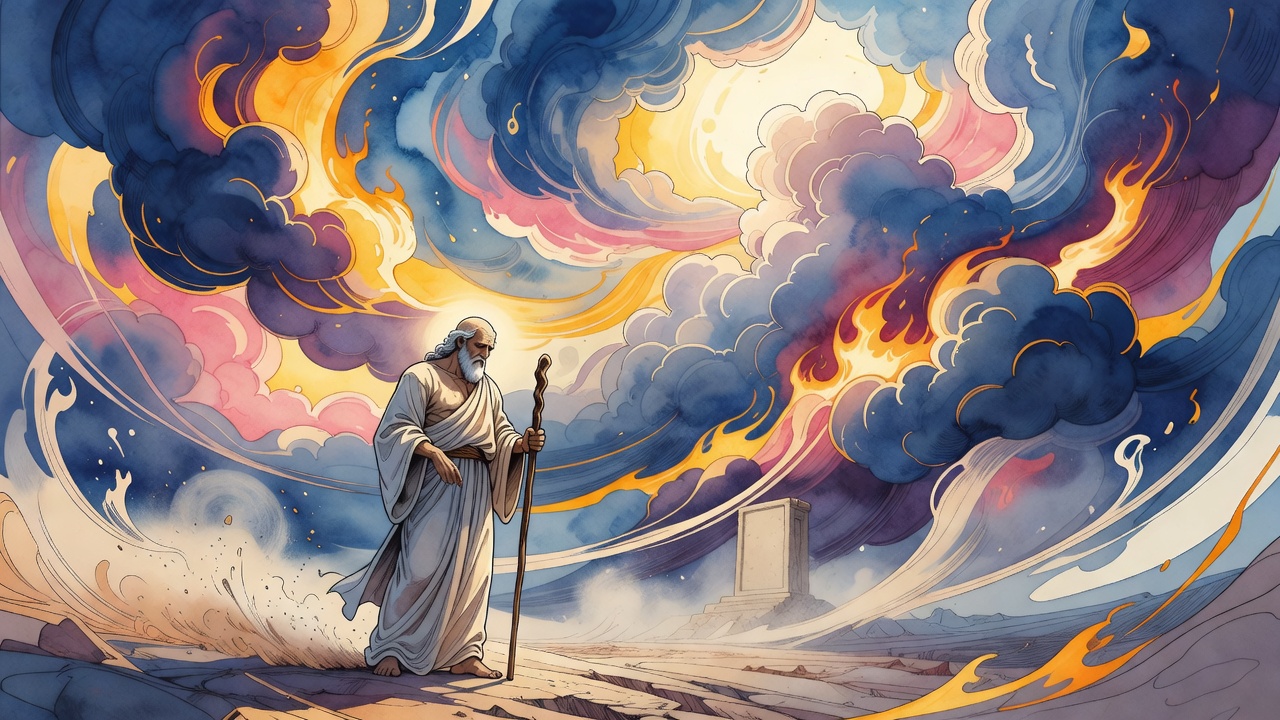
The warning had already entered his life. A flood was coming. Flesh had filled the earth with violence, and the world was moving toward water as surely as a stone moves toward the ground. Noah counted the future before he counted sons. A child born into that decree would learn his father's face and then drown under the same sky.

The Children He Refused to Risk

So Noah waited. Year after year, he kept the door of fatherhood closed. Other men filled their houses with noise and heirs. Noah left his house quieter than it had to be because love, in his case, meant refusing to summon lives into a sentenced world.

Then God commanded him to take a wife. The refusal ended there. Noah obeyed, not because the danger had passed, but because obedience now required descendants. Three sons came into the house near the edge of the deluge: Shem, Ham, and Japheth. Not ten. Not a nation. Three.

Even the small number carried mercy. If they proved righteous, the ark would not have to swell beyond measure. If they proved corrupt, fewer children would have to be lost. That was the arithmetic of a world already under judgment, cold in calculation and unbearable in a father's chest.

The Ark Closed Around Eight Lives

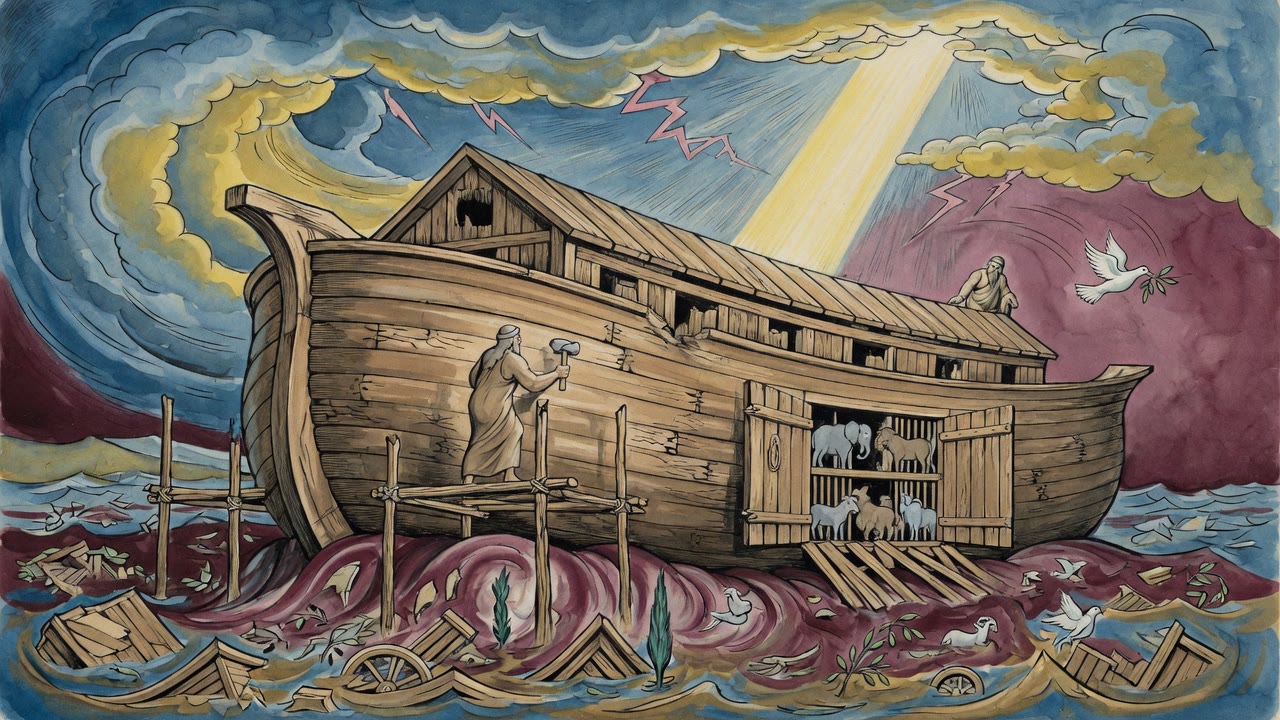
The ark rose slowly under Noah's hands. Wood, pitch, rooms, a door. Every plank said the same thing to the people outside it: the future was not joking. But the years passed, and the sky stayed dry, and ordinary life has a way of making warnings look theatrical.

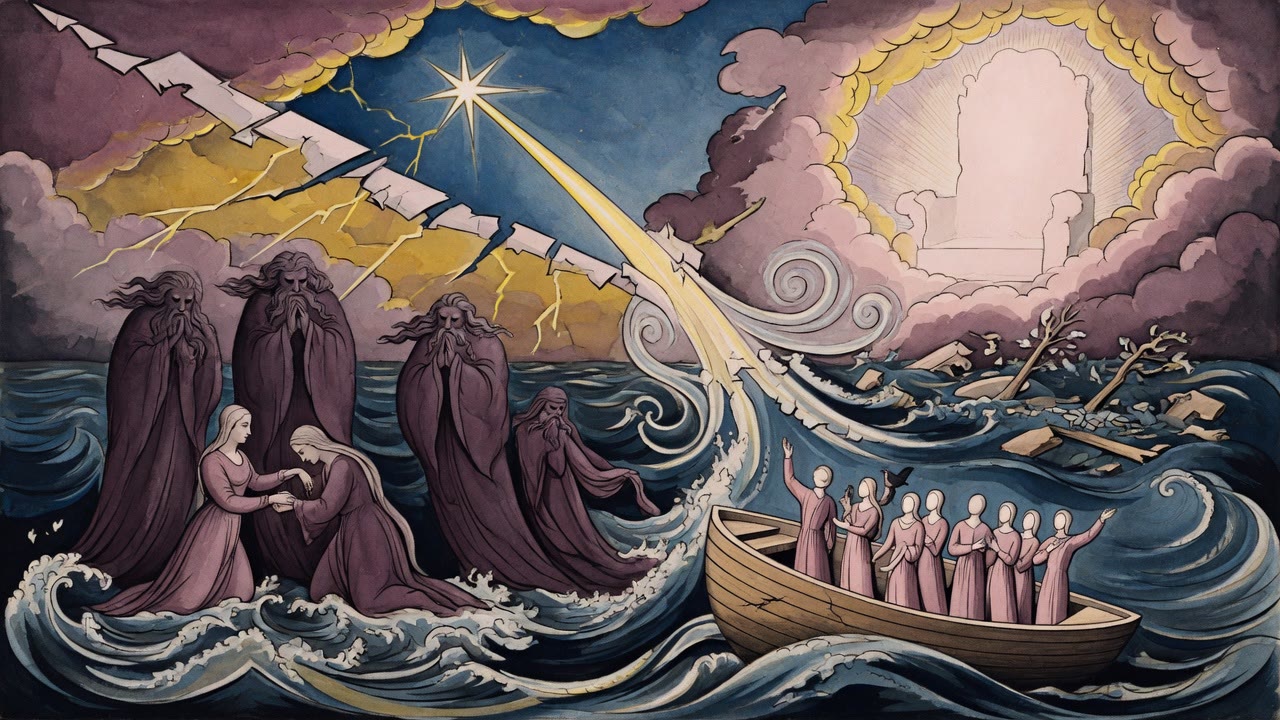
Noah brought his wife, his sons, and his sons' wives inside. Eight lives entered. The door closed around them while the world outside remained full of people who had heard enough to mock him and not enough to change.

The rain came. The deep opened. The ark lifted off the ground, and all the careful waiting of Noah's long unmarried life became a single fact: he had not brought extra children into the waters. The sons he did have were alive in the dark hull with him, listening to animals breathe and timbers strain while everything familiar vanished under the flood.

A Survivor Asked Too Late

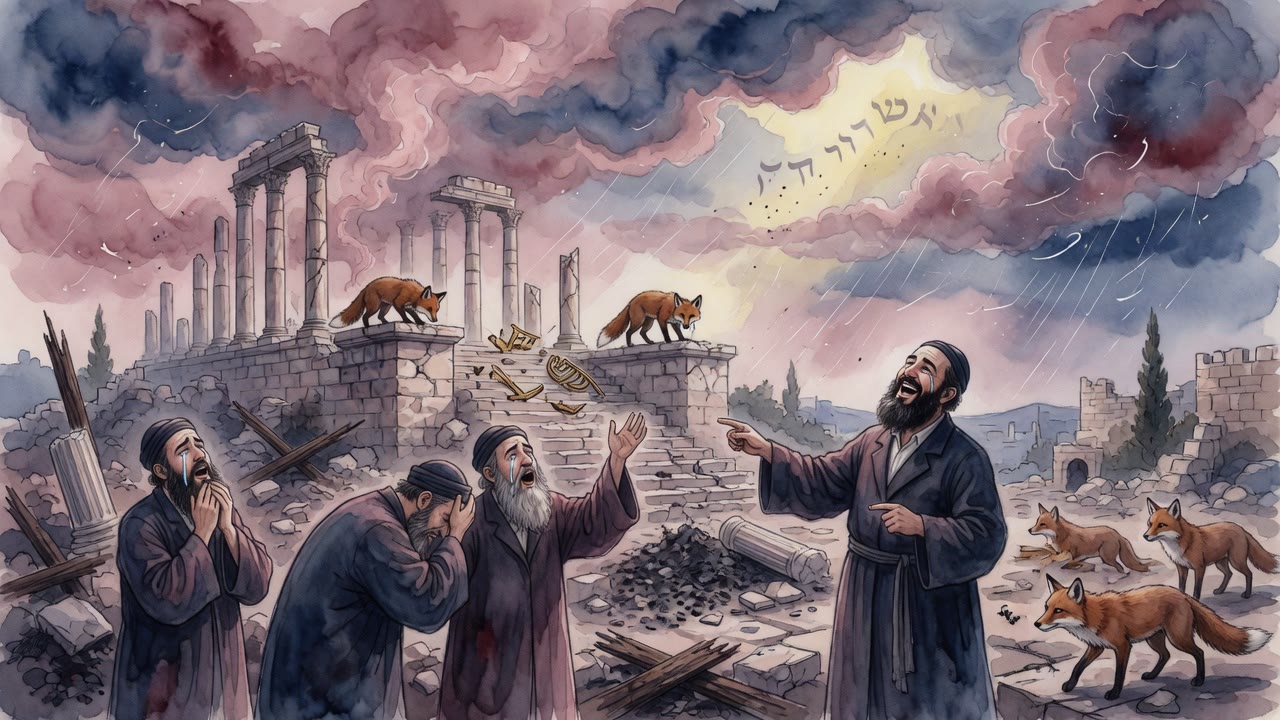
When the waters had done their work, grief came aboard like a second flood. Noah looked out and wept over the destruction. "The Merciful One should have mercy," he said. The words were true. They were also late.

God answered him as a shepherd answers a hired guard who has found his voice after the flock is gone. When the warning came, when the ark was ordered, when the sentence could still have been met with pleading, Noah had not stood before heaven and demanded mercy for the world. Now, after the bodies were hidden under water, he spoke.

The rebuke cut more sharply because Noah was not cruel. He had shaped his own life around the catastrophe. He had delayed marriage. He had limited the children who might have suffered. He had built exactly what God commanded. But private caution is not the same as intercession. A man can protect his own house and still fail to beg hard enough for everyone else's.

The Door Opened to Empty Ground

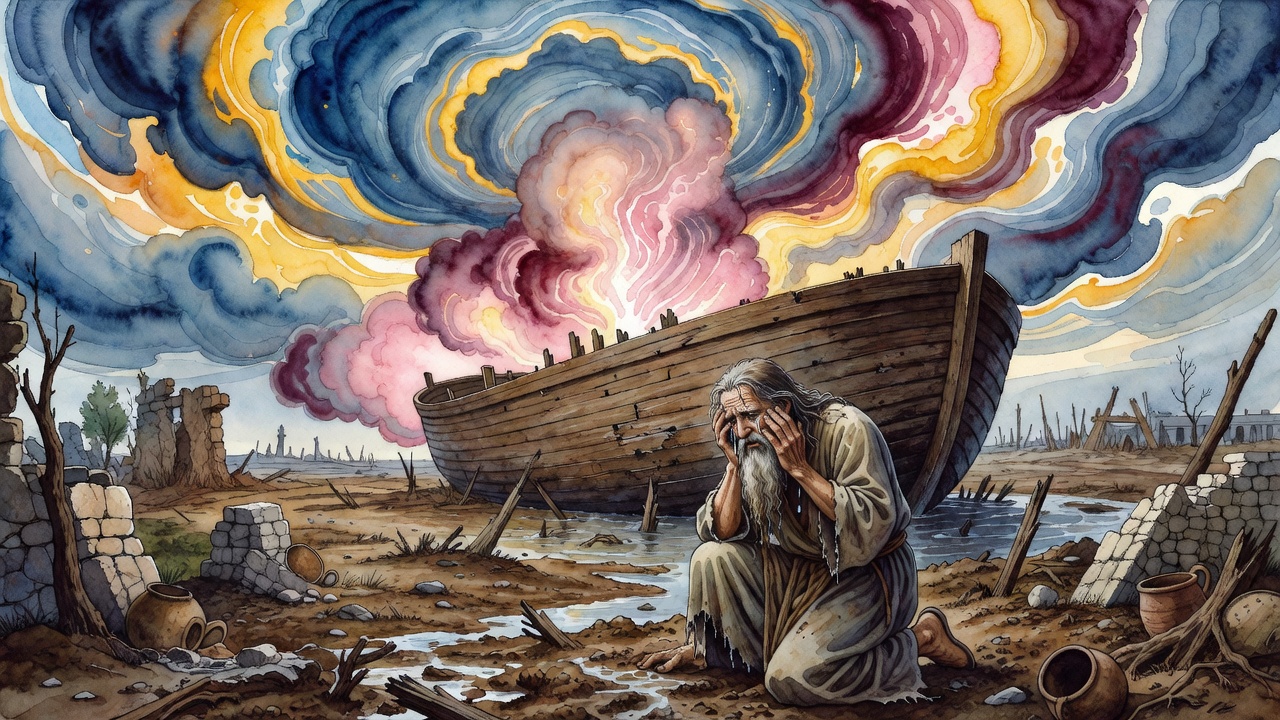
The earth dried, but Noah did not rush out. He had entered by command. He would leave by command. The ark had become more than a vessel by then. It was the only room in the world that still contained the old world, the last breath of it, the last family, the last memory of streets and fields and human noise before water took them.

God spoke to Noah and told him to go out. The man who was wiser than the ten generations before him still had to put a foot onto ground that had no neighbors left on it. Wisdom did not make that step easy.

He walked out with the sons he had almost refused to have. The animals poured after them. Hooves struck mud. Wings beat open air. The world was clean, but clean can be a frightening word when it means empty.

Noah had tried to keep children from drowning. Now those children stood beside him as the first fathers of a broken earth. He had delayed their birth to spare them the flood, and the flood gave them the whole world with almost no one in it.


← All myths
From the tradition

Sources

3 sources

The texts this telling draws on, in full. Open a card to read inline, or expand it for a wider, quieter read.

Legends of the Jews 4:59Legends of the Jews

Ginzberg, in Legends of the Jews, tells us that Noah wept bitterly at the sight of the destruction. He turned to God, saying, "O Lord of the world! Thou art called the Merciful, and Thou shouldst have had mercy upon Thy creatures."

It's a raw, human moment. After all, who wouldn't be overwhelmed by such a scene? But God's response, as recounted in Legends of the Jews, is… well, let's just say it's not exactly comforting.

God rebukes Noah, calling him a "foolish shepherd." Ouch.

God says, "Now thou speakest to Me. Thou didst not so when I addressed kind words to thee, saying: 'I saw thee as a righteous man and perfect in thy generation, and I will bring the flood upon the earth to destroy all flesh. Make an ark for thyself of gopher wood.'" for a second. God is pointing out that He warned Noah, gave him a chance to intercede, to plead for humanity. God even told Noah why he was choosing him. But Noah, focused on his own salvation, remained silent.

God continues, "Thus spake I to thee, telling thee all these circumstances, that thou mightest entreat mercy for the earth. But thou, as soon as thou didst hear that thou wouldst be rescued in the ark, thou didst not concern thyself about the ruin that would strike the earth. Thou didst but build an ark for thyself, in which thou wast saved. Now that the earth is wasted, thou openest thy mouth to supplicate and pray."

The message is clear: Noah was so consumed with his own survival that he neglected his responsibility to advocate for others. He missed his chance to be a true leader, a true intermediary between God and humanity.

It's a harsh lesson, isn't it? It’s easy to get caught up in our own lives, our own problems, especially when facing something as huge as a coming flood. But this story from Legends of the Jews challenges us to look beyond our immediate needs and consider the bigger picture.

Are we so focused on building our own "arks" that we forget to speak up for those who are suffering? Are we waiting until after the disaster to offer our prayers, when we could have acted beforehand?

Perhaps Noah's tears weren't just for the devastation he saw, but also for the opportunity he missed. And maybe, just maybe, his story is a reminder to us all to be more than just survivors, but to be advocates, to be compassionate, and to speak up for mercy, even when the waters are rising.

Full source
Bereshit Rabbah 34:6Bereshit Rabbah

The familiar story is this: the flood, the animals, the ark bobbing along on a chaotic sea. But what happened after? The waters receded, the dove returned with the olive branch… and then what? God tells Noah to "go out of the ark" (Genesis 8:16). Simple enough. According to Bereshit Rabbah 34, there’s a fascinating layer beneath the surface.

The Midrash (rabbinic interpretive commentary) interprets this as referring to Noah himself. Noah, it says, possessed a wisdom greater than the ten generations that came before him, from Adam onward. Of all those generations, God only spoke directly to Noah. "God spoke to Noah," the text emphasizes. That’s a powerful statement about his unique position.

Why the hesitation to leave the ark? Bereshit Rabbah uses a compelling analogy. It’s like a leader who leaves their post and puts someone else in charge. When they return, they naturally say, "Okay, my turn again. You can step down now." Or think of a scribe who temporarily replaces another. Upon the original scribe's return, the replacement yields their position.

The Midrash suggests God essentially ceded control of the world to Noah for the duration of the flood. Noah was responsible for the survival of all living creatures. But now, God was back, ready to resume that control. Hence, the command: "Go out of the ark."

But here’s the twist: Noah didn’t immediately obey. He didn’t accept the command. Why? He worried! As the text explains, Noah feared going out and repopulating the earth, only to have his descendants face another catastrophic flood. He wondered, "Shall I go out and resume normal life, and procreate, only to bring my children into a curse?" He believed, the Midrash tells us, that humanity would eventually be destroyed by another deluge.

Imagine the weight of that concern. He had just witnessed unimaginable destruction. He had seen the world cleansed by water. The trauma must have been immense.

So, what changed his mind? That Noah maintained this attitude until the Omnipresent – a beautiful way to refer to God – swore an oath, promising never to bring another flood. As (Isaiah 54:9) states, "For, this is for Me like the waters of Noah; as I took an oath that the waters of Noah would no longer pass over the earth."

Only with this divine assurance, this unbreakable promise, did Noah finally feel safe enough to leave the ark and begin again.

It makes you wonder, doesn't it? Sometimes, even after the storm has passed, we need a powerful promise, a deep reassurance, to truly step out of our own "arks" and embrace the future with hope.

Full source
Yalkut Shimoni on Torah 43:2Yalkut Shimoni on Torah

"And Noah was five hundred years old" (Genesis 5:32). What is the reason that everyone in his generation fathered children at a hundred or two hundred years, while he fathered at five hundred? Rather, the Holy One, blessed be He, said: If they are wicked, I do not wish that they perish in the waters; and if they are righteous, I would burden him to build many arks. So the Holy One, blessed be He, restrained his fountain and he fathered children at five hundred, so that even Japheth, the eldest, when the Flood came, would not yet be a hundred years old and liable to punishment.

"And Noah fathered Shem." But was not Japheth the eldest? Rather, you first expound Shem because he was righteous, because he was born circumcised, because the Holy One, blessed be He, set His Name upon him, because Abraham came forth from him, because he served in the high priesthood, because the Temple was built within his territory. And the number of his letters the Holy One, blessed be He, suspended for the generations from the generation of the Flood until the generation of the Dispersion: three hundred and forty years.

"And it came to pass, when men began to multiply" (Genesis 6:1). This teaches that they were spilling their seed upon the trees and upon the stones; and because they were steeped in fornication, the Holy One, blessed be He, increased females among them, as it is written, "and daughters were born to them."

Rabbi Shimon son of Rabbi: his wife bore him a daughter. Rabbi Hiyya the Elder saw him and said to him, "The Holy One, blessed be He, has begun to bless you." He said to him, "How so?" He said, "As it is written, 'And it came to pass, when men began to multiply,' and so on [where multiplying is linked to daughters]." He went up to his father, who said to him, "The Babylonian has gladdened you. Even so, there is need for wine and need for vinegar; the need for wine is greater than for vinegar. There is need for wheat and need for barley; the need for wheat is greater than for barley. When a man marries off his daughter and lays out his expenses, he says to her, 'May you have no need to return here.'"

Rabban Gamliel married off his daughter. She said to him, "Father, pray for me." He said to her, "May you have no need to return here." She bore a male child. She said to him, "Father, pray for me." He said to her, "May the cry of 'woe' never cease from your mouth." She said to him, "Father, at the two joys that have come to me you curse me?" He said to her, "Both are blessings. Since you will be at peace in your house: may you have no need to return here. And since you have a living blessed child: may the cry of woe never cease from your mouth, the woe of 'my child has not eaten,' the woe of 'my child has not drunk,' the woe of 'my child has not gone to the synagogue.'"

Full source