5 min read

Akiva Fined a Rich Man for One Public Slap

No bone broke. No blood spilled. The rich man laughed at the fine until Akiva named the pale face as blood lost, and Gods image as the one insulted.

Curated by Arthur · Told by Maggid ·
Table of Contents
  1. The Blow That Left No Wound
  2. Quarrels That Include Every Body
  3. When the Loss Is a Life Not Yet Born
  4. The Fine That Taught the Courtyard

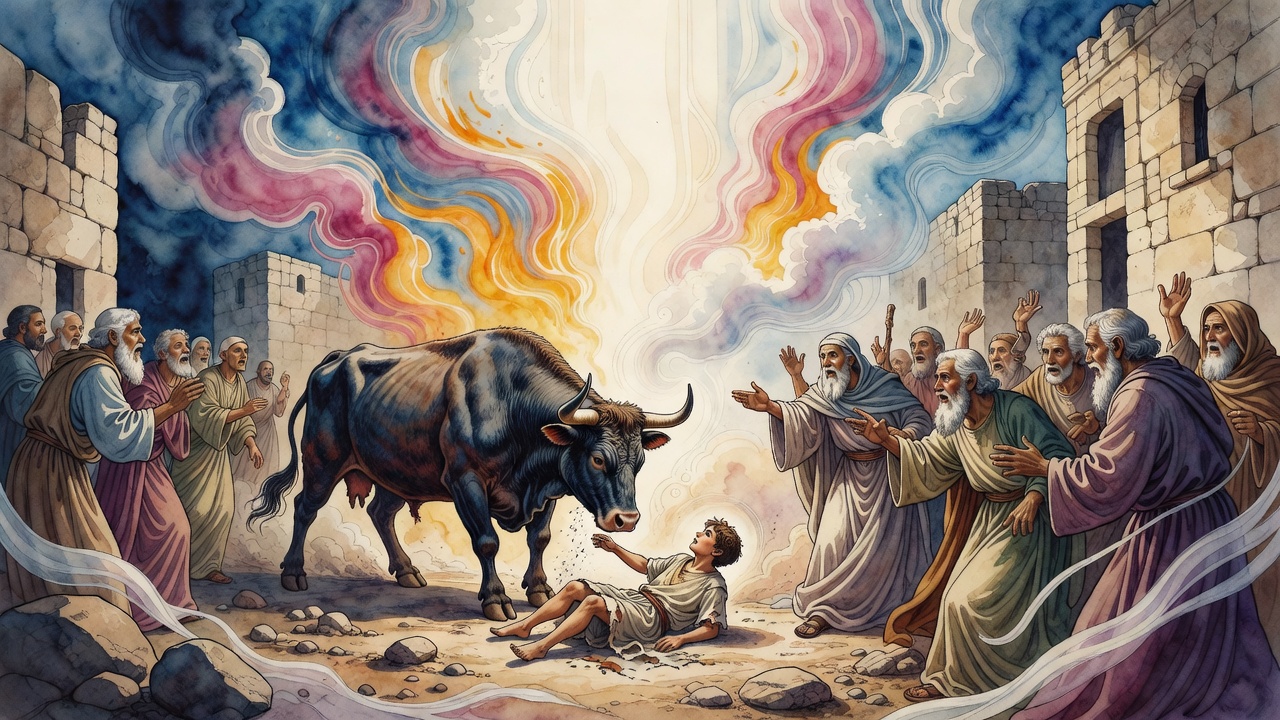
The slap cracked across the courtyard like a dry stick. The struck man did not fall. He stood with the color draining from his face while the rich man who had hit him wiped his palm on his cloak and looked around for laughter.

Akiva Fined a Rich Man for One Public Slap Click for full size

"How much," the rich man asked the court, "can a slap possibly be worth?"

The Blow That Left No Wound

Rabbi Akiva heard the case as the Mishnah later kept it among the laws of damages. No fracture. No open cut. Only the public shaming of a human being in front of neighbors who would remember the sound longer than they remembered the market prices of that day.

Akiva set a heavy fine. The rich man sneered harder, counting coins in his head as if the court were a game for poorer men. Akiva did not move. When you humiliate a person, the blood leaves the face. That lost blood is on your hands even when no drop hits the stones. You struck a man made in the image of God. Shame him in the open, and you shame the One who formed him from dust and breath.

Dignity was not a luxury for soft hours and polite company. It was sacred enough to cost a man who thought wealth made palms free and faces cheap. The struck man touched his cheek once, as if checking whether the skin still belonged to him.

Around them the courtyard quieted. A slap that left no bruise had become more expensive than many a broken bone.

Quarrels That Include Every Body

The Torah's injury laws often say "if men quarrel." Rabbi Yishmael refused to let the word "men" erase women from the ledger of pain. When the ox that kills is discussed, Scripture says "a man or a woman" (Exodus 21:29). That one explicit pairing, he taught, opens every other injury law like a master key. A woman who strikes owes. A woman who is struck collects. The body under the blow is not ranked by gender before the fine is named.

The slap in Akiva's court sat inside that wider field. The pale face belongs to whoever was shamed, whether the tongue that later told the tale said "he" or "she." Public injury is public injury. The law that learned to see women in the ox verse also learned to see the full human cost of a hand raised in contempt.

Quarrels do not stay in the mouths of men alone. Courts that pretend otherwise invent a Torah smaller than the one given at Sinai.

When the Loss Is a Life Not Yet Born

Elsewhere the same tradition faces a harder number. Men struggle in the road. A pregnant woman is struck. The child is lost before breath. Who is paid, and how do you price a life that never cried outside the womb?

The sages first give the payment to the husband whose child it was, reading the word "pregnant" as a limit that keeps strangers from claiming what is not theirs. Early market math that compared a woman's value before and after birth collapses under scrutiny, because a woman may be worth more after delivery when the danger of childbirth has passed. They assess the offspring themselves and award that sum. If there is no husband, heirs receive. If the mother was a convert or freed maidservant without a husband to claim, the striker may pay nothing under that head, a cold edge of the old law that still shows how carefully, and how painfully, the court tried to measure invisible loss.

A slap's humiliation and a lost pregnancy are not the same wound. Both force the court to name a harm that coins can only roughly answer, and both refuse the rich man's shrug that if you cannot see the blood, there is no bill.

The Fine That Taught the Courtyard

The rich man paid. Coins left his bag with a sound smaller than the slap had been. The struck man left with more than silver. The courtyard learned that a public face drained of blood is a kind of bleeding, and that God's image is not a phrase for sermons only, to be packed away when the market opens.

Akiva's ruling traveled from mouth to mouth. Later teachers repeated it when arrogance mistook a soft blow for a free blow. The hand that shames still writes a debt, even when the skin stays whole and the physicians find nothing to bind.

No bone broke that day. The law still counted the hit. The image of God still stood in the courtyard, a little paler, and a little more expensive to insult than the rich man had believed when he raised his hand.


← All myths

From the tradition

Sources

3 sources

The texts behind this telling. Some cards carry a translation of the source; others are our own retelling of it, and each card says which. Every card links out to the original.

Exempla of the Rabbis, No. 98Exempla of the Rabbis (Gaster, 1924)

Retold in our words. Read the original at the link below.The Exempla of the Rabbis, Moses Gaster (1924) · Public Domain

Rabbi Akiba was known throughout Israel not only for his vast learning but for the sharpness of his legal judgments. The Mishnah (the earliest code of rabbinic law) in Baba Kama (f. 90b) preserves one of his most famous rulings, a decision that turned on a single, devastating insight.

A man came before the court complaining that another man had struck him. The blow was not severe, no bones were broken, no blood was drawn. But the victim's dignity had been shattered. He demanded compensation. The assailant, a wealthy and arrogant man, sneered at the proceedings. "How much can a slap possibly be worth?" he asked.

Rabbi Akiba studied the case carefully. He ruled that the assailant must pay a substantial fine, not merely for the physical pain, which was minimal, but for the humiliation. In Jewish law, shaming a person in public is considered one of the gravest offenses, comparable to shedding blood. The Talmud teaches that when you humiliate someone, the blood drains from their face. And that lost blood is on your hands.

The assailant protested the size of the fine. Rabbi Akiba was unmoved. "You struck a man made in the image of God," he said. "When you shame a human being, you shame the One who created him." Avot de-Rabbi Natan (ch. 3) adds that this ruling established a principle that echoed through generations of Jewish law: the dignity of a person is not a luxury to be protected when convenient. It is sacred, and those who violate it will pay dearly.

Full source
Mekhilta Tractate Nezikin 6:2Mekhilta DeRabbi Yishmael

Retold in our words. Read the original at the link below.Mechilta, translated by Rabbi Shraga Silverstein · CC-BY

"And if men quarrel", this verse mentions men. But does the law of personal injury apply only to men? What about women who injure others or are injured? Rabbi Yishmael argued that all injury laws in the Torah apply equally to women.

His proof came from a general principle. Throughout the Torah, injury laws are stated without specifying gender. But in one case, (Exodus 21:29), regarding an ox that kills, the Torah explicitly includes "a man or a woman." Rabbi Yishmael reasoned: since the Torah went out of its way to specify women in one particular injury case, it was signaling that women are included in all injury cases. The explicit mention in one verse unlocks the implicit inclusion across every verse.

This interpretive move is powerful. Rather than requiring the Torah to mention women separately in every single law of damages, Rabbi Yishmael treated one explicit mention as a master key that opened all the others. The Torah specified "a man or a woman" once to establish the principle. Every other injury law, even though it mentions only "men," is understood to include women as well.

The practical implication was enormous. Women had full standing in Jewish injury law, both as potential claimants and as potential defendants. A woman who injured someone owed the same compensation a man would. A woman who was injured was entitled to the same recovery. One verse established gender equality across an entire legal domain.

Full source
Yalkut Shimoni on Torah 335:7Yalkut Shimoni on Torah

Translation of the source text.Torat Emet (Yalkut Shimoni) · CC-BY-NC

Another interpretation: since it says, "as the woman's husband shall impose upon him" (Exodus 21:22), I might think this applies even though the pregnancy is not his; Scripture therefore says "pregnant," teaching that he pays only the husband to whom the pregnancy belongs. A person who intended to strike his fellow but struck the woman, and her offspring came out, pays the value of the offspring. How? We assess the woman, how much she was worth before she gave birth and how much she is worth after she gave birth. Rabbi Shimon ben Gamliel said: if so, once a woman gives birth she increases in value! Rather, we assess the offspring, how much they are worth, and give it to the husband. If she has no husband, it is given to the heirs. If she was a maidservant who was freed, or a convert, he is exempt. Rav Pappa said: an ox that gored a maidservant and her offspring came out pays the value of the offspring. What is the reason? It is a pregnant donkey that he damaged, for the verse says, "Stay here with the donkey" (Genesis 22:5), a people resembling a donkey. Should it not say the increase in value of the offspring rather than their value? Rav Yehudah said: how does he pay the value of the offspring and the increase of the offspring? We assess the woman, how much she was worth before she gave birth and how much she is worth after she gave birth. What does Rabban Shimon ben Gamliel mean? Rava said he means this: is she really more valuable before she gives birth than after, when surely a woman is more valuable after giving birth, since she is freed from the danger of childbirth? Rather, we assess the offspring and give it to the husband. So too it was taught. Rabbah said he means this: is the woman valued only for the one who will sire offspring, with nothing of her own in the increase of the offspring? Rather, we assess the offspring and give it to the husband, and the increase of the offspring they divide. So too it was taught: Rabban Shimon ben Gamliel says, and so on. There is a difficulty between one statement of Rabban Shimon ben Gamliel and another; it is no difficulty: here she is a first-time mother, there she is not. And the Rabbis say the increase of the offspring also goes to the husband, for it was taught: from the implication of "and her offspring come out" do I not know she was pregnant? Rather, it tells you the increase of the pregnancy belongs to the husband. And Rabban Shimon ben Gamliel needs that word "pregnant" for what was taught: he is never liable until he strikes her opposite the place of the pregnancy. Rav Pappa said: do not say literally opposite the place of the pregnancy, but wherever the swelling of the fetus rises, excluding a hand or a foot.

Full source