5 min read

When the Ox Gored a Child the Law Still Stood

A known killer ox struck a boy in the lane. Someone claimed the death rules covered only adults. The verse about son and daughter closed that door.

Curated by Arthur · Told by Maggid ·
Table of Contents
  1. Why the Torah Added Son and Daughter
  2. Other Doubled Words of Liability
  3. The Mother at the Gate
  4. Citizen, Stranger, Small, Grown

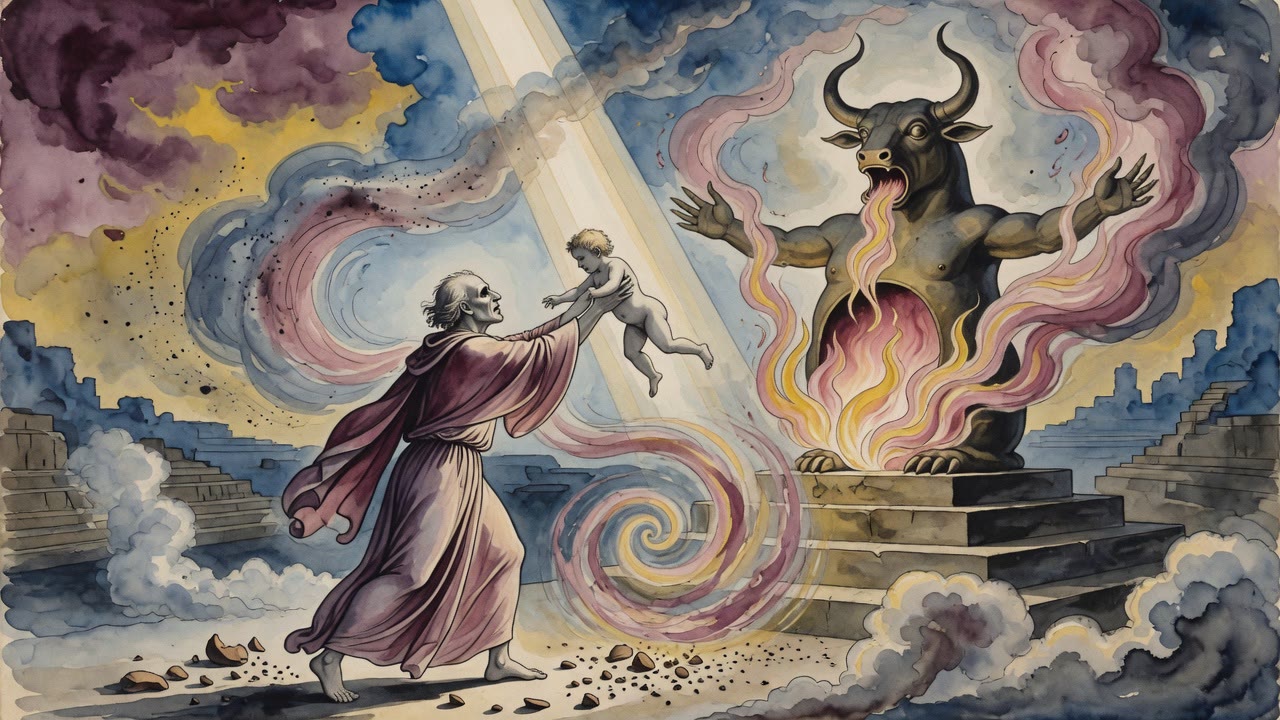
The child was small enough that the ox's horn caught him under the ribs and lifted him like a sack. Dust, screaming, then the heavy quiet that follows when a body stops answering. The ox was already known in the town. A gorer, warned, not first-blood. The owner had been told. He had shrugged.
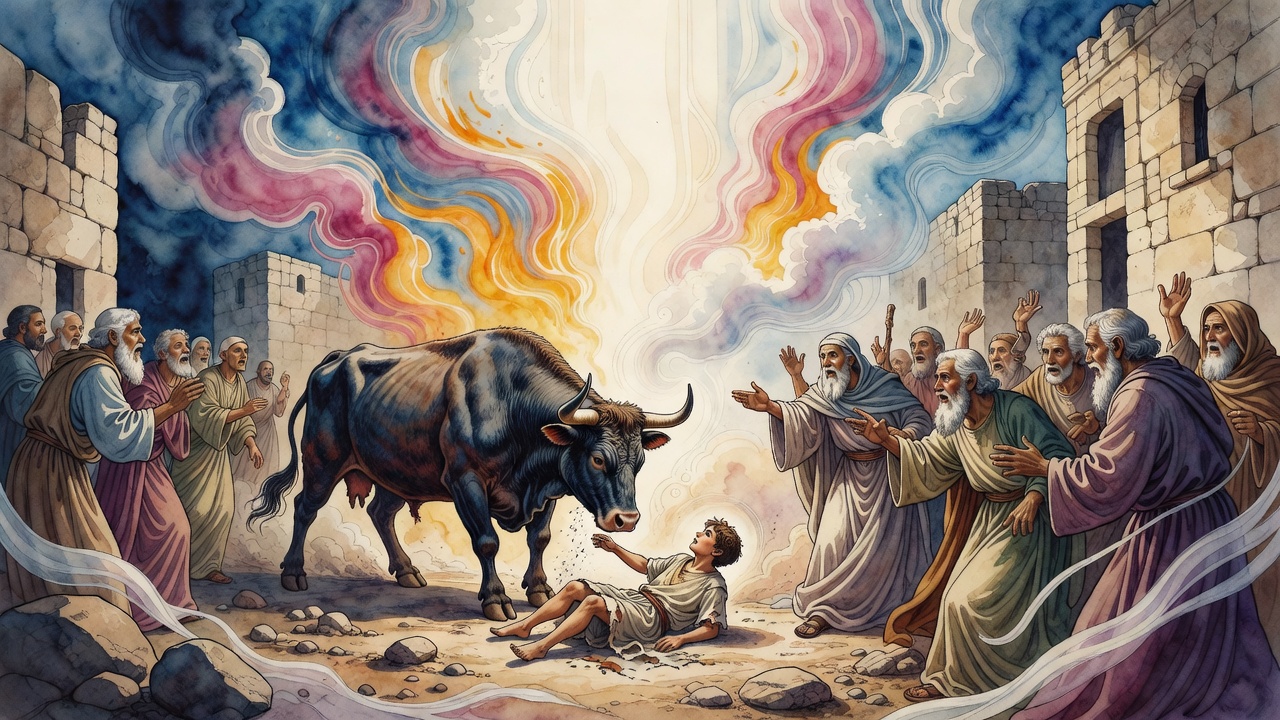
When the Ox Gored a Child the Law Still Stood Click for full size

In the shade of the gate someone muttered that the verse about a known ox killing a man or a woman meant adults. A child's death, the mutter said, was tragedy, not the full capital pattern. Mothers in the crowd turned with faces that could cut stone.

Why the Torah Added Son and Daughter

The teaching that settled the gate was older than the mutter. "Or if it gore a son, or it gore a daughter" stands because "man or woman" might be heard as grown only. From the extra clause the same law covers minors. One Torah for the citizen and for the stranger in the related readings. One standard when the victim is small. The ox that is a known killer does not get a discount because its victim had not yet grown a beard.

The owner tried to bargain down to silver alone, as if the warning history of the beast could be forgotten. The judges recited the conditions of the known gorer. Knowledge. Failure to guard. Death. The child's age did not thin the case. A scribe read the son-and-daughter clause twice, slow, so the mutter could not pretend it had not heard.

The owner then claimed the child had teased the animal. Witnesses said the boy had been carrying water, nothing more. Even had he teased, the known gorer's duty of restraint does not dissolve because a child is foolish. Adults guard beasts. Children do not bargain with horns.

Other Doubled Words of Liability

In the same family of careful speech, a paid watchman faces "if stolen, it shall be stolen." The doubling is not style for its own sake. Teachers who refuse to waste syllables hear layers of liability, of when the watchman pays and when the circumstance excuses. Redundancy in Torah is a door, not an ornament.

Money cases test the heart another way. A man says, you owe me a hundred. The other says, nothing. Witnesses prove fifty in hand. Must he swear on the rest? The oath drawn from "this is it" turns on partial admission from the person's own mouth, not only on what witnesses extract. The father of Rabbi Apturiki ruled one way. The chamber kept arguing. What matters for the street is that speech in court has weight. What you concede shapes what you must swear.

The ox owner's earlier shrugs were a kind of speech too. He had admitted the beast was dangerous when neighbors warned him, then denied the force of that admission when blood ran. The court remembered both mouths.

The Mother at the Gate

The boy's mother did not care about watchmen or oaths. She cared that no one would say her son counted less because he was short. When the verse of son and daughter was read aloud, she put her forehead against the gatepost and stayed there until the owner was bound over.

Neighbors who had laughed at the ox's earlier nips went home quieter. A known beast is a sentence waiting for a body. The body can be a child. The law had already written that sentence down. One man who had joked that it only goes for dogs sold his own goring-prone bull the next week and took a loss without complaint.

At the funeral the mother said nothing about silver. She said the name of her son and the fact that Heaven had not needed him to be tall to count him.

Citizen, Stranger, Small, Grown

The wider principle kept echoing. One Torah for the citizen and the proselyte in the goring laws' neighborhood of equality. The court that protects the convert's blood protects the child's blood. Hierarchy of victimhood is a habit Israel is ordered to refuse. The horn is counted the same.

By evening the ox was sentenced under the known-gorer rule, and the owner's shrug had become a debt he would carry past the funeral. The lane was washed. The verse remained, short and stubborn, for the next time someone tried to make a child's death smaller than a man's.

A student walking home repeated the clause under his breath like a charm against soft cruelty. Son or daughter. Man or woman. The same law. The same God who hears both heights of cry.


← All myths

From the tradition

Sources

3 sources

The texts behind this telling. Some cards carry a translation of the source; others are our own retelling of it, and each card says which. Every card links out to the original.

Mekhilta Tractate Nezikin 11:1Mekhilta DeRabbi Yishmael

Retold in our words. Read the original at the link below.Mechilta, translated by Rabbi Shraga Silverstein · CC-BY

"Or if it gore a son, or it gore a daughter" (Exodus 21:31). The Mekhilta asks why this clause about the goring ox is needed at all. An earlier verse, dealing with an ox known to be dangerous, already states that "it kill a man or a woman" (Exodus 21:29), and the penalties are set there. But "a man or a woman" might be heard to mean only adults. From where, then, do we learn that the same law applies when the ox gores minors? From the added words "a son or a daughter," which the sages read as including the young.

The exposition keeps widening the circle. The plain words speak of a clearly identified son or daughter, but the rabbis ask about a tumtum (one whose sex is indeterminate) or a hermaphrodite, and they include them too from the same phrase. The verse seems to address another person's son or daughter, yet the sages extend the ruling to the owner's own children, drawn in by the inclusive reading "in any event."

Finally the law might be thought to protect only an Israelite victim. From where do we learn that it covers a proselyte who has joined Israel? From the principle stated elsewhere, "One Torah shall there be for the citizen and for the proselyte" (Exodus 12:49). Step by step the Mekhilta shows that the protection of the goring-ox law reaches every human life without exception, young or old, native or convert.

Full source
Mekhilta Tractate Nezikin 16:14Mekhilta DeRabbi Yishmael

Retold in our words. Read the original at the link below.Mechilta, translated by Rabbi Shraga Silverstein · CC-BY

The Torah addresses the liability of a paid watchman with an apparently redundant phrase: "if stolen, it shall be stolen." The doubling of the word "stolen" in (Exodus 22:11) caught the attention of Rabbi Yossi, who saw legal meaning in what others might dismiss as stylistic repetition.

Rabbi Yossi explains that the redundancy is deliberate. The Torah repeats "stolen" to expand the scope of the watchman's liability beyond theft alone. The phrase "if stolen, it shall be stolen" includes loss as well. A paid watchman who claims the item was stolen is liable, and a paid watchman who claims the item was lost is equally liable. The doubled language encompasses both scenarios.

The Mekhilta then turns to the phrase "from him", two small words that carry enormous legal weight. "From him" limits the watchman's liability to situations where the theft or loss occurred while the item was in his direct custody. If the watchman delegated responsibility to a young shepherd-boy and the item was stolen from the boy, the watchman is not liable. The boy was not a qualified custodian, and the watchman did not personally fail in his duty of care.

However, if the watchman entrusted the item to a grown, professional shepherd, someone qualified to serve as a keeper, the watchman remains fully liable. Delegating to a competent adult does not transfer responsibility. The watchman made a commitment to the owner, and hiring a substitute does not release him from that commitment.

From just a few seemingly redundant words, the rabbis constructed a precise framework governing custody, delegation, and liability, principles that remain relevant in legal systems to this day.

Full source
Yalkut Shimoni on Torah 346:12Yalkut Shimoni on Torah

Translation of the source text.Torat Emet (Yalkut Shimoni) · CC-BY-NC

The father of Rabbi Apturiki taught: "I have a maneh [a hundred zuz] in your hand," and the other says "you have nothing of yours in my hand," and witnesses testify that he holds fifty, you might think he must swear concerning the rest. The verse states "for any lost thing of which one says, this is it" (Exodus 22:8): upon his own admission you impose an oath, but you do not impose an oath upon him through the testimony of witnesses. And Rabbi Chiyya is a Tanna and may disagree. But the verse states it! That verse he requires for an admission to part of the claim. And the father of Rabbi Apturiki would say to you: it is written "it (hu)" and it is written "this (zeh)", one for admission to part, and one for admission of the same kind as the claim. And the other holds there is no requirement that the admission be of the same kind as the claim, holding like Rabban Gamliel; as we learned: if one claimed wheat from him and he admitted to barley, he is exempt, but Rabban Gamliel holds him liable. Rabbi Chiyya bar Abba said in the name of Rabbi Yochanan: one who falsely pleads that a thief took a deposit is not liable until he denies part and admits part, for the verse says "this is it." And this differs from Rabbi Chiyya bar Yosef, who said: there is a mixing of passages written here, and when "this is it" is written it is written concerning a loan. And why is a loan different? As Rabbah explained: why did the Torah say that one who admits to part of a claim must swear? There is a presumption that a person will not be brazen before his creditor. This one would have wished to deny it all, and the reason he admitted is that a person will not be brazen; and he would have wished to admit all of it, and the reason he denied part is that he reasoned, "if I admit all of it he will sue me at law; let me evade him for now until I have the means and repay him." Therefore the Merciful One imposes an oath upon him, so that he will admit the whole to him. Rami bar Chama taught: all four bailees require denial of part and admission of part. What is the reason? The unpaid bailee, it is written explicitly "this is it." The paid bailee, derives "giving, giving" from the unpaid bailee. The borrower, "and when one borrows," the conjunctive "and" adds to the earlier subject. The renter, if according to the one who says he is like an unpaid bailee, that is the unpaid bailee; and if according to the one who says he is like a paid bailee, that is the paid bailee.

Full source