6 min read

False Witnesses Who Took the Blade They Aimed

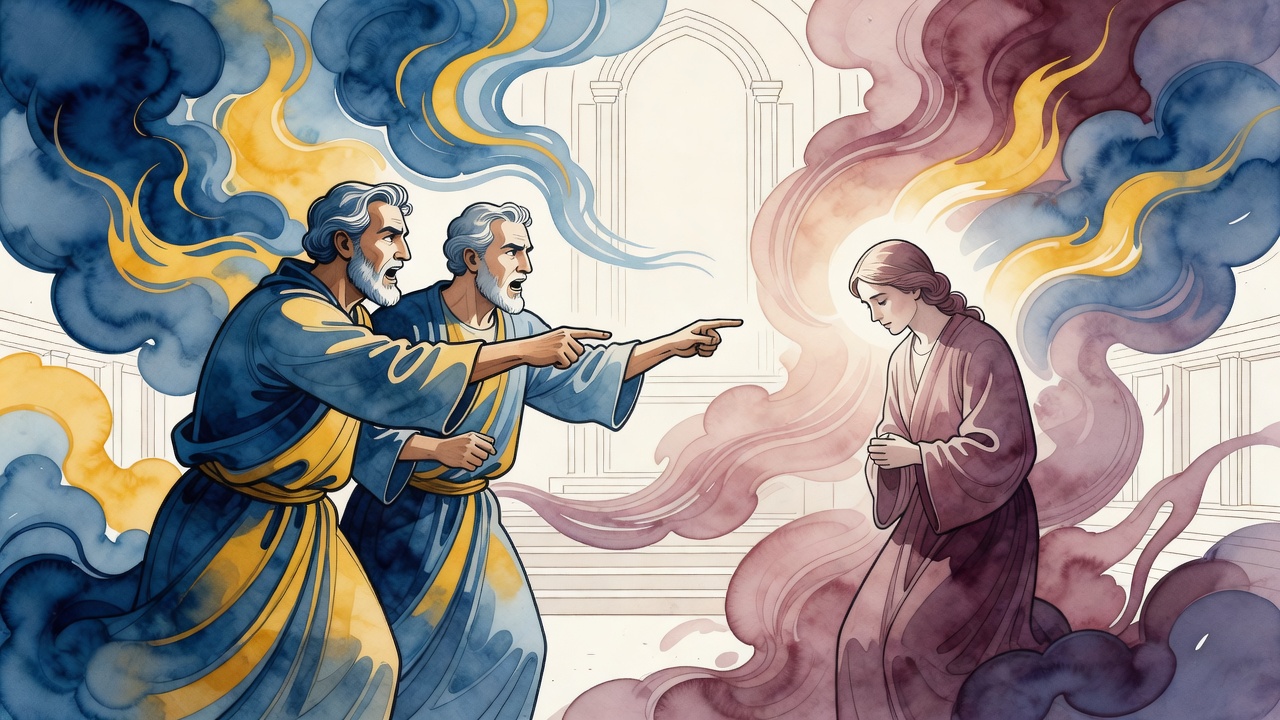
Two men stood in court and pointed at an innocent life, until later mouths proved they had never been where they claimed to stand.

Curated by Arthur · Told by Maggid ·
Table of Contents
  1. The Mouths That Built a Death
  2. Before Flesh and Blood
  3. How a Lie Becomes Scheming
  4. Measure Returned to the Hand That Aimed
  5. The Room After the Turn

Two men rose on the stone floor and swore they had seen a killing at noon. The accused did not look at them. He looked at the dust between his sandals, as if the dust might open and swallow the day before their mouths finished building a rope.
False Witnesses Who Took the Blade They Aimed Click for full size

The Mouths That Built a Death

The court required speech, not paper. God had already said a single mouth was not enough to establish a matter (Deuteronomy 19:15). Two mouths could hang a man. Three mouths could do the same work with the same cold power. The words had to be spoken where judges could hear the breath that carried them.

The first witness raised his hand. "We saw him strike by the threshing floor," he said. He named the hour as if he owned the sun. The second nodded too quickly, as if agreement were a skill he had practiced alone in a doorway. Between them they drew a map of the road, the blood, the angle of light on the chaff.

The accused swallowed and said nothing that could cut their story open. Silence is not always guilt. Sometimes it is the sound a man makes when language has already been stolen from him by better liars.

The litigants stood. Standing was not politeness. It was a mitzvah (a commandment) of the moment, a body forced into attention while judgment hung loose above the room. Sitting would have made the court feel like a market. Standing made it feel like an altar with no fire yet.

Before Flesh and Blood

The judges sat as if they were only men with tired backs. The law refused that comfort. "Before the Lord," the old teaching said, and the phrase did not mean a painted wall. It meant the two parties thought they faced soft human faces, and in truth they stood before the One who counts false breath as violence.

A clerk shifted a tablet. Someone outside shouted a price for grain, then a laugh that did not belong in a capital room. Inside, the air narrowed to two pairs of eyes and the thin thread of a story that wanted a body on a rope before sunset.

The accused was not a hero. He was tired. Sweat ran into the corner of his mouth. He tasted salt and kept still, because stillness was the only weapon left when every word he might speak would be weighed against two rehearsed voices. One judge watched his hands. Another watched the witnesses' feet, the small dance of men who do not know where to put fake courage.

How a Lie Becomes Scheming

Another pair of men came later, not to save a reputation for its own sake, but to place bodies in the same hour. Their clothes still held the dust of a different road. "How can you testify that you stood by the threshing floor?" they asked the first pair. "You were with us that day, in the other town, until the shadows went long and the bread was broken."

That was the hinge. Contradiction about the victim's whereabouts could leave a crack of doubt. A man might have moved. Contradiction about the witnesses themselves closed the door. The law named such men zomemin, scheming witnesses, only when their own presence was proven false, when the lie turned and bit the mouth that made it.

The first pair tried to talk over the new words. They raised volume as if volume were evidence. The judges cut them short. A false story is loud. A proven alibi is quiet and heavy, like a stone set carefully on a scale.

One of the schemers wiped his lip and left a smear of dust there. He looked at his partner and found no rescue in that face. Partnership in a lie is only friendship until the hour of exposure.

Measure Returned to the Hand That Aimed

The Torah had already banned false testimony among the words spoken at Sinai (Exodus 20:13). The midrash tightened the screw until it hurt in exact places. If the schemers aimed at money, money answered. If they aimed at lashes, lashes answered. If they aimed at death, death answered, but only after a verdict had already been spoken against the innocent man they tried to destroy.

The rule was merciless and exact. Intent was not a mood. Intent was the punishment they had tried to load onto another back. When the plot failed in open court, the load rolled back onto them, measure for measure.

One of the false witnesses opened his mouth and no sound came. The other found a word and lost it halfway. Their plot had been a blade pointed outward. Now the handle was in their own ribs.

The accused lifted his head for the first time since noon. He did not smile. Vindication is not always joy. Sometimes it is only air returning to a chest that had stopped believing in air.

The Room After the Turn

Outside, the grain market kept shouting. Inside, two men who had tried to turn speech into murder learned that speech can turn again. The clerk wrote. A guard shifted his weight. A woman in the doorway unclenched her knuckle and left a small crescent of blood where her tooth had been.

The judges did not rush the next step into spectacle. Capital weight is not a festival. Still, the law would not leave the aimed death hanging in the air like unfinished weather. What the schemers had prepared for their brother, the court prepared for them.

When the first pair was led out, the accused remained standing a moment longer than required, as if his knees had forgotten the permission to bend. Then he sat. The stone floor did not become kind. It only became a floor again, and that was enough.


← All myths

From the tradition

Sources

4 sources

The texts behind this telling. Some cards carry a translation of the source; others are our own retelling of it, and each card says which. Every card links out to the original.

Sifrei Devarim 189:2Sifrei Devarim

Retold in our words. Read the original at the link below.Sifrei by Rabbi Shraga Silverstein · CC-BY

Specifically,

The passage lays out a very specific scenario regarding zomemin (זוממין) – these are “scheming witnesses," witnesses proven to have lied under oath. But what exactly turns a regular liar into a zomem?

The text explains: "We are hereby taught that he is not liable until he falsifies himself." In other words, there’s a crucial distinction between simply giving false testimony and actively contradicting oneself in a way that exposes the lie. This principle is paramount for establishing liability.

So, how does this play out in practice? Sifrei Devarim provides an example. " Now, Witness B steps forward and challenges A. But here's where it gets interesting. If Witness B says, "How can you say that? The victim (or the accused) was with us that day, in this place," A is not yet considered zomem.

Why not? Because Witness B hasn’t directly contradicted Witness A’s ability to witness the event. The victim (or perpetrator) could have been in two places at once, perhaps! It's unlikely, sure, but there's still a sliver of doubt.

But what if Witness B says something different? What if they declare, "How can you testify to that? You, Witness A, were with us on that day, in that place!"?

Ah, now we're talking. These witnesses, says Sifrei Devarim, are zomemin. They are actively contradicting their own testimony by placing themselves elsewhere. They are exposed. And according to the ancient laws, they face the punishment they sought to inflict through their false testimony. They are killed for their testimony.

Think about the implications here. This isn’t just about catching someone in a fib. It's about the integrity of the entire legal system. It's about ensuring that witnesses are held accountable for the devastating consequences their lies can bring. The Talmud (Makkot 5b) discusses this at length, elaborating on the punishments and intricacies of the law of zomemin.

This passage from Sifrei Devarim forces us to confront a fundamental question: What is the true cost of a lie? What responsibility do we have to ensure that our words reflect the truth, especially when those words carry the power to alter someone's life forever?

And sometimes, those consequences can be a matter of life and death.

Full source
Sifrei Devarim 190:12Sifrei Devarim

Retold in our words. Read the original at the link below.Sifrei by Rabbi Shraga Silverstein · CC-BY

Our guide for this journey is Sifrei Devarim, a collection of legal interpretations on the Book of Deuteronomy. Specifically, This verse becomes the foundation for understanding how Jewish law approaches false accusations.

The text spells it out pretty plainly: "If money (i.e. if he schemed to make his brother liable for money), money (i.e. then he pays money); if stripes, stripes; if (other) punishments, punishments." In other words, the punishment for false testimony should mirror the punishment the schemers intended for their victim. It’s a powerful concept of measure for measure, aligning the consequences with the intended crime.

Where does the Torah explicitly prohibit false testimony? We find it in the Ten Commandments themselves! "You shall not testify against your neighbor false testimony" (Exodus 20:13). It’s right there, alongside some of the most fundamental ethical principles in Judaism. This connection emphasizes the severity with which Judaism views perjury – it isn’t just a minor infraction, but a violation of a core principle.

Here's where it gets really interesting. The Sifrei Devarim uses this verse – "to do to his brother" – to establish a crucial legal principle regarding edim zomemin. "From here they ruled: Edim zomemin are not killed unless the verdict has been pronounced (to kill the defendant)."

Why is this so significant? Well, it seems the Sadducees, a Jewish sect during the Second Temple period known for their literal interpretations of the Torah, had a different view. the verse says, "the Sadducees were wont to say: Scheming witnesses are not killed unless the defendant is killed, it being written (Deuteronomy 19:21) "a soul for a soul"." They believed that only if the accused actually died based on the false testimony could the conspiring witnesses be put to death.

The sages, however, disagreed. The text continues, "to which the sages replied: But is it not written 'Then you shall do to him as he schemed to do to his brother'. But his brother is (still) living?" The sages are pointing out the obvious: the verse emphasizes the intent of the false witnesses. The punishment should reflect what they intended to do, even if they didn't succeed in killing their victim. The victim is still alive, so how can the "soul for a soul" argument be applied directly?

But then the text throws us a curveball: "If so, why is it written "a soul for a soul"? For I might think that they are killed as soon as their (the refuters') testimony is accepted. It is, therefore, written "a soul for a soul", they are not killed unless the verdict has been pronounced (to kill the defendant)."

So, what's going on here? It seems that even the sages recognized the potential for injustice. What if the refuting witnesses come forward and their testimony is accepted immediately? Shouldn't the conspiring witnesses be punished right away? This is where the "soul for a soul" verse comes in. It provides a safeguard, ensuring that the edim zomemin aren't put to death until the court has actually pronounced the death sentence on the original defendant. It’s a pause button, a moment of reflection to make sure everything is absolutely certain. This nuance is important. It shows the legal system’s careful calibration of justice and mercy.

This passage from Sifrei Devarim offers us a glimpse into the intricate world of Jewish legal reasoning. It highlights the importance of truth, the dangers of false accusations, and the delicate balance between justice and mercy. It also displays the Rabbis’ commitment to interpreting scripture in a way that promotes fairness and prevents unnecessary loss of life. And how can we be more mindful of the power our words hold?

Full source
Sifrei Devarim 190:6Sifrei Devarim

Retold in our words. Read the original at the link below.Sifrei by Rabbi Shraga Silverstein · CC-BY

Sifrei Devarim, a crucial part of Jewish legal and ethical thought, hits us with a powerful reminder about the weight of such moments.

"Before the L-rd." It sounds simple. But the text isn't just talking about physical location. It's a gut-check. A reminder that when someone stands in judgment, they aren't just facing fallible humans. As Sifrei Devarim poignantly puts it: "They think they are standing before flesh and blood, they are standing before the L-rd!" It's a profound statement about the responsibility of those in power, and the sacredness of the judicial process. What does it mean to act "before the L-rd?" It suggests a level of honesty, integrity, and awareness that transcends everyday interactions. It demands a recognition that justice isn't just a human construct, but something rooted in a higher moral order.

Then, the text throws us another curveball: "Before the Cohanim (priests) and the judges who shall be in those days." Now, this phrase seems straightforward, but the rabbis, never content with the obvious, dig deeper.

R. Yossi Haglili, a sage known for his sharp interpretations, asks a rhetorical question that cuts to the heart of the matter: "Would it enter your mind that they (should stand before) a judge who is not in your days! Why would someone stand before a judge from a bygone era?

So, what's really going on here? The text offers a couple of fascinating possibilities.

One interpretation revolves around the idea of familial relationships. Imagine a judge who was once related to one of the litigants – perhaps through marriage. This connection would normally disqualify him from judging the case. But what if that connection is severed, say, by the death of the relative? He becomes "distant," and therefore, fit to judge. This is what "in your days" might refer to: his present status allows him to judge the case. It’s a subtle point about how circumstances change and how those changes affect justice.

The other interpretation, equally intriguing, concerns the judge's qualifications. "In those days" could refer to someone who was certified to judge at that time. This interpretation ties into a deeper theme: the tendency to idealize the past. It directly references Kohelet (Ecclesiastes) 7:10: "Do not say: What has happened that the former days were better than these?" In other words, don't assume that judges of the past were inherently more righteous or capable than those of the present. Each generation must strive for justice within its own context.

Both interpretations drive home the same fundamental idea: justice isn't static. It's not a fixed set of rules handed down from on high. It's a living, breathing process that requires constant vigilance, careful consideration, and a deep awareness of the present moment.

So, the next time you find yourself in a situation where judgment is being rendered, remember the words of Sifrei Devarim. Whether you're the one being judged, or the one doing the judging, remember that you are standing "before the L-rd." And that carries a weight, a responsibility, that we can never afford to forget.

Full source
Sifrei Devarim 190:1Sifrei Devarim

Retold in our words. Read the original at the link below.Sifrei by Rabbi Shraga Silverstein · CC-BY

On "Then the two men shall stand" (Deuteronomy 19:17), the midrash says: it is a mitzvah for the litigants to stand.

The gloss requires standing parties in court. No full trial narrative is given.

Full source