5 min read

The Worker Whose Wage Died When the Sun Went Down

A day laborer finishes a wall as light fails and waits for coin that does not come. Night falls twice when wages stay in a rich man's bag.

Curated by Arthur · Told by Maggid ·
Table of Contents
  1. The Last Stones
  2. In His Day
  3. Righteousness as a Road for Presence
  4. Interest, Brothers, and the Slow Knife
  5. What the Town Began to Count
The Worker Whose Wage Died When the Sun Went Down Click for full size

The Last Stones

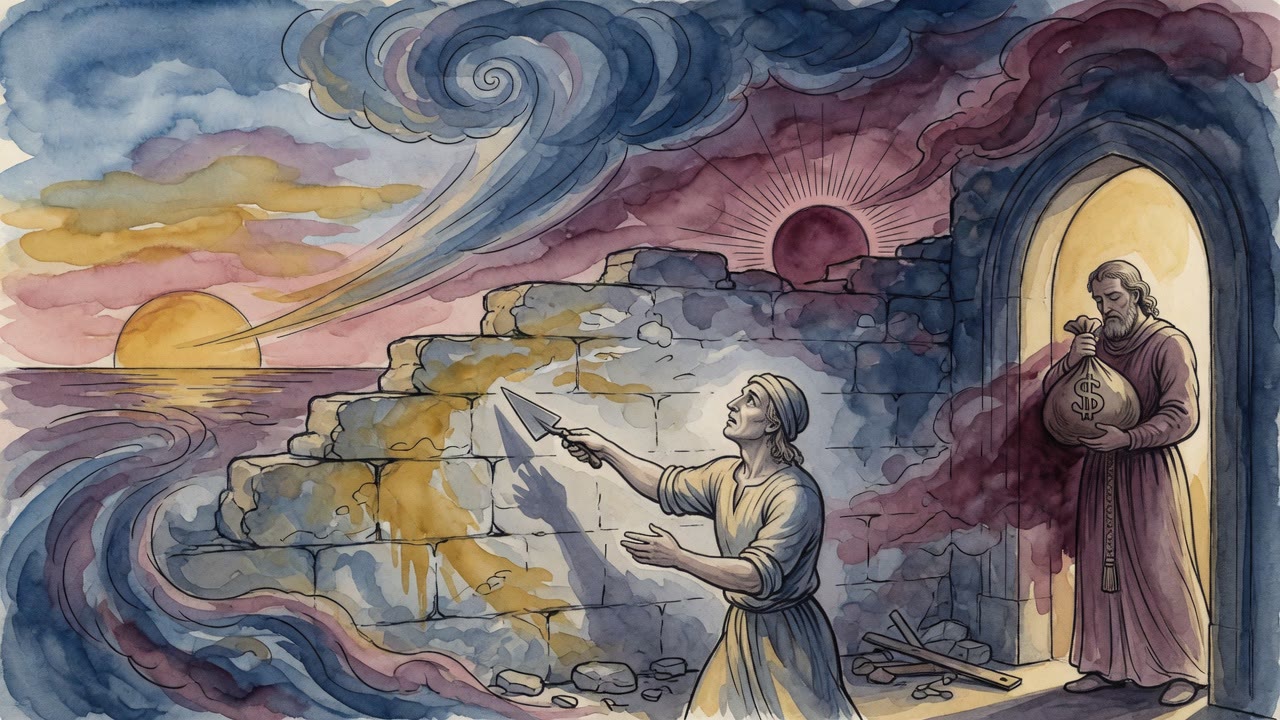
The laborer set the last stone into the wall while the sun bled out along the ridge. His palms were raw. Dust had become a second skin. He waited by the gate with the patience of a man who has already spent tomorrow's bread in his mind.

The owner walked past with a friend, speaking of a wedding and a new cloak. He did not look at the wall he had bought with another man's spine. "Tomorrow," he said, when the laborer stepped into his path. The word fell soft and rotten.

Night came. The laborer's children learned the sound of a door that opens without a coin behind it. Hunger is a teacher with perfect attendance. It arrived on time even when wages did not.

In His Day

"In his day you shall give his wage." The verse does not romanticize work. It times payment to the life of the body that earned it. A day laborer's day ends. His claim does not float into a rich man's convenience.

Do not let the sun set on it when the agreement is a day hire. Night is when the poor count. Night is when a delayed coin becomes a stolen meal. The Torah treats that delay as a crime against a person, not a bookkeeping style.

In the morning the laborer returned, not with a riot, with a face that made the owner's dog quiet. He named the verse without naming the verse. He named his children's empty bowls. The owner paid then, angry at being made to feel like a thief in his own courtyard. The anger was accurate. Feeling like a thief is sometimes the first honest weather a man has felt in months.

Righteousness as a Road for Presence

Near these rulings the midrash speaks of righteousness that paves a way for the Divine Presence. Pay what you owe when the body needs it, and you are not only keeping a contract. You are clearing a road. Delay wages, and you clutter that road with a stone that looks small in your hand and breaks a shin in his house.

Heaven is not bribed by building projects financed with unpaid evenings. The wall stood straight. The owner's name in the town did not. People can smell a household that eats on the hunger of its workers. The smell lasts longer than plaster.

The laborer took the coin and did not bless the owner. The teaching on pledges had already said what needed saying. Righteousness can stand before God without a thank-you speech. Still, payment on time would have needed no speech at all.

Interest, Brothers, and the Slow Knife

In the same moral neighborhood sit the bans on interest to a brother. Coin that multiplies while a poor man sinks is a slow knife. Rabbi Shimon's line of ethics on lending refuses to treat a neighbor as a field you harvest with percentages.

The owner who delayed wages was not charging interest. He was doing something cruder. He was borrowing the laborer's night without writing a note. Ethics in silver begin before the clever contracts. They begin when a man's sweat is still wet on the stones you will brag about.

Later the owner tried to hire the same laborer at a lower rate, counting on hunger to negotiate for him. The laborer walked to another gate. Hunger negotiates. So does memory.

What the Town Began to Count

Word moved. Other day workers began to stand at gates at sundown instead of accepting "tomorrow" as a custom. A few owners paid early to avoid the look that had shamed the first man. Shame is a cheap enforcement tool, and sometimes it is the only one a town has before the court wakes.

In Midrash Aggadah, the wage law stays sharp because poverty is not a subplot. It is the clock by which many commandments are timed. Give in his day. Return the pledge when night needs it. Do not feed your house on another house's empty table.

The wall the laborer built outlasted the owner's cloak. On certain evenings, when the light failed in the same way, he would pass it with his grandson and say only, "I was paid for that, late." The boy did not understand the wound in the word late. He would, the first time someone tried to buy his day with a promise instead of a coin.

Before the next hire he asked the wage at the gate and the hour of payment in the same breath. Owners who hated the question revealed themselves early. Owners who answered cleanly got his back and his silence. He had learned that contracts spoken only about stones and not about sundown are incomplete tools, sharp on one side and soft where a family can be cut.

On a later job a young worker accepted "tomorrow" with a shrug. The older laborer pulled him aside at dusk and told him about the wall, the cloak, the dog that went quiet. "Your day ends when the light ends," he said. "Do not donate your night to a man who already owns a cloak." The youth stayed at the gate until coin changed hands. One more household ate that evening. One more owner learned the town was counting sunsets.


← All myths

From the tradition

Sources

4 sources

The texts behind this telling. Some cards carry a translation of the source; others are our own retelling of it, and each card says which. Every card links out to the original.

Sifrei Devarim 279:1Sifrei Devarim

Retold in our words. Read the original at the link below.Sifrei by Rabbi Shraga Silverstein · CC-BY

The Torah, in its infinite wisdom, understands that feeling intimately. to a seemingly simple verse in Devarim (Deuteronomy) and see what hidden depths it reveals about fairness, labor, and the value of time.

The verse in question, Devarim 24:15, states, "In his day shall you give his wage." Seems straightforward. Pay people when they've earned their keep. But the rabbis, in their brilliant way, saw more than just the surface. They asked: What does "in his day" really mean?

The Sifrei Devarim (a collection of legal midrash on the book of Deuteronomy) uses this verse to explore the timeframe within which a worker is entitled to their wages. And the conclusion is surprisingly generous.

The Sifrei Devarim derives from this verse that a day laborer, someone hired for the daytime, can claim their wages the entire night following their work. And conversely, a night laborer has the entire following day to claim what they’re owed. The Torah already commands us not to withhold wages overnight. As it says, "The wage of a hired (day-) laborer shall not abide with you until morning" (Leviticus 19:13).

But the rabbis didn't stop there. They looked at another phrase, "the sun shall not go down upon it" (Deuteronomy 24:15) referring to the wage of a night laborer. From this, they deduced that the night laborer is entitled to their wages until sunset of the following day.

So, what’s the big deal? Why this emphasis on timing?

It all comes down to respect and the inherent value of labor. A worker's time is precious. Their livelihood depends on receiving their wages promptly. By extending the claim period, the Torah safeguards the worker's rights and ensures they aren't unduly burdened by delays. It acknowledges their vulnerability and the power imbalance inherent in the employer-employee relationship.

This isn't just about legal technicalities. It's about human dignity. It's about recognizing that everyone, regardless of their social standing, deserves to be treated with fairness and respect. It's a powerful reminder that even in the most seemingly mundane aspects of life, like paying wages, we have an opportunity to uphold the highest ethical standards.

So, the next time you're considering the timing of a payment, remember this teaching. Remember the day laborer who toiled under the sun, and the night laborer who worked while others slept. And remember that justice, like a wage earned, is best delivered promptly.

Full source
Sifrei Devarim 278:1Sifrei Devarim

Retold in our words. Read the original at the link below.Sifrei by Rabbi Shraga Silverstein · CC-BY

Sifrei Devarim 278, drawing on (Psalm 85:14), tells us, "His righteousness shall go before Him and shall set his steps on the path." In other words, our acts of tzedakah, of righteousness, pave the way, clearing a path before the Divine Presence itself. Our good deeds aren't just fleeting moments; they have lasting impact, rising up and influencing the very fabric of reality. Think of it: even when we don't see the immediate results of our actions, they're making a difference.

Let's How seriously does Jewish law take the concept of paying people what they're owed? Very seriously.

The Torah, in the Book of Deuteronomy (Devarim), commands us, "You shall not oppress a hired laborer" (Devarim 24:14). Seems straightforward. But wait, isn't that already covered? Leviticus (Vayikra) 19:13 says, "You shall not oppress your neighbor and you shall not rob." So why repeat it?

Here's where it gets interesting. Sifrei Devarim isn't just repeating itself. It's highlighting the severity of withholding wages. Someone who holds back a worker's pay transgresses not one, not two, but five negative commandments, and one positive one! The negative commandments include: "You shall not oppress your neighbor," "You shall not rob," "You shall not oppress a poor hired laborer," and two more implied by the verse "There shall not abide with you the wages of a hired man until morning." Then, there's the positive commandment, "In his day shall you give his wage," and the prohibition against letting the sun set on unpaid wages.

That's a powerful statement. It emphasizes the importance of prompt and fair payment. It's not just a legal obligation; it's a moral imperative. Why so strict? Because denying someone their wages, even for a day, can have devastating consequences. It's about more than just money; it's about dignity, livelihood, and basic human rights.: these ancient texts, written millennia ago, are still speaking to us today. They remind us that our actions, both big and small, have profound significance. Whether it's striving for righteousness that ascends to the heavens or ensuring that a worker receives fair pay, every deed matters. And isn’t that a powerful thought to carry with us?

Full source
Sifrei Devarim 263:3Sifrei Devarim

Retold in our words. Read the original at the link below.Sifrei by Rabbi Shraga Silverstein · CC-BY

Sifrei Devarim turns to Strict Rules Against Charging Interest to a Brother.

The verse in question says, "But to your brother shall you not give interest" (Deuteronomy 23:20). Seems straightforward. But the Rabbis, in their infinite wisdom, weren’t content with a simple reading. They delved deeper, asking: If it already says, "You shall not give interest to your brother," what’s the point of repeating it? The Rabbis of the Sifrei Devarim (a Halakhic Midrash on Deuteronomy) wanted to know what exactly the Torah was trying to communicate.

Enter R. Gamliel, a sage whose insights still resonate centuries later. He distinguishes between two types of interest: antecedent and supervening. What does that even mean?

You need a loan from a friend. Before even asking, you send them a little "thank you" gift, thinking, "This will grease the wheels and make them more likely to lend me the money." According to R. Gamliel, that seemingly innocent gift is antecedent interest. It's a subtle way of influencing the lender, a pre-emptive attempt to sweeten the deal. It's like saying, "I know I'm going to ask you for something, so here's a little something for you in advance.”

Now, let's flip the scenario. You borrow money from a friend, pay it back in full, and then, feeling grateful, send them a gift, explaining, "This is for your money that was 'idle' with me" – meaning, for the inconvenience or opportunity cost they incurred by lending you the funds. This, says R. Gamliel, is supervening interest. Even after the debt is settled, you're still trying to compensate them for the loan.

Why the fuss? Why are these seemingly generous gestures considered problematic? The Rabbis were concerned with the potential for exploitation and the preservation of a pure, unadulterated act of kindness. Lending money should be a mitzvah, a good deed, not a business transaction disguised as friendship. The act of lending should be selfless.

The text continues, promising that if we adhere to these principles – if we lend without seeking undue gain – "so that the L-rd your G-d will bless you in all to which you put your hands." The Sifrei Devarim interprets this to mean that Scripture "established" for him a blessing in all the sending forth of his hands. It's a beautiful idea: that ethical behavior in our financial dealings leads to overall prosperity and blessing.

So, what’s the takeaway? Are we giving with strings attached? Are we trying to manipulate situations to our advantage, even in subtle ways? The Torah is nudging us to be more mindful, more generous, and more ethical in all our interactions, especially when money is involved. Maybe that's not such an ancient idea after all.

Full source
Sifrei Devarim 263:1Sifrei Devarim

Retold in our words. Read the original at the link below.Sifrei by Rabbi Shraga Silverstein · CC-BY

Our tradition understands that feeling deeply. It even has laws to protect against it. to a little corner of Jewish law, specifically dealing with the ethics of lending and borrowing. It's found in Sifrei Devarim, a collection of legal interpretations on the Book of Deuteronomy. And it brings up something really subtle, but profoundly important about the power dynamics in a lender-borrower relationship.

Rabbi Shimon asks a fascinating question: How far does the prohibition against charging interest go? Is it just about the money?

He reads the verse in Deuteronomy (23:20-21) prohibiting interest, and homes in on a single word: "devar," meaning "thing" or "matter." But devar is also closely related to "dibbur," which means "speech." So, Rabbi Shimon suggests, the prohibition against interest extends beyond just monetary gain.

It means the lender shouldn't even subtly exploit the borrower! The lender shouldn't ask the borrower to "Go and greet that man," or "Find out if that man has come from his place." Why? Because even seemingly innocent requests can create a sense of obligation, a feeling that the borrower "owes" the lender something beyond the money itself. It creates a power imbalance, a subtle form of pressure.

The borrower might feel compelled to do these favors, even if they're inconvenient or time-consuming, simply because they're indebted to the lender. That feeling of obligation, that subtle coercion, is itself a form of interest, a non-monetary return on the loan. And that's what Rabbi Shimon is getting at. The Torah is concerned not just with the financial transaction, but with the entire human relationship.

Isn't that amazing?

Then the text goes on to clarify the famous verse about lending to the stranger versus the brother. "To the stranger you may lend with interest, but to your brother you shall not." What's going on here? Is the Torah promoting a double standard?

The Sifrei Devarim explains: "To the stranger you shall give interest" – that's a mitzvah aseh, a positive commandment. "But to your brother you shall not give interest" – that's a mitzvah lo ta'aseh, a negative commandment.

In other words, lending to a non-Jew with interest is permissible, but lending to a fellow Jew with interest is strictly forbidden. This isn't necessarily about favoring one group over another, but about the unique responsibilities we have towards our own community. The idea is that within the Jewish community, we should be supporting each other, not profiting from each other's misfortunes. The ideal is one of mutual aid and support.

It's a challenging idea, for sure. And it raises lots of questions about how we apply these principles in our modern, globalized world. But at its heart, this passage from Sifrei Devarim reminds us that ethics aren't just about following rules. They're about being mindful of the power dynamics in our relationships, and striving to create a society based on fairness, compassion, and mutual respect.

Think about the subtle ways we can create pressure, and strive to build relationships based on genuine generosity and respect. Are there "hidden interests" in your relationships that you might not even be aware of?

Full source