5 min read

The Dropped Coin That Fed a Hungry Stranger

A sela slips from a closed fist into the dust, a poor man picks it up for bread, and heaven counts the accident as if the giver meant every grain of the gift.

Curated by Arthur · Told by Maggid ·
Table of Contents
  1. The Coin Hits Dust
  2. The Sheaf No One Meant to Leave
  3. Rabbi Elazar's Larger Hand
  4. Doubt in the Standing Grain
  5. Blessing That Does Not Wait for Intent
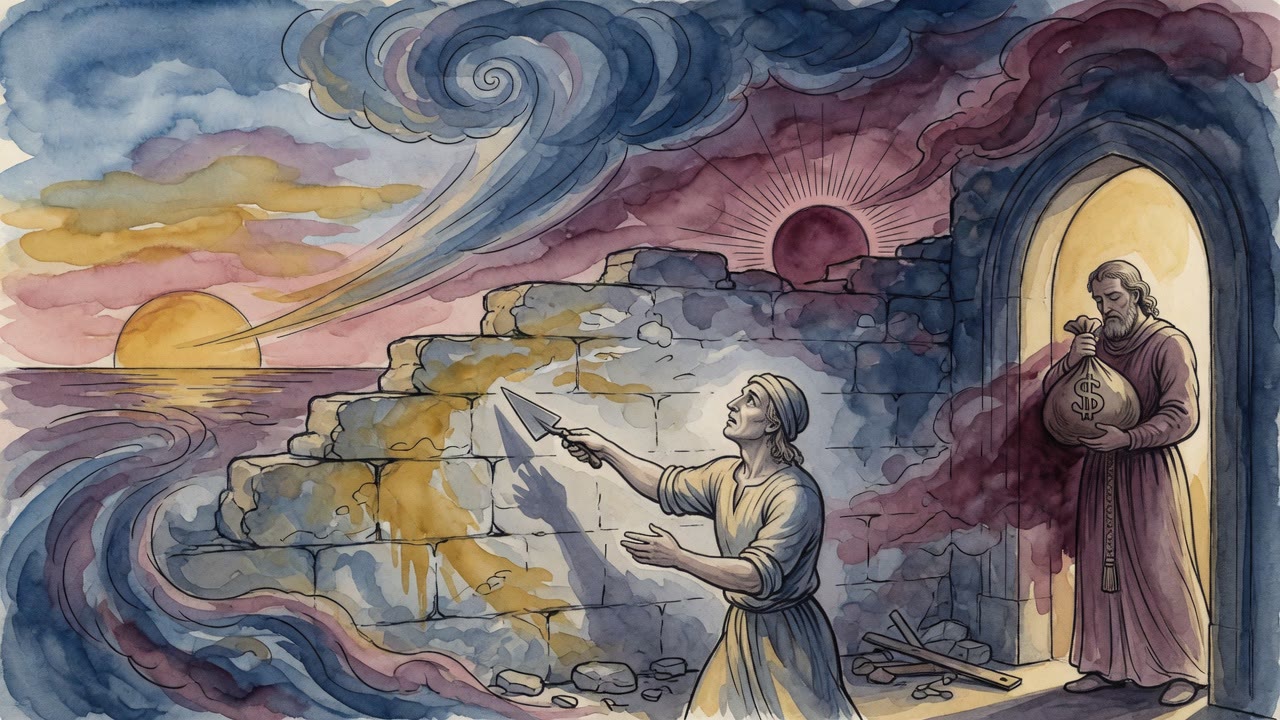
The Dropped Coin That Fed a Hungry Stranger Click for full size

The Coin Hits Dust

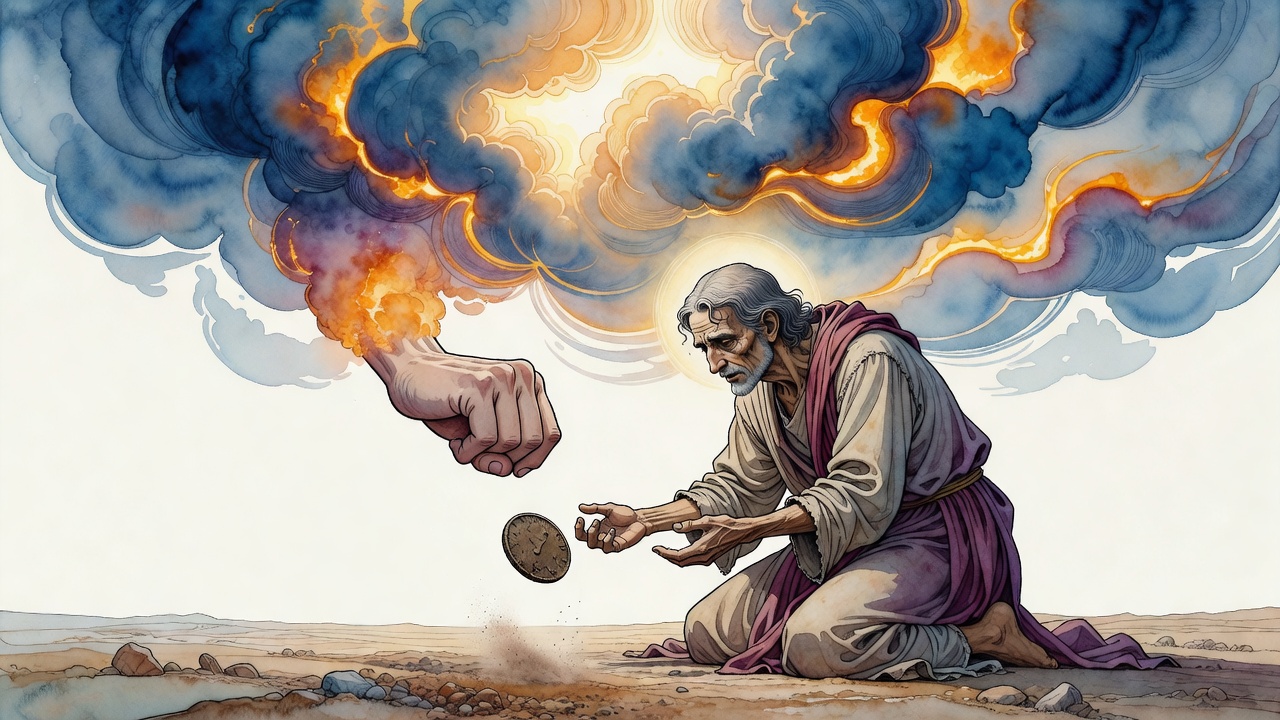
The sela left his fingers without asking permission. One moment it rode the crease of his palm, warm from the market day. The next it rang against stone, spun once, and lay flat in the lane dust like a small sun someone had stepped on. He did not turn. His mind was already three steps ahead on the price of oil and the weight of the sack on his shoulder. Behind him a man whose ribs showed through a thin shirt bent as if the ground had called him by name.

The poor man closed his hand around the coin. Bread. Salt. A night without the empty ache that keeps a person from sleeping. He did not bless the owner. He did not know the owner. He only knew the street had given him a day.

God counted the drop as if the fist had opened on purpose.

The Sheaf No One Meant to Leave

In the fields the same law wore different clothes. After a long day of cutting, a sheaf of grain sat at the edge of a row like a child left behind after the wagons turned for home. The farmer's workers had already stacked what they meant to stack. Sweat dried on their necks. Shadows stretched. Then one of them remembered the sheaf, or half remembered it, and the owner felt his own hand start to rise toward the path back.

The Torah stopped him cold. Do not return to take it (Deuteronomy 24:19). The forgotten sheaf, shikchah (שכחה), was no longer his. It belonged to the stranger, the orphan, and the widow. Forgetting, once it crossed a line the law could measure, became a gift the giver could not reclaim. The heads of the rows stayed with the owner. A sheaf already gripped for the city and then left on the road was not shikchah either. Intent had already claimed it. But a true forgetfulness, the kind that happens when the body is tired and the mind is elsewhere, turned private grain into public mercy.

The poor waited at the edges of fields the way the poor always wait: eyes down, hope thin, dignity held like a cracked cup.

Rabbi Elazar's Larger Hand

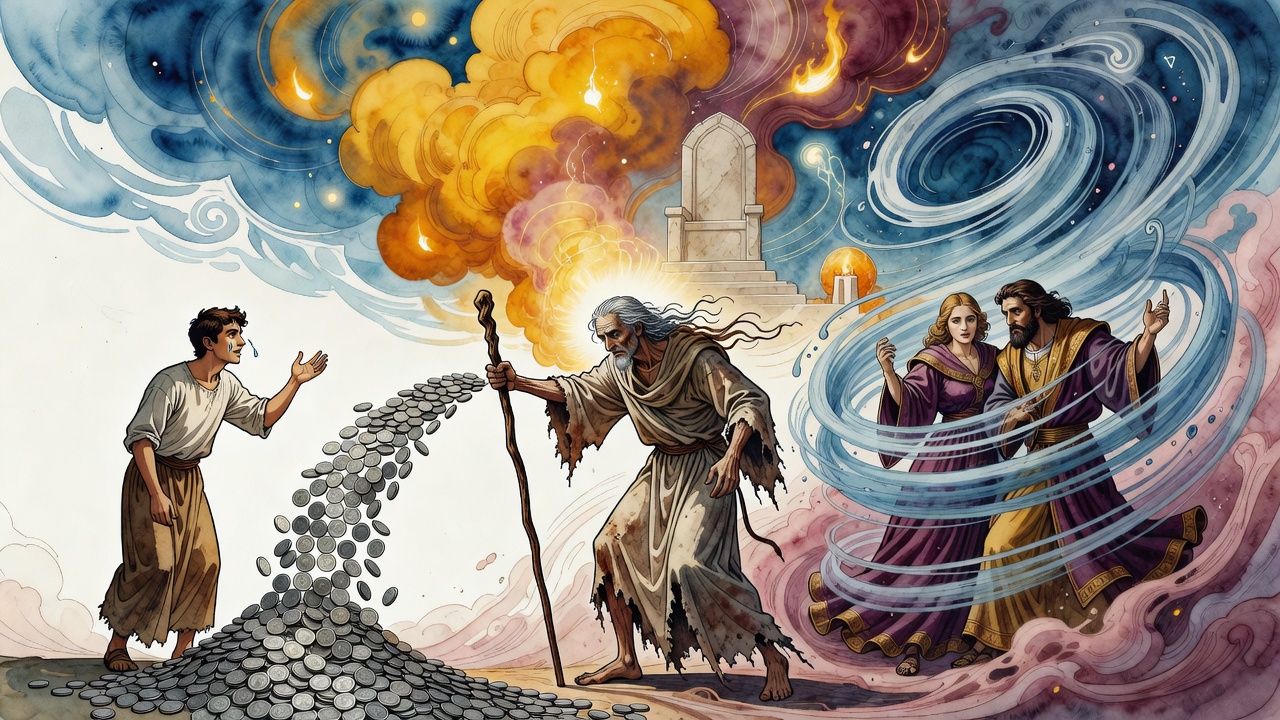
Rabbi Elazar ben Azaryah took the coin and the sheaf and set them on the same scale. If a man drops a sela without noticing, and a poor person finds it and eats, Scripture treats the accident as if the owner had intended charity. The verse that carries the forgotten sheaf also carries a promise: leave it for the stranger, the orphan, and the widow, so that the Lord your God will bless you. The blessing attaches not only to deliberate open-handedness. It attaches to the mercy that leaks out of a life when the fist loosens by fatigue or chance.

From the smaller case he climbed to the greater. If unintended giving is written as giving, and blessing rides on that giving, how much more does heaven weigh the man who means to give and then gives. The argument does not scold the careful. It refuses to waste the careless kindness. The world is full of people who never plan to be generous and still feed someone by a coin that escapes.

Doubt in the Standing Grain

Rabbi Yishmael stood in the grain and measured doubt. An ear whose head reaches the standing crop, cut with the rest, belongs to the owner. Harvested with the field, it was never forgotten. Left alone, it is shikchah. When no one can say which, the burden of proof falls toward the owner, because a person does not lose his property on a maybe. The law is not soft poetry about kindness. It is a field map with edges, so that the poor know where they may gather without becoming thieves, and the owners know where their rights stop without becoming hard.

On some evenings the widow covered a sheaf with straw so no one else would claim it first. On some evenings the orphan arrived late and found only stubble. The coin in the dust and the sheaf in the row were different machines of the same engine: a world where God lets accident feed the hungry and still insists on edges sharp enough to keep the hungry from being cheated of what the law already gave them.

Blessing That Does Not Wait for Intent

Night settled on the lane. The man who dropped the sela ate supper without knowing he had paid for another man's bread. The man who found the sela slept with a full stomach and did not know whose name to thank. Between them the blessing moved like a quiet third guest, uninvited by either and counted by the only One who saw both hands.

In the field the forgotten sheaf waited under moonlight. Tomorrow a stranger would bind it and carry it home. The owner would walk past the empty place and feel a small wrongness, the way a pocket feels lighter after a coin is gone. Then he would remember the command and leave the wrongness alone. That leaving was the point. Not the speech. Not the ceremony. The refusal to turn back.


← All myths
From the tradition

Sources

3 sources

The texts behind this telling. Some cards carry a translation of the source; others are our own retelling of it, and each card says which. Every card links out to the original.

Sifrei Devarim 283:6Sifrei Devarim

Retold in our words. Read the original at the link below.Sifrei by Rabbi Shraga Silverstein · CC-BY

You don't even notice. A poor person finds it, uses it to buy food, and sustains themselves. Did you just perform an act of charity?

That's precisely the scenario that Rabbi Elazar ben Azaryah explores in Sifrei Devarim 283.

He asks: where do we learn that if someone accidentally drops a sela (an ancient coin), and a poor person finds it and uses it to feed themselves, it's considered by Scripture as if the original owner had intentionally given it as charity?

His answer lies in the verse from Deuteronomy (Deuteronomy 24:19): "to the stranger, to the orphan, and to the widow shall it be, so that the L-rd your G-d will bless you." This verse refers to the laws of shikchah, the forgotten sheaf. Farmers were commanded to leave behind any forgotten sheaves in the field for the poor to collect. The Torah promises blessing for this act of unintentional giving.

Rabbi Elazar ben Azaryah uses a powerful argument a fortiori – a method of logical inference. He argues, if unintentionally giving, through shikchah, is accounted by Scripture as if one had intentionally given – and merits a blessing – then how much greater must be the reward for someone who intends to give and actually does give?

Think about the ripple effect of our actions, intended or not. This passage suggests that even unintentional acts of kindness can have profound consequences and that the Divine sees not just the action, but also the potential for good within it. It’s a powerful reminder that even when we don't see the direct impact of our actions, they can still contribute to a world of blessing.

Full source
Sifrei Devarim 283:4Sifrei Devarim

Retold in our words. Read the original at the link below.Sifrei by Rabbi Shraga Silverstein · CC-BY

Jewish law has a fascinating way of dealing with this very situation, particularly when it comes to the forgotten bounty of the harvest. It’s all rooted in the concept of shikchah (שִׁכְחָה), often translated as "forgotten sheaves.": after a long day of harvesting, A reader can overlook a stray sheaf of grain. But instead of allowing the farmer to simply reclaim it, the Torah (specifically (Deuteronomy 24:1)9) instructs, "do not return to take it." Why? Because it belongs to the poor, the widow, and the orphan. It’s a beautiful system, a built-in mechanism for social justice right there in the fields.

So, how does this work in practice? Sifrei Devarim, an ancient commentary on the Book of Deuteronomy, explores the specifics. It asks, what exactly constitutes shikchah?

The Sifrei tells us that the "heads of rows" are excluded from shikchah. What does that mean? Well, the sheaf closest to the row indicates its status. It’s all about intent and connection. And what if a farmer had already taken hold of a sheaf, intending to bring it to the city, but then forgot it along the way? The rabbis agree: that’s not shikchah either. The intention was there; it was already, in a sense, “claimed."

What if only some of the workers forgot the sheaf, but the owner didn't? Or vice versa? What if the poor were already eyeing it, standing before it, maybe even covering it with straw to mark it as theirs? Again, the answer is no – it's not shikchah. There’s a level of awareness, of connection, that negates the idea of true forgetfulness.

The Sifrei goes on to explore the question of quantity. How much grain must be forgotten for it to qualify as shikchah? The sages, in their wisdom, estimated that it must be less than two sa'ah (סְאָה), an ancient unit of measurement roughly equivalent to about two gallons. So, if a farmer forgot a sheaf containing two sa'ah, it's not considered shikchah.

But things get interesting when we consider multiple sheaves. What if two sheaves were forgotten, containing a total of two sa'ah between them? Here, we have a disagreement between Rabban Gamliel and the other sages. Rabban Gamliel argued that they still belong to the owner, while the sages maintained they belong to the poor.

Rabban Gamliel posed a thought-provoking question: "If there are more sheaves, is the power of the owner increased or decreased?" The other sages conceded that it is increased. So, Rabban Gamliel reasoned, if one sheaf containing two sa'ah isn't considered shikchah, then surely two sheaves containing the same amount shouldn't be either!

The sages countered with a clever analogy: "No, this is so for one sa'ah, which is like a pile. " In other words, a single, larger heap is treated differently than multiple smaller bundles. The aggregation changes the equation. It's a fascinating glimpse into the nuances of rabbinic logic.

What’s so powerful about this discussion in Sifrei Devarim isn’t just the legal technicalities, but the underlying principle: the Torah's concern for the vulnerable. Shikchah isn't simply about forgotten grain; it’s about remembering our responsibility to those in need. It's about creating a system where even accidental oversights can become opportunities for kindness and support. And that’s a harvest worth celebrating.

Full source
Sifrei Devarim 283:5Sifrei Devarim

Retold in our words. Read the original at the link below.Sifrei by Rabbi Shraga Silverstein · CC-BY

It might seem insignificant, but in Jewish law, even the smallest forgotten thing holds immense value.

We're delving into a fascinating area of Jewish agricultural law today, specifically the concept of shikchah (שִׁכְחָה), or "forgotten sheaves." Imagine a farmer harvesting his field. He accidentally misses a sheaf of wheat. The Torah, in (Deuteronomy 24:19), commands him: "do not return to take it." This isn’t just good manners; it's a commandment, a mitzvah. These forgotten sheaves are designated for the poor, the widow, and the orphan.

So, what happens when the lines get blurred? What if it's not entirely clear if something was truly forgotten? That's where Rabbi Yishmael comes in, as discussed in the Sifrei Devarim 283.

Rabbi Yishmael offers a ruling on a very specific scenario: an ear of grain, whose head reaches up to the standing grain. Now, if this ear was harvested together with the rest of the standing grain, it belongs to the owner. The very act of harvesting it alongside everything else proves it wasn't really forgotten. But if it wasn't harvested with the rest, it belongs to the poor as shikchah.

But what if we’re not sure? What if there’s a safek (סָפֵק), a doubt? This is where it gets interesting. Rabbi Yishmael rules that if there is a doubt as to whether it was harvested with the standing grain, it belongs to the owner. Why? Because the burden of proof falls on the one trying to take it away from the owner's possession. It's a legal principle: you can't just claim something is shikchah without evidence.

This raises a broader question: how do we treat doubtful cases of other agricultural gifts designated for the poor? The Torah mandates leaving portions of the harvest for the needy, including leket (לֶּקֶט) fallen grain, and peah (פֵּאָה) the corner of the field. What happens when we're unsure if something qualifies?

The Sifrei provides an answer: just as a doubtful case of shikchah belongs to the owner, a safek of leket is treated as leket, and a safek of peah is treated as peah. In other words, err on the side of generosity!

Where does this principle come from? From the very purpose of these laws, as we learn from the verse: "to the stranger, to the orphan, and to the widow shall it be." These agricultural laws are fundamentally about providing for the vulnerable. When in doubt, we should lean towards fulfilling that purpose.

So, the next time you see a field after harvest, remember the shikchah. It's more than just leftover grain; it's a symbol of our responsibility to care for those in need, and a reminder that even in doubt, generosity should guide our actions.

Full source