5 min read

The Girl Whose Cry Brought Down Wicked Sodom

Sodom fenced its trees, armed its courts against strangers, and burned Lot's daughter, whose cry brought wicked judgment down.

Curated by Arthur · Told by Maggid ·
Table of Contents
  1. The Trees Were Sealed
  2. The Judges Took the Roads
  3. Peletith Filled the Bucket
  4. The Fire Was Made Legal
  5. Her Cry Reached the Throne

The poor man should have died in the street.

That was the law of Sodom. No loaf in his hand. No figs dropped from an orchard. No stranger warmed by a door. Hunger was not an accident there. It was policy, guarded by fences, judges, and fire.

The Trees Were Sealed

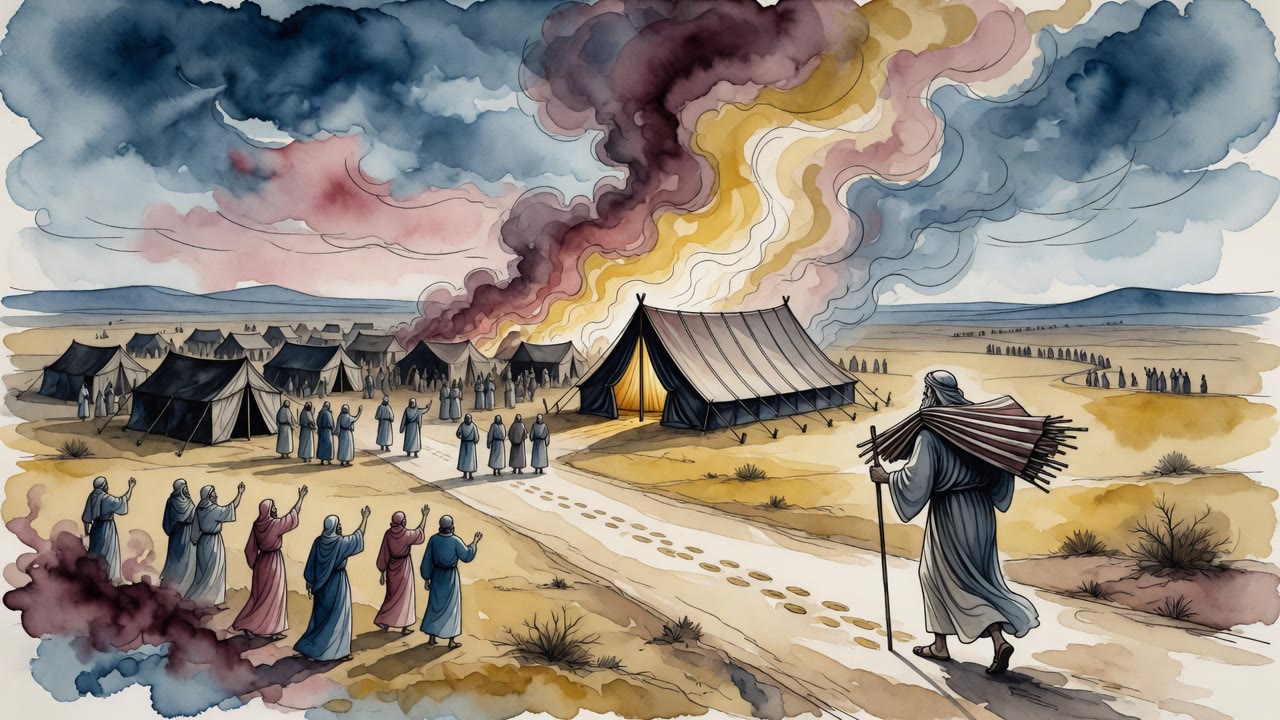
The city had trees heavy with fruit, but the fruit hung behind barriers raised above the branches. A traveler could look up and smell ripeness in the heat. A child could hear figs fall inside the enclosure. Even the birds could not reach what grew there.

The people of Sodom did not merely refuse guests. They built a city where refusal had nails and hinges. The orchards said it before any officer had to speak: nothing leaves this place for a hungry mouth.

God had given them soil, rain, shade, and trees. They answered with locks. The stranger saw abundance and was taught the city's first lesson. Bread existed. Mercy did not.

The Judges Took the Roads

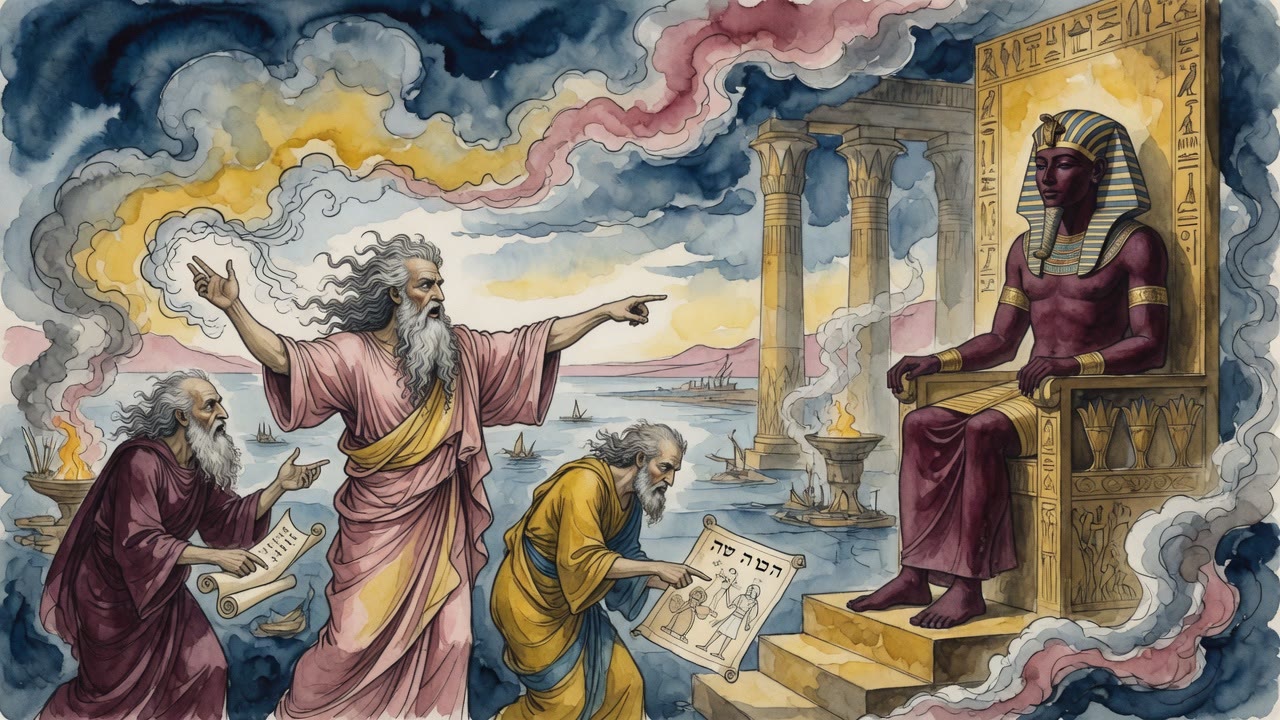
At the gates sat judges who knew exactly how to make robbery sound clean. A wayfarer entered with a cloak, a purse, a walking staff, maybe a name from some safer place. He left stripped.

The court did not shout like bandits. It measured, ruled, fined, and smiled. A man who protested found another charge waiting. A woman who asked for water learned that questions could cost as much as theft. Sodom had discovered a sharper cruelty than lawlessness. It could injure a stranger and call the wound a judgment.

The judges gave the city what cruelty always wants: permission to feel orderly. No one had to admit he hated the poor. No one had to say he feared the stranger. The verdict did the speaking.

By evening the road outside the city carried men with dust on their skin and no garment over their shoulders. Inside the walls, the judges remained seated. Their hands were clean. Their judgments were not.

Peletith Filled the Bucket

Peletith, daughter of Lot, lived inside that city and married into wealth. Her house had food. Her street had a starving man. Every day he was still there, folded into the dust, too weak to disappear.

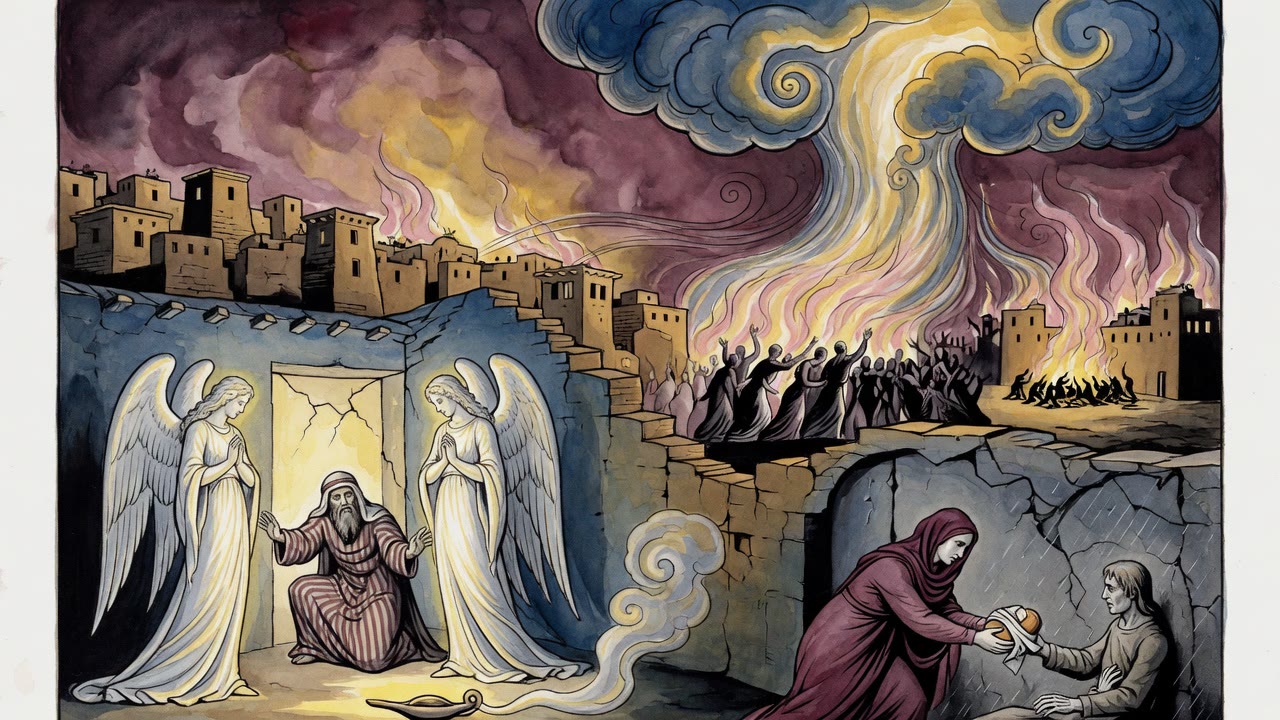
She did not announce compassion. Speech was dangerous. She took a bucket for water and hid provisions inside it, bread and whatever else her hand could carry from her home. At the well, the bucket looked ordinary. In the street, it became life.

The poor man ate because she bent near him. He lived one more day, then another. His cheeks changed. His bones stopped shouting through his skin.

That was how Sodom found her. Not through prophecy. Not through confession. Through the scandal of survival.

The men of the city asked the only question their laws knew how to ask. How is this poor man still alive?

They watched. They followed the bucket. They found the bread hidden beneath the daily errand, and the whole machine of the city turned toward one young woman. Peletith had strengthened the hand of the poor, and Sodom had a decree for that. Whoever gave bread to the needy would be burned by fire.

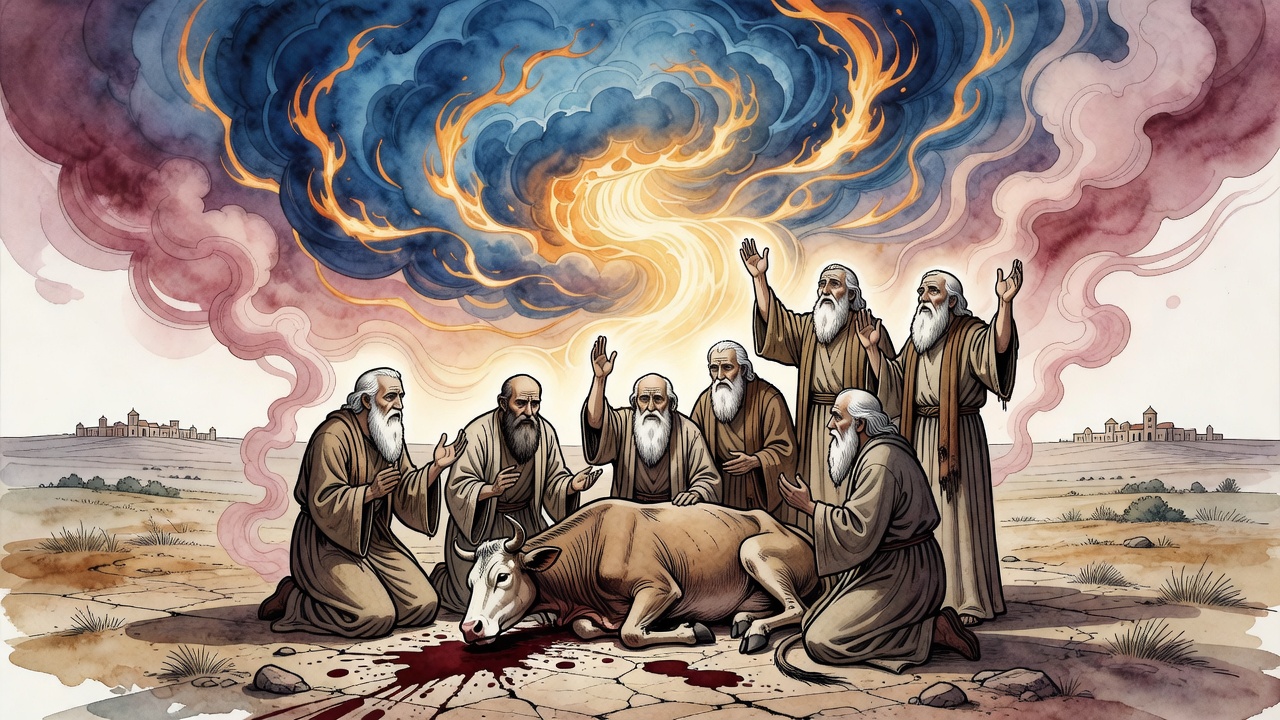
They brought her out as if they were carrying a verdict, not a victim. The fire was prepared with public confidence. A city that fenced fruit from birds did not tremble when it burned a woman for feeding a man.

Peletith stood before the flames. The law had her body. It did not have her voice.

Her Cry Reached the Throne

She cried upward, past the smoke, past the men who thought the case was finished. Sovereign of all worlds, maintain my right and my cause against the men of Sodom.

The cry did not scatter in the air. It rose before the Throne of Glory.

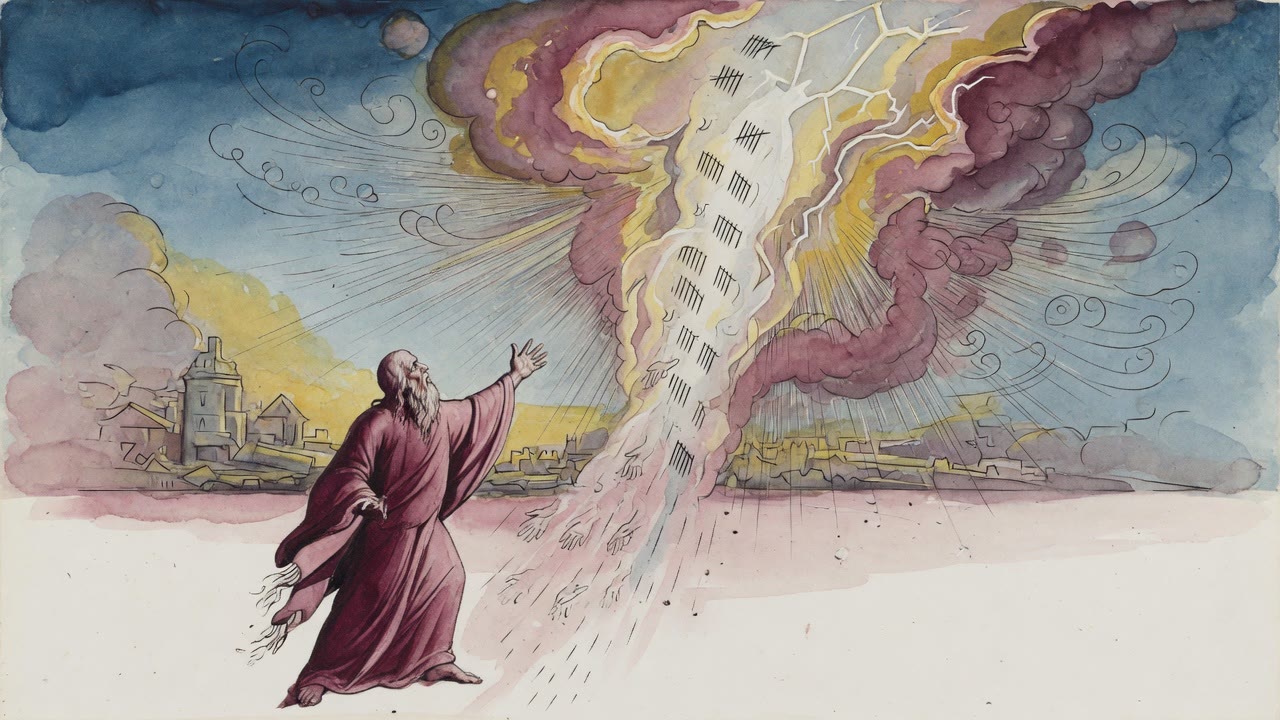
In that hour, heaven answered with descent. God would come down and see whether the city had done according to her cry. Not according to their cry. Hers. The voice of the burned girl became the measure of the whole city.

Then the foundations lost their patience. What had stood upright would be turned over. The surface would become the underside. The city that had built fences against birds, courts against strangers, and fire against mercy would learn what it meant for judgment to arrive from below and above at once.

Peletith's body went into flame. Her cry remained standing.


← All myths

From the tradition

Sources

3 sources

The texts this telling draws on, in full. Open a card to read inline, or expand it for a wider, quieter read.

Pirkei DeRabbi Eliezer 25:6Pirkei DeRabbi Eliezer

The familiar story is this: – fire, brimstone, a pillar of salt. But what specific sins pushed them over the edge? What was life really like in that infamous city? to the ancient text Pirkei DeRabbi Eliezer, a fascinating work of Jewish literature that retells and expands upon biblical narratives. In chapter 25, we get a glimpse of the depravity that defined Sodom, not just in the realm of personal morality, but in their very societal structures.

Rabbi Nathaniel paints a picture of extreme selfishness. He says the people of Sodom lacked any consideration for honoring their "Owner", that is, God, by refusing to share food with travelers and strangers. But it gets worse. They didn't just withhold; they actively hoarded. They fenced in their fruit trees, protecting them from everyone, “even… the bird of heaven.” This is a reference to (Job 28:7), "That path no bird of prey knoweth." Imagine, a society so closed off, so utterly devoid of generosity, that they wouldn’t even allow birds to partake in the bounty of nature! What does it say about a culture when their first instinct is to deny even the simplest act of kindness? It speaks to a deep-seated fear, a scarcity mentality taken to the extreme. It’s not just about the food; it's about a fundamental lack of empathy.

Then, Rabbi Joshua, son of Ḳorchah, adds another layer of horror. He tells us that the Sodomites appointed "lying judges" who actively oppressed any traveler or stranger who dared to enter their city. These weren’t just inept or biased judges; they were deliberately malicious, perverting justice to rob and humiliate outsiders. These victims were then sent away "naked," as described in (Ezekiel 22:29), "They have oppressed the stranger without judgment." Can you imagine the terror? The feeling of utter helplessness at the hands of a corrupt system?

So, here we have two key elements: extreme selfishness and systemic injustice. Sodom wasn't just a place of individual sins; it was a society built on the foundation of cruelty and greed.

What's truly chilling is how relevant these themes remain today. We might not be fencing off fruit trees, but are we always mindful of those less fortunate? Do we ever turn a blind eye to injustices perpetrated by those in power? Sodom serves as a stark warning, a reminder that a society's moral compass is only as strong as its willingness to care for the vulnerable and uphold justice for all. It forces us to ask ourselves: what kind of society are we building? And what will history say about us?

Full source
Pirkei DeRabbi Eliezer 25:8Pirkei DeRabbi Eliezer

Rabbi Judah tells us that in Sodom, a truly horrific decree was issued: anyone who dared to help the poor, even with a simple loaf of bread, would be burned alive. Imagine living in a society where compassion is a capital crime. It's almost impossible to fathom, isn't it?

Enter Peleṭith, daughter of Lot, married to a wealthy man in this twisted city. One day, she saw a desperately poor man in the streets, and her heart broke. As Job says (30:25), "Was not my soul grieved for the needy?" Peleṭith couldn't ignore his suffering.

So, what did she do? She devised a plan. Every day, when she went to draw water, she'd secretly fill her bucket with food from her own home and share it with the starving man. Think about the courage that took! She knew the risks, but she couldn't stand by and watch someone suffer.

Of course, in a society as depraved as Sodom, secrets don't stay hidden for long. The men of Sodom, noticing the poor man's continued survival, grew suspicious. They investigated and discovered Peleṭith's act of kindness. Their response? They dragged her out to be burned alive.

Can you imagine her terror? Standing before a raging fire, facing a horrific death for the crime of… empathy? In her desperation, Peleṭith cried out to the heavens: "Sovereign of all worlds! Maintain my right and my cause at the hands of the men of Sodom!" Her cry, the Pirkei DeRabbi Eliezer recounts, ascended before the Throne of Glory.

And then, something extraordinary happened. The Holy One, blessed be He, responded. God said, "I will now descend, and I will see" (Genesis 18:21) whether the men of Sodom have truly acted according to the cry of this young woman. "I will turn her foundations upwards, and the surface thereof shall be turned downwards."

The Pirkei DeRabbi Eliezer points out a crucial detail here. The verse doesn't say "according to their cry," but "according to her cry." It was Peleṭith's individual plea, her singular act of defiance against the overwhelming cruelty of Sodom, that triggered divine intervention. One person, one act of kindness, can have such profound consequences. Peleṭith’s story, though filled with darkness, ultimately shines a light on the power of compassion and the importance of standing up for what's right, even when the entire world seems to be against you. It reminds us that even in the face of unimaginable evil, a single voice, a single act of kindness, can reach the heavens and change the course of history. What cry will you send out into the world?

Full source
Targum Pseudo-Jonathan on Genesis 18:21Targum Pseudo-Jonathan on Genesis

The Hebrew of (Genesis 18:21) says only, "I will go down now and see." Targum Pseudo-Jonathan opens a window into what God is actually going down to see. And the window is heartbreaking.

"I will now appear," the Aramaic paraphrase reads, "and see whether, as the cry of a damsel torn away, which ascendeth before Me, they have made completion of their sins."

The rabbis preserved a tradition that the specific tz'aqa, the scream, that reached the divine throne from Sodom was the scream of a particular young woman. Most versions name her or describe her as a girl who either fed a stranger or tried to protect one, and who was tortured by the city for it. Her cry is the evidence in the case.

Yet even here, at the edge of verdict, the Targum insists on the possibility of repentance. "If they have wrought repentance, shall they not be as innocent before Me? and as if not knowing, I will not punish."

This is the double signature of Jewish divine justice. The cry of the victim is never ignored, not a single scream is forgotten in heaven. And the door of teshuvah (repentance) is never locked until the last possible moment. Sodom will fall because it chose not to walk through that door, not because the door was shut.

The takeaway: God hears the scream of the voiceless and waits, as long as He can, for the perpetrator to turn.

Full source