The Day Laborer Climbs and Lifts His Soul for Wages
A hired man risks the ridge for a day's pay and watches the sun drop while the owner delays. Holding back his wage is counted as taking his soul.
Table of Contents
 Click for full size
The Incline Before Dawn
He climbed the ridge while the stars were still out because the owner wanted stones moved before heat. His sandal slipped once on loose gravel. He fell to one knee, caught himself with a palm that would bleed later, and rose again. Why did he risk his life on this incline if not that you should give him his wage in the daytime?
The verse says he is poor and to it he lifts his soul. The teaching refuses to stop at the poor man alone. The rich hireling is included. The weaver and the carder, whose work does not dangle them over a cliff, are included. Still, heaven hurries payment for the poor and impoverished more than for others, because delay lands on them like a second stone.
Sunset and the Closed Purse
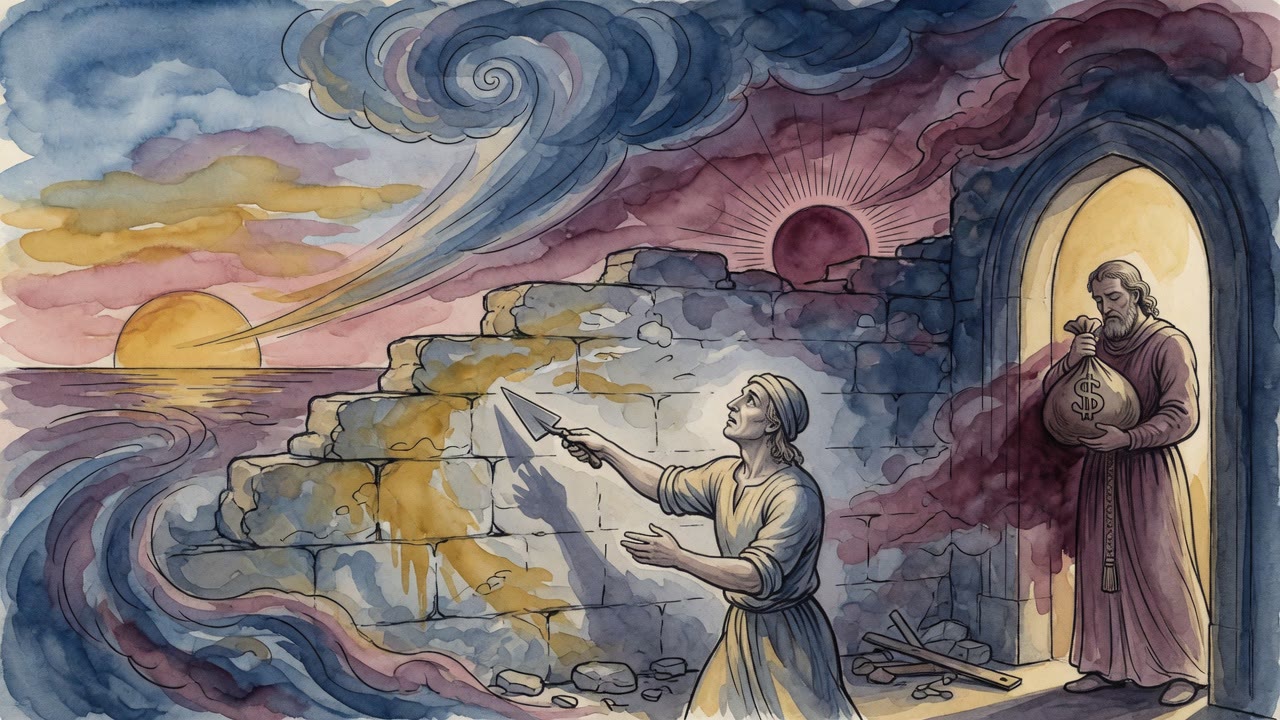
At sundown the stones were stacked. He carried the last load and set it down with shaking arms. The owner counted them twice and talked about tomorrow's ledger. The laborer stood with dust in his teeth. He had children who ate in the evening or not at all. He lifted his soul toward the coins the way a drowning man lifts a face toward air.
If they had agreed to delay, the interdict eases. They had not. The owner simply liked the power of making a man wait. He turned away and walked toward his house. The law named that power: if one holds back a hired laborer's wage, it is reckoned as if he took his soul.
Call Out or Stay Silent
The laborer almost swallowed the insult. Then he called. Not because he was commanded to perform anger, and not because silence would erase the sin. There will be sin in the owner either way. But heaven hastens payment for the one who calls more than for the one who does not. The cry is a legal act and a human one.
"Pay me," he said, loud enough for the yard. He walked after the owner and stood in the doorway. The owner's face hardened. Neighbors came and listened. Coins finally left the purse with the ugly music of reluctance. The laborer's hand closed on metal that was already food. He turned and left before gratitude could be demanded of him.
What Was Almost Stolen
Walking home he understood the teaching's sharpness. The owner did not raise a knife. He raised a delay. Delay can kill as quietly as a blade if the house at the bottom of the hill is waiting on bread. Taking a soul does not always look like murder. Sometimes it looks like "come back tomorrow" spoken by a full man to an empty one.
His wife met him at the door. He gave her the coins. They hit the table. Children woke to the sound and came running. The ridge, the slip, the bleeding palm, all of it was a road toward this small noise of metal. He washed and did not bless the owner. He blessed the law that called delay by its true name.
The Owner That Night
The owner slept poorly. He told himself the man was rude. He told himself ledgers take time. Under those stories sat a simpler one: he enjoyed the bow of a waiting head. The teaching will not flatter him. It will say he reached for a soul with a closed fist of hours.
In the morning he paid the next laborer before noon without speech. He walked into the yard, opened the purse, and gave. Fear is not the purest teacher, but it is a teacher. The ridge still needed stones. The men who climbed it still lifted their souls with every step. The purse learned to open while the sun was high. At dusk the owner stood at the same doorway and refused to enjoy anyone's wait.
← All myths