5 min read

The Widow Who Found What the Harvester Forgot

A widow follows the reapers at dusk and finds a sheaf the law left behind. Forgetting becomes a door. Poverty eats from mercy in the field.

Curated by Arthur · Told by Maggid ·
Table of Contents
  1. Dusk in the Standing Grain
  2. Leave What You Forget
  3. Grapes in a Neighbor's Vineyard
  4. Who Counts as Neighbor
  5. The Field After the Blessing
The Widow Who Found What the Harvester Forgot Click for full size

Dusk in the Standing Grain

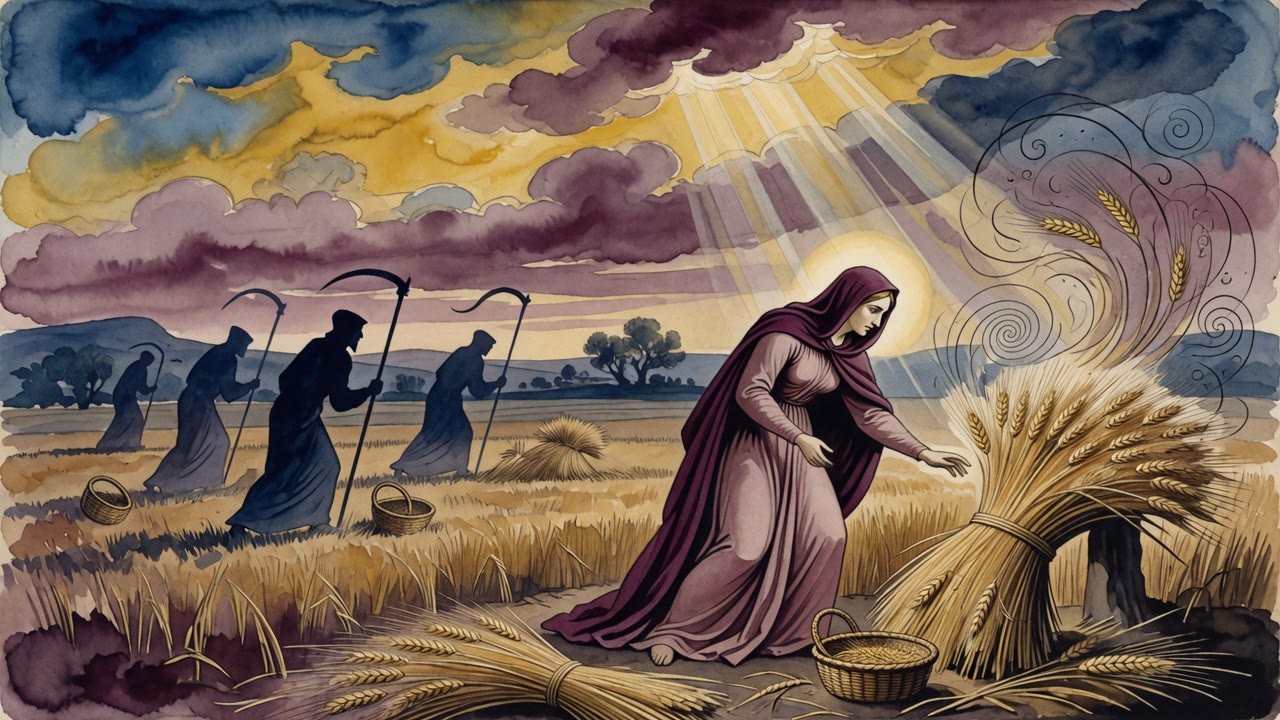
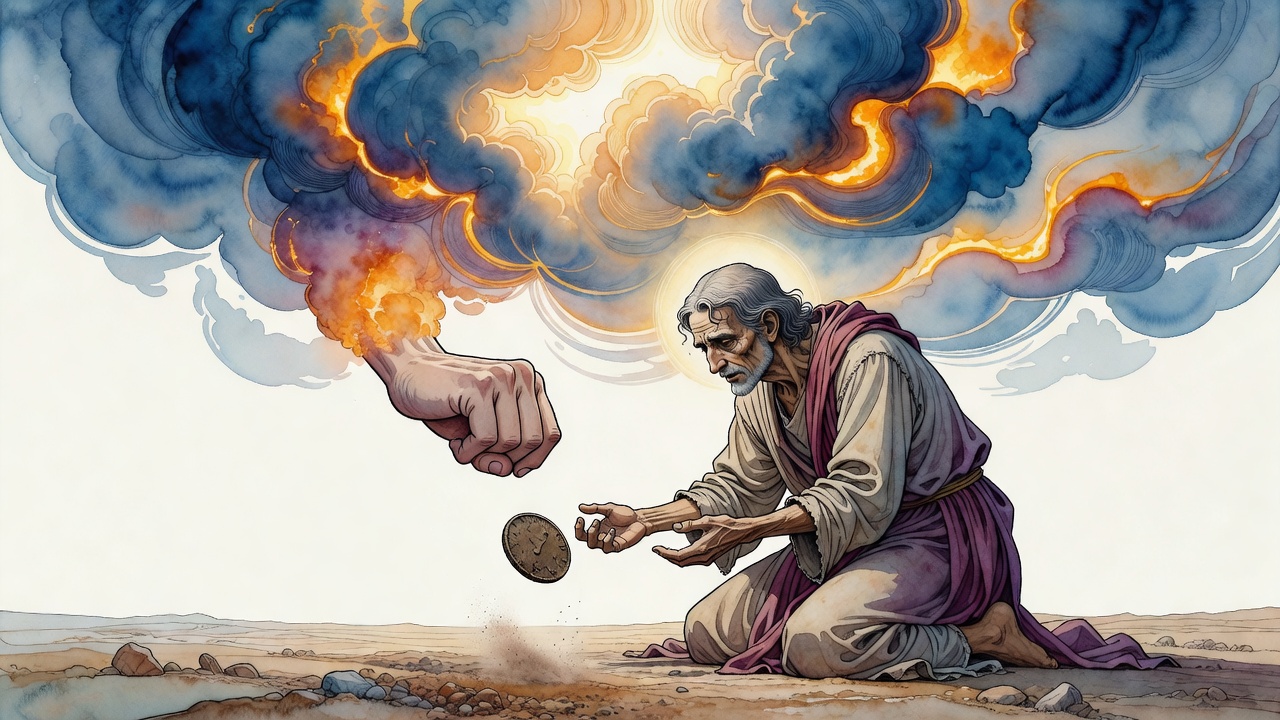
The widow waited until the reapers' laughter moved farther down the row before she stepped into the stubble. Her feet knew the difference between theft and the path the Torah left open. She was not there to swing a sickle like an owner. She was there for what forgetfulness, commanded forgetfulness, might leave behind.

A sheaf lay near the edge of the field, tied and somehow overlooked. Or not overlooked. In this people's law, some overlooking is holy. She knelt, hands careful, and felt the grain's weight the way a body feels bread before it is bread.

A reaper turned, saw her, and almost shouted. Then he remembered whose field this was, and whose teaching bound the owner, and he only wiped his face and kept walking. The shout died in his throat like a fly in honey.

Leave What You Forget

The forgotten sheaf is not a loophole for the greedy poor or a trick for the lazy rich. It is a discipline on memory. When your hand has left it and your mind has moved on, do not run back as if charity were a mistake you still have time to correct.

For the widow, the stranger, the fatherless, the sheaf becomes a door that opens without forcing anyone to beg in the owner's kitchen. Begging in kitchens has a cost measured in swallowed pride. Gathering in stubble has a cost measured in cut ankles. She paid the second cost gladly.

The poor come after the harvest rhythm, not during it as raiders. Pluck with the hand. Do not lift the sickle as if the field had changed deeds. Access is not ownership. The boundary keeps the gift from becoming a second conquest.

Grapes in a Neighbor's Vineyard

On another day she hired herself to a vineyard row. The Torah met her there with a different mercy. When you come into your neighbor's vineyard, you may eat grapes to sate yourself, but you shall not load a vessel as if you were the merchant of another man's vines.

Eat, do not suck the fruit into waste. Grapes while you work grapes. Figs while you work figs. Wait for the good ones rather than stripping the row like a thief in a hurry. Sages argue how much a worker may eat against the measure of a wage. Some limit. Some open the hand wider than the coin. The argument itself feeds the worker, because it admits the body in the heat has a claim the ledger must hear.

She ate enough to stop the shake in her hands and not enough to make the owner count bunches with a tight mouth. Dignity is often a quantity problem disguised as a moral one.

Who Counts as Neighbor

"Your neighbor" in these rows is a legal word with edges. The midrash draws lines the modern ear may hate and still must hear as the text's own map. Neighbor, not every outsider in the same way. Neighbor, not the Temple's consecrated property treated as a free orchard. Boundaries are how gifts stay gifts instead of becoming chaos that ends with the strong taking everything and calling it freedom.

She did not need a philosopher. She needed a sheaf and a lawful grape. The map that got her those things was written in the same ink that told owners not to harvest their own forgetfulness back into the barn.

At home she set grain to dry and felt, for one evening, the house thicken into something like safety. Safety for a widow is often measured in days, not years. Days matter. Anyone who scorns a day of bread has never watched a child sleep hungry.

The Field After the Blessing

The owner of the first field later told his sons that the sheaf he "forgot" had been left near the path on purpose after the first year. The law still called it forgotten. His heart called it placed. Heaven, the old teachers would say, can count both names without breaking.

In Midrash Aggadah, harvest laws are not rustic decoration. They are how a land keeps from becoming only a machine for owners. The widow's hands in the stubble are part of Israel's worship as surely as any song, because they force abundance to notice the people it did not invite to the first table.

She returned the next season. The reapers had learned not to shout. The sheaves kept appearing where memory and mercy overlapped. She never thanked the owner in the market. He never asked her to. Between them the field did the talking, in the only language that matters when the sun is going down and the grain is still warm.

One season a younger widow came beside her and reached for a sheaf still sitting in the owner's clear memory. The older woman stopped the hand. "Not that one. He has not forgotten it. Wait for the law's forgetfulness, not for your hunger to rename theft as need." They waited. Another sheaf, truly left, truly free, appeared near the path. They took that one and split it. Teaching travels best when it arrives as bread shared on a border between right and wrong.

The owner saw them and almost spoke a blessing, then kept silence because blessings can become a purchase of gratitude. He had learned from lenders and courts that righteousness does not always need an audience. The field kept its own records. Heaven, the old books say, reads those records without ink.


← All myths
From the tradition

Sources

4 sources

The texts behind this telling. Some cards carry a translation of the source; others are our own retelling of it, and each card says which. Every card links out to the original.

Sifrei Devarim 283:2Sifrei Devarim

Retold in our words. Read the original at the link below.Sifrei by Rabbi Shraga Silverstein · CC-BY

The Torah commands us, in (Deuteronomy 24:19), that when reaping our harvest, if we leave a sheaf in the field, we cannot go back to retrieve it. It must be left for the poor, the widow, and the orphan. Beautiful. But the rabbis, ever meticulous, immediately started asking, "What exactly constitutes 'the field'?" And more importantly, what qualifies as being 'forgotten' and therefore subject to shikchah?

The text we are examining revolves around a debate between Rabbi Yehudah and the other Sages regarding the scope of this mitzvah. Rabbi Yehudah takes a more restrictive view. He argues that “in the field” excludes anything hidden in the ground. if something is buried, it's not truly "forgotten" in the same way a sheaf left behind during the harvest is. It's intentionally set aside.

The Sages disagree. They believe "in the field" includes what is hidden. This might seem contradictory, but their rationale goes deeper. They also use "in the field" to include standing grain as subject to shikchah. Now, why is that inclusion so crucial?

The Sages present a logical argument, a kal v’chomer (קַל וָחוֹמֶר), an argument from minor to major. They reason like this: If a sheaf, from which the poor don't directly receive as much – meaning they don't have an inherent "right" to it during the initial harvest – still becomes shikchah if forgotten, then standing grain, from which the poor do directly benefit via leket (gleanings) and peah (the corner of the field left unharvested), should certainly be subject to shikchah if forgotten!

However, there's a counter-argument! Perhaps the forgotten sheaf is different because it doesn't "save" other forgotten sheaves or standing grain nearby. In other words, if you remember one sheaf, you still have to leave any others you forgot. But remembered standing grain does "save" forgotten sheaves and standing grain. If you remember to harvest some standing grain, you’re also likely to gather anything else left behind in that area. Therefore, the Sages insist, the Torah must explicitly state "in the field" to include standing grain within the laws of shikchah. Otherwise, we might wrongly assume it's exempt.

So, what’s the big takeaway here? It's not just about the technicalities of agricultural law. It’s about the constant, critical examination of how we can best ensure that the needs of the vulnerable are met. It's about wrestling with the nuances of intention, responsibility, and the spirit of generosity. It challenges us to consider not just the letter of the law, but its underlying purpose: to create a more just and compassionate world.

Full source
Sifrei Devarim 283:1Sifrei Devarim

Retold in our words. Read the original at the link below.Sifrei by Rabbi Shraga Silverstein · CC-BY

It's a concept called shikchah, often translated as "forgotten sheaves," and it's all about leaving a little something for those in need.

(Deuteronomy 24:19) tells us, "When you reap your harvest in your field and forget a sheaf, do not go back to get it. Leave it for the foreigner, the fatherless and the widow, so that the Lord your God may bless you in all the work of your hands." Simple enough. But as always, the rabbis dug deep to understand the nuances.

The Sifrei Devarim, a collection of legal midrash on the Book of Deuteronomy, tackles some interesting questions about shikchah. For instance, what if you're harvesting in someone else's field? Does the law of shikchah still apply?

Rabbi Meir, a prominent sage of the 2nd century, believed that shikchah doesn't apply if you're making sheaves in your neighbor's field. But the other sages disagreed, ruling that it does apply, regardless of whose field it is. These weren't just abstract legal points; they were real-life scenarios with real implications for people's livelihoods.

Now, let's get into the nitty-gritty. What exactly constitutes a "sheaf"? Is it just one? A hundred?

The text specifies, "if you forget a sheaf in the field," and not a heap of sheaves. This raises a key question: if you forget more than two sheaves, does shikchah still apply?

To answer this, the Sifrei Devarim points to the end of the verse: "to the stranger, (one), to the orphan and to the widow shall it be." The orphan and widow are considered as one unit here, so the implication is that we're talking about small amounts.

From here, the rabbis established a clear rule: Two sheaves are considered shikchah, but three are not. It's a seemingly arbitrary distinction, but it provides a concrete guideline.

And it doesn't stop there! The principle extends to other crops as well. Two piles of olives or carobs? Shikchah. Three piles? Nope.

There's also the concept of peret, which relates to gleanings of grapes. (Leviticus 19:10) commands us not to gather the fallen grapes of our vineyard. The rule? Two berries that fall at a time are considered peret, but three are not.

What's the takeaway from all this? It's not just about the technicalities of Jewish agricultural law. It's about a system designed to ensure that even in times of abundance, we remember those who are less fortunate. It's about creating a society where even the smallest oversight can become an opportunity for kindness and support. It’s about weaving compassion into the very fabric of our daily lives.

So, the next time you see something seemingly insignificant left behind, perhaps a single stalk of wheat or a forgotten olive, remember the concept of shikchah. And maybe, just maybe, it'll inspire us to look for ways to create our own modern-day versions of leaving a little something for those in need.

Full source
Sifrei Devarim 266:5Sifrei Devarim

Retold in our words. Read the original at the link below.Sifrei by Rabbi Shraga Silverstein · CC-BY

Would you be allowed to pluck a few as you worked? The Torah actually addresses this very question, and like so many things in Jewish law, the answer isn't quite as simple as it first appears.

The passage in Sifrei Devarim 266 explores the nuances of (Deuteronomy 23:25), which states, "When you come into your neighbor's vineyard, you may eat your fill of grapes, as many as you desire, but you shall not put any in your vessel." What does "your neighbor" even mean in this context? The text specifies: "your neighbor, but not a gentile," implying that the permission to eat applies specifically to Jewish-owned vineyards. It's a reminder of the communal and ethical considerations woven into even seemingly simple agricultural laws. And interestingly, "your neighbor, but not the Temple" excluding consecrated property from this right.

About those grapes. The verse says, "you may eat." But how may you eat? The text clarifies: "but not suck (out the wine and discard the rest, [for this would result in his eating a greater number of grapes])." No wine tasting and spitting here! The concern is with fairness and avoiding waste. It's about respecting the owner's property and not taking advantage of the situation.

What about other fruits? "Grapes, and not figs," the passage emphasizes. This leads to a fascinating ruling: "If he were working with (i.e. picking) grapes, he should not eat figs; if he were working with figs, he should not eat grapes. But he should restrain himself until he reaches the choice ones (and then eat)." So, if you're a grape picker, stick to grapes – and wait for the best ones! It’s a lesson in delayed gratification and focusing on the task at hand.

But here's where it gets even more interesting. How much can a worker eat? Is there a limit? R. Elazar b. Chasma believes there is. He says the verse "so as to sate your soul" implies that a worker may not eat more than his wage. In other words, the value of the grapes consumed should be equivalent to the worker's compensation.

However, the sages disagree! They interpret "so as to sate" to mean that a worker may eat even more than his wage. This suggests a more generous and compassionate approach, recognizing the hard work and physical exertion involved in harvesting.

So, what are we to make of all this? It seems like the Torah, through these interpretations, is trying to balance the rights of the owner with the needs of the worker. There's a tension between strict justice and compassionate generosity. It’s a reminder that even in something as simple as eating grapes in a vineyard, there are ethical considerations and different perspectives to consider.

This passage from Sifrei Devarim invites us to think about our own interactions and relationships. Are we being fair and just? Are we being generous and compassionate? And are we remembering to appreciate the fruits of our labor, both literally and figuratively? Perhaps next time you enjoy a bunch of grapes, you'll remember this ancient debate and the deeper questions it raises.

Full source
Sifrei Devarim 268:1Sifrei Devarim

Retold in our words. Read the original at the link below.Sifrei by Rabbi Shraga Silverstein · CC-BY

It’s like those Russian nesting dolls, each layer revealing something new. Let's peel back some layers from the book of Devarim, Deuteronomy, specifically from the collection known as Sifrei Devarim.

First, consider the simple phrase, "your neighbor." Who exactly is your neighbor? Well, the Sifrei Devarim makes a very specific point: "your neighbor," it says, "but not a gentile." And, "your neighbor," again, "but not the Temple." Now, this doesn’t necessarily mean exclusion, but rather specificity. The laws being discussed here likely pertain to interactions within the Israelite community, setting boundaries and expectations for those relationships.

What about gleaning from a field? The Torah commands us to leave the corners of our fields unharvested for the poor and the stranger. What are the practicalities? Sifrei Devarim elaborates: "you may pluck the ears with your hand," but, crucially, "you may not cut them with the sickle." It seems like a minor detail, but it speaks volumes about the spirit of the law. The poor are entitled to glean, but not to harvest freely. There's a dignity maintained, a limit set. It's about providing access, not ownership, reinforcing the idea that even in times of need, boundaries and respect are paramount.

Expanding on that, the text stresses, "but you shall not lift a sickle" (for yourself, even) when you lift a sickle upon the standing corn of your neighbor. This adds another layer of protection. Even when helping a neighbor harvest, you can’t surreptitiously take for yourself. Honesty and integrity must prevail. It’s a reinforcement of fairness and preventing exploitation, cloaked in the simple act of harvesting.

Now, let's shift gears to a completely different area: marriage. (Deuteronomy 24:1) states, "If a man take a woman…" Seems straightforward. But the rabbis of the Sifrei Devarim dive deep into the implications. The text notes: "We are hereby taught that a woman is acquired (as a wife) by money."

Wait, what? "Acquired"? That sounds harsh to our modern ears. But let's unpack it. The rabbis are wrestling with the legal basis of marriage. They are confronting the question of how a marriage is enacted. The text is suggesting that the transfer of money, a ketubah (a marriage contract) or marriage contract, is one of the mechanisms by which a marriage is legally established.

The logic they use is fascinating, almost like a legal thought experiment. Without this verse, the text argues, one might assume that if a Hebrew handmaid can be acquired with money (even without physical intimacy), then surely a woman, who can be married through intimacy, could certainly be married with money!

But, the text then throws in a counter-argument. What about a yevamah, a levirate widow? This is a woman who, according to Jewish law, is obligated to marry her deceased brother's brother. This union is established through yibum, cohabitation, but not through money. The yevamah case throws a wrench in the neat and tidy logic. So, the Torah must explicitly state "If a man take a woman," to emphasize that monetary transaction can indeed establish a marriage.

It's a complex discussion, highlighting how the rabbis meticulously analyzed every word of the Torah to derive legal and ethical principles. They weren't just passively accepting the text; they were actively engaging with it, questioning, challenging, and refining their understanding.

What does all this tell us? It invites us to engage with the text, to ask questions, and to confront the complexities of applying ancient wisdom to our modern lives.

Full source