Parshat Shoftim4 min read

A Snake Killed the Murderer Whom Yehudah ben Tabbai Could Not Convict

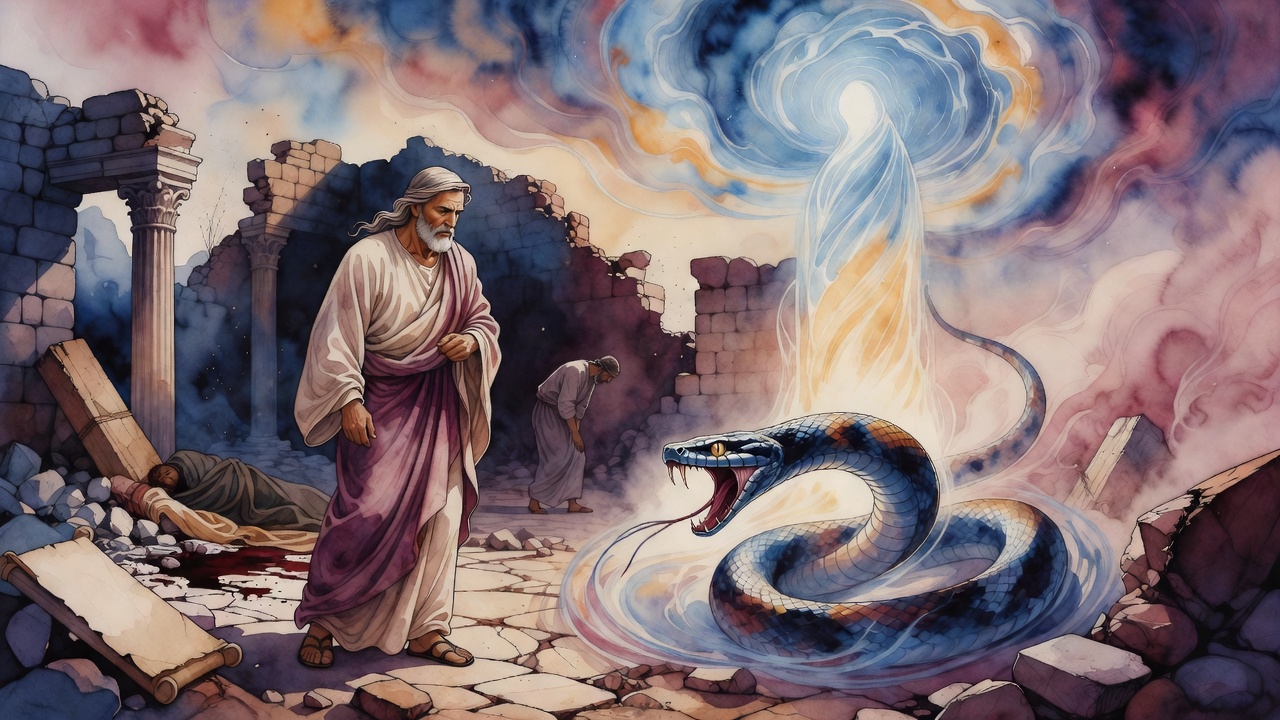
A man lay dying in a ruin and a second man stood over him holding a wet knife. Yehudah ben Tabbai was the only person who saw it, and one is not two.

Curated by Arthur · Told by Maggid ·
Table of Contents
  1. The Ruin at the Edge of the Road
  2. What One Pair of Eyes Cannot Do
  3. The Oath He Swore Instead of a Verdict
  4. The Omniscient One Will Exact Punishment
  5. Two Bodies in One Ruin
A Snake Killed the Murderer Whom Yehudah ben Tabbai Could Not Convict Click for full size

The Ruin at the Edge of the Road

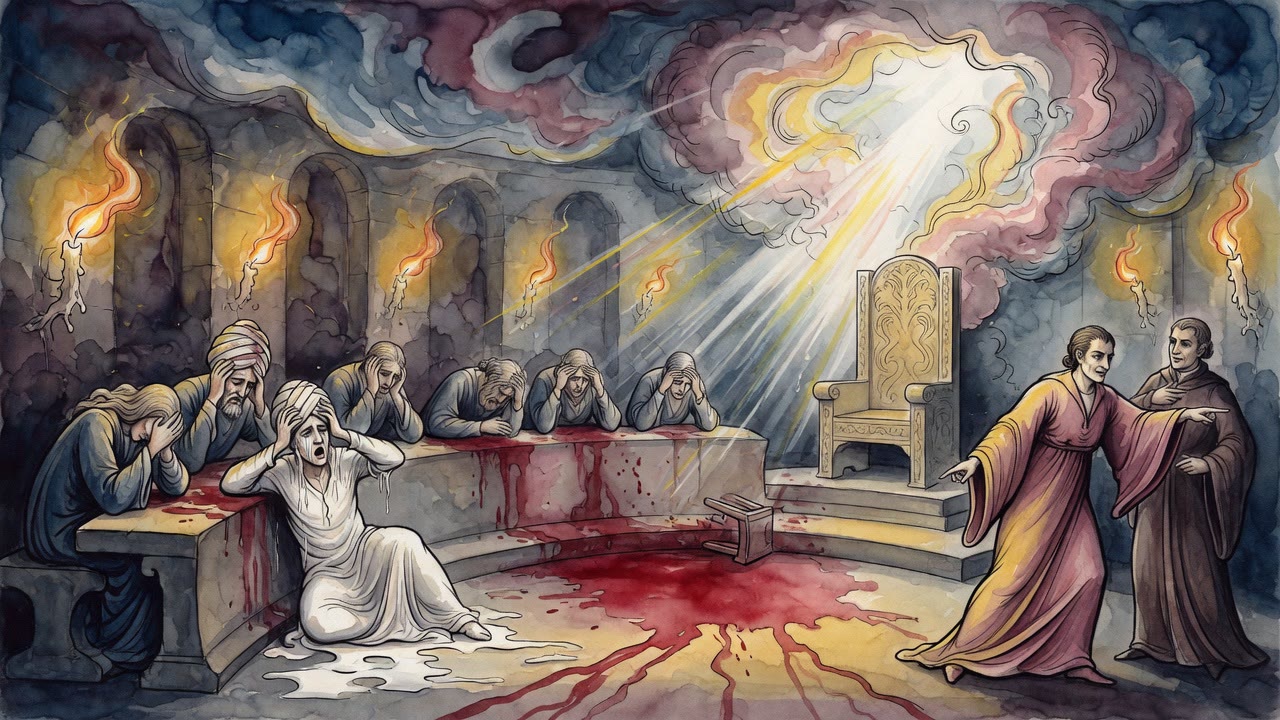
Yehudah ben Tabbai stepped through a gap in a broken wall and stopped. A man lay on the floor of the ruin with his heels dragging slow lines through the dust. His breath came in short pulls that did not fill him. Over him stood a second man, and the knife in that man's fist was still wet, the blade dark along its edge and bright at the spine where the blood had not run.

Nobody else came through the gap. No neighbor with a basket, no boy chasing a goat off the road. The track outside stayed empty in the heat.

The killer did not run. He shifted his grip on the handle and waited to learn what the sage would do about him.

What One Pair of Eyes Cannot Do

Yehudah counted the people in the ruin before he had taken a second step, and the count decided everything. Two witnesses put a man to death. One witness, however learned, however certain, however exactly placed by heaven in the right doorway at the right hour, puts nobody to death at all.

He had taught that law in the study hall for years. He had never before stood inside it with a dying man at his feet and the guilty man breathing four cubits away.

He could have named himself the second pair of eyes and let the bench assume the rest. He could have walked out to the road and found someone willing to swear to a thing he had not seen. Judges have done worse for smaller certainties.

He did neither.

The Oath He Swore Instead of a Verdict

"May God come upon me if neither I nor you killed this man," Yehudah said. "But what can I do to you? The Torah has written: by the word of two witnesses shall a thing be established."

He had bound himself with an oath to the truth of what he had seen, and in the same breath handed the killer his freedom. The most powerful judge in Israel stood in a collapsed house and announced that he was powerless. He would not invent a partner for his own eyes. He would not stretch the law one finger to cover a case that deserved covering, because a law stretched once for an obvious murderer stretches again for a doubtful one.

The man with the knife said nothing. Behind him, the breathing on the floor had gone quiet.

The Omniscient One Will Exact Punishment

"The Omniscient One will exact punishment of that man," Yehudah said.

He did not point. He did not raise his voice. He named no sentence and set no date, because he had no authority to set one. He handed the case up past the roofless walls to a court that does not require a second mouth, and then he was finished, and there was nothing left in the ruin for him to do.

He had hardly finished speaking when a snake came out of the fallen stones.

Two Bodies in One Ruin

It struck the killer and it did not let go quickly. He went down into the same dust he had spilled blood on, beside the man he had spilled it from, and the knife dropped and lay where either of them could have reached it and neither ever would.

Yehudah walked back out through the gap in the wall with clean hands and nothing to report to the court. No file was opened. No pair of witnesses was ever assembled. The dust in the ruin covered two men instead of one, and the rule that two mouths are needed to end a life stood exactly where it had stood that morning, unbent by the worst afternoon a judge could be handed.


← All myths
From the tradition

Sources

2 sources

The texts behind this telling. Some cards carry a translation of the source; others are our own retelling of it, and each card says which. Every card links out to the original.

Mekhilta Tractate Kaspa 3:11Mekhilta DeRabbi Yishmael

Retold in our words. Read the original at the link below.Mechilta, translated by Rabbi Shraga Silverstein · CC-BY

Yehudah ben Tabbai once entered a ruin and found a man in his death throes. A knife dripping with blood was in the hand of another man, clearly the murderer. Yehudah turned to the killer and said: "May God come upon me if neither I nor you killed this man. But what can I do to you? The Torah has written: 'By word of two witnesses shall a thing be established'" (Deuteronomy 19:15).

Yehudah knew who the murderer was. The evidence was overwhelming, a dying man, a blood-soaked knife, and a single witness (Yehudah himself). But one witness is not enough. The Torah requires two. Without a second witness, the judicial system could not act. Yehudah was powerless to punish a man he watched commit murder.

Instead, he invoked divine justice: "The Omniscient One will exact punishment of that man." He had barely finished speaking when a snake bit the murderer, and the man died.

This story illustrates both the limitations and the majesty of the Torah's judicial system. The human court was bound by its procedural rules, two witnesses or nothing. But God's justice operates without those constraints. Where the earthly court could not act, Heaven acted immediately. The snake served as God's agent of retribution, striking the moment Yehudah declared the case beyond human jurisdiction. The story affirms that no guilty person ultimately escapes judgment, even when the legal system cannot reach them.

Full source
Against Apion 11:1Against Apion

Retold in our words. Read the original at the link below.Against Apion, trans. William Whiston · Public Domain

He tackles this head-on in his work, Against Apion, a passionate defense of Judaism against its detractors. And in this section, Josephus gets straight to the point: he's had enough of historians who get it wrong.

He calls out the "vanity of those that profess to write histories," suggesting that these historians are more interested in their own opinions than in accurately portraying the past. Ouch.

Here’s the kicker: Josephus argues that the so-called "Barbarians" – a term the Greeks used for anyone not Greek – actually did a better job of preserving ancient history than the Greeks themselves! The people often dismissed as uncivilized, according to Josephus, were more reliable keepers of the historical record. Why? Perhaps they were less concerned with embellishment and more focused on simply passing down the stories as they received them.

Josephus is laying the groundwork for a powerful argument. He's about to address the claim that the Jewish people are a relatively new phenomenon, simply because Greek writers haven't mentioned them much.

His strategy is brilliant. He's already suggested that Greek historians aren't always the most trustworthy. Now, he's preparing to present evidence from other sources – foreign writings – to prove just how ancient the Jewish people really are. He also intends to demonstrate that the criticisms leveled against the Jewish nation are, quite frankly, unfair.

Essentially, Josephus is saying, "Don't take my word for it. Look at what other cultures have to say. See for yourselves how deeply rooted our history is." It's a bold move, and it sets the stage for a fascinating exploration of Jewish history as seen through the eyes of the ancient world.

How much of what we think we know about the past is based on reliable sources, and how much is shaped by bias and prejudice? And who gets to decide which stories are told, and which are forgotten? These are questions worth pondering, even today.

Full source