Parshat Beshalach7 min read

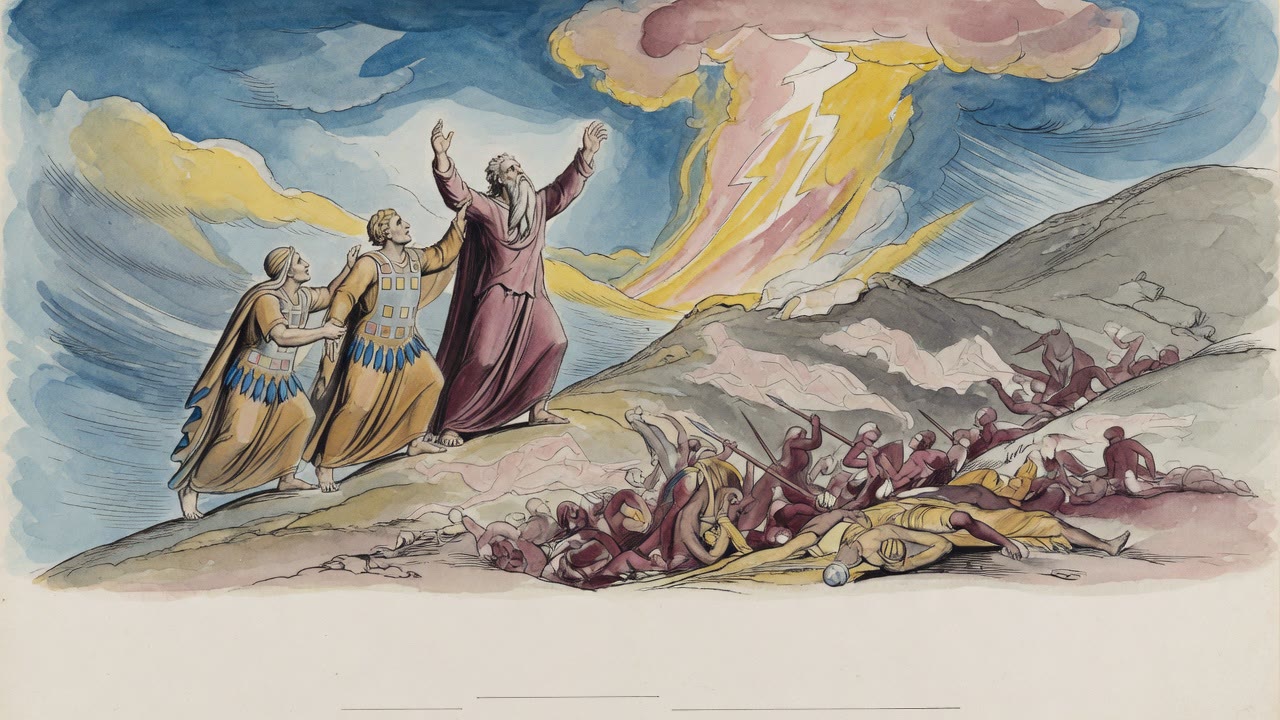
Aaron and Hur Held the Arms of Moses Aloft on the Hill

Joshua cuts Amalek's ranks below while Moses' arms fail on the hill, and Aaron and Hur hold them skyward until the enemy breaks at dusk.

Curated by Arthur · Told by Maggid ·
Table of Contents
  1. Joshua Cut Down the Champions
  2. Three Men on the Summit
  3. One Hand Clean, One Hand Claiming Precedent
  4. Write It, So the Whip Remembers
  5. The Report That Crossed the Desert

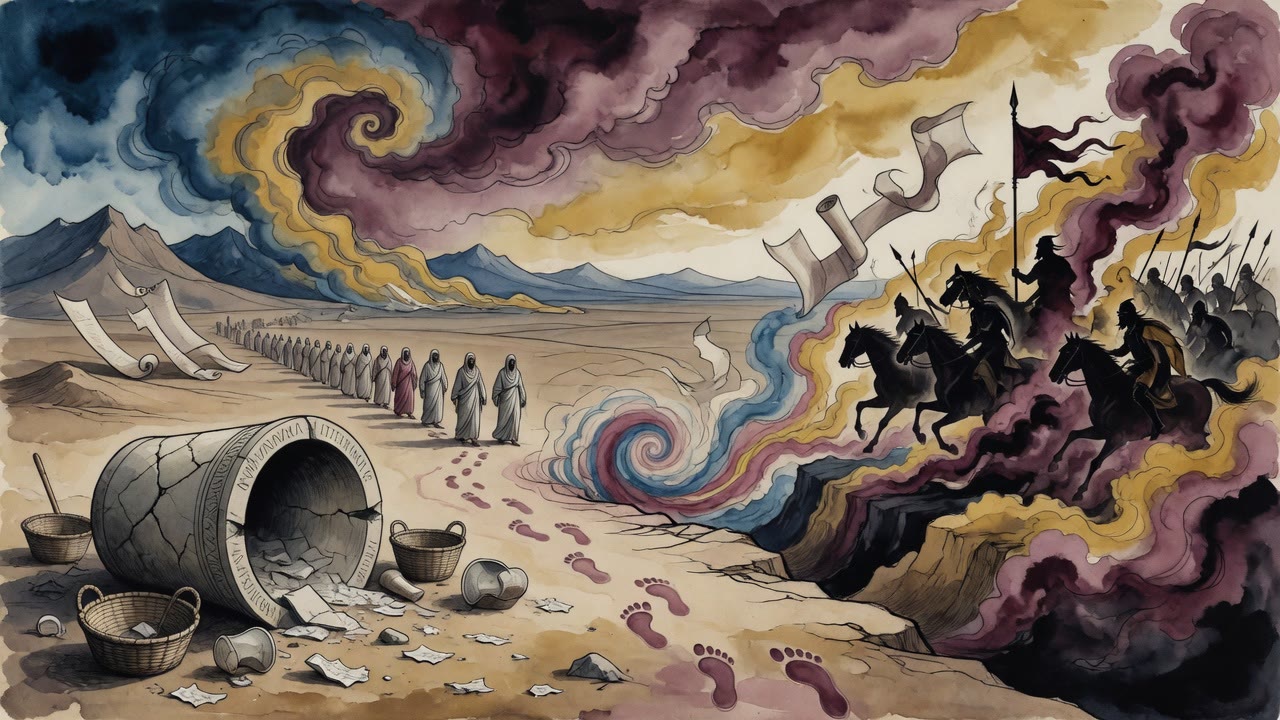
Amalek came out of the desert at Rephidim and struck the rear of the column, where the tired walked and the water jars hung lightest. Israel had barely finished quarreling about thirst. Now the slowest of them were dying first, and the camp filled with the sound of a war no one had chosen.

Aaron and Hur Held the Arms of Moses Aloft on the Hill Click for full size

Moses gave Joshua one night to choose men and go out. Joshua did exactly as Moses told him. Not almost. Not in spirit. He did not stray from a single word of the command, and that exactness was not weakness. It was the discipline that won the field below while Moses worked above.

Joshua Cut Down the Champions

Joshua weakened Amalek. Rabbi Yehoshua pictures him finding the champions who stood at the head of each rank and cutting them down first, so that every line behind them lost its spine. Rabbi Elazar the Modaite hears three acts packed inside the single Hebrew verb: he began, he seized, he shattered. Even the small connecting words of the verse are read as Amalek's sons and the armies marching behind them, so that the whole hostile host is counted on the page and no part of the attack slips off the record.

Three Men on the Summit

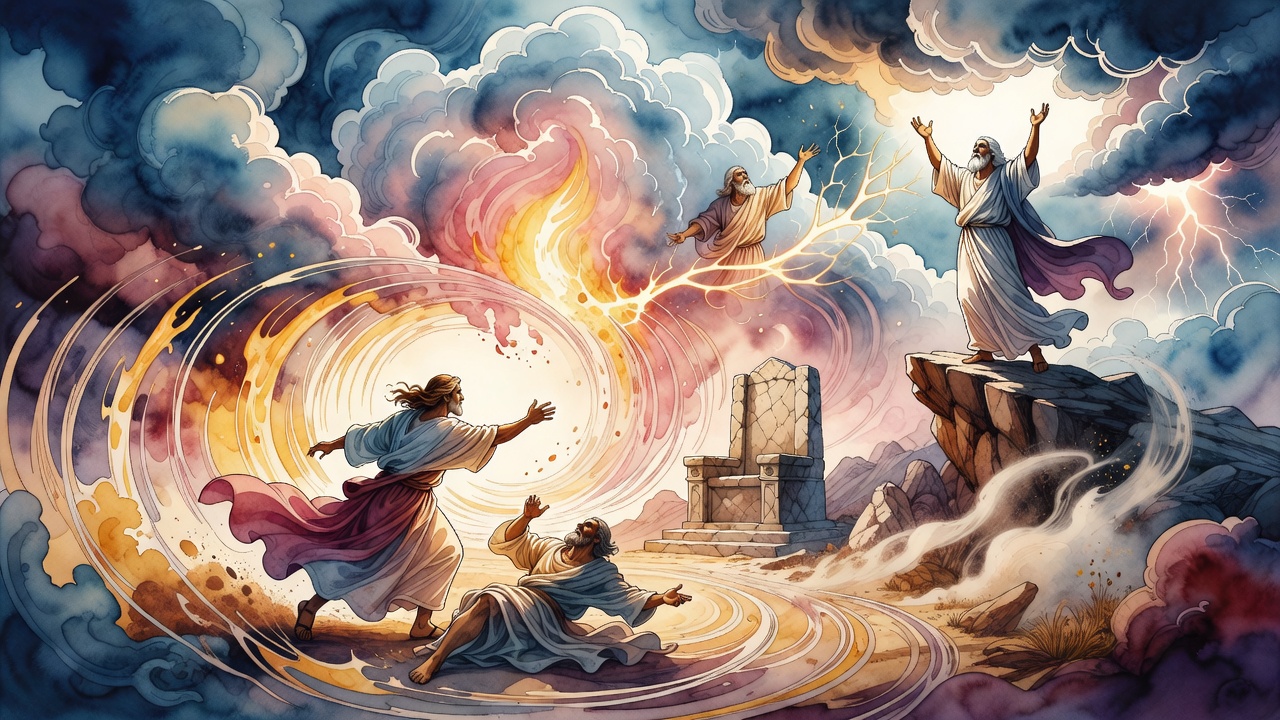
While the lines closed below, three men climbed the hill. Moses in the center, Aaron at one side, and a third man, Hur, son of Miriam the prophetess, so that the family of Moses stood tight around the crisis. Below them the battle spread like a living map that changed with every lift of a hand.

When Moses raised his hand, Israel prevailed. When he lowered it, Amalek prevailed (Exodus 17:11). No one on that hill pretended the flesh of Moses carried magic. The soldiers in the dust looked up when the staff cut the sky, and the gesture pulled their eyes and their hearts toward the One who had ordered the staff into those fingers. Faith climbed the hill with their eyes. When the hand sank behind the ridge of Moses' own exhaustion, the memory thinned, and Amalek took the gap.

Arms grow heavy. Faith has weight in the muscle. Sweat ran, the staff slipped against his palm, and the hand that had stretched over the sea began to shake above the plain. Aaron saw the tremor first and caught the elbow before the staff clattered. Hur took the other side. They dragged a stone into place and sat Moses on it, not as a king but as a man whose arms had become the nation's spine, and they braced him left and right until the line below stopped breaking.

One Hand Clean, One Hand Claiming Precedent

The Torah would later say his hands were steadfast (Exodus 17:12), and the sages heard two testimonies in the one word. One hand was steadfast because it was clean. In all his years of leading, judging, and carrying this people, Moses had taken nothing from Israel. Not a donkey, not a gift, not a bribe dressed as gratitude. The other hand was steadfast because of what the mouth above it was saying.

"Lord of the universe," Moses said through clenched teeth, "by my hand You took Israel out of Egypt. By my hand You split the sea for them. By my hand You performed miracles and acts of might for them. By this hand, perform them for them now as well."

It was not boasting. It was a legal argument before the heavenly court. Heaven had already chosen these fingers as its instrument of deliverance, and Moses was asking heaven not to abandon its own precedent while Amalek still breathed on the plain. Hours passed. The sun moved. A fly walked the back of his numb hand and he could not spare a shake to drive it off. Three men held one posture until the day bent toward evening and the enemy broke into the scrub.

Write It, So the Whip Remembers

Then the Lord told Moses to write the war in the book (Exodus 17:14), and the elders drew out the principle that runs beneath history. A whip used to lash Israel will in the end be lashed itself. Pharaoh came and enslaved Israel, and the Holy One shook him into the Sea of Reeds (Psalms 136:15). Amalek came and savaged the stragglers, and his memory was marked for blotting out from this world and the world to come. Every kingdom that harms Israel will be punished by the very instrument it used. That is why the war had to be written down and not only remembered. It is the first entry in a ledger heaven keeps open.

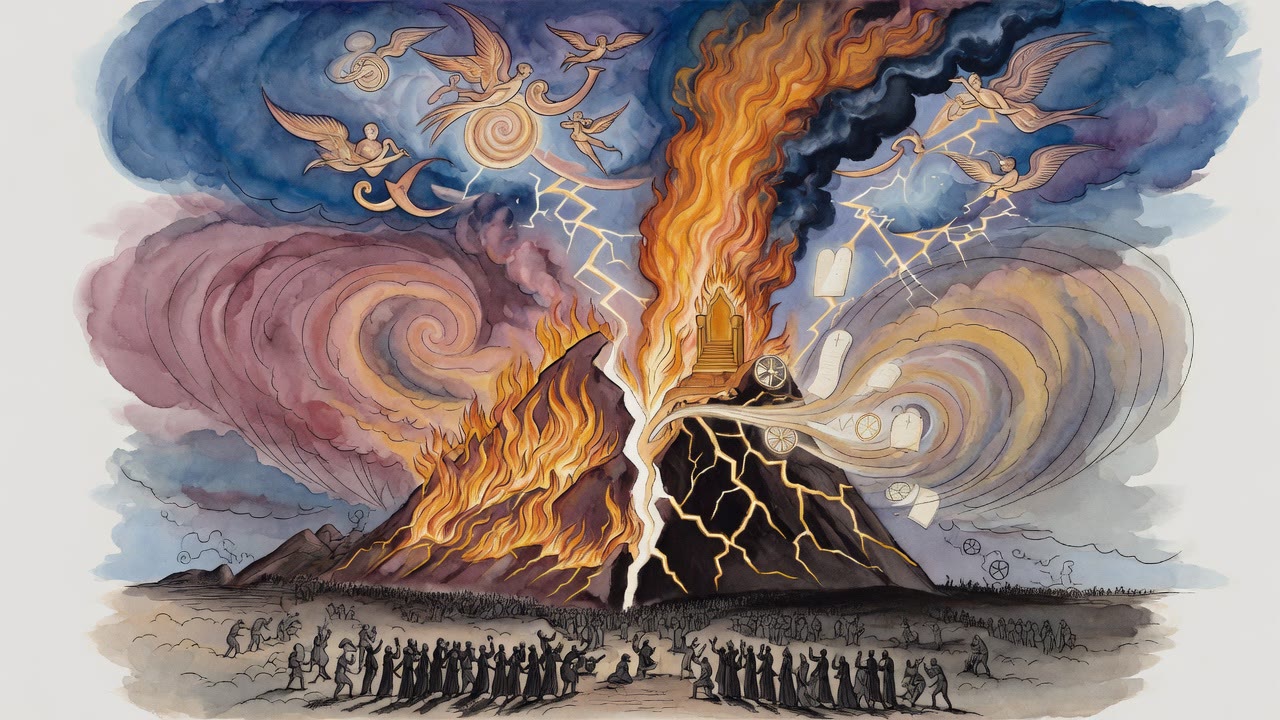
The sages found four writings tucked inside the one command, scattered across Torah, Prophets, and the Scroll of Esther, and inside the command a quiet hint. Moses was told to rehearse the war in Joshua's ears, a signal that Joshua, not Moses, would lead Israel into the Land. Moses did not catch it, and pleaded to enter until God said, "Enough." Jacob was promised protection and still trembled at the Jordan, afraid his own sins had cancelled the promise. David heard better. When he killed a lion and a bear over his flock, he did not boast; he asked why such strength had been lent to him, and concluded that Israel must be facing a danger he was meant to answer. Goliath was that danger. Mordecai watched Esther taken into the palace and refused to read it only as ruin; perhaps Israel would be saved through her. He was right. Amalek's own line ran forward to Agag and then to Haman, and Haman's fall became Purim, a memory Israel never lost. The enemy who meant to erase Israel became a reason Israel remembers.

The Report That Crossed the Desert

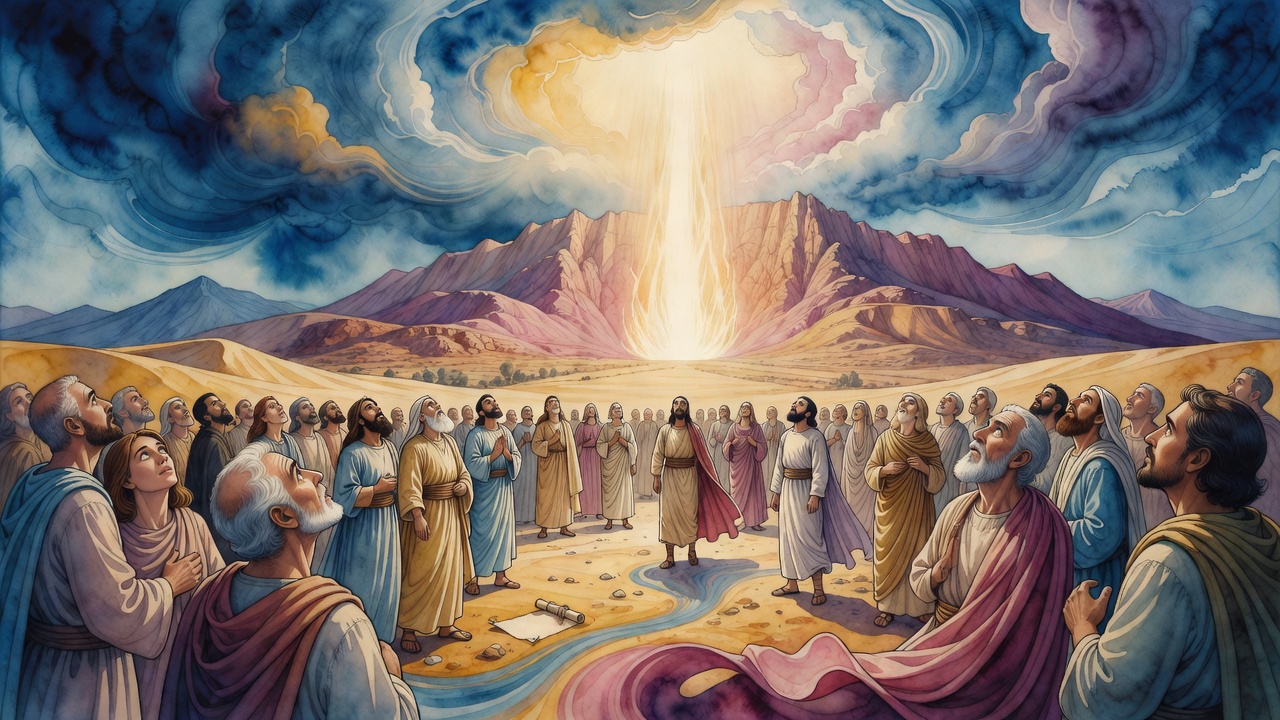
Behind the battle, an older report was still traveling the world. At the sea, Israel had waited to sing until three proofs stood complete: Pharaoh's host drowned, Egypt's rule broken, Egypt's gods exposed as frauds. Only then did the mouths open: "Who is like You among the mighty, O Lord?" (Exodus 15:11). Rabbi Eliezer taught that the splitting of the sea was heard from one end of the world to the other. The kings of Canaan melted when the news reached them, and a generation later Rahab of Jericho would still say that no spirit was left in any man. In Midian, Yithro heard the same report and did the opposite of melting. He packed what a priest could carry and set his face toward the camp.

He was walking toward a son-in-law whose arms had failed on a hilltop and been held up by two other men. From that posture the sages drew a rule for every congregation that came after. The one who stands before the community in supplication, above all on a fast day, must never stand alone. One supporter at his right hand, one at his left, the way Aaron and Hur stood on the hill, holding up the man who holds up everyone else.


← All myths
From the tradition

Sources

7 sources

The texts behind this telling. Some cards carry a translation of the source; others are our own retelling of it, and each card says which. Every card links out to the original.

Mekhilta DeRabbi Shimon Ben Yochai 17:10Mekhilta DeRabbi Shimon Ben Yochai

Translation of the source text.Mechilta de-Rabbi Simon b. Jochai, ed. D. Hoffmann, Frankfurt 1905 · Public Domain

"And Joshua did as Moses had said to him" (Exodus 17:10) he did what he was commanded and did not transgress the decree of Moses. "And Moses, Aaron, and Hur" this Hur was the son of Miriam. "Went up to the top of the hill." Regarding the matter we discussed from here we learn that the prayer-leader of the congregation should have one at his right and one at his left.

Full source
Mekhilta DeRabbi Shimon Ben Yochai 17:13Mekhilta DeRabbi Shimon Ben Yochai

Translation of the source text.Mechilta de-Rabbi Simon b. Jochai, ed. D. Hoffmann, Frankfurt 1905 · Public Domain

"And Joshua weakened Amalek" (Exodus 17:13). Rabbi Yehoshua says: He went down and cut off the heads of the mighty men standing at the heads of the ranks. Rabbi Elazar the Modaite says: It uses a notarikon [reading the word as initials of other words] he began [vayachel], and he seized [vayochez], and he shattered [vayishaber].

"Amalek" according to its plain meaning. "The people" these are his sons. "And" [the particle et] these are the armies that were with him; these are the words of Rabbi Yehoshua. Rabbi Elazar the Modaite says: "Amalek" according to its plain meaning; "the people" these are his sons; "and" [et] these are the armies that were with him; and when it says "and" [ve-et] these are the armies that were with his sons. "By the edge of the sword." Rabbi Yehudah says: "By the edge of the sword" we learn that this war was conducted only by the command of might. Others say: "By the edge of the sword" there was fulfilled in them what is said elsewhere, "For I will make you into blood, and blood shall pursue you; if you have not hated blood, then blood shall pursue you" (Ezekiel 35:6).

"And the LORD said to Moses, Write this for a memorial in the book." The first elders say: A whip with which Israel is lashed will in the end itself be lashed. Let the whole world learn from Pharaoh, that because he came and enslaved Israel, the Omnipresent drowned him in the sea, as it says, "and He shook off Pharaoh and his host into the Sea of Reeds" (Psalms 136:15). And so you find with Amalek, that because he came and harmed Israel, the Omnipresent destroyed him from this world and from the world to come, as it says, "For I will utterly blot out the memory of Amalek" (Exodus 17:14). So too every nation and kingdom that comes and harms Israel, by that very thing the Omnipresent exacts punishment from it.

Full source
Mekhilta DeRabbi Shimon Ben Yochai 17:14Mekhilta DeRabbi Shimon Ben Yochai

Translation of the source text.Mechilta de-Rabbi Simon b. Jochai, ed. D. Hoffmann, Frankfurt 1905 · Public Domain

"Write this as a memorial in a book" (Exodus 17:14). "Write" means what is written here. "This" means what is written in Deuteronomy. "A memorial" means what is written in the Prophets. "In a book" means what is written in the Scroll. So says Rabbi Yehoshua. Rabbi Elazar of Modi'in says: "This" means what is written here and in Deuteronomy; "a memorial" means what is written in the Prophets; "in a book" means what is written in the Scroll.

"And rehearse it in the ears of Joshua" (Exodus 17:14) - on that very day Joshua was anointed; so says Rabbi Yehoshua. Rabbi Elazar of Modi'in says: This is one of four who were given a hint; two took heed and two did not take heed. Moses was given a hint and did not take heed: "And rehearse it in the ears of Joshua" - meaning Joshua would bring Israel into the Land. In the end Moses stood and made all those requests and all those supplications, until it was said to him (Deuteronomy 3:26): "Enough! Speak no more of this matter." Jacob was given a hint and did not take heed, as it is said (Genesis 28:15): "Behold, I am with you and will keep you." In the end he was afraid, as it is said (Genesis 32:8): "And he was afraid and distressed." Is it possible that one whom the Holy One, blessed be He, assured in this way should be afraid? Rather, he said: Perhaps sin will be the cause. David was given a hint and took heed, as it is said (1 Samuel 17:36): "Your servant has struck down both the lion and the bear." He said: What am I, that I have killed these three wild beasts? Rather, perhaps some matter is destined to befall Israel, and they are destined to be saved through me. Therefore it is said (1 Samuel 17:36): "And this uncircumcised Philistine shall be as one of them." Mordecai was given a hint and took heed, as it is said (Esther 2:11): "And every single day Mordecai walked before the court of the harem." He said: Is it possible that this pious woman should be married to this uncircumcised man? Rather, perhaps some matter is destined to befall Israel, and they are destined to be saved through her. Immediately, "the matter became known to Mordecai, and he told it to Queen Esther" (Esther 2:22).

"For I will utterly blot out" (Exodus 17:14). "Blot out" in this world; "I will utterly blot out" in the world to come - him and all his family; so says Rabbi Yehoshua. Rabbi Elazar of Modi'in says: "Amalek" - this refers to Agag. "The remembrance" - this refers to Haman. "Blot out" him and all his family; "I will utterly blot out" him and all that generation. "From under heaven" (Exodus 17:14). Rabbi Yehoshua says: That Amalek should have no offspring or grandchild, so that no one should say, "This camel belonged to Amalek; this ewe belonged to Amalek; this tree belonged to Amalek." Rabbi Elazar of Modi'in says: Because he came to destroy Israel from under the wings of heaven, Moses said before the Holy One, blessed be He: Master of the universe, this wicked one comes to destroy Your children from under heaven - the scroll of the Torah that You gave them, who will read in it? Rabbi Nathan says: Haman came only as a reminder for Israel, as it is said (Esther 9:28): "These days of Purim shall not pass away from among the Jews, nor shall the memory of them perish from their descendants."

Full source
Mekhilta Tractate Amalek 1:25Mekhilta DeRabbi Yishmael

Retold in our words. Read the original at the link below.Mechilta, translated by Rabbi Shraga Silverstein · CC-BY

The Torah describes a strange scene during the battle against Amalek: "When Moses lifted his hand, Israel prevailed; and when he lowered his hand, Amalek prevailed" (Exodus 17:11). The Mekhilta immediately challenges the obvious reading. Do the hands of Moses really have the power to strengthen an army or break an enemy?

The answer is no. And yes. Moses' physical hands did not possess magical force. But when Moses raised his hand toward heaven, the Israelite soldiers on the battlefield looked up and saw it. That upward gesture directed their eyes and their thoughts toward God. They "gazed at it and affirmed their faith in Him who commanded Moses to do thus."

The mechanism was not sorcery but focus. Moses' raised hand served as a visual anchor for the entire army's faith. When they saw the hand lifted high, they remembered who was truly fighting for them, and their confidence surged. When the hand dropped, when the visual reminder disappeared, they forgot, and they faltered.

The Holy One Blessed be He then "wrought for them miracles and mighty acts." The miracles did not flow from Moses' hand but from the faith that his gesture inspired. Moses was not casting a spell. He was directing attention. The Mekhilta strips the scene of any hint of magic and replaces it with something more powerful: the idea that a single visible act of faith can channel divine salvation for an entire nation.

Full source
Mekhilta Tractate Amalek 1:34Mekhilta DeRabbi Yishmael

Retold in our words. Read the original at the link below.Mechilta, translated by Rabbi Shraga Silverstein · CC-BY

The verse says Moses' hands were "steadfast" during the battle against Amalek (Exodus 17:12). The Mekhilta reads that single word as a double testimony, each of Moses' two hands testified to something different.

One hand was steadfast because Moses had never taken anything from the people of Israel. Throughout decades of leadership, guiding them out of Egypt, adjudicating their disputes, mediating between them and God, he had never enriched himself at their expense. Not a single donkey, not a single gift. His hand was clean, and that cleanness gave it strength.

The other hand was steadfast because of what Moses now said in prayer: "Lord of the universe, by my hand You took Israel out of Egypt. By my hand You split the sea for them. By my hand You performed for them miracles and acts of might. So by my hand, perform miracles and acts of might for them at this time as well."

Moses was not boasting. He was making a legal argument before the heavenly court. If God had already established a pattern, using Moses' hands as the instrument of deliverance, then consistency demanded those same hands deliver Israel again. The past miracles became precedent. The hands that parted the Red Sea were now raised over the battlefield, and Moses was essentially saying: You chose these hands. Do not abandon them now.

Full source
Mekhilta Tractate Shirah 8:1Mekhilta DeRabbi Yishmael

Retold in our words. Read the original at the link below.Mechilta, translated by Rabbi Shraga Silverstein · CC-BY

The Mekhilta pinpoints the exact moment when Israel first declared (Exodus 15:11): "Who is like You among the mighty, O Lord?" It was not during the plagues. It was not at the moment of departure from Egypt. It came only after Israel saw three things happen simultaneously at the Red Sea.

First, they saw that Pharaoh and his hosts were lost, swallowed by the waters, gone without a trace. The most powerful army in the known world vanished in an instant. Second, they saw that the rule of Egypt had been abolished. Not merely weakened or humbled, but permanently broken as a force that could dominate Israel. Third, they saw that idolatry had been castigated, the gods of Egypt, in whose name Pharaoh claimed authority, were exposed as powerless frauds.

Only when all three conditions were met, the army destroyed, the empire broken, the false gods humiliated, did Israel open their mouths and sing. The song was not premature celebration. It was a verdict rendered after the evidence was complete.

This reading from the Mekhilta DeRabbi Yishmael (Tractate Shirah 8:1) suggests that genuine faith requires visible proof. Israel did not sing because they were told to believe. They sang because they saw. The Red Sea was not a test of blind faith, it was a demonstration so overwhelming that the only possible response was "Who is like You among the mighty?"

Full source
Mekhilta Tractate Amalek 3:2Mekhilta DeRabbi Yishmael

Retold in our words. Read the original at the link below.Mechilta, translated by Rabbi Shraga Silverstein · CC-BY

The Torah opens the portion of Yithro by saying, "And Yithro, the priest of Midian, the father-in-law of Moses, heard all that God had done" (Exodus 18:1), and the Mekhilta records a dispute among the sages over exactly what report it was that reached Yithro and moved him to leave Midian and join Israel. R. Eliezer holds that what Yithro heard was the splitting of the sea, the great miracle at the Red Sea when the waters stood up like walls and Israel passed through on dry land.

To establish that this single event could indeed reach a man as far off as Midian, R. Eliezer argues that the splitting of the sea was heard from one end of the world to the other. He brings two proofs from the book of Joshua. The first is the verse, "And it was, when all the kings of the Emori heard" (Joshua 5:1), showing that the news of the dried-up waters had spread among distant nations and melted their courage even a full generation later.

The second proof comes from the mouth of Rachav the harlot of Jericho, who told the spies sent by Joshua, "For we heard how the Lord dried up the waters of the Red Sea before you when you went out of Egypt, and when we heard, our hearts melted, and no spirit was left in a man before you" (Joshua 2:10-11). If even the Canaanites of Jericho trembled at the report, then surely Yithro in nearby Midian heard it too, and unlike the kings who melted in fear, he responded by coming to draw near to the God of Israel.

Full source