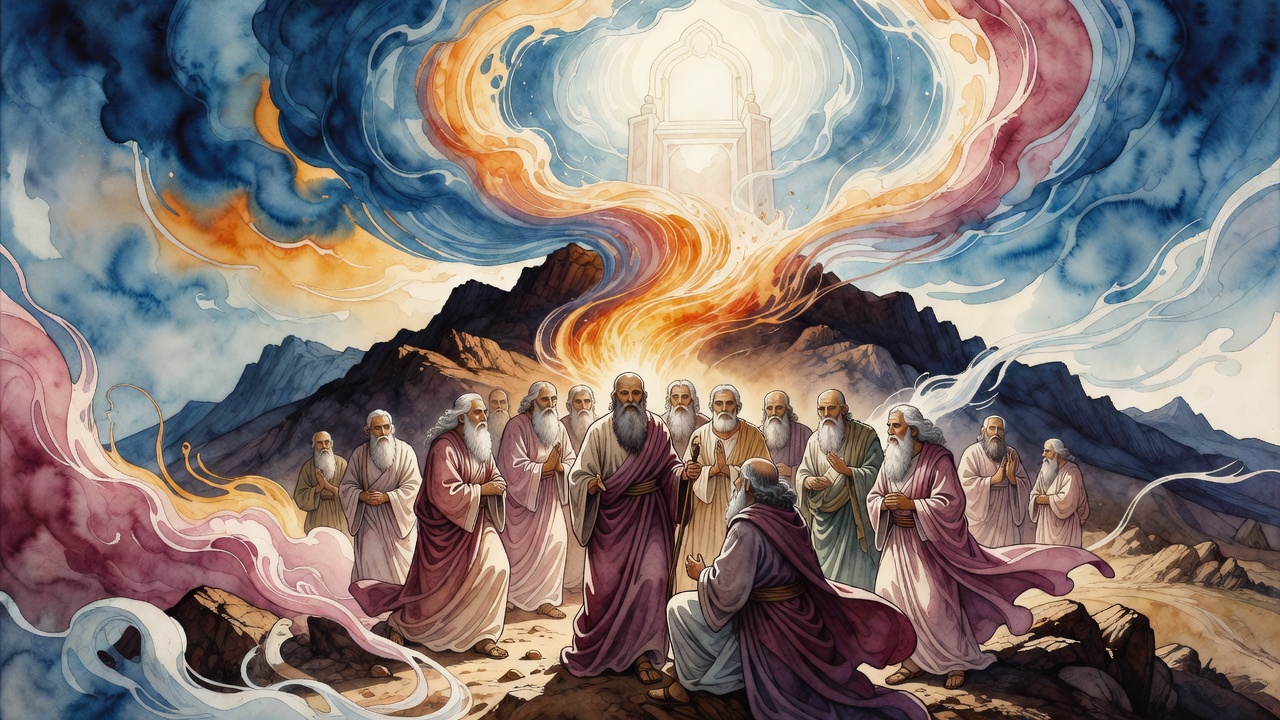
Three Men Climb the Hill While Israel Fights Amalek Below
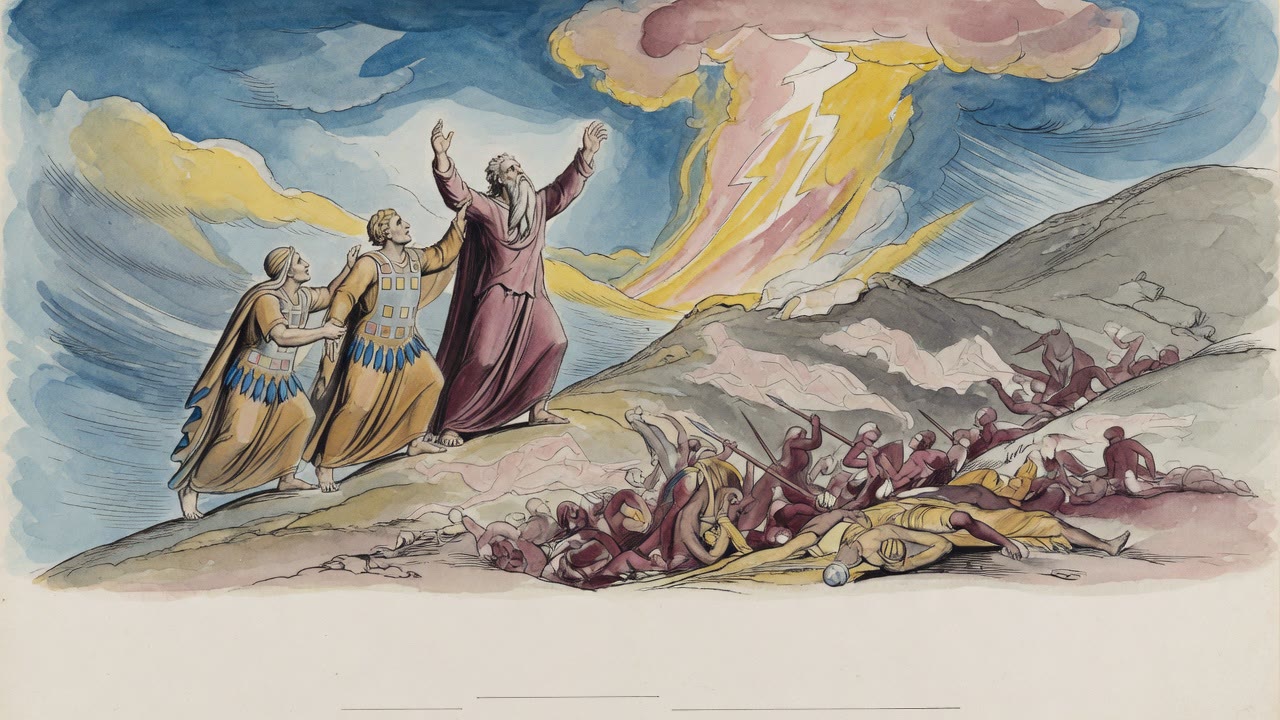
Moses, Aaron, and Hur climb a hill above the battle with Amalek, and the names they carry up are not the living but the dead.
Table of Contents
The sand below was already loud. Iron on iron, the short cries men make when they are too busy to scream properly, the dull collapse of bodies that will not get up again. Amalek had come out of the dry country to fall on the stragglers, the slow, the children at the back of the line, and now the young men of Israel were down in the valley trying to push them back with whatever they had (Exodus 17:8).
 Click for full size
Three Men Leave the Valley and Start Climbing
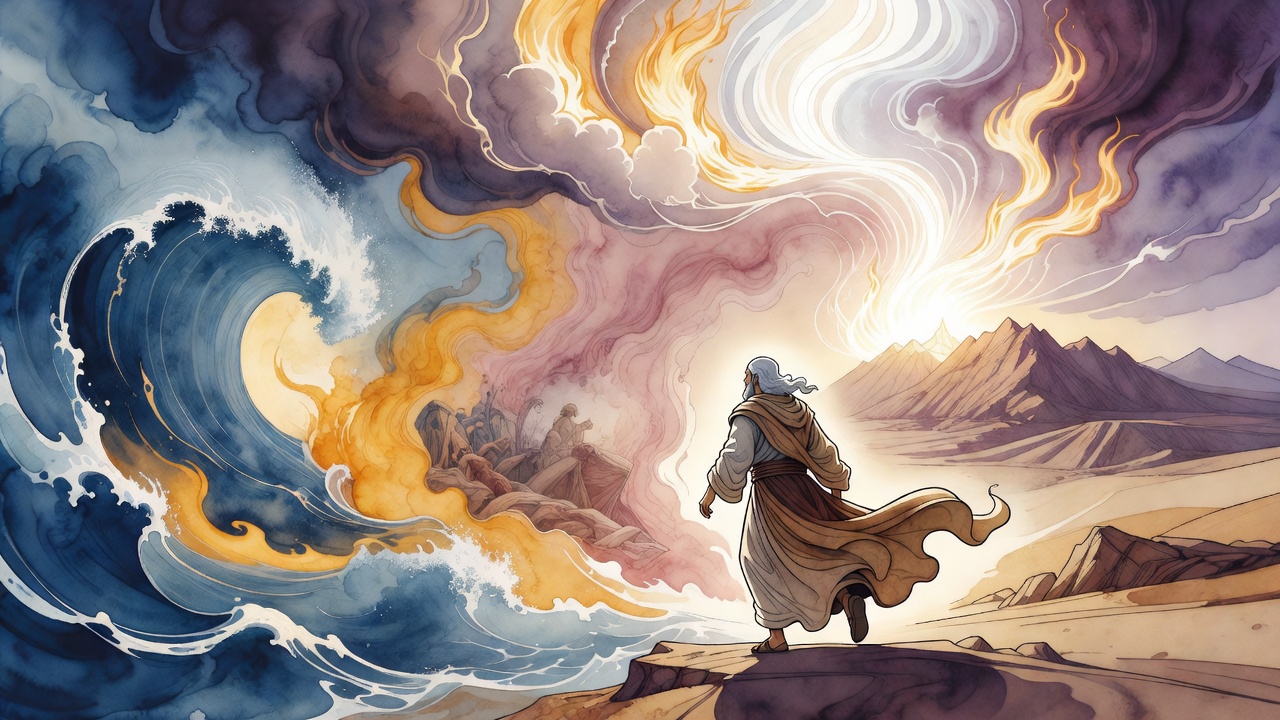
Three men did not go down into the valley. They went up. Moses turned away from the fighting and set his foot on the slope, and behind him came Aaron and Hur, breathing hard, their sandals slipping on loose stone (Exodus 17:10). Anyone watching from below would have seen it and felt the bottom drop out of their courage. The leader was leaving. The old men were climbing away from the killing while boys held the line.
That is what it looked like. It was the opposite of what it was.
Moses did not climb the hill to escape the battle. He climbed it because the battle could not be won down there with swords alone, and he knew it. He had walked these people out of Egypt. He knew their faces, knew the names of the men bleeding in the sand, and he was not going up to watch them die from a safe distance. He was going up to do the only thing that might keep them alive.
Moses Lifts His Hands and the Battle Turns
At the top he raised his arms. Both hands, open, lifted high over the valley. And the strangest thing happened. When his hands were up, Israel pushed forward. When his arms tired and sank, even for a moment, Amalek surged and Israelite men went down (Exodus 17:11).
So it was not the swords that decided it. It was the hands. The fighting in the valley was only the visible half of something being decided on the hill, and the hill was where Moses meant to win it.
But arms are only arms. They grow heavy. The blood drains out of them, the shoulders burn, the fingers go numb, and a man past his youth cannot hold them up forever no matter how many lives hang on it. Moses felt his hands beginning to fall, and with them, he could see it, the line below beginning to break.
Aaron and Hur Hold Up the Sinking Arms
Therefore Aaron and Hur moved. They rolled a stone under him so he could sit, and then one took the right arm and one took the left, and they held his hands up for him. Two men propping a third, steady as posts, until the sun went down (Exodus 17:12). And Israel cut Amalek down.
Two men holding up a third man's arms. That is a strange picture for a battle. It is not the picture of a general. It is the picture of men carrying something too heavy for one person, lifting a weight together, and the weight was not the arms. The weight was what the arms were reaching for.
Because the hands were not raised to ask for victory. The three of them climbed that hill, all three, because what they carried up could not be carried by one. They went to bring to mind the deeds of the fathers and the mothers. They went up to name the dead.
What Balaam Saw From His Own Hilltop
There is a way to read the hill, and it comes from another man on another height who did not love Israel at all.
Long after the sand at Amalek had gone quiet, a hired seer named Balaam was paid to stand above the camp of Israel and curse it (Numbers 22). He took the fee. He climbed to a high place, the way men climb to do harm, and he opened his mouth to call down ruin. What came out was not a curse.
"From the peaks of the rocks I see him, from the hilltops I gaze upon him" (Numbers 23:9). He looked down expecting tents and livestock, expecting a soft target, and instead he saw something he could not curse. Even an enemy on a hill, straining to find a weakness, could not find one. He saw rocks. He saw hills. And the rocks and the hills were not the land.
The Rocks Are the Fathers, the Hills the Mothers
The peaks of the rocks were the three who came before, Abraham, Isaac, and Jacob, lives carved into the people harder than any stone. The hilltops were the four mothers, Sarah, Rebecca, Rachel, and Leah. That was the strength a hostile man saw from above and could not touch. Not numbers. Not iron. The weight of those who had gone before, gathered up and remembered.
So go back to the first hill, the one above Amalek, and look again at three old men and a pair of lifted arms. Moses on the stone with his hands in the air was not waving for help. He was holding up the names. Abraham who left his country. Isaac on the wood. Jacob who wrestled till dawn. Sarah who laughed. Rebecca at the well. Rachel and Leah. He lifted them like a man lifts a heavy thing over his head, until his arms failed, and then two more men took the weight from his hands so it would not fall, and held it up with him until the killing in the valley stopped.
The young men below thought their leader had walked away from the fight. He had walked into the harder half of it. And he had needed both of them, Aaron on one side and Hur on the other, because no single pair of hands could hold up that many dead at once.
← All myths