Parshat Ki Tisa6 min read

Satan Danced Among Israel at the Foot of the Golden Calf

On the fortieth day Satana stirred the camp, the gold leapt into a calf, and the Accuser leaped and danced through the frenzy below Sinai.

Curated by Arthur · Told by Maggid ·
Table of Contents
  1. The Whisper That Emptied the Mountain
  2. The Earrings the Women Would Not Give
  3. The Beast That Rose From the Fire
  4. The Letters That Fled the Stone
  5. The Gold That Marked the Guilty

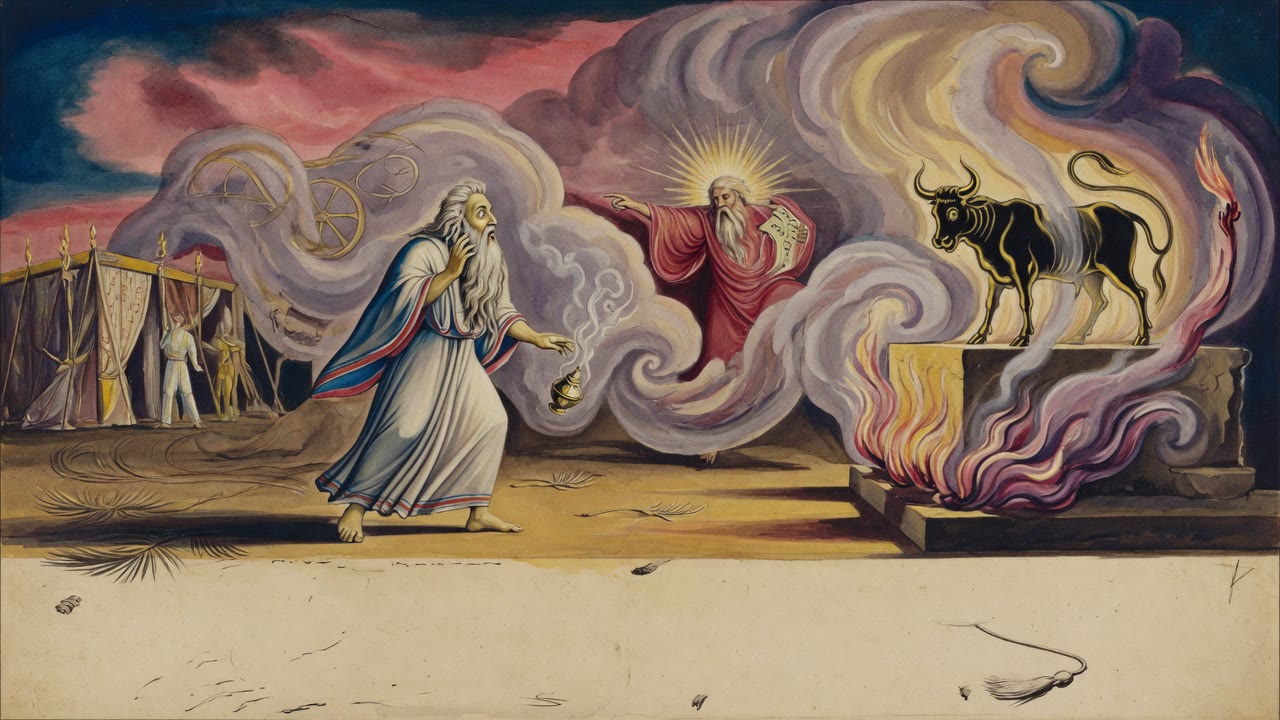
At noon on the fortieth day the sky over the camp went wrong. A bier appeared, hung in the air between heaven and earth, and on it lay the shape of a dead man. The people knew the face. Moses had climbed into the fire on the mountain and now floated above them, cold, finished, carried off by the flame that burned before the Lord.

The vision was not God's. Satana had come down into the camp. He moved through the crowd and bent their hearts with pride, and into every ear he poured the same whisper, that their leader was consumed in the mountain and would not come back down to them.

The Whisper That Emptied the Mountain

Fear travels faster than reason in a frightened camp. Men pointed at the bier and cried out that this was the man who had brought them up out of the land of Egypt, and now he was gone. The Egyptian sorcerers Jannes and Jambres worked the panic like a crowd, turning grief into demand. The people wanted a god they could carry, a god of gold, the kind Egypt had carried before them.

One man stood in the gap. Hur, grandson of Miriam, set himself against the crowd and rebuked them. "You are no longer mindful of the many miracles God wrought for you," he told them. They answered him with their hands. They killed him where he stood, a prophet's grandson murdered at the foot of the mountain that still smoked from God's voice.

The Earrings the Women Would Not Give

They came to Aaron with Hur's blood still on the ground and a threat in their mouths. Make us a god, or we will do to you what we did to him. Aaron looked at the body and made a cold calculation. He asked them for the golden rings from the ears of their wives and daughters, certain the women would refuse and the whole frenzy would collapse against their stubbornness.

The women refused. They denied their husbands the gold and would not surrender a single ornament to such a thing. For that, Heaven later gave them the new moons, Rosh Chodesh, as their own festival, a reward kept in the calendar forever. But the men did not wait. They tore the rings from their own ears and heaped the gold before Aaron, and the trap meant to stop them became the furnace that fed the sin.

The Beast That Rose From the Fire

Among the gold thrown into the flames lay a small leaf of silver. Long before, at the edge of the Nile, Moses had engraved four leaves with the faces of the celestial Throne, the lion, the man, the eagle, and the bull, and cast them in to raise the coffin of Joseph from the river. Three he used. The fourth, the leaf marked with the bull, he handed to a woman to hold and forgot to reclaim. That leaf had ridden the ornaments of Israel out of Egypt and now slid into Aaron's fire.

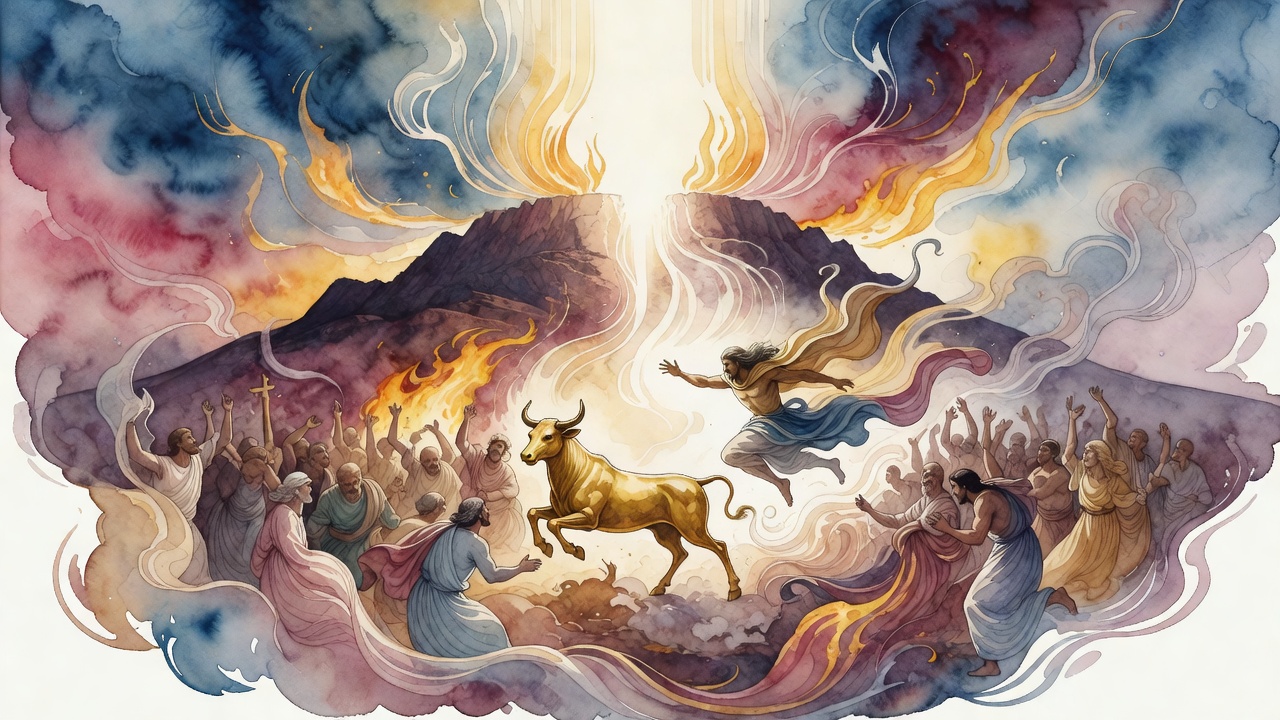
Satana entered the flames. Out of the molten gold rose the likeness of a calf, lowing, alive with stolen power, a beast no human hand had shaped. The camp roared. They sat down to eat and to drink, and they rose up to play, and the Accuser came out of the fire after his handiwork and danced. He leaped and spun before the people, dancing through the revel he had built, the dark master of the festival staged where Israel had heard the commandments three weeks before.

The Letters That Fled the Stone

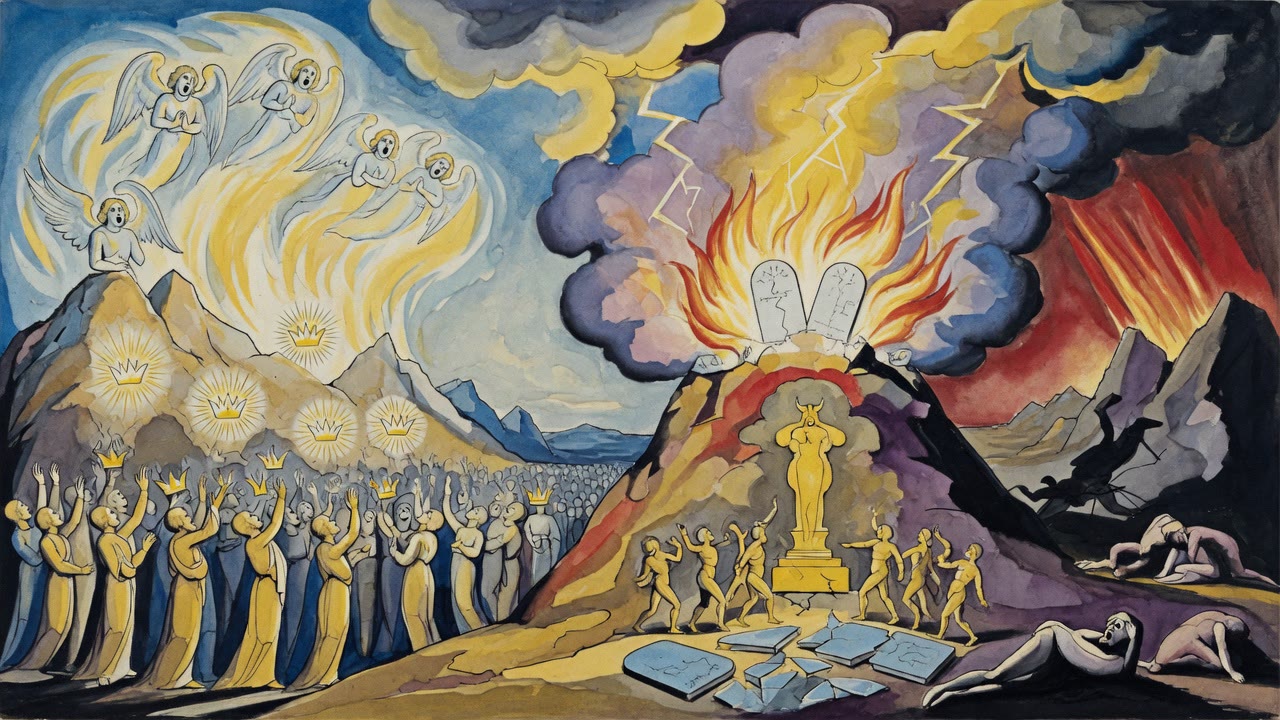
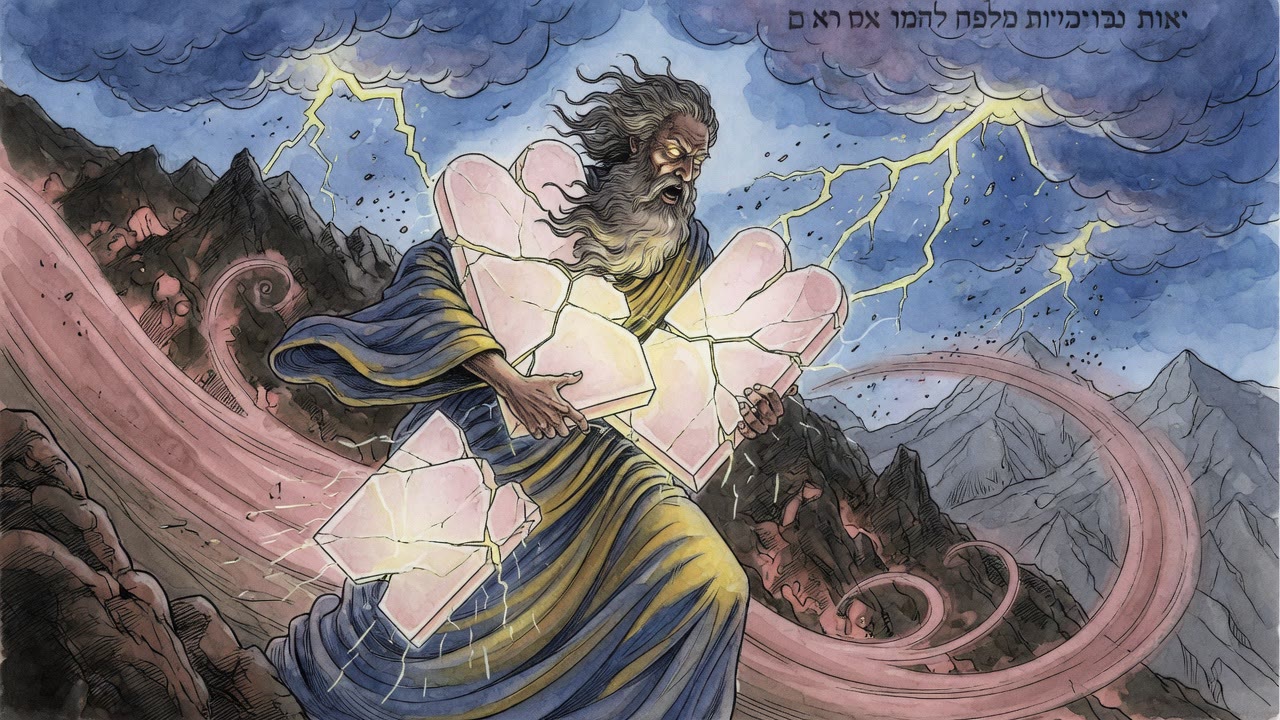
Moses came down the mountain with the two tablets in his arms, written on both sides by the finger of God. He saw the calf. He saw Satana among the people, leaping and dancing before them. Then the writing moved. The holy letters lifted off the stone and flew, carried away into the air of the heavens, refusing to remain on tablets brought down to a camp that worshipped a beast of gold. The stone in his hands went dead and empty, and he flung it to the ground and shattered it.

The moment the tablets broke, the ocean stirred. The waters of the world rose up to flood the camp, because the Torah that holds creation together had just been thrown down in pieces. Moses turned on the sea and demanded what it wanted from the dry land. "Israel has not been faithful to it," the waters answered. So he ground the calf to powder, strewed it on the water, and forced the people to drink.

The Gold That Marked the Guilty

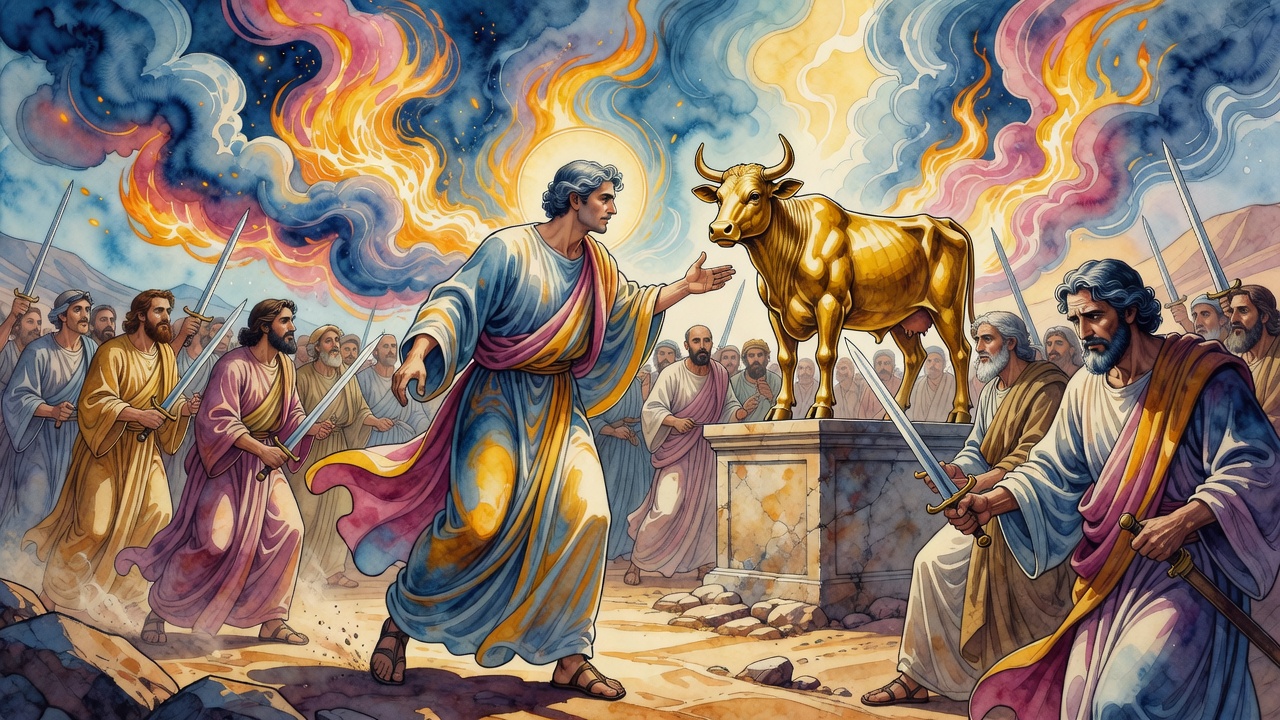
The draught was a verdict. Whoever had given a trinket of gold to the calf drank, and the sign came forth upon his nostrils, gold blooming on his face like a brand, the metal naming the man who had served it. Moses stood at the gate of the camp where the court would sit and called out, "Who is on the Lord's side? Let him come unto me." The sons of Levi ran to him, the ones who had not touched the calf, and he set them as judges over their own people.

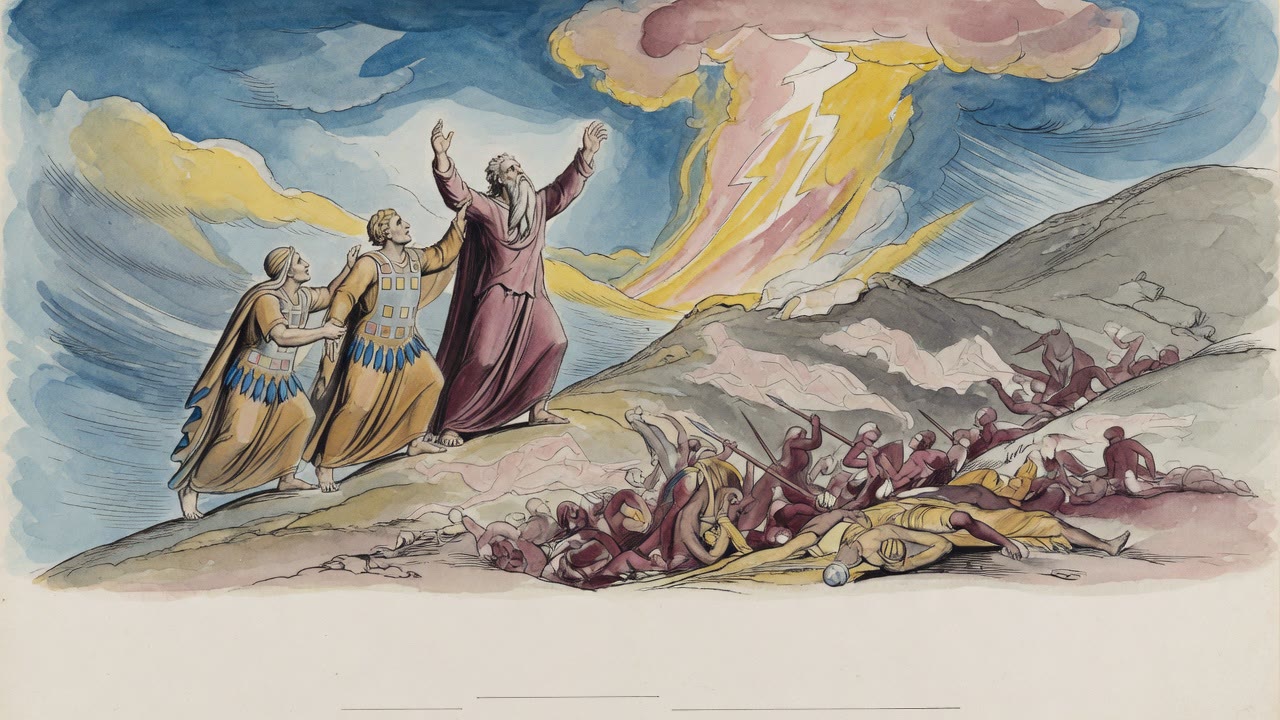
They went through the camp with swords, and the marked men fell. Three thousand dropped that day, the gold still bright in their nostrils. Aaron, dragged before his brother, swore he had only cast the metal into the fire. "Satana entered into it," he said, "and there came out of it the likeness of this calf." The beast was never his. It belonged to the dancer in the flames, who had stepped down into a frightened camp at noon and left it strewn with the dead.


← All myths
From the tradition

Sources

5 sources

The texts this telling draws on, in full. Open a card to read inline, or expand it for a wider, quieter read.

Targum Jonathan on Exodus 32Targum Jonathan

The golden calf episode in (Exodus 32:1-35) is already one of the Torah's most dramatic stories. The Targum Jonathan makes it wilder, stranger, and more theologically loaded than anything in the Hebrew original.

The trouble starts with a detail the Bible never mentions. The people did not simply lose patience waiting for Moses. "Satana had come, and caused them to err, and perverted their hearts with pride." The Accuser himself descended to stir up the crowd, convincing them that Moses "may have been consumed in the mountain by the fire which flameth from before the Lord."

The women of Israel come out looking heroic. When Aaron asked for gold rings, "their wives denied themselves to give their ornaments to their husbands." The men tore out their own earrings instead. The calf was a male sin.

Aaron's motivation gets a backstory the Hebrew text omits entirely. He had seen Hur slain before him. Hur, grandson of Miriam, had tried to stop the people and was murdered. Aaron cooperated out of terror, not enthusiasm.

When Moses descended and saw the calf, the Targum says he saw "Satana among them dancing and leaping before the people." The holy writing on the tablets "flew, and was carried away into the air of the heavens" before the stone shattered. Even the letters refused to witness what came next.

The punishment was forensic. Moses ground the calf to powder, mixed it with water, and made the Israelites drink. "Whoever had given thereto any trinket of gold, the sign of it came forth upon his nostrils." The gold literally marked the guilty through their faces.

Aaron's defense is extraordinary. He claims he threw gold into the fire "and Satana entered into it, and there came out of it the similitude of this calf." The calf was not his creation. It was Satan's.

Moses then stood at the "sanhedrin (the supreme rabbinic court) gate of the camp" and issued the terrible command. Those who bore the golden mark in their nostrils fell that day: three thousand men.

Full source
Legends of the Jews 2:97Legends of the Jews

The Torah tells us that Moses ascended Mount Sinai to receive the Torah, the sacred law, from God. Before he left, Moses told the people he would return in forty days with the divine teachings. But, according to Ginzberg's retelling in Legends of the Jews, on the fortieth day, at noon, Satan himself intervened! Imagine this: Satan, with all his deceptive power, conjured a vision. A vision of Moses, lying dead on a bier, floating between heaven and earth.

The people, witnessing this horrific spectacle, cried out, "This is the man Moses that bought us up out of the land of Egypt." Panic and disillusionment set in. They felt abandoned, lost without their leader.

Then, under the influence of the magicians Jannes and Jambres – remember them from the stories of the plagues in Egypt? – they approached Aaron, Moses' brother. They said, "The Egyptians were wont to carry their gods about with them… and now we desire that thou shouldst make us a god such as the Egyptians had." They longed for a tangible symbol of faith, something to fill the void left by Moses' apparent demise.

Hur, the son of Miriam, and a leader appointed by Moses in his absence, bravely stood against them. He rebuked them, saying, "O ye frivolous ones, you are no longer mindful of the many miracles God wrought for you!" But his words fell on deaf ears, and the people, in their rage and fear, murdered him. Imagine the chaos, the raw emotion!

Turning to Aaron, they threatened him: "If thou wilt make us a god, it is well, if not we will dispose of thee as of him." Aaron faced an impossible choice. He feared for his own life, but more than that, he feared the consequences of the people committing such a heinous sin – the murder of a priest and prophet. He thought, as Legends of the Jews explains, that God would never forgive them.

So, Aaron made a calculated decision. He decided to grant their wish, but in a way that he hoped would prevent the creation of the idol. He demanded that they bring him the golden earrings of their wives, sons, and daughters. He reasoned that the women would refuse, and the whole plan would fall apart. Smart thinking. But here's where the story takes another turn. Aaron's plan only worked partially. The women, refused to surrender their jewelry for such a blasphemous purpose! Midrash Rabbah praises the women for their unwavering faith in God during this crisis. As a reward for their steadfastness, God granted women the new moons, Rosh Chodesh, as special holidays. The Zohar tells us that in the world to come, they will be further rewarded, like the new moons, they will be rejuvenated monthly.

However, the men, desperate for a god, removed their own earrings – a common practice in that era, particularly amongst Arab men – and brought them to Aaron. The women stood firm in their faith, while the men, gripped by fear and anxiety, succumbed to the pressure. The story of the Golden Calf is a stark reminder of how easily we can be swayed by fear and how important it is to hold onto our faith, even in the face of uncertainty. What does this ancient story tell us about our own vulnerabilities and the importance of moral courage today?

Full source
Legends of the Jews 2:98Legends of the Jews

It wasn't just a random act of idol worship, oh no. The seeds of that disaster, according to some fascinating legends, were sown long before.

Let's rewind to the Exodus. Remember when Moses, with God's help, was leading the Israelites out of Egypt? One of his important tasks was retrieving the coffin of Joseph from the depths of the Nile. Now, this wasn't a simple retrieval operation. It required a bit of divine ingenuity.

As Ginzberg's retelling in Legends of the Jews tells us, Moses employed a rather unique method. He took four leaves of silver and engraved on each the image of one of the beings represented at the Celestial Throne. Think of them as powerful symbols: the lion, the man, the eagle, and the bull. Each represented a divine attribute.

He began by casting the leaf with the image of the lion into the river. Immediately, the waters became tumultuous, roaring like a lion. Then, he threw in the leaf with the image of the man, and miraculously, the scattered bones of Joseph united themselves into an entire body. Finally, when he cast in the third leaf, the one with the eagle, the coffin floated to the surface.

But here's where the story takes a turn. Moses, having no further need for the fourth leaf, the one with the bull, asked a woman to hold onto it for him. He was, understandably, preoccupied with transporting Joseph's coffin and simply forgot to reclaim it. A simple oversight. Not so fast.

This forgotten leaf, with its potent image of the bull, found its way into the ornaments that the people brought to Aaron when they demanded a god to lead them in Moses' absence. And according to the legends, it was exclusively owing to this bull's image, this object imbued with magical virtues, that a golden bull arose out of the fire into which Aaron cast the gold and silver.: a seemingly insignificant act of forgetfulness, a potent symbol left unattended, and suddenly, a golden idol is born. The story suggests that no calf would have risen if that magical object was not present. The Zohar tells us of the power of images and symbols, and how they can be manipulated for good or ill.

It's a cautionary tale, isn't it? A reminder that even the smallest actions, the most unintentional omissions, can have enormous consequences. It also hints at the deep power inherent in symbols and images, and how they can be used to shape reality, for better or for worse. And perhaps, it's a reminder that even our heroes, like Moses, are capable of making mistakes that have far-reaching implications. What "forgotten leaf" might we be carrying around that could unintentionally shape the future?

Full source
Legends of the Jews 2:109Legends of the Jews

The familiar story is this: Moses is up on Mount Sinai, receiving the Torah, and the Israelites, impatient and doubting, melt down their gold and fashion a false idol. Moses descends, sees the idolatry, and in a fit of righteous anger, shatters the tablets.

What happened next is where things get truly wild.

In Legends of the Jews, (Ginzberg), hardly had Moses broken those tablets when the ocean itself – the very foundation of the world as they knew it – threatened to burst forth and flood everything. Imagine! The cosmos itself reacting with fury to Israel’s betrayal.

Why? Because the Torah, the divine instruction, is what holds everything together. As we find in Midrash Rabbah, the world stands only through the observance of the Torah. And with Israel’s unfaithfulness, the waters argued, the very reason for creation was undermined.

So, what did Moses do? This is where the story takes a turn that’s both bizarre and strangely logical. Moses took the Golden Calf, burnt it to ashes, and then, in a move that seems straight out of a mystical thriller, "strewed it upon the water." It wasn’t just symbolic. He then challenged the waters, essentially asking: "What do you want from the dry land?"

The waters, personified in this legend, responded with the chilling truth: "Israel has not been faithful to it [the Torah]." Talk about cosmic drama!

Moses, ever the mediator, then makes a grim offer. He declares that all who committed idolatry would be given to the waters. "Are you now satisfied with these thousands?" he asks. He's essentially saying, "Here, take the guilty."

But even that wasn't enough! The ocean remained enraged and refused to retreat. The ocean only calmed after Moses forced the children of Israel to drink of the water mixed with the ashes of the Calf. Talk about a bitter draught of repentance.

What are we to make of this strange tale? It's more than just a story about punishment. It highlights the profound connection between human actions and the very fabric of reality. It suggests that our choices, our faithfulness (or lack thereof), can have cosmic repercussions.

It makes you think, doesn't it? What "calves" are we worshipping? And what waters are we stirring up as a result?

Full source
Targum Pseudo-Jonathan on Exodus 32:6Targum Pseudo-Jonathan on Exodus

The day Aaron had hoped to delay arrived. Targum Pseudo-Jonathan describes it in language that is more revealing than the Hebrew's euphemism: "they arose, and sacrificed burnt-offerings; and the people sat around to eat and to drink, and rose up to disport themselves with strange service" (Exodus 32:6).

The Hebrew says only that they rose up "to play", letzachek. The targum specifies: strange service, avodah zarah, idolatry itself. But the midrashim of the classical period (Shemot Rabbah 42:1, c. 600 CE) understood the Hebrew verb as carrying three meanings simultaneously: idolatry, sexual license, and bloodshed. The three cardinal sins of Jewish tradition, compressed into a single word.

How did a feast turn so dark so quickly?

The sages traced the progression with painful clarity. First came the offerings, outwardly religious, inwardly confused. Then the meal, communal, bonding, normalizing the ritual. Then the dancing and the playing, which slid, as such celebrations can, into behavior no one would have endorsed in the morning. By nightfall, the camp that had stood at Sinai forty days earlier was unrecognizable.

This is why the Torah, and the targum, does not spare the detail. The golden calf story is not a tale of theological error alone. It is a tale of moral collapse, a whole society coming apart in a single afternoon because its center had been swapped for an idol, and idols cannot hold a community's center. Only the Memra of the Lord could do that, and the Memra had been temporarily displaced by a piece of gold that had come from men's ears.

The classical rabbinic comment is stark: the sin of the calf laid the groundwork for every future national catastrophe. Generations later, when the Temple would fall and exile would begin, the sages would say that the residue of that afternoon was still being atoned for.

The Maggid takes this home: replace the center of a community with the wrong thing, and everything that orbited the center begins to fall.

Full source