4 texts
Aaron in Jewish mythology is documented here through 4 source passages from 1 distinct source names represented in this theme. The strongest clusters come from Rabbinic Midrash (4), with frequent witnesses in Yalkut Shimoni on Torah (4). These texts preserve how Jewish writers, sages, and mystics described aaron across biblical interpretation, rabbinic storytelling, medieval compilation, and kabbalistic teaching.
This page is a topic hub, not a single article. Use it to compare how different Jewish sources treat aaron: where the theme appears in narrative, how it changes across source families, which figures or symbols recur, and which passages are most useful for citation. Representative entries include Aaron Saw Hur Slaughtered and Built an Altar, Aaron Stalled the Calf and Proclaimed a Feast to the LORD, Aaron Took the Blame Like the Tutor for the Prince, and Moses Prays and Aaron Becomes the Essence. For synthesized anthology narratives, start with The Staff Jacob Carried Across the Jordan Ended Up in Aaron's Hand, Why the Dedication Waited for Nisan and Aaron Needed Moses's Help, and Aaron and Chur Held Moses' Arms Because Levi and Judah Earned It.
Idolatry (2), Repentance (2), Divine Justice (1), Forgiveness (1), Prayer (1), and Priesthood (1)
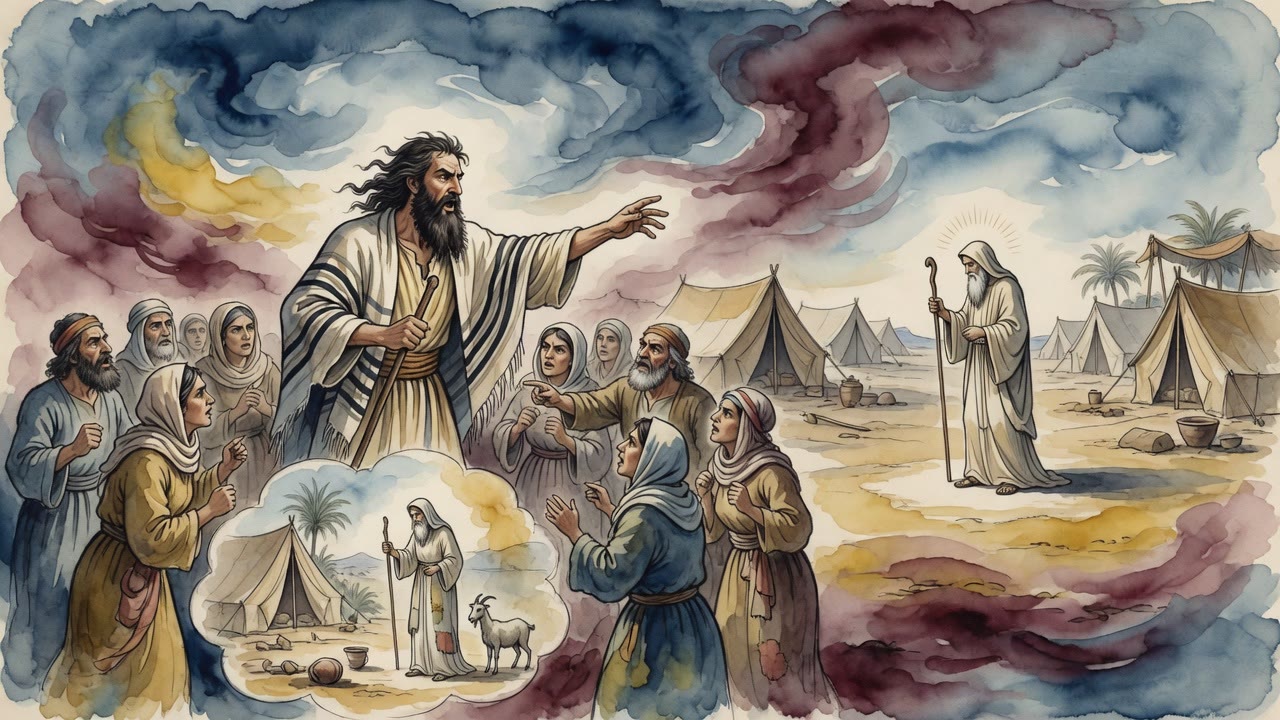
The verse says Aaron built an altar, but the rabbis read into that single word a man trapped between two terrible choices. What did Aaron see in that moment? He saw the body of Hur...
Read again what Aaron saw, the rabbis say, and you find a calculated delay. If he let the people build the thing themselves, one tossing in a pebble, another a stone, the work woul...
A third reading turns Aaron's gesture into deliberate self-sacrifice. If the people build the calf themselves, the guilt clings to them. So Aaron reasoned: better the blame fall on...
The golden calf left a stain on Aaron. Scripture says the LORD was "very angry with Aaron, to destroy him," and the rabbis read that destruction not as Aaron's own death but as the...
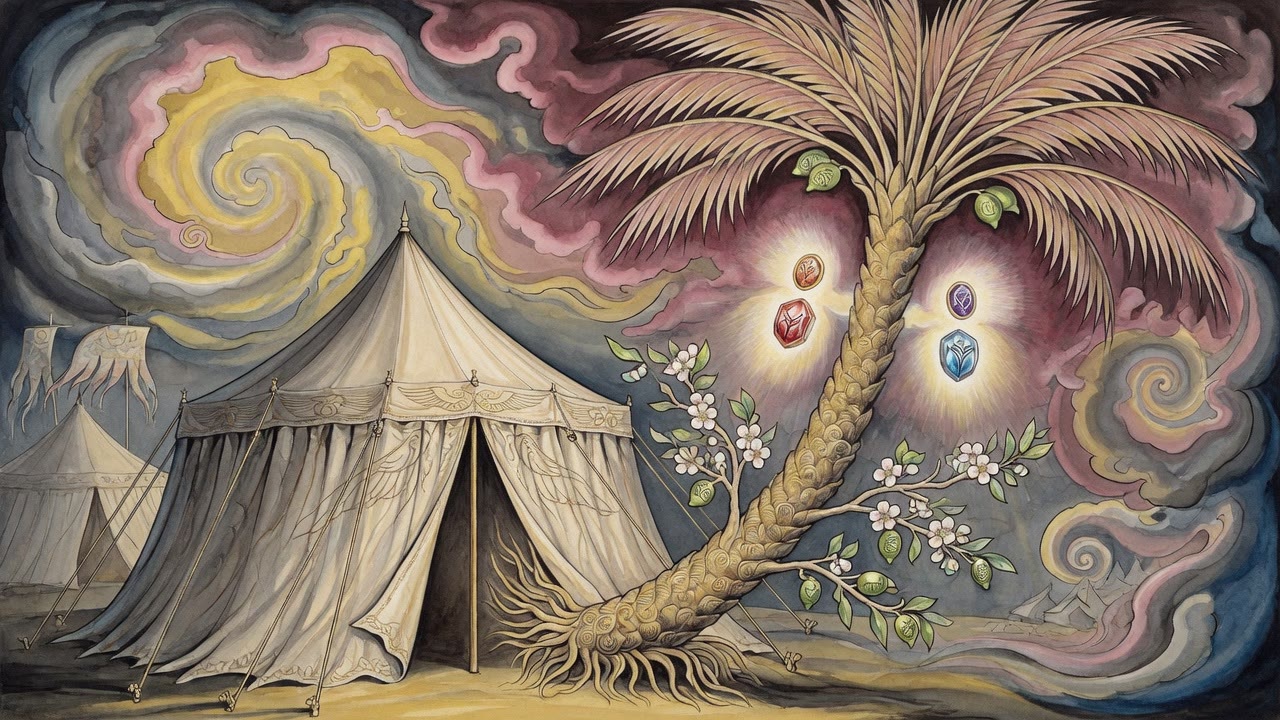
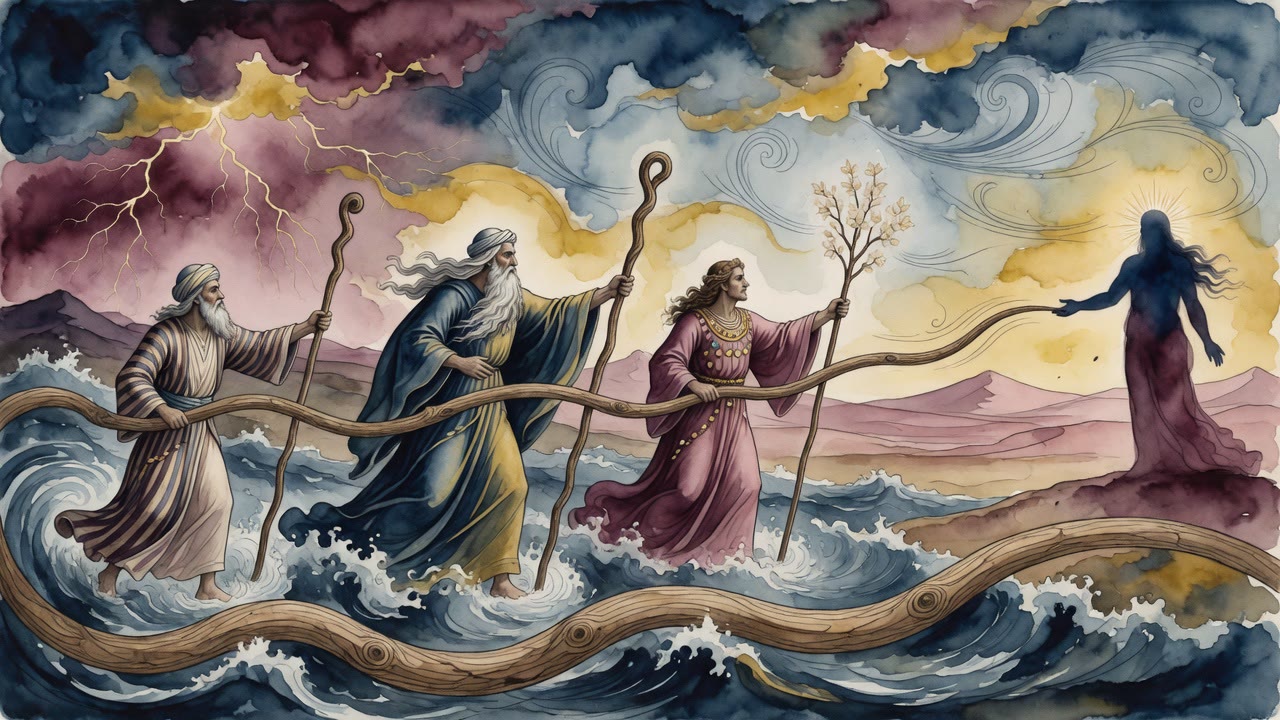
The rabbis traced one walking stick from Jacob to Judah to Moses to Aaron to David, and said the Messiah will one day hold it too.
Ginzberg reads the Tabernacle dedication delayed for Isaac's birthday in Nisan and Aaron needing Moses's joint entry to bring the Shekinah as twin pictures.
When Aaron and Chur positioned themselves on either side of Moses during the battle against Amalek, the Mekhilta says they were not randomly chosen...
Bamidbar Rabbah pictures God sitting in heaven all day building ladders, lowering one person and raising another while coins keep moving.
After the Exodus, Moses's father-in-law and his brother sat together at the first great celebration. The songs were not just for God. They were for Moses.
Pseudo-Jonathan briefs Moses fully: the peoples whose land Israel will enter, the foreknowledge of Pharaoh's refusal, and an admonition for Israel.
Shemot Rabbah joins Egypt, Passover, justice, Aaron, the tablets, and the Tabernacle into one story about redemption arriving on time.
Ginzberg reads Moses born on the future Song-at-Sea day and God's warnings to Moses and Aaron before Pharaoh as twin pictures of cosmic preparation.
Yalkut Shimoni on Torah imagines Moses as the prophet who could hear God's voice and remain unchanged, while Aaron's unenvying joy made redemption possible.
The Torah shows Moses lifting his hands above the battle with Amalek. The Mekhilta says he was not asking for victory. He was naming the dead.
The Torah names Miriam as sister of Aaron, not Moses. The Mekhilta reveals why: the title belongs to the brother who risked everything for her.
Mekhilta DeRabbi Yishmael counts pairs, detours, days, and wisdoms to track exactly what was lost when Moses, Aaron, and the desert ended.
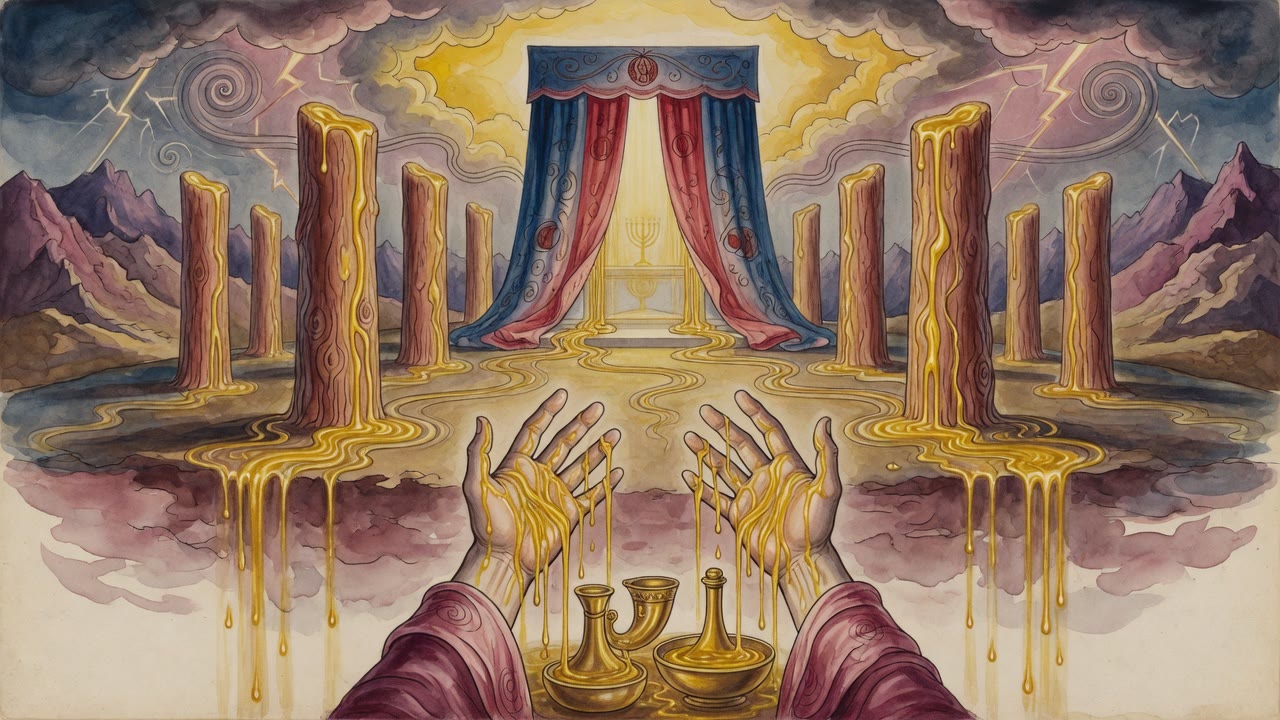
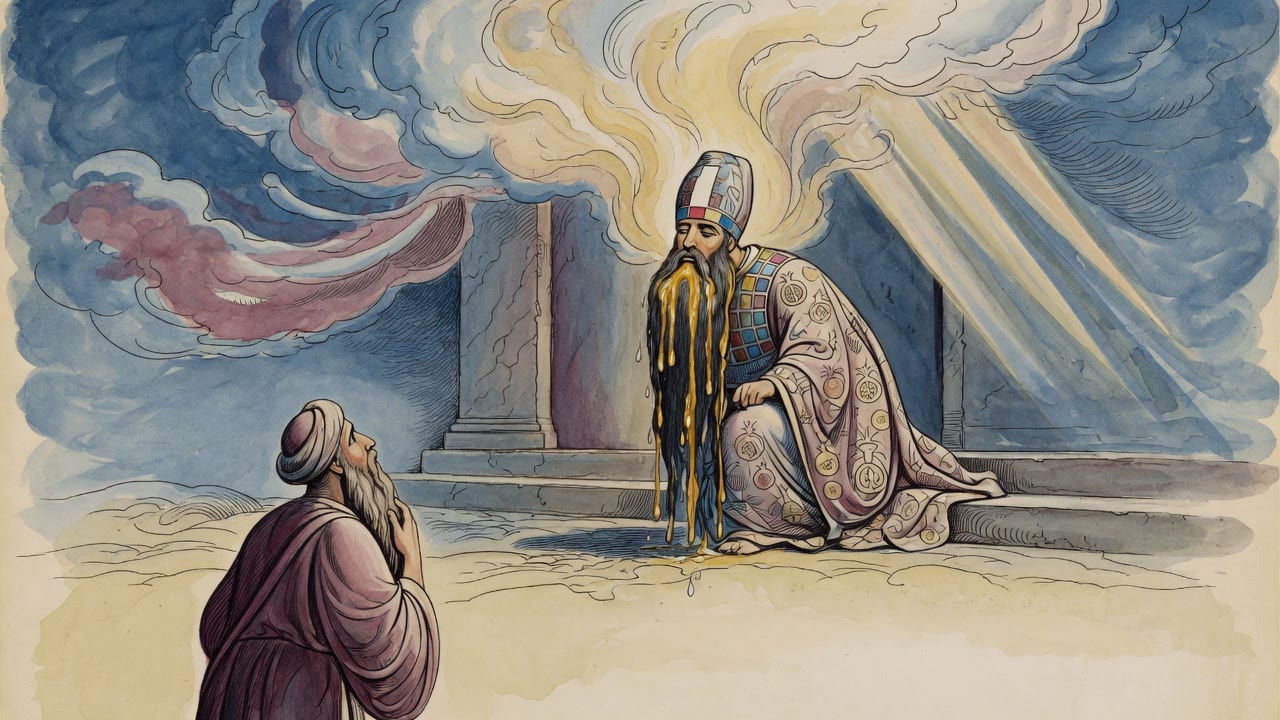
Moses poured the sacred oil over Aaron's head and felt it on his own face. A midrash reads that confusion as the secret of brotherhood.
The Sages argued that Aaron's priesthood was decreed before creation and could not be undone -- not even by the Golden Calf.
Pseudo-Jonathan supplies three exact priestly counts the Hebrew leaves blank: seventy-one bells, seven days of succession, twelve tribal logs of oil.
Targum Pseudo-Jonathan turns two altar laws into one severe story: iron must stay away from the stones, while Aaron's body is marked for holy service.
God gave Moses a recipe for sacred oil in the wilderness. He made twelve logs of it. That tiny amount anointed the entire Tabernacle, every high priest, and...
Most people assume Aaron was forgiven for the Golden Calf. The Targum Jonathan says every time he approached the altar, the shape was still there.
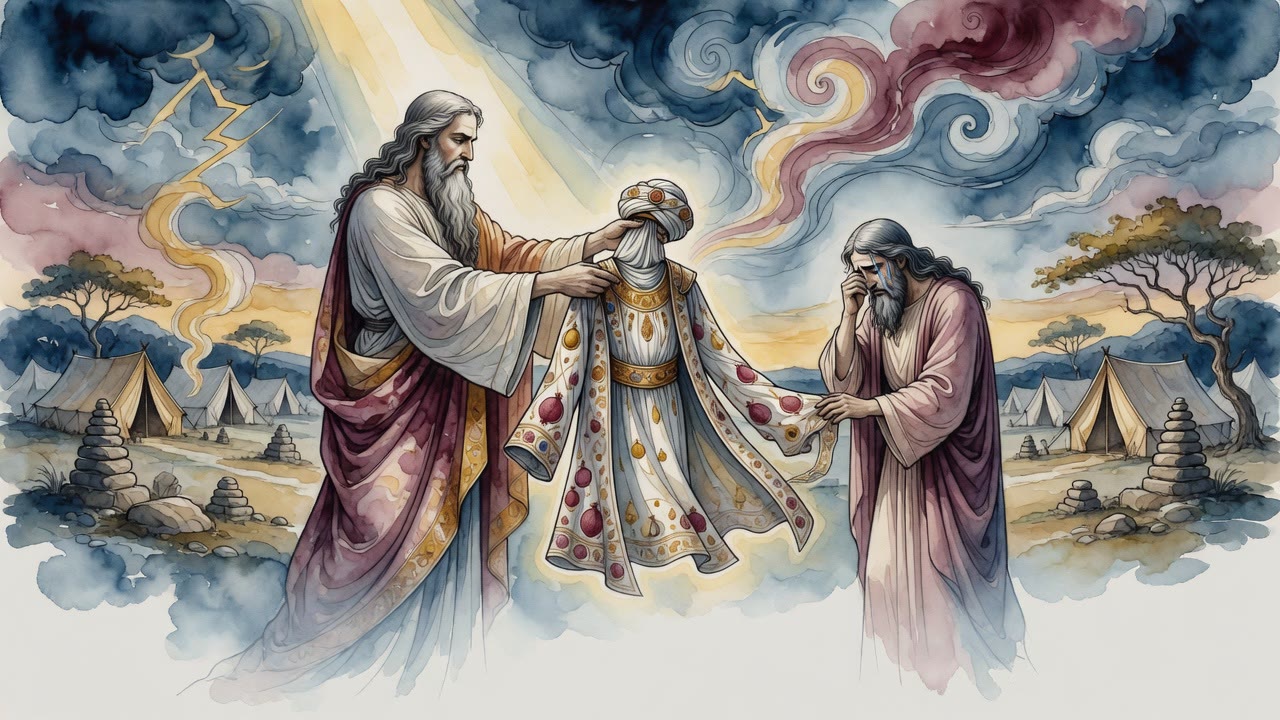
When God chose Aaron as High Priest, Aaron didn't want the job. He was a man who shunned distinctions, and Moses had to persuade him to accept.
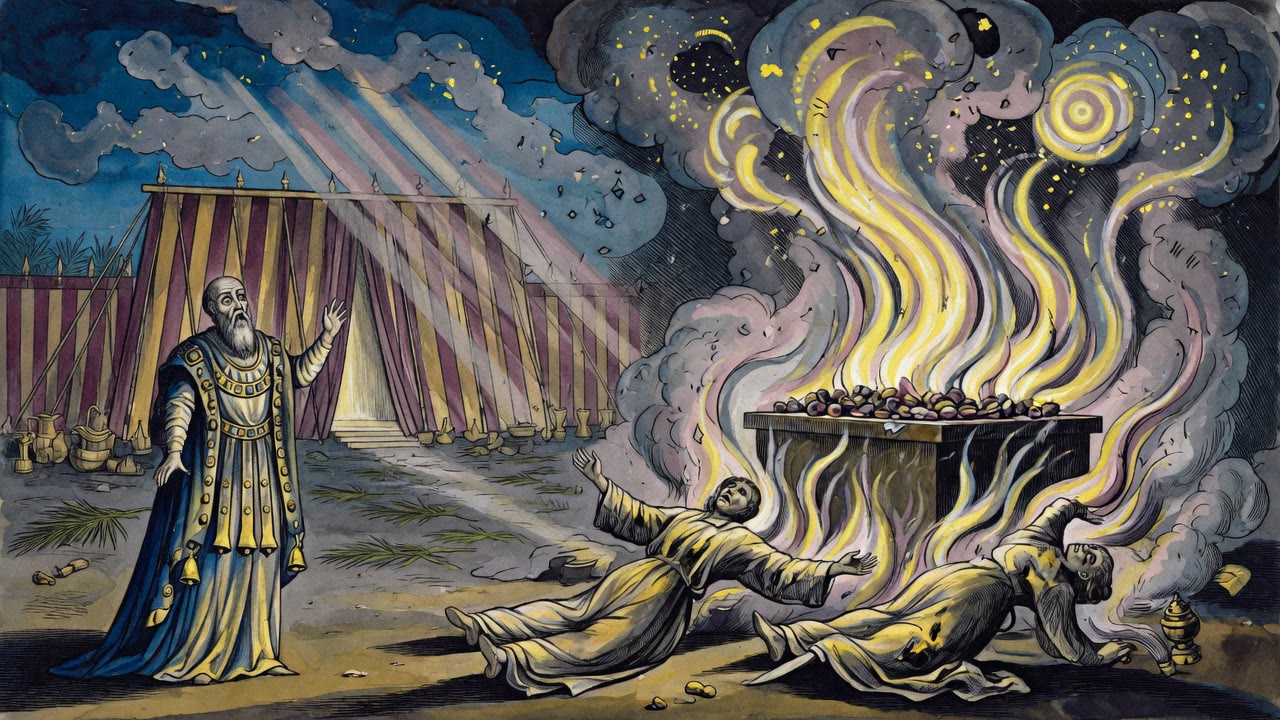
The Tabernacle's grand opening. Aaron's greatest day. Two of his sons were dead within the hour. The decree had been waiting since Mount Sinai.
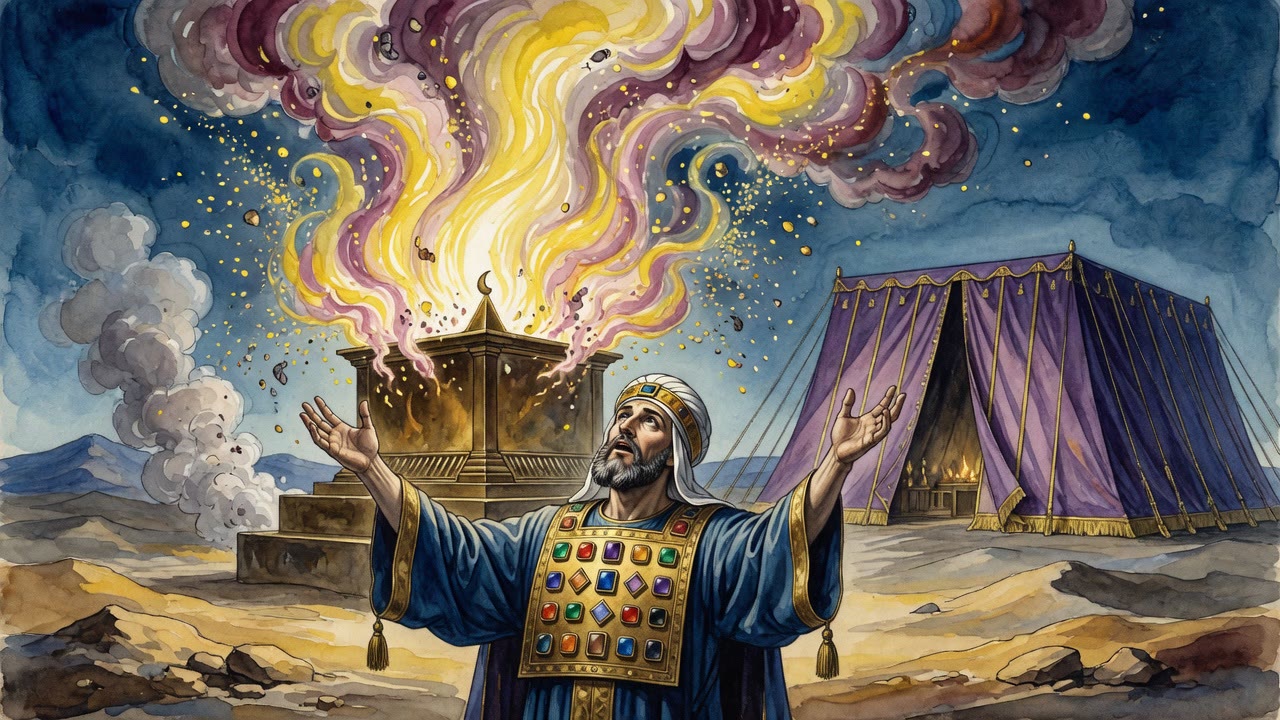
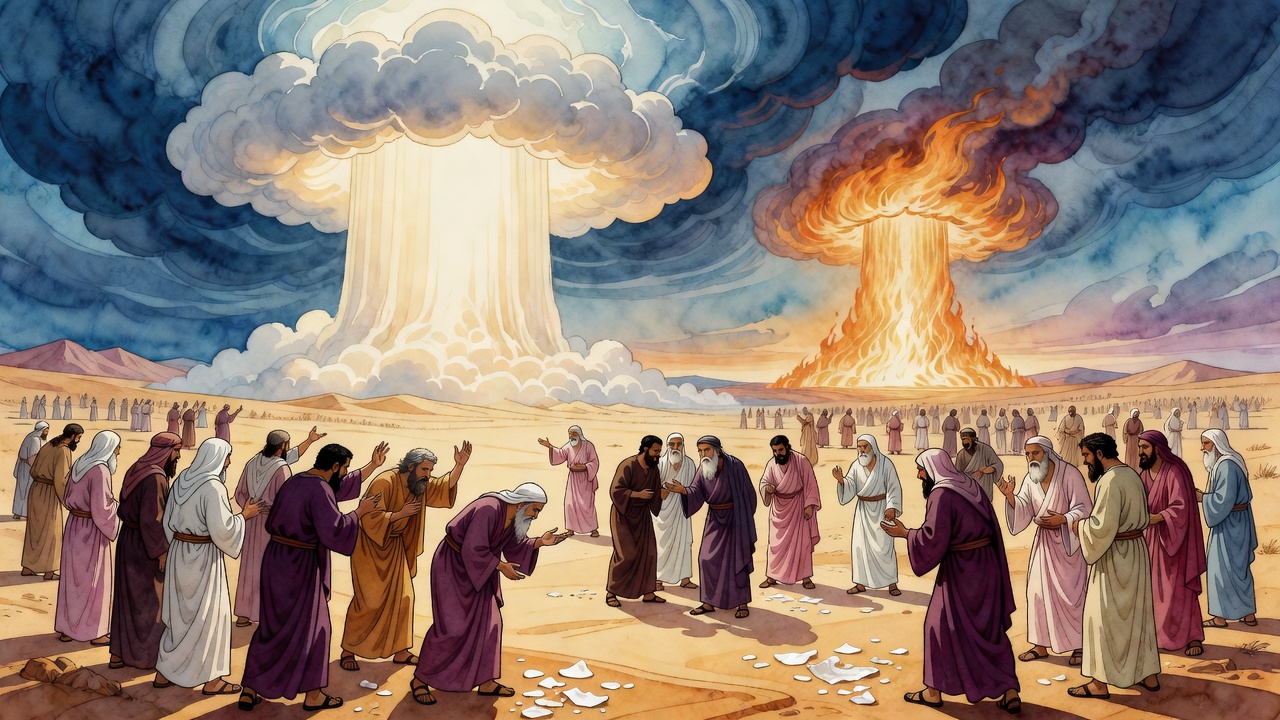
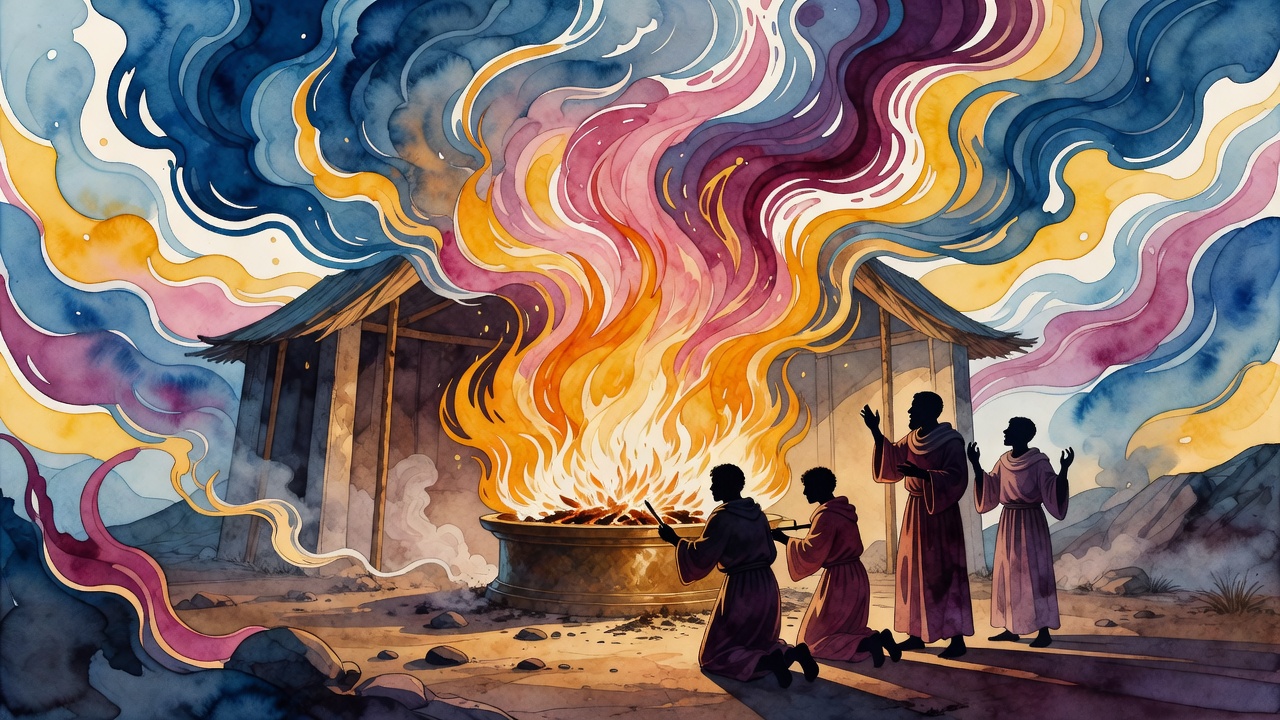
For seven days, Aaron performed the inauguration rituals alone with no sign from God. On the eighth day, fire came down from heaven and consumed everything...
Moses was furious. The goat of the sin offering had not been eaten, and he rebuked Aaron's surviving sons directly. Then Aaron explained. And Moses...
Fire descended at the Tabernacle dedication and never left. Pirkei DeRabbi Eliezer traces it from the wilderness to the Temple, consuming offerings and sons.
Ginzberg reads the elders being rewarded with leading the Pesach sacrifice and the Tabernacle's dedication day producing eight laws as twin structural moments.
Ginzberg reads the Israelite camp as a perfectly ordered twelve-thousand-cubit square and Moses placing Aaron in the center as twin pictures of sacred order.
Ginzberg reads Aaron's greater glory in lighting the menorah and Moses's gentle preparation of Aaron for his death as twin pictures of fraternal care.
Sifrei Bamidbar reads idolatry as rejecting the whole covenant and Aaron receiving God's messages through Moses as twin pictures of mediated authority.
Moses asked for one night before answering Korah's challenge. The reason tells you something about how Moses understood both anger and the way God judges.
Moses set the incense test for morning. Korah spent the night canvassing every tribe, building a coalition far larger than Moses had seen before.
Those born in the wilderness had never seen the sun. The divine clouds that covered the camp were there for Aaron. When he died, so did the clouds.
When Aaron died, Amalek saw the opening they had been waiting for. But they attacked in disguise, dressed as Canaanites, hoping to misdirect Israel's prayers.
Ginzberg reads Moses's hesitation costing the priesthood and Zelophehad's daughters revealing Moses's limits as twin pictures of how hesitation and pride cost.
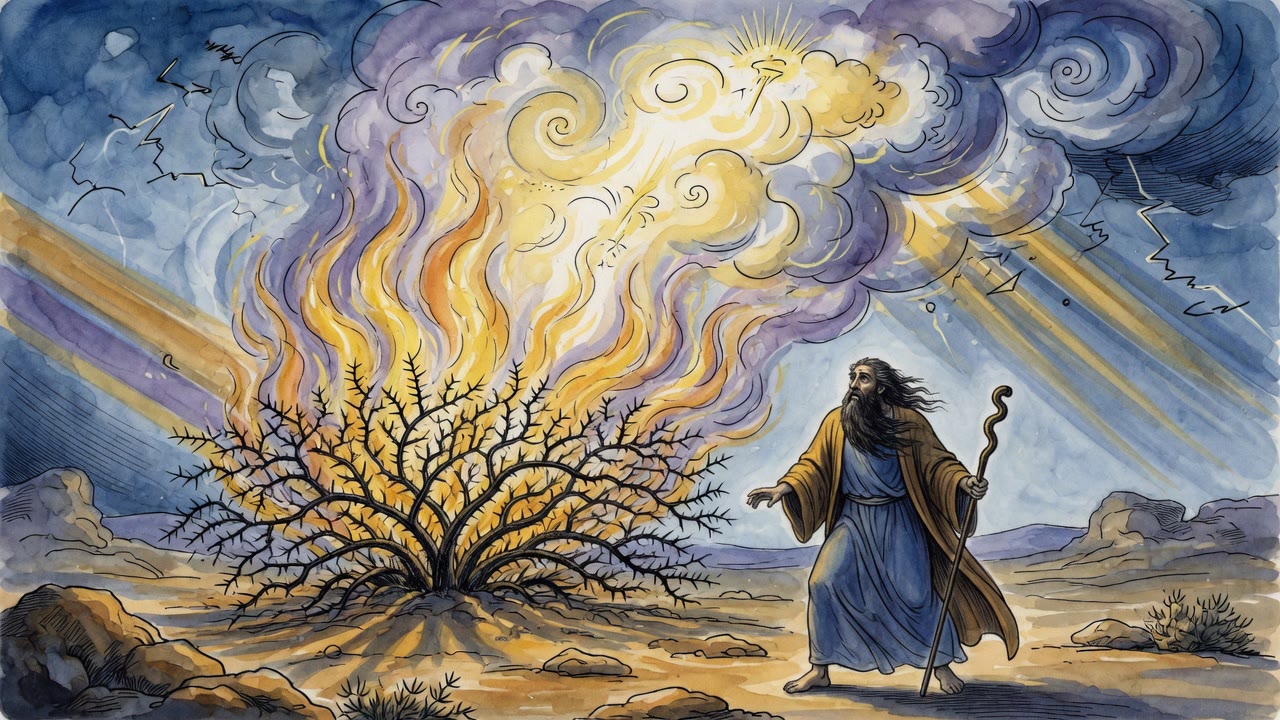
Moses didn't want to lead the Exodus. He argued with God through five excuses at the burning bush. God finally lost patience, and the punishment stuck.
The Torah usually says Moses and Aaron. Once, it says Aaron and Moses. A tannaitic midrash says the reversal was deliberate, and it changes everything.
Moses told a starving nation that God would feed them in the dark. By morning the ground was covered in bread. The rabbis explain why the timing was the lesson.
The Torah uses a word for the manna jar that appears nowhere else. The rabbis cracked it open and found a linguistic argument hiding a theology of witness.
The rabbis matched three wilderness miracles to three people. When each person died, their miracle died with them. Moses carried the last of all three.
Freed from Egypt, fed by miracles, facing no enemies they could not escape. Israel still found ways to fail. The Midrash tracks every stumble with something...
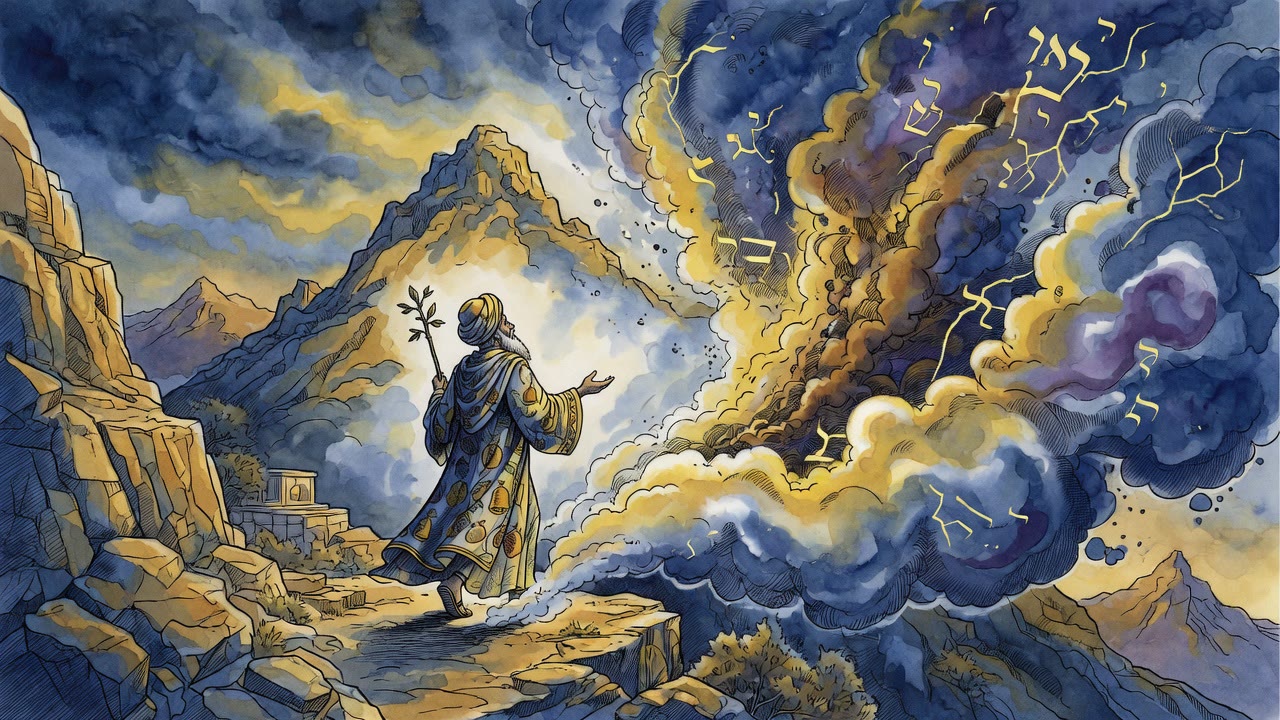
The plagues came through Aaron's staff. He never asked for the credit. When God called him to the mountain, he went willingly, and the angels wept.
Three moments from Aaron's life reveal a priest who spent his entire career standing between catastrophe and the people he served. even when it cost him...
Moses received the Torah at Sinai. But it was Aaron who protected the living tradition - the thing that breaks when no one is watching.
The first day of Nisan was so singular it earned ten names. Aaron spent the seven days before it in mourning he did not yet know he needed.
Aaron challenged God over the deaths of Nadab and Abihu. God answered with a reason no parent expects, and Aaron's response was gratitude.
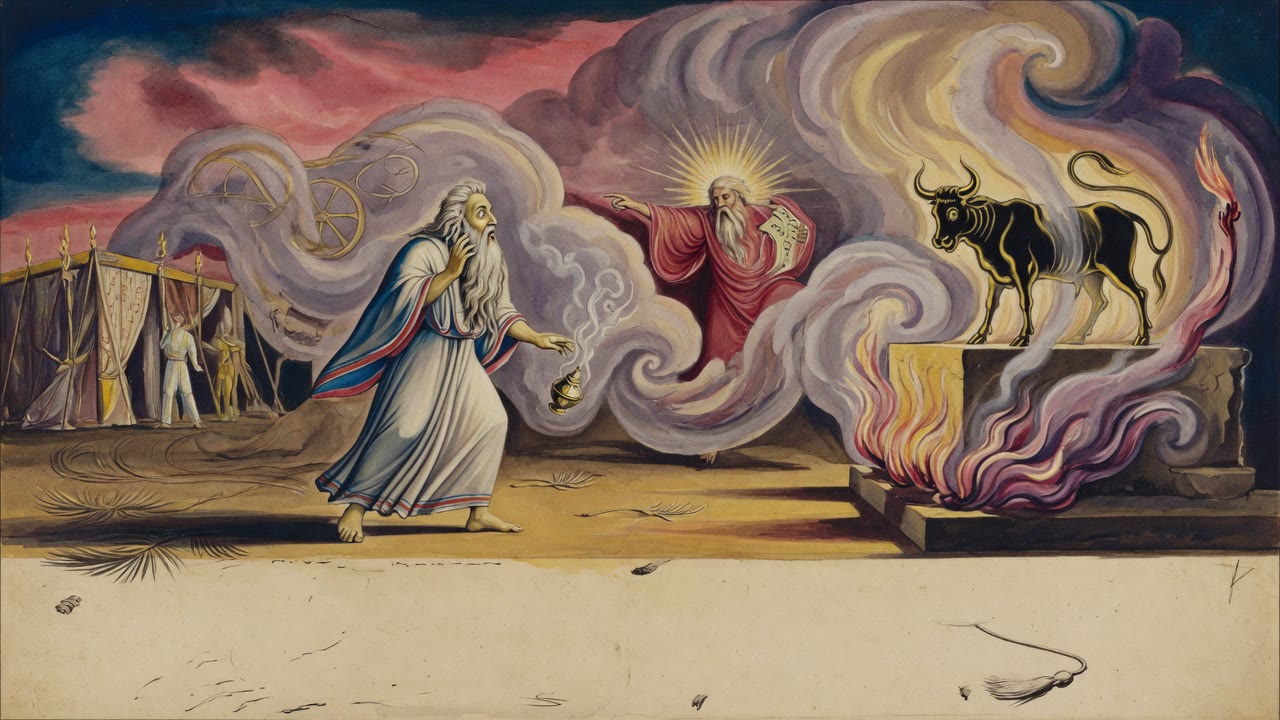
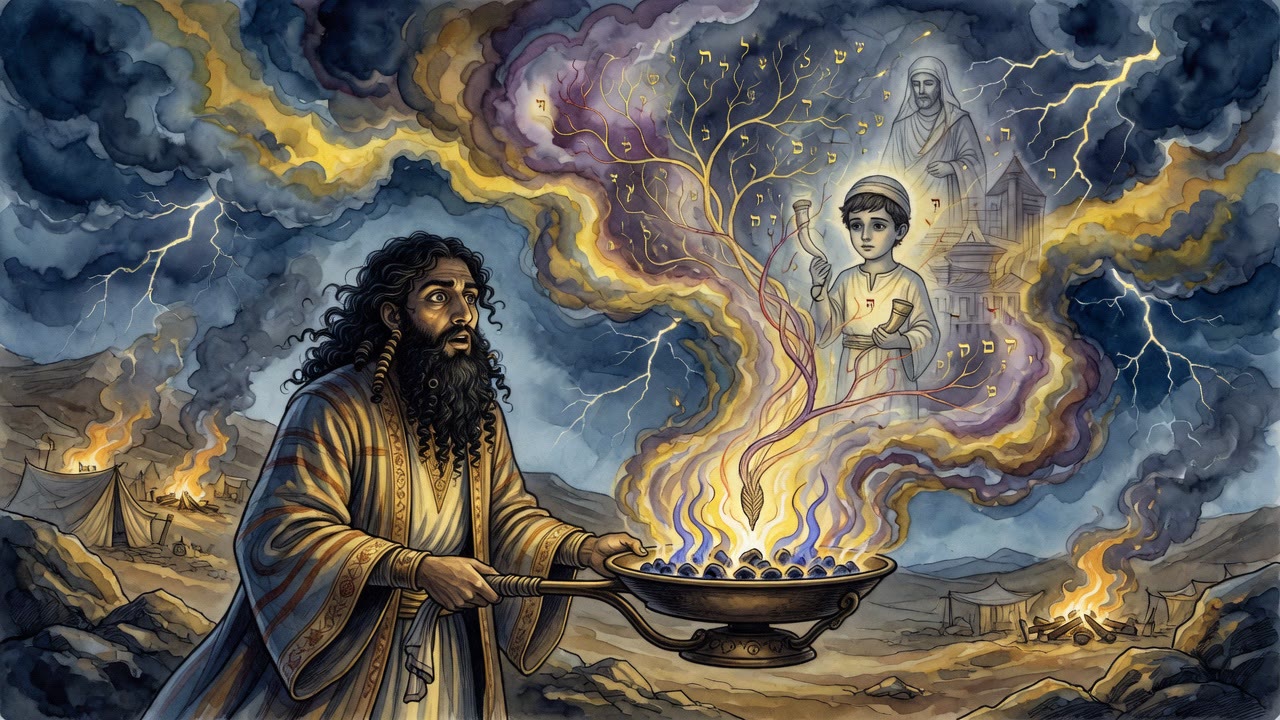
When plague struck Israel after Korah's rebellion, Moses sent Aaron running with incense. The remedy came from a secret learned in heaven.
Israel did not believe because of Moses's miracles. They believed because Aaron spoke a secret phrase their ancestors had been waiting centuries to hear.
Even the wicked ask for signs before they act. The rabbis traced Pharaoh's demand for a wonder to a principle God had built into creation itself.
Moses anointed Aaron as High Priest, but Aaron could not serve for a full week. The Book of Jasher explains the waiting and the cost.
When Israel fell into idol worship in Egypt, one voice broke through the silence. Aaron's call to repentance reached the tribe of Gad when no one else could.
Moses and Aaron were both prophets, yet the Kabbalists taught that only one of them crossed the final threshold of divine access. The difference between...
A close reading of two adjacent verses in Exodus reveals that Aaron placed the preserved manna jar before the Ark long before most assume. The Mekhilta uses...
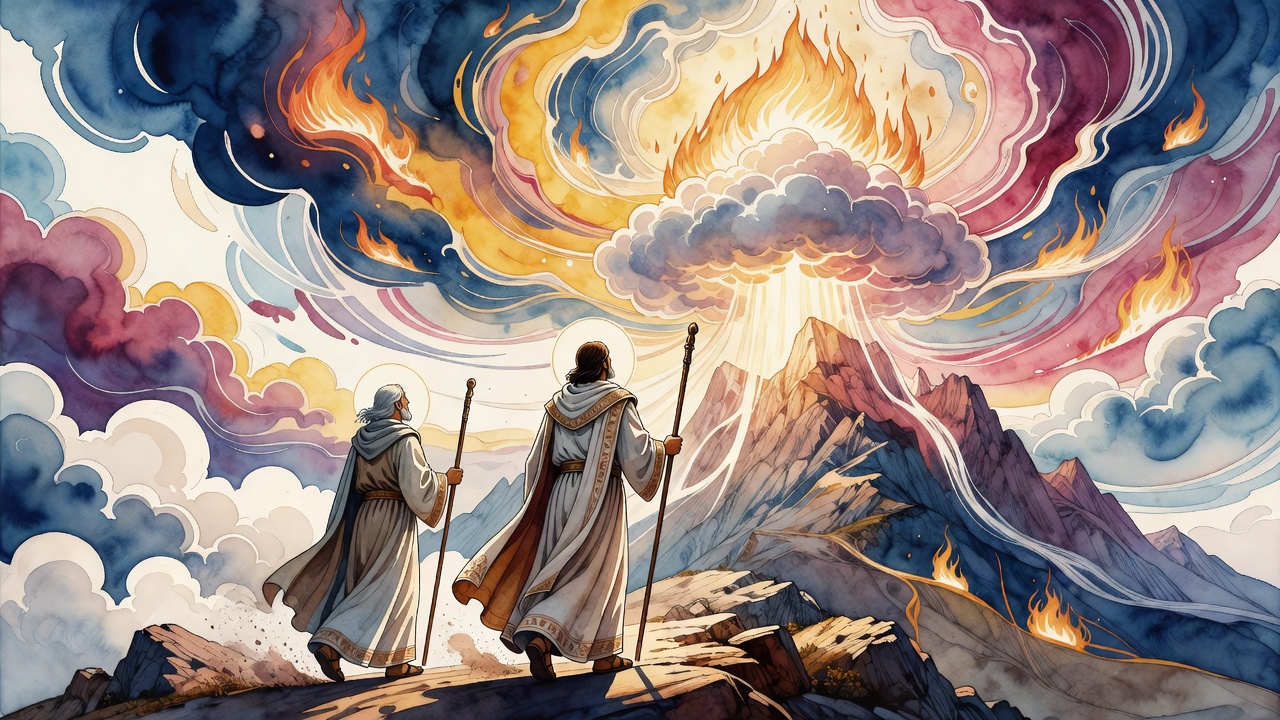
God invited both Moses and Aaron to ascend Sinai together. Then a series of specific commands revealed that the invitation had a limit. The Mekhilta traces...
When God told Moses he would be gathered to his people as Aaron had been, the rabbis noticed something remarkable: Moses did not merely accept this. He...
Aaron's death is one of the most intimate scenes in the Torah, and Moses was the only witness. The midrash fills in what the Torah omits: the moment Moses...
The Torah says Aaron was washed before becoming High Priest. The Targum Jonathan reveals what that washing actually required, and why the priestly...
After Korah's rebellion was crushed, a plague swept through Israel and killed thousands in a single day. Aaron stopped it by running into the space between...
When Aaron's staff swallowed the staffs of Pharaoh's magicians, something stranger than a magic trick happened. The rabbis spent centuries explaining why...
Pseudo-Jonathan choreographs the Exodus plagues by hand: Aaron over the canals, Moses sprinkling ashes upward, the Holy One severing the army at the sea.
Midrash Tanchuma reads an extra et to mean a heavenly tabernacle rose alongside the earthly one, and a repeated Take Aaron to transfer the priesthood.
Two passages from Shemot Rabbah read Aaron and Moses as paired ministers whose kiss at the mountain and division of plagues form one mission.
Targum Jonathan reads the Tabernacle, Aaron's return, the Levite exchange, and the tribal offerings as one symbolic map of Israel.
Targum Jonathan imagines the Mishkan as a guarded world of fire, water, blood, oil, incense, and silver, where holiness must never be handled casually.
Blood on a lintel, a convert at the gate, two letters of Torah grammar, Aaron in the Holy of Holies. Four thresholds in Shemot Rabbah.
Shemot Rabbah reads the Exodus as God dismantling every rule of rank, putting younger brothers, shepherd staffs, and spared firstborns first.
Pharaoh hired the world's best sorcerers to out-magic Moses. They kept up for five plagues. Then the sixth broke their bodies and their craft.
Shemot Rabbah reads Aaron examining Naḥshon to assess Elisheva and Moses' staff removing hidden idols as twin pictures of how lineage carries spiritual weight.
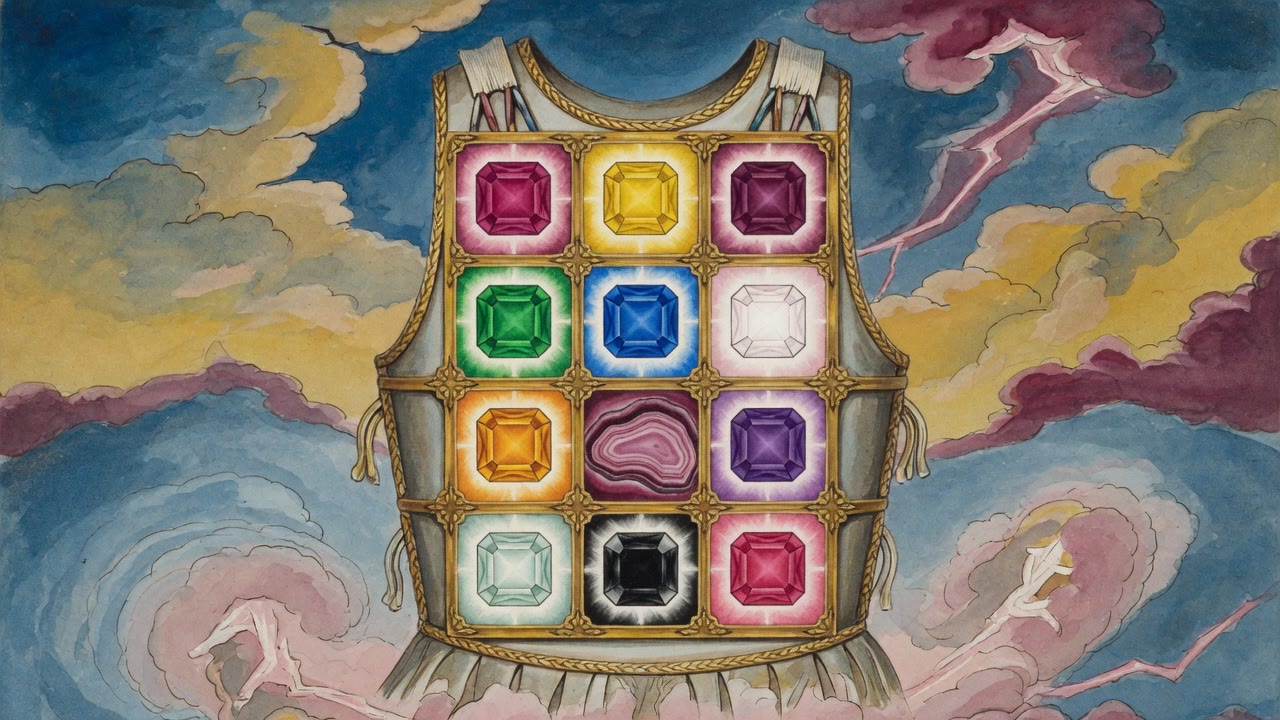
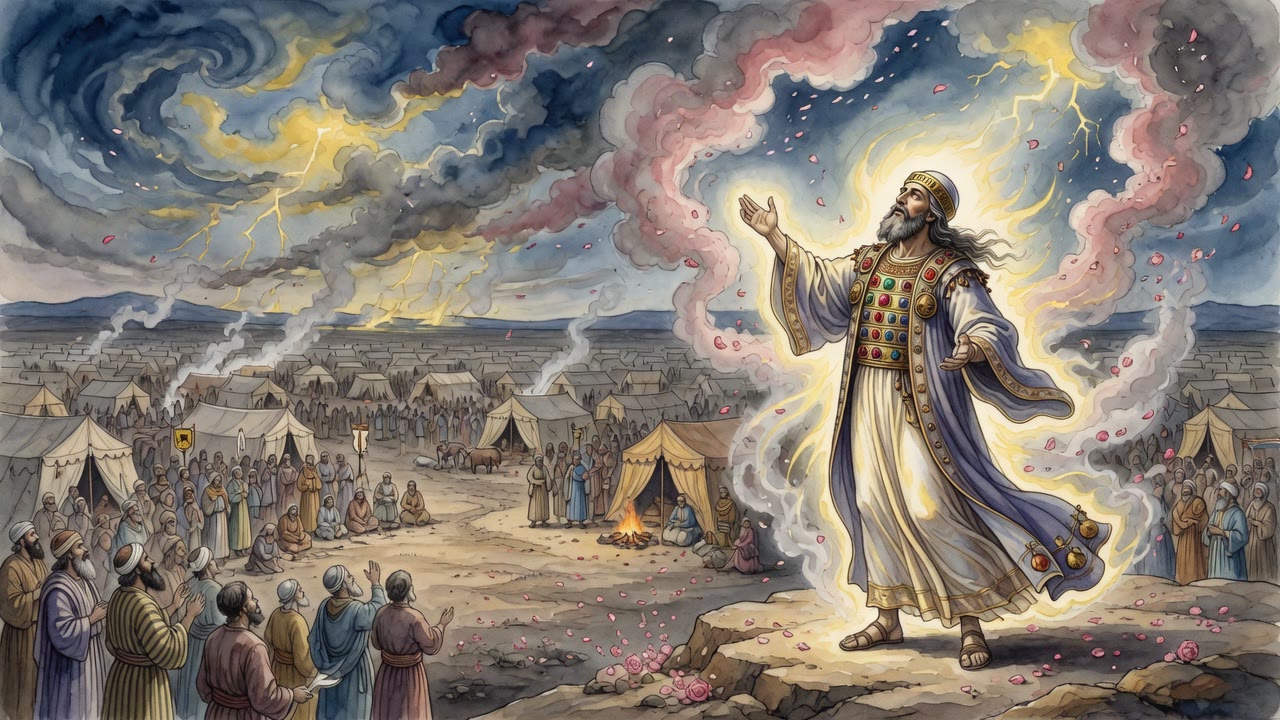
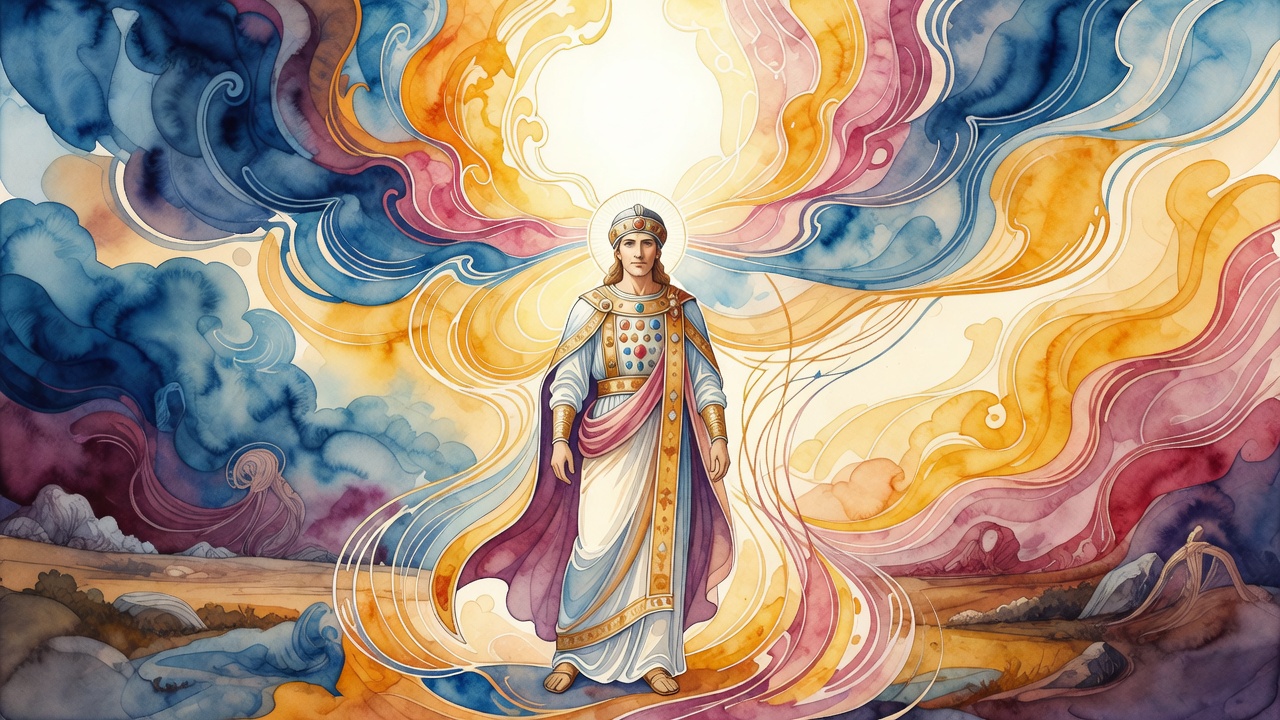
The high priest of ancient Israel wore twelve gemstones on his chest. When someone asked a question, individual letters carved into the stones would glow.
When Nadav and Avihu died, the Torah records that Aaron was silent. Three Hebrew words. The rabbis considered this one of the most extraordinary moments in...
Aaron stopped more sins than Moses by never mentioning sin. His method was to make people feel too ashamed to misbehave after he had been kind to them.
Aaron became High Priest on the same altar where the golden calf had stood. Every time he approached it, the rabbis say, he remembered.
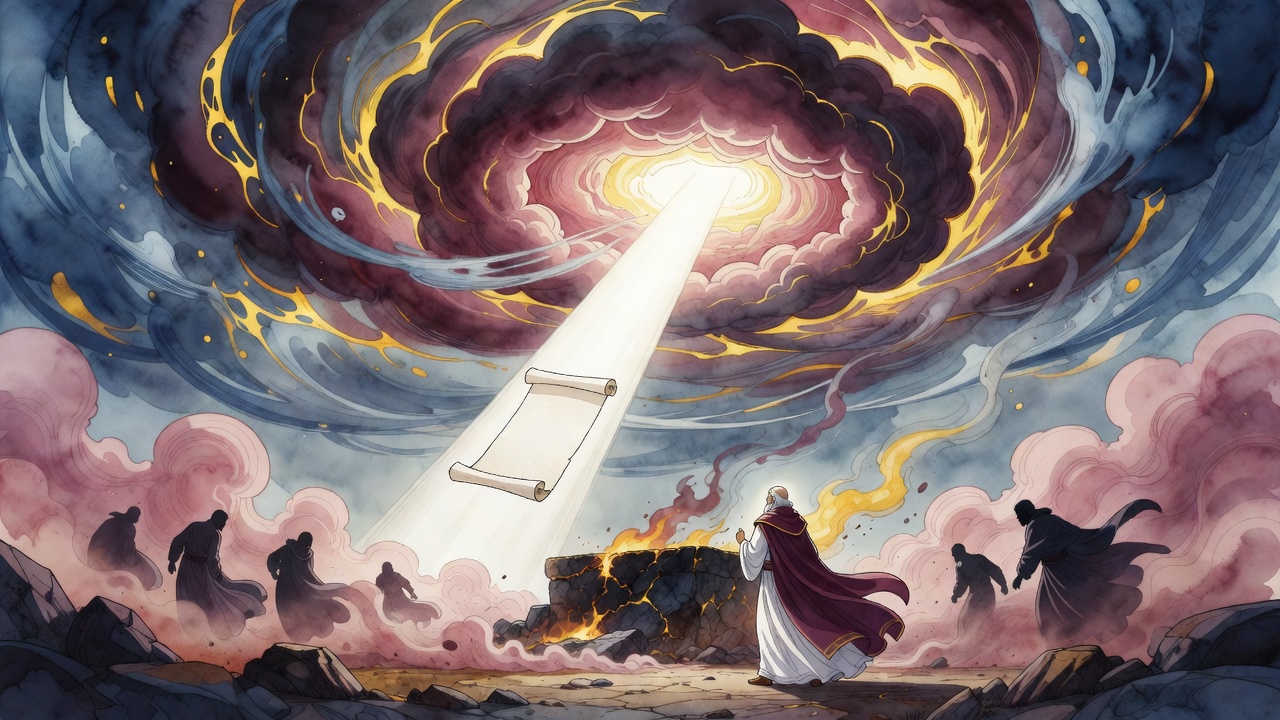
After Korach challenged Aaron's right to the altar, God did something unusual: issued a formal written deed. The rabbis explain why God's word alone was not...
The Midrash traces three separate traditions to make one argument: Aaron's holiness was not inherited from his office but was the quality that made him fit...
When God told Aaron that he and his sons must bear the sin of the sanctuary, the rabbis of Sifrei Bamidbar understood this as a terrifying accountability...
God told Moses to bring Aaron near for the priestly consecration. The Targum Jonathan added three words the Torah never contains: Aaron was far off, on...
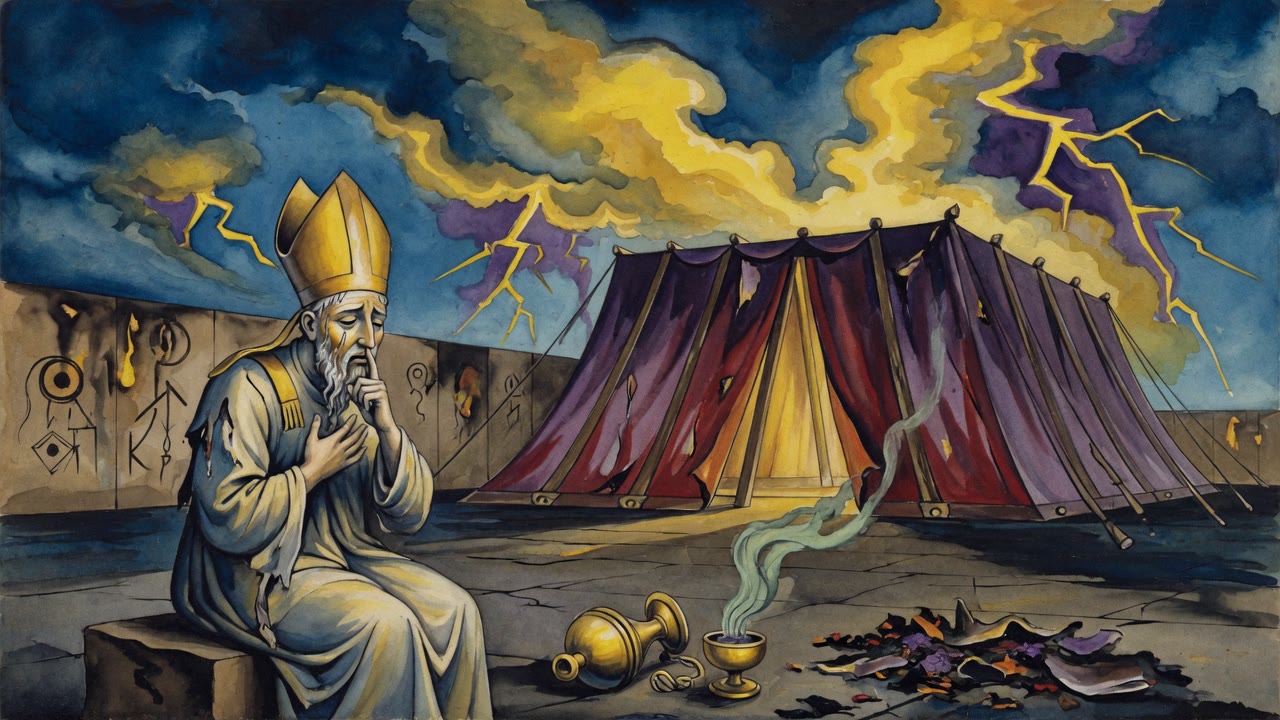
On the day Aaron was supposed to offer his first sacrifice as High Priest, he stopped cold. The Targum Jonathan says he saw the shape of the Golden Calf...
Every tribe in Israel received a portion of the Promised Land. The Levites received designated cities. Aaron and his sons received something the Torah...
The Torah has a secret hiding inside the flour offering. It is not about poverty. It is about what God actually counts. Bring a bull if you can afford it.
The rabbis noticed that Torah laws are never placed next to each other by accident. A missed flour offering, an outbreak of skin disease, a wife brought to...
Bamidbar Rabbah reads Aaron defending his son's lineage, the sotah's bitter water, and the Golden Calf as one crisis hiding inside the Tabernacle floor.
Aaron was named High Priest in public, lost two sons to strange fire, and watched a half-Egyptian boy curse God for being shut out of the tribes.
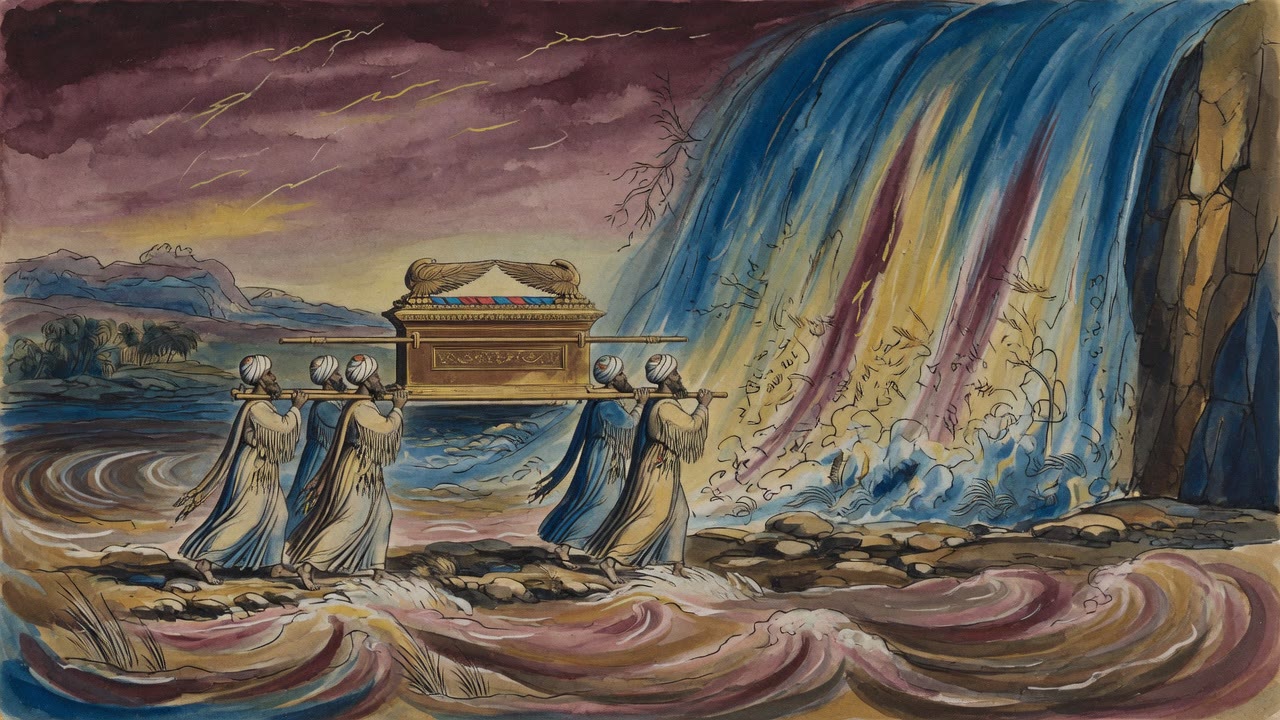
Most people think the Levites bore the Ark across the Jordan. Shemot Rabbah flips it. The Ark bore them, and the riverbed rose to meet their feet.
Vayikra Rabbah hides three images of priesthood. A bull arranged like a hill. A blessing said in the wrong order. A lamp in God's hand.
Sifrei Bamidbar uses the Levitical exclusion, the red heifer structure, and the adjutant priest to define what the priesthood actually does.
Bamidbar Rabbah turns the census of Israel into a cosmic discipline, beginning with Abraham above the stars and ending with vows kept before God.
When every other tribal prince brought offerings at the Tabernacle, Aaron watched. The midrash captures his despair, and then God's answer, which changed...
Korah did not start his rebellion with a speech. He started it with a parable about a poor widow that made every listener hate Moses on the spot.
Korah had a genuine prophetic vision of greatness in his bloodline. He saw exactly right. He understood exactly wrong. And the difference cost him everything.
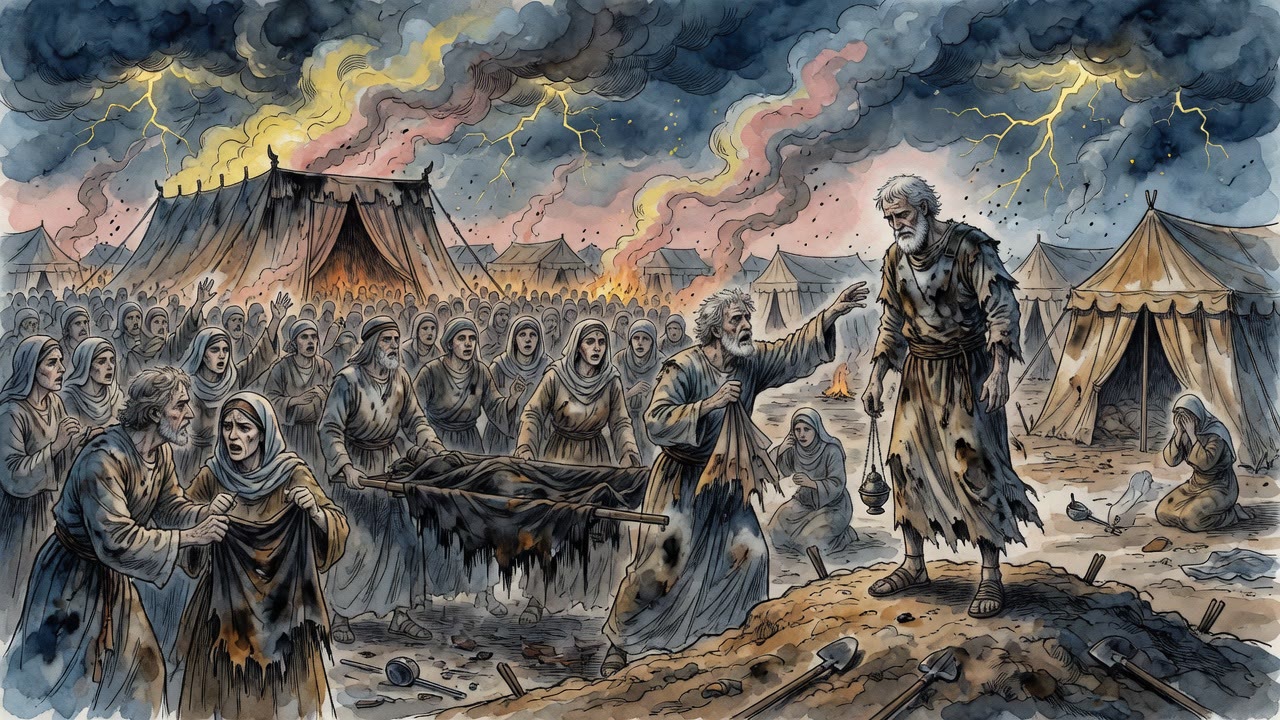
When the plague swept through the camp, Aaron ran into the gap between the dead and the living and held it open with incense. The sages say he was doing...
Most people think Aaron was born into the priesthood. A tannaitic midrash says the whole nation used to be priests. One moment narrowed it to a single family.
Miriam spoke against Moses and the cloud withdrew. What the rabbis found was not a gossip warning - it was a portrait of three siblings called in one breath.
The prophet Zechariah glimpsed two figures standing before God's throne - one priest, one king. The rabbis of Bamidbar Rabbah knew exactly who they were.
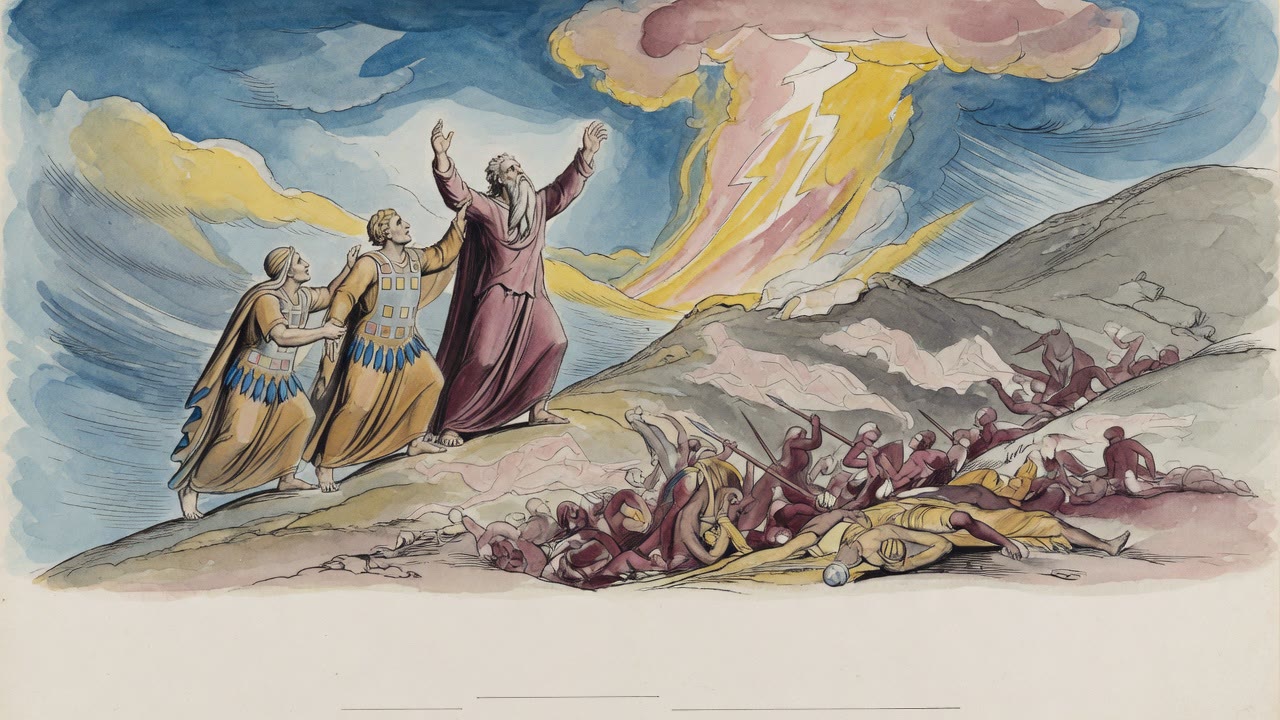
When 24,000 Israelites were dying, one man acted. Ben Sira remembers Aaron's grandson Phinehas as the man who stood in the gap between Israel and destruction.
Aaron organized Israel's tribes by ancestry - then Israel turned his own family's lineage against him. How God responded reveals the weight words carry.
Moses had the hardest errand of his life: tell his brother it was time to die. Aaron solved the problem for him. He walked up the mountain willingly.
Aaron's priesthood was framed by two catastrophes -- the Golden Calf and Korah's rebellion. Both threatened him. Both failed to destroy him.
When Aaron died on Mount Hor, the heavens grieved before Moses could. The tradition records that the Angel of Death approached Aaron gently, and that Moses...
When Aaron died on Mount Hor, Israel mourned him more intensely than they would later mourn Moses. The rabbis asked why, and their answer changes how you...
Tanchuma regulates the priesthood with three rulings: the order of Torah reading, the warning against rebellion, and the hands that cannot raise in blessing.
Jewish tradition makes a startling claim: the covenant with Aaron the priest outlasted and outranked the covenant with David the king. Sifrei Bamidbar...
The Torah never explains why Aaron, not Moses, brings several of the plagues. Targum Jonathan gives the reason: Moses owed debts of gratitude to the Nile...
Pseudo-Jonathan will not abbreviate Exodus 28:1 and 36:2, naming all four priestly sons and every kind of wise-hearted artisan in full.
Pseudo-Jonathan preserves the priest's breastplate-names over the heart and the equal-weight spice proportions of the incense, refusing to abbreviate.
After Korah's rebellion, the question of the priesthood still felt unsettled. God's answer was twelve rods, one night, and almonds that ripened before dawn.
Ginzberg reads Moses bringing Aaron and Eleazar beyond the camp before revealing the priesthood and Ebed-Melech's 66-year sleep as twin protections.
Vayikra Rabbah turns Leviticus into a story about gifts, speech, rebuke, priesthood, and the danger of serving holiness for the wrong reason.
Bamidbar Rabbah links palm trees, Aaron, David's pure speech, Yoav, Adam, and cities of refuge into one myth of judgment softened by mercy.