Parshat Beshalach5 min read

Joshua Broke Amalek Inside a Single Verb

At Rephidim Joshua weakened Amalek while Moses hands held the sky. Rabbi Eliezer later split one verb into king, family, and armies in full.

Curated by Arthur · Told by Maggid ·
Table of Contents
  1. Dust, Thirst, and a Raised Pair of Hands
  2. One Word That Held a Whole Army
  3. Who Can Turn Him Back
  4. Trust at the Edge of the Sea and the Edge of War
  5. After the Verb
Joshua Broke Amalek Inside a Single Verb Click for full size

Dust, Thirst, and a Raised Pair of Hands

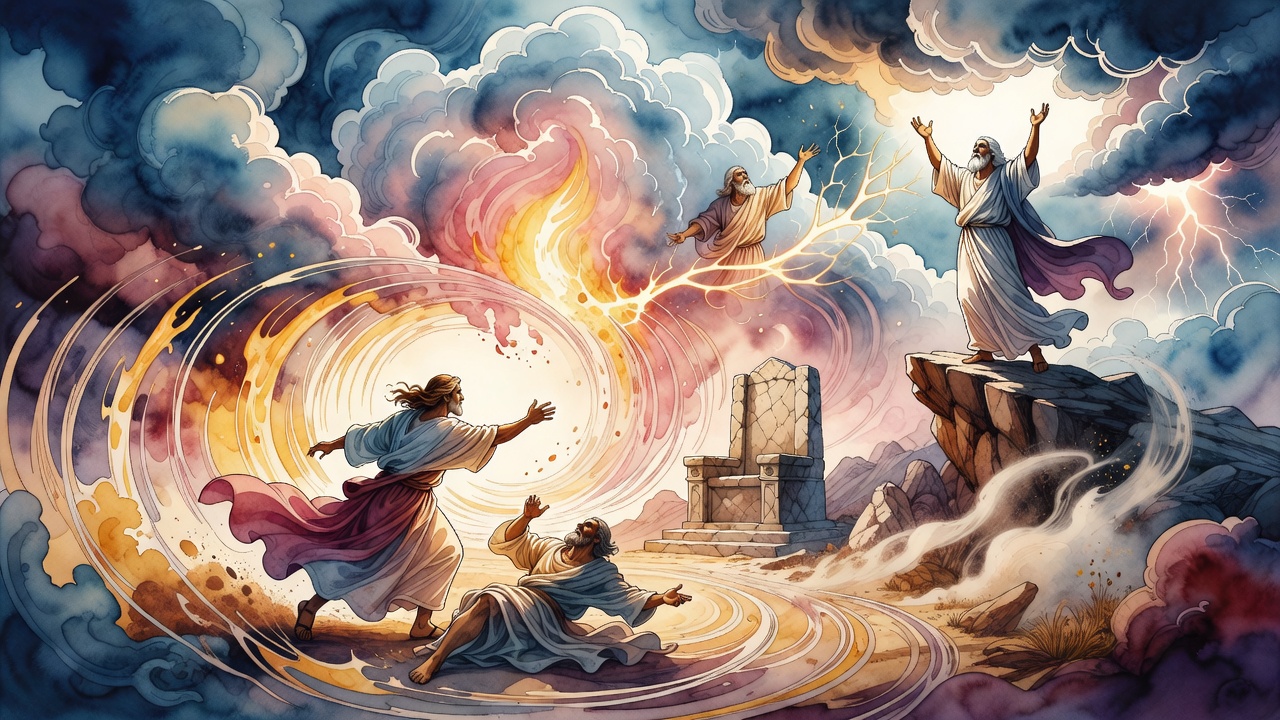
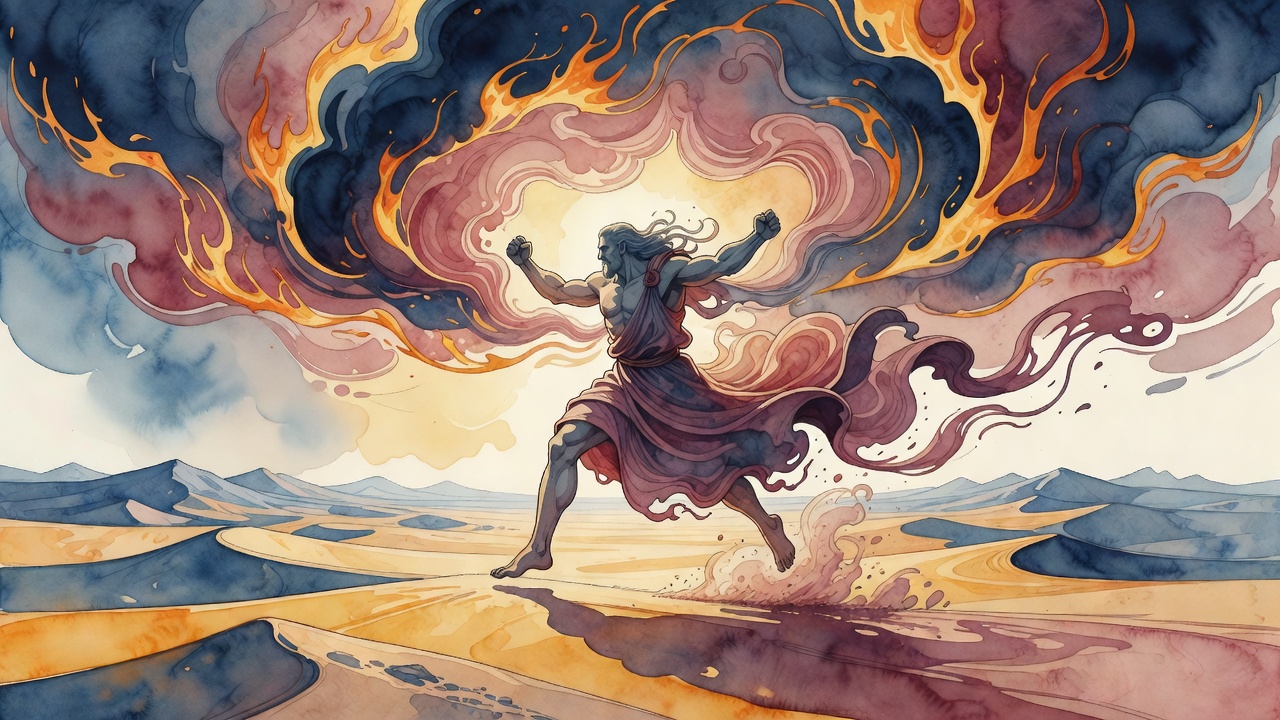
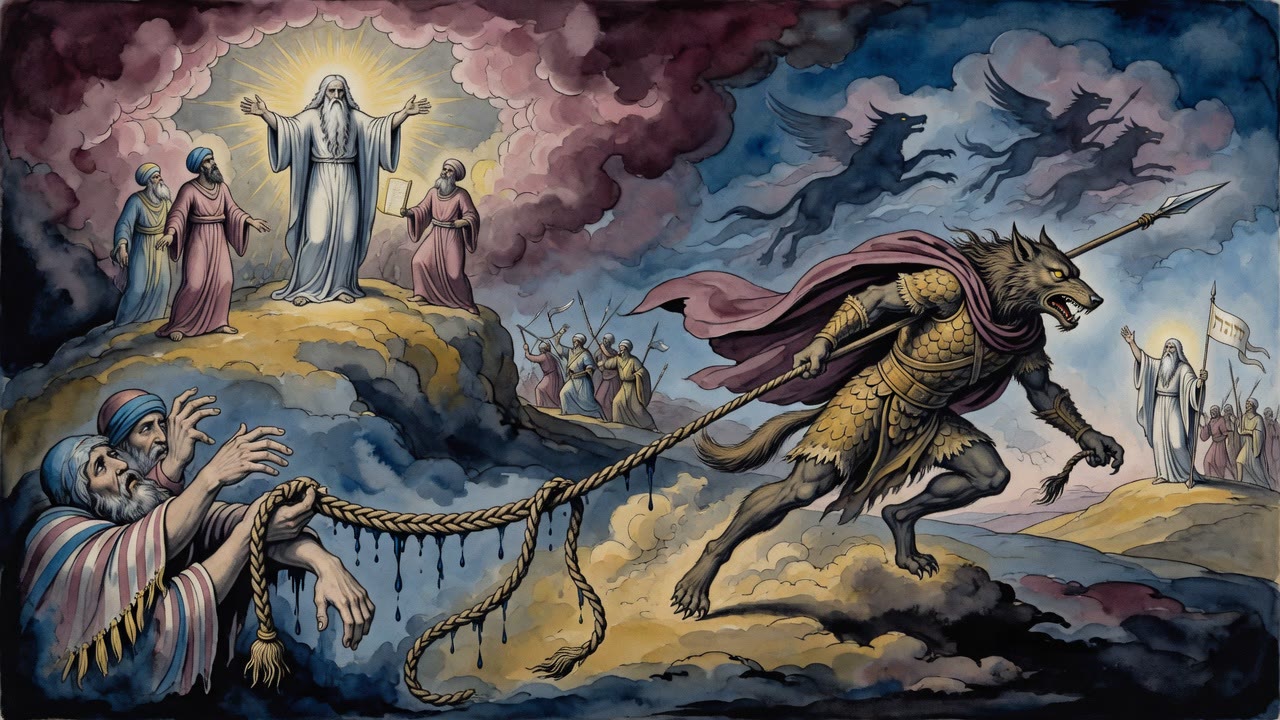
Joshua ran toward the sound of Amalek with a sword that still smelled of new smithing. Behind him, on the hill, Moses lifted his hands, and when the hands fell Israel fell with them. The battle was not only metal. It was a vertical argument about which force would tire first.

Amalek struck the rear, the weary, the ones lagging without water in their mouths. Joshua learned the enemy's ethics in the first hour: cruelty aimed at weakness. He answered with a pursuit that did not romanticize itself. War under the hill was labor, breath, and the grit of sand in open cuts.

When the sun finally bent, the field held a quieter kind of horror. The Torah would later compress the outcome into a single verb: vayachalosh, and he weakened, and he broke.

One Word That Held a Whole Army

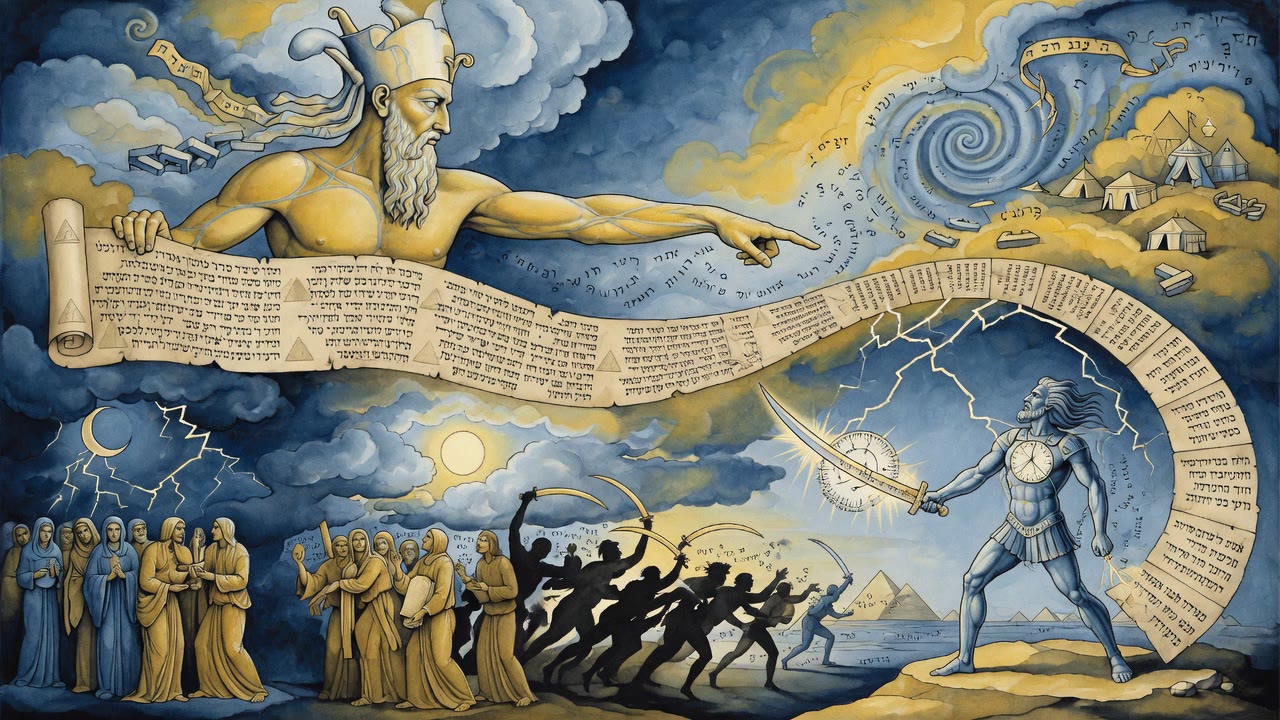
Rabbi Eliezer, centuries after the dust settled, refused to leave that verb as a flat report. He cracked it open by notarikon (reading a word by its letters as a phrase) until it named more than a skirmish. The word carried Amalek the king, and Amalek with wife and children, and his people, and the fighters bound to his children's fight. Total structure, not a lucky clash.

Joshua in the field did not hear the acronym. He heard shields. Still the later reading fits the feeling of that day: nothing of the attacking order was meant to remain tidy. The war against Amalek is not a story about a fair duel between champions. It is a story about dismantling a machine that feeds on stragglers.

Moses' hands finally held with help of stone and of Aaron and Hur. Heaven and muscle shared the credit without splitting into two religions of cause. Joshua finished what the hill began.

Who Can Turn Him Back

In another chamber of the same tannaitic house, Pappus read Job and said God is one and who can turn Him back, a picture of power that cannot be appealed. Rabbi Akiva stopped him. Enough. The words of the Maker are not unchallengeable because they are brute. They stand because they run with truth and justice.

On the field against Amalek the distinction mattered in the bones. Israel did not win because power enjoys winning. Israel won inside a claim that the attack on the weak was already judged. If God's will were only force, the hill would be a spectacle. Akiva's correction turns the hill into a court.

Joshua wiped blood from his wrist and did not compose theology. He only knew the enemy had come for the tired, and that heaven had not treated that choice as a minor foul.

Trust at the Edge of the Sea and the Edge of War

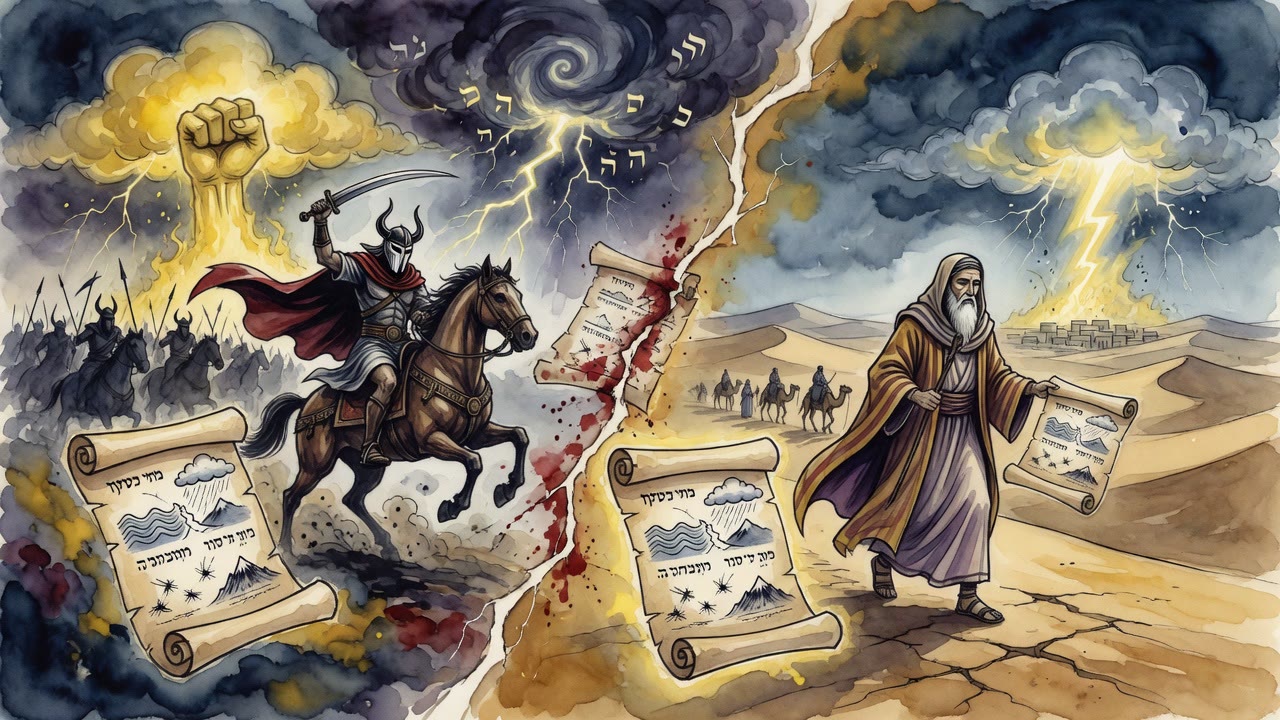
Jeremiah's line travels through the same midrashic bloodstream: cursed is the man who trusts in man, blessed is the man who trusts in the Lord. At the Reed Sea the people had faced the binary of schemes and prayer. At Rephidim the binary returned with spears attached.

Joshua could plan formations. He could not replace the hands on the hill with cleverness alone. The curse is not against skill. The curse is against treating skill as a god. When the hands above faltered, skill below bled. When the hands held, skill found room to work.

Close is the Lord to all who call, the psalm says in the same teaching. Calling did not look like a whispered meditation that day. It looked like a prophet's arms shaking while two men held them up, and like a younger commander refusing to let Amalek write the last line of the wilderness.

After the Verb

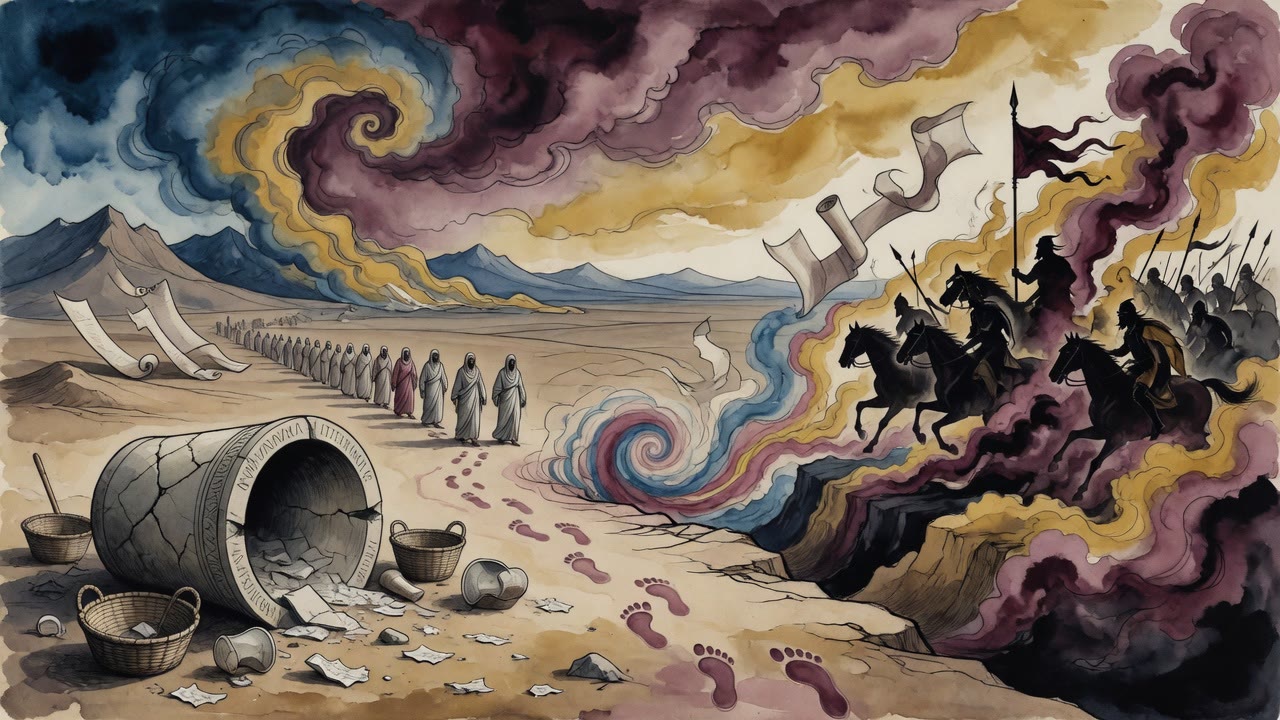
Night covered the field. Israel drank what water they could find and did not sing yet. Songs would come later, on other shores, with other grammars. This night was inventory of the living and the dead, and the long stare of people who had learned that survival can be a commandment.

Joshua cleaned the sword and felt no glamour. The word that would one day open his victory into king and kin and troops still slept inside a future teacher's mouth. On the ground, victory was only the absence of Amalek's next strike for a little while.

Moses came down the hill with arms that would hurt for days. He did not need notarikon to know what had been broken. He needed sleep, and a people still willing to walk, and a memory sharp enough to refuse amnesia about those who hunt the weary. Joshua walked the edge of the camp once more before he let his eyes close. In the dark the verb of the day still flexed, not as grammar, as muscle: break the structure that feeds on stragglers, or the structure returns at the next oasis with the same smile and the same teeth. A boy from the rear ranks, one of those Amalek had meant to cut down first, sat against a rock and watched the hill where Moses had stood, already rehearsing a story he would tell wrong, then closer to right, then wrong again, the way war stories do when breath is still short and water is still the louder god.


← All myths

From the tradition

Sources

3 sources

The texts behind this telling. Some cards carry a translation of the source; others are our own retelling of it, and each card says which. Every card links out to the original.

Mekhilta Tractate Amalek 1:37Mekhilta DeRabbi Yishmael

Retold in our words. Read the original at the link below.Mechilta, translated by Rabbi Shraga Silverstein · CC-BY

Rabbi Eliezer claimed that a single Hebrew word in the Torah contained an entire military history encoded as an acronym. The word is "vayachalosh," which appears in the account of Joshua's battle against Amalek at Rephidim (Exodus 17:13). Most translations render it simply as "he weakened" or "he defeated." But Rabbi Eliezer broke it apart letter by letter.

"Vayachalosh" means "and he broke." "Amalek" refers to the king himself. "Et Amalek" encompasses his wife and children. "Amo" means "his people," the warriors who fought alongside him. "Et amo" extends to the warriors who fought alongside his children. In Rabbi Eliezer's reading, this single verse is not just saying Joshua won a battle. It is cataloguing the total annihilation of an entire military structure: the king, his family, his soldiers, and the soldiers attached to his family.

This method of acronymic reading, called notarikon in rabbinic terminology, treated every word of the Torah as a compressed archive of meaning. The rabbis believed that God chose each word with infinite precision, and that human language in Scripture could contain layers of information far beyond its surface meaning. Rabbi Eliezer's decoding transforms a simple battle report into a detailed record of total victory. The war against Amalek was not a skirmish. It was the systematic dismantling of an enemy nation, and the Torah recorded every dimension of that destruction inside a single word.

Full source
Mekhilta Tractate Vayehi Beshalach 7:9Mekhilta DeRabbi Yishmael

Retold in our words. Read the original at the link below.Mechilta, translated by Rabbi Shraga Silverstein · CC-BY

Pappus expounded a verse from Job: "And He is one, and who can turn Him back? Whatever He desires, He does" (Job 23:13). His interpretation was straightforward, God is the sole judge of all who enter the world, and no one can contest His words. When God decides, the decision is final. There is no court of appeal, no higher authority, no possibility of reversal.

Rabbi Akiva cut him off: "Enough, Pappus!" The interruption was sharp, and Pappus pushed back: "And how do you understand the verse?" Rabbi Akiva's answer reframed the entire concept. The words of Him who brought the world into being are not to be contested, not because God is arbitrary, but because "all of them are in accordance with truth and justice."

The distinction is subtle but profound. Pappus described a God whose judgments cannot be challenged because He is all-powerful. Rabbi Akiva described a God whose judgments need not be challenged because they are always just. Pappus saw divine sovereignty as brute authority. Rabbi Akiva saw it as perfect justice. In Pappus's reading, questioning God is futile. In Rabbi Akiva's reading, questioning God is unnecessary, because once you truly understand God's actions, you discover they were right all along. The Mekhilta preserves this exchange to teach that Jewish theology does not ask believers to submit to arbitrary power. It asks them to trust in justice they may not yet fully comprehend.

Full source
Mekhilta Tractate Vayehi Beshalach 3:13Mekhilta DeRabbi Yishmael

Retold in our words. Read the original at the link below.Mechilta, translated by Rabbi Shraga Silverstein · CC-BY

The Mekhilta brings the prophet Jeremiah into its sustained argument about the power of prayer, citing one of the sharpest contrasts in all of Scripture: "Cursed is the man who trusts in man" (Jeremiah 17:5).

The statement is absolute. Any person who places ultimate reliance on human power, on armies, alliances, political maneuvering, personal strength, stands under a divine curse. Jeremiah was speaking to a generation that was tempted to trust in Egypt's military support against Babylon, and his message was unsparing: human power will fail you. It always does.

The very same chapter offers the opposite declaration: "Blessed is the man who trusts in the Lord, and the Lord will be his trust" (Jeremiah 17:7). The curse has a counterpart. Those who place their reliance on God, who turn to prayer instead of human schemes, receive blessing rather than curse.

The Mekhilta then asks: what happens when people actually pray? The answer comes from (Psalms 145:18): "Close is the Lord to all who call upon Him." God does not remain distant when His people pray. He draws near. The act of prayer collapses the distance between heaven and earth, between the Creator and the creature who calls out to Him.

This teaching was aimed directly at the Israelites standing at the Red Sea. They faced a choice: trust in human solutions, fight, flee, negotiate. Or trust in God through prayer. Jeremiah's stark binary left no middle ground. One path led to curse, the other to blessing. One ended in failure, the other in the presence of a God who comes close to those who call.

Full source