5 min read

At Sinai, God's Voice Split the World Open

At Sinai the mountain burned, angels crowded the sky, and God's voice struck Israel dead before raising them to hear again.

Curated by Arthur · Told by Maggid ·
Table of Contents
  1. The Camp Hears the Trumpet
  2. Angels Fill the Air
  3. The Voice Becomes Seventy Tongues
  4. The First Word Takes Their Souls
  5. Moses Stands Between Fire and Flesh

The mountain was fenced off before it caught fire.

For three days, no foot and no hoof could cross the line. Moses moved between camp and cloud with the warning in his mouth. Israel washed their garments and waited at the edge of the forbidden slope, close enough to see the mountain, far enough to live.

Parents held children back. Animals were kept from wandering. The boundary cut through ordinary life and made the ground itself dangerous. Sinai was not a hill for climbing anymore. It had become the place where heaven would lean down, and the earth below had to be taught restraint.

The Camp Hears the Trumpet

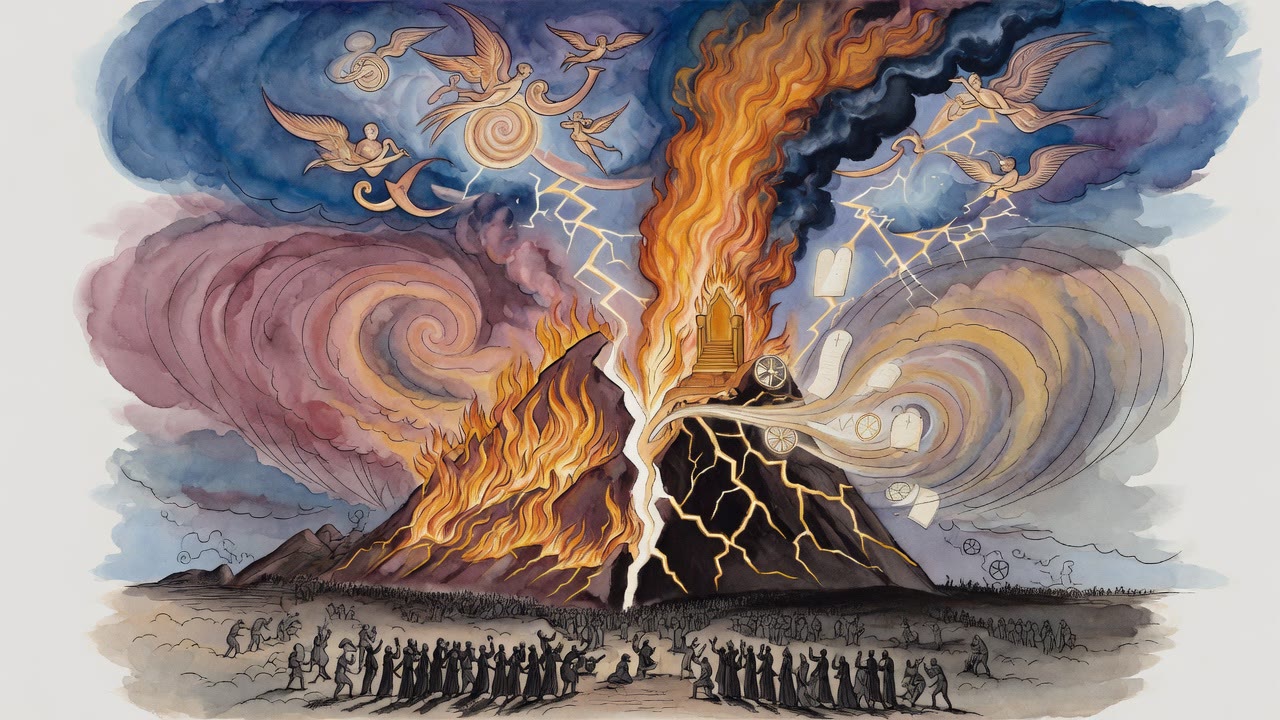
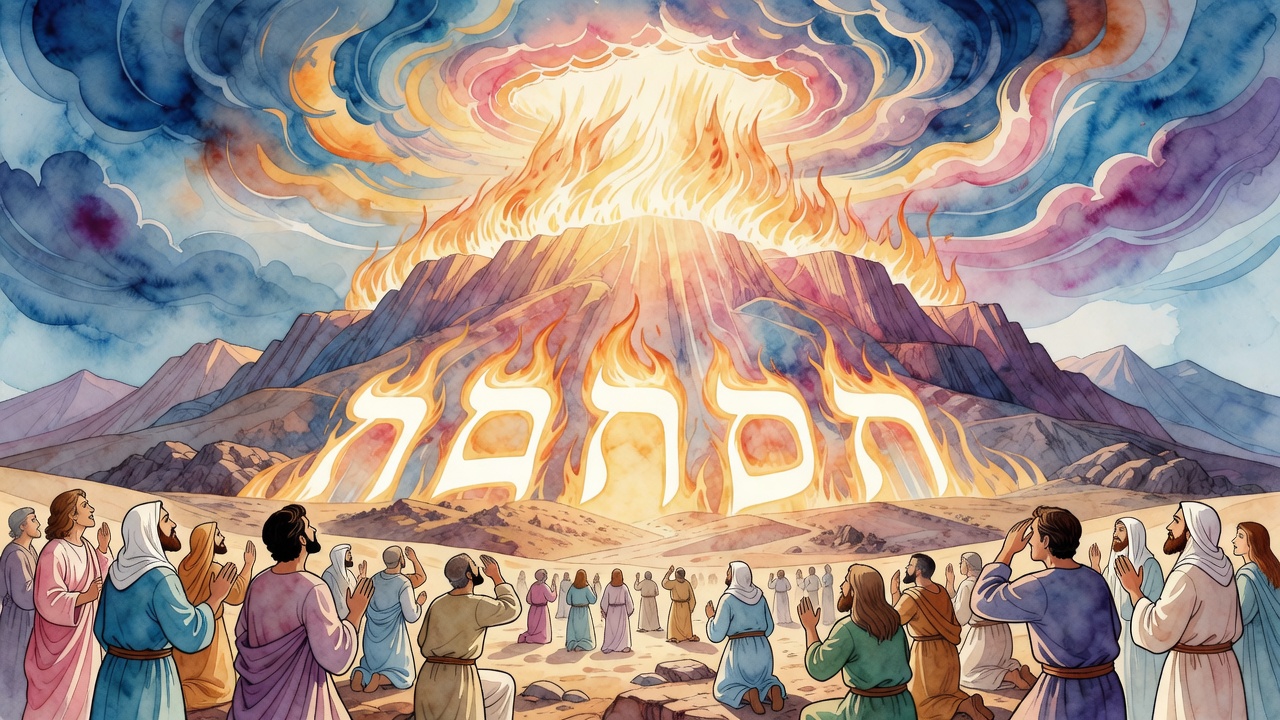
Morning broke under thunder. Lightning tore through the cloud. A shofar blast rolled over the camp, not fading but growing louder, as if the sound had found a stairway in the air and kept climbing it.

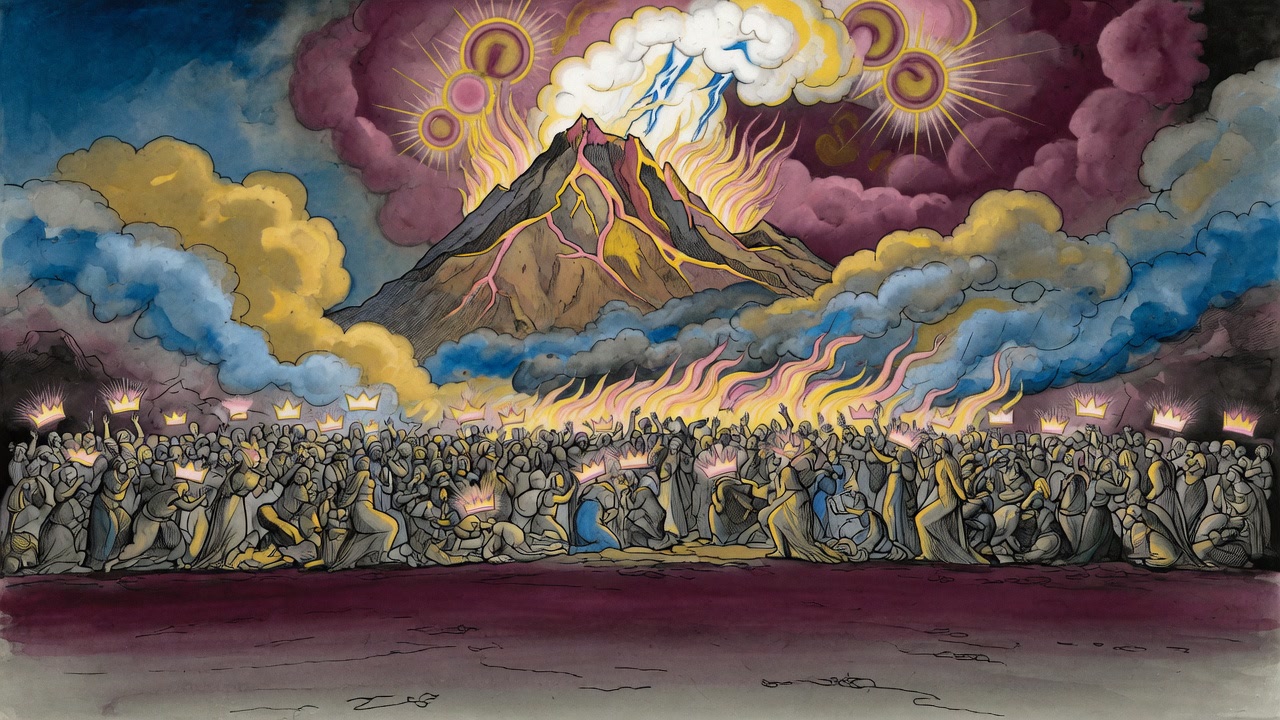
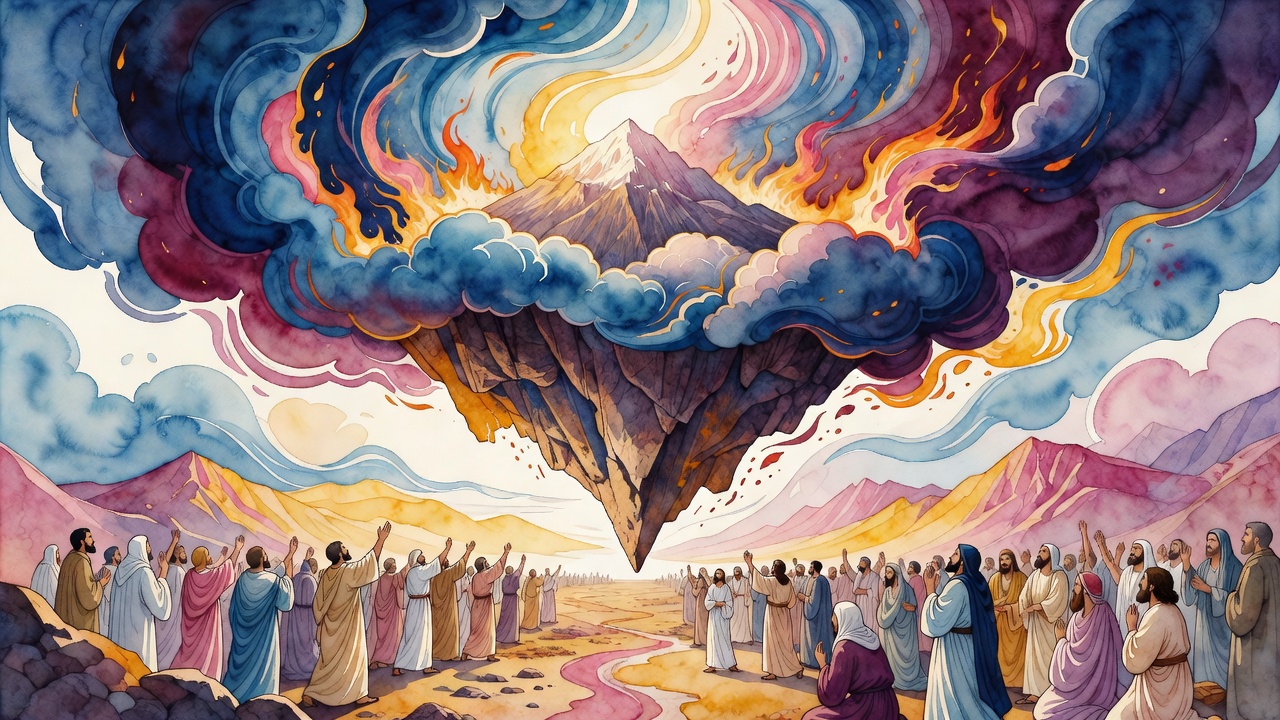
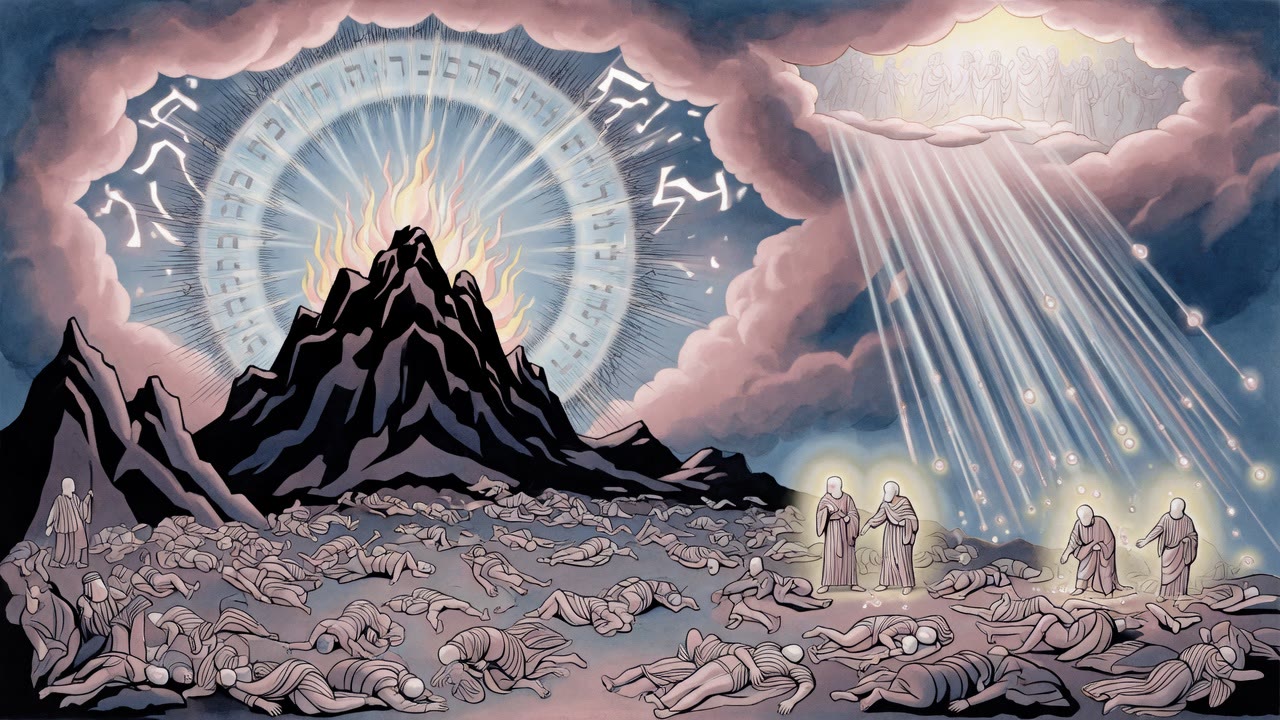
Then God descended in fire. Smoke climbed from the mountain like smoke from a furnace, thick and black, and the whole mountain shook. The people trembled where they stood. The border around Sinai was no longer a rule. It was mercy. Without it, flesh would have rushed toward flame and vanished.

Moses brought the people out to meet God, and the camp moved toward the sound. Each step made the warning sharper. The mountain did not become gentler as they approached. The trumpet grew louder. The smoke thickened. The ground answered the Voice before the people heard a single word.

Angels Fill the Air

The Holy One did not arrive alone. The sky filled with chariots, rank behind rank, until the mountain stood beneath a host too large for the eye to hold. Twenty-two thousand angels came down with Him, drawn from the myriads and thousands sung in the psalms.

They did not crowd the air like a mob. Heaven arrived as a camp. Every presence had its place. Every fire knew its boundary. Sinai became the meeting point of earth, flame, voice, and throne, with Moses standing between the living people below and the burning command above.

The people had left Egypt with the noise of pursuit behind them. At Sinai the sound was different. No chariot wheel threw mud. No taskmaster raised a whip. The terror came from holiness itself, ordered and bright, more dangerous than Pharaoh because it was not evil and could not be fled.

The Voice Becomes Seventy Tongues

The first Voice did not remain one sound. It split into seven, and the seven opened into seventy tongues. The speech that came from Sinai crossed the camp and kept going, outward to the nations, outward past every border that human beings use to feel safe from God.

Beyond Israel, souls failed when the Voice reached them. At the foot of the mountain, Israel was not abandoned to that death. The same Voice that could empty a body could also return life to it.

Each listener received the Voice according to strength. Elders heard as elders could bear it. Young men heard by their measure. Children heard without being crushed. The Voice did not shrink, but it bent toward the vessel before it. The same fire can cook bread or consume a house.

The First Word Takes Their Souls

Then the command came.

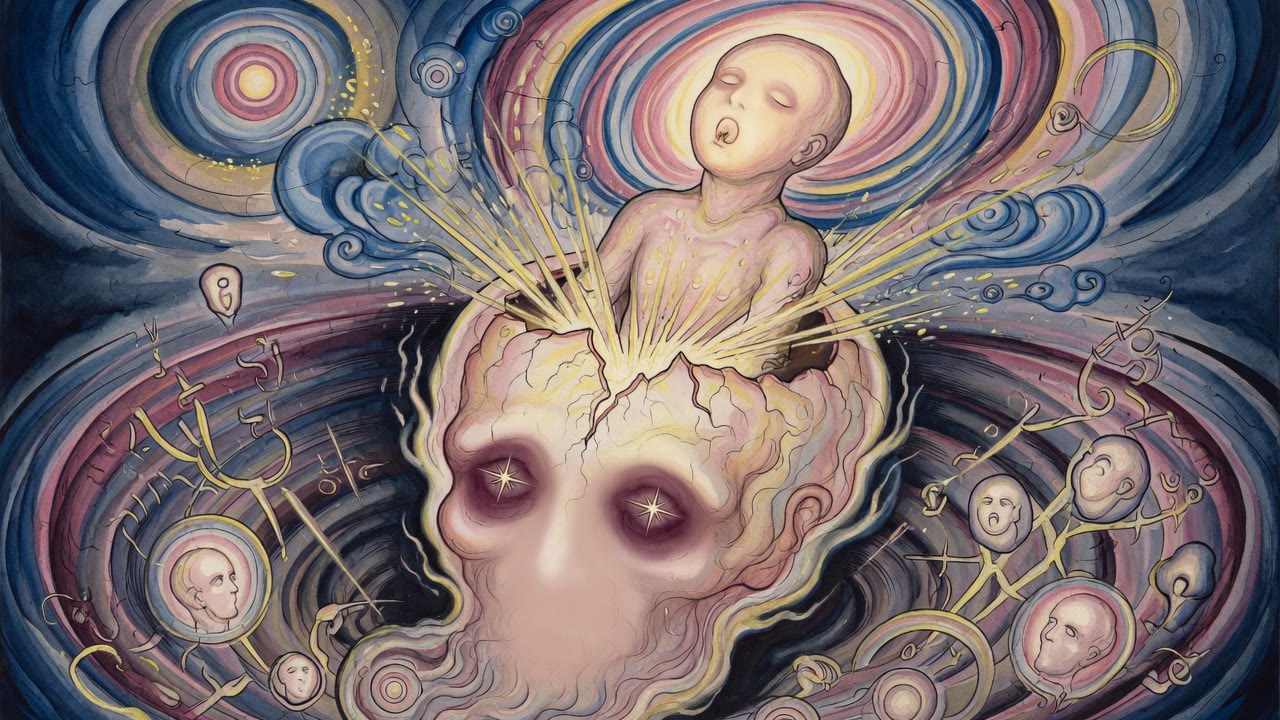
The people had asked to hear God, and the first word took their souls from them. Bodies stood at Sinai, but life fled. The camp that had trembled became a field of emptied vessels. The Voice had not been cruel. It had been too alive for ordinary bodies.

Some fled twelve mil from the mountain before their strength failed. Some had no distance left in them at all. Angels brought the people back toward the place they could not survive, because the covenant could not be received from far away.

They were brought back. Breath returned. Soul returned. The people rose again from the edge of death so the second command could reach them too. Revelation did not merely instruct them. It killed and revived them, as if Torah had to pass through death before it could live inside Israel.

Moses Stands Between Fire and Flesh

After the second word, the people could not pretend strength they did not have. They cried for Moses to stand between them and the Voice. Let him hear. Let him speak. Let divine fire pass through a human mouth before it entered human ears.

Moses did not make Sinai smaller. He made it survivable. The mountain still smoked. The angels still filled the heights. The Voice still belonged to God. But from that moment on, revelation came through a man who could climb into the cloud and return with words that bodies could carry.

The fence stayed at the mountain. The Voice entered the people.


← All myths
From the tradition

Sources

4 sources

The texts this telling draws on, in full. Open a card to read inline, or expand it for a wider, quieter read.

Shemot Rabbah 29:2Shemot Rabbah

The familiar picture has it as a solitary moment, maybe Moses standing on the mountain alone. But Jewish tradition paints a much grander, more awe-inspiring picture. Get ready for this…

Shemot Rabbah, a classic collection of Midrash (interpretive stories elaborating on the Bible), dives deep into that very moment. It all starts with the verse, "I am the Lord your God," and connects it to (Deuteronomy 5:4): "Face to face the Lord spoke with you." Now, how do we even begin to

Rabbi Avdimi of Haifa gives us a image. He suggests that when God spoke at Sinai, twenty-two thousand angels descended with Him! Where does he get that number? From (Psalms 68:18): "The chariots of God are myriads, thousands of angels [shinan]." Rabbi Avdimi reads this closely. "Myriads" in biblical usage means at least twenty thousand, and "thousands" indicates at least two thousand. Add them up, and you get a heavenly host of 22,000!

Wait a minute. Imagine that many angels all crowded together. Would it be chaotic? The verse anticipates this concern. It adds that these angels were shinan, which doesn't just mean "angels," but also "tranquil" [shaanan] and "serene." So, it wasn't a chaotic mob scene, but a harmonious, powerful presence.

The Midrash continues, quoting the same verse from Psalms: "My Lord is in their midst." But here's a fascinating detail: The text points out that the word for "Lord" isn't written with the usual yod that starts the Tetragrammaton (the four-letter name of God). Instead, it's spelled alef-dalet-nun-yod, which literally means "our master" or "lord." This, the Midrash emphasizes, emphasizes God's absolute mastery over the entire world.

Rabbi Levi offers another interpretation: each angel had a tablet over their heart inscribed with the ineffable name of God.

And the Rabbis add yet another layer: The name of God – El – was intermingled with the name of each angel. Think Mikhael and Gavriel. It's like God's essence was woven into the very fabric of their being.

So what’s the big takeaway from all this? The Midrash reveals the heart of the matter. God, blessed be He, tells Israel: "Don't think that because you saw many faces, perhaps there are many gods in the heavens. Know that I am the one Lord." It's a powerful reminder of monotheism, a firm declaration that despite the overwhelming display of divine power and the sheer number of angels, there is only one God.

Isn't it amazing how one verse – "I am the Lord your God" – can open up such a tradition of images and ideas? It makes you wonder what other hidden depths lie within the words we read every day. What other amazing stories are waiting to be discovered?

Full source
Pirkei DeRabbi Eliezer 41:13Pirkei DeRabbi Eliezer

Well, It wasn't exactly a gentle experience. In fact, it was so intense that, according to Pirkei DeRabbi Eliezer 41, the Israelites actually died – metaphorically, but also, perhaps, more literally than we usually imagine.

The voice of the second commandment – "You shall have no other gods before me" – boomed forth, and the people were "quickened." This wasn't just a wake-up call; it was a resurrection! They'd been so overwhelmed that they'd collapsed, only to be brought back to life. Standing on their feet, they cried out to Moses: "Moses, our teacher! We are unable to hear any more the voice of the Holy One, blessed be He, for we shall die even as we died (just now).."

"Speak thou with us," they pleaded, "but let not God speak with us, lest we die" (Exodus 20:19). They were begging for an intermediary, someone to filter the divine message into something they could handle. The raw, unfiltered voice of God was just too much.

Here’s where it gets even more fascinating. The Holy One, blessed be He, heard the voice of Israel, and it was pleasing to Him. God wasn't offended by their fear; God understood their limitations.

So, what did God do? According to Pirkei DeRabbi Eliezer, He sent for Michael and Gabriel, two of the most powerful angels. These weren't just messengers; they were divine escorts. And their mission? To bring Moses closer to God.

But here's the kicker: Moses didn't want to go! The text says they took hold of his two hands "against his will" and brought him near unto the thick darkness, as it is said, "And Moses drew near unto the thick darkness where God was" (Exodus 20:21).

Why the resistance? Was Moses afraid too? Perhaps he understood the gravity of what was about to happen, the immense responsibility of receiving the Torah on behalf of the entire nation. Maybe he knew that entering the "thick darkness" meant leaving behind a part of himself.

Whatever the reason, the image is striking: angels practically dragging Moses towards the divine presence. It highlights the almost unbearable intensity of the encounter, the sheer force required to bridge the gap between the human and the divine. It reminds us that even the greatest prophets sometimes need a little…divine encouragement.

This passage from Pirkei DeRabbi Eliezer isn't just a historical account; it's a powerful metaphor for our own spiritual journeys. How often do we shy away from the "thick darkness," the challenging, uncomfortable spaces where true growth happens? How often do we ask for an intermediary, a buffer, rather than facing the raw, unfiltered truth? And maybe, just maybe, sometimes we need a little push – even an angelic one – to take that leap of faith.

Full source
Shabbat 88bTalmud Bavli, Shabbat

And Rabbi Yehoshua ben Levi said: With each and every utterance that went forth from the mouth of the Holy One, blessed be He, the souls of Israel departed, as it is said (Song of Songs 5:6), "My soul went out when He spoke."

But since at the first utterance their souls departed, how did they receive the second utterance? He brought down the dew with which He is destined to revive the dead, and He revived them, as it is said (Psalms 68:10), "You poured down generous rain, O God; when Your inheritance was weary, You sustained it."

And Rabbi Yehoshua ben Levi said: With each and every utterance that went forth from the mouth of the Holy One, blessed be He, Israel retreated backward twelve mil, and the ministering angels would lead them back.

Full source
Midrash Tanchuma Buber, Shemot 22:4Midrash Tanchuma Buber, Shemot

"And all the people saw the voices" (Exodus 20:18). What is the meaning of "the voices"? Rather, the one voice was turned into seven voices, and from seven into seventy tongues. And why into seventy tongues? So that all the nations would hear. And when the voice went forth, every single nation heard the voice of the Holy One, blessed be He, and its soul departed; but Israel were not harmed. How? [The voice went forth. Rabbi Tanchuma said:] The voice went forth and slew the nations, [because they did not accept] the Torah, and gave life to Israel, [because they accepted] the Torah. This is what Moses said to them at the end of forty years: "For who is there of all flesh that has heard the voice of the living God speaking out of the midst of the fire, as we have, and lived?" (Deuteronomy 5:26). And it says: "Did ever a people hear the voice of God..." (Deuteronomy 4:33). You heard and lived, but the nations heard and died. Come and see how the voice went forth to Israel: each and every one heard according to his strength, the elders according to their strength, the young men according to their strength, the youths, the little ones, the sucklings, and the babes according to their strength, and even Moses according to his strength, as it is said: "Moses spoke, and God answered him by a voice" (Exodus 19:19). What is the meaning of "by a voice"? Rather, by a voice that Moses was able to bear. And so it says: "The voice of the Lord is in strength" (Psalms 29:4), by the strength of each and every one: the pregnant women according to their strength, and all according to their strength. Rabbi Yose son of Rabbi Chanina said: If you are astonished at this, learn from the manna.

Full source