The Roller Slipped and the Court Chose Exile
A stone roller slipped on a hillside, an ox gored in a street, and the court learned how to punish without stacking two deaths on one hand.
Table of Contents
The roller left his hands on the upper path and found a body on the lower one. He had been packing a roof. The stone cylinder was ordinary. Gravity did the rest. By the time he reached the man below, the chest was still.
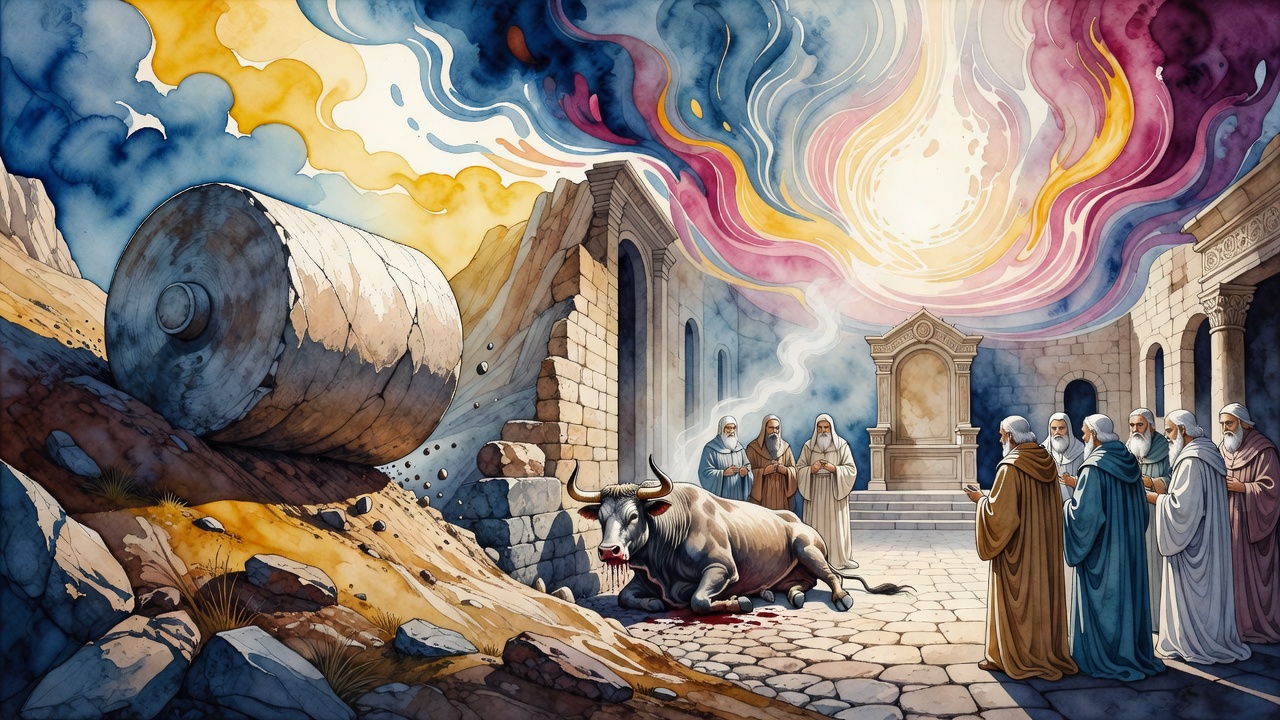 Click for full size
Three Ways a Lawful Day Turns Lethal
The Mekhilta lined up the accidents that send a killer into exile, not under a sword. A person rolls a heavy stone roller downhill and it slips. A person descends a ladder and the ladder collapses onto someone below. A person lowers a bucket into a well and the rope fails. In each case the work was lawful. There was no malice, no plan, no raised fist. Hands set something in motion. Downward force finished the story.
Exile to a city of refuge was the answer until the High Priest died. It was not ordinary punishment. It was quarantine with a door, a place where the blood-avenger could not reach, and a public admission that unintended death still tears a hole the community must name.
The Ox That Knew How to Kill
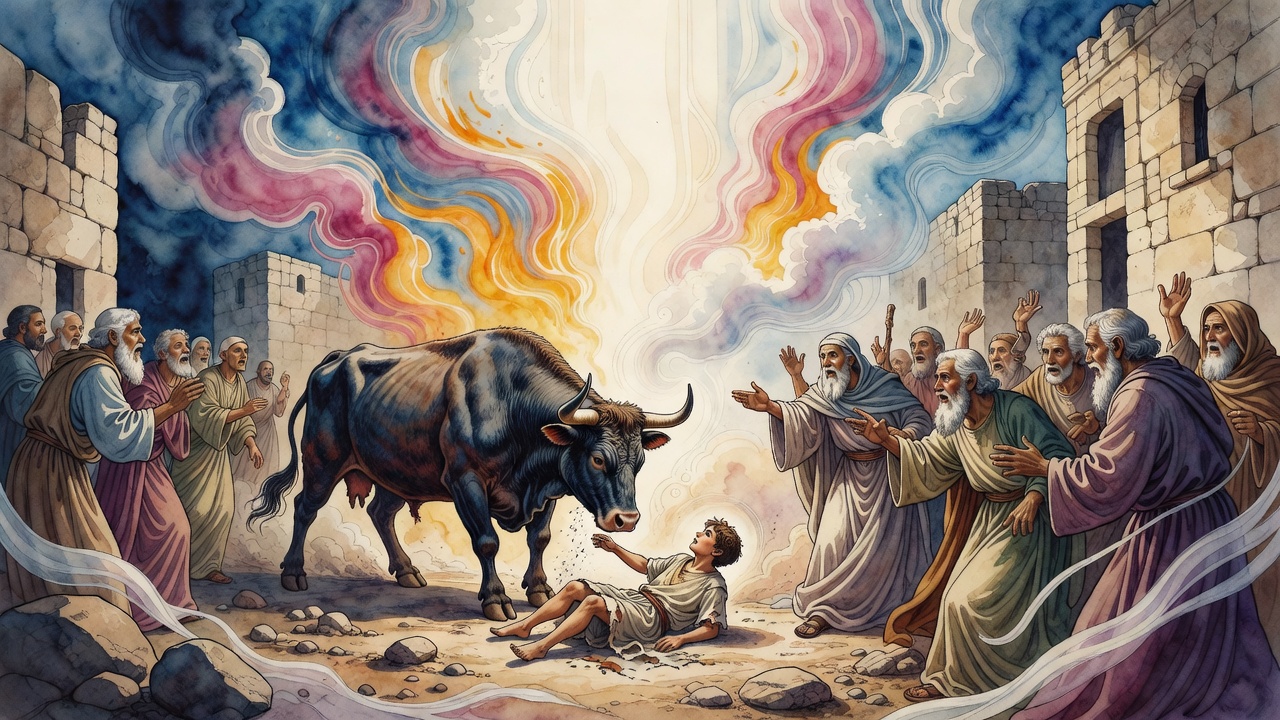
An ox gored a person in the street and the Torah ordered the animal stoned. The sages sorted the cases the law would catch. An ox forced to fight in an arena did not count the same way, because the violence had been staged by human hands for sport. A beast that killed on its own, in ordinary space, carried a different charge. The animal's body answered for the death. The owner's purse answered according to whether the ox was known to gore or not.
Blood on a horn is not the same as blood under a roller, yet both leave a corpse and a court that cannot pretend nothing happened. One track smells of intent in the animal's pattern. The other smells of a day that went wrong while a man did his work.
One Wickedness, Not Two
A single act can break more than one rule at once. The sages chewed the question of double payment and refused the stack. For one wickedness you make him liable, not for two. Where a crime carries a death sentence from the court, no money penalty rides on top of it. The graver verdict stands alone.
They tested the rule from every side, closing the loopholes reason might invent. Then a tender line surfaced in the case of a pregnant woman struck so that she miscarried. Damages and payment for her pain went to her. The value of the lost children went to her husband, or to his heirs. Rav Papa held that the payment to the husband stands even when the conception sat outside marriage, because the verse still ties the penalty to the husband. Exact. Not doubled. Not soft.
What the Hillside Court Decided
The man with the roller walked into exile with dust still on his palms. No one called him a murderer in the full sense. No one called the dead man lucky. The goring ox was stoned in another town the same season. A thief caught red-handed paid double; a thief who confessed early paid principal and a fifth on a different track, never both stacks for one deed. The pattern under all of it was the same. Name the death. Match the hand. Do not invent a second punishment to make the living feel cleaner.
On the road to the refuge city the hills looked ordinary again. That was the cruelty and the mercy of accident law. The world keeps its shape after the body falls. The court has to put a shape around the fall so the next hand on a roller remembers what the last hand cost.
His wife met him at the city gate with bread for the road to the refuge. She did not ask if he meant it. She had seen the hill. Intention was not the question the Torah asked first. The question was what a community does when lawful work kills.
In the study house they compared him to the owner of a goring ox. One man sent force downhill without hate. One man failed to guard a beast that had shown its pattern. Both stories end with a body and a procedure. The ox is stoned so the horn cannot teach other horns. The roller man is hidden so the avenger's grief cannot become a second murder. Different tools. Same refusal to shrug.
The rule against double liability kept the court from theatrical cruelty. Stack death and fine for one deed and you teach the public that vengeance has no ceiling. Split the pregnant woman's damages with care and you teach that each loss has a name and an address. Rav Papa's insistence that the husband's claim stands even in awkward conceptions is not coldness. It is the Torah's habit of assigning responsibility without waiting for a tidy family story.
Years later, people still pointed at the refuge city when they taught apprentices how to set a roller. Fear of exile is a teacher. So is the memory of an ox led out to be stoned while children watched and learned that animals who kill do not keep their place among the living herds.
← All myths