5 min read

She Scooped the Spilled Oil Into Her Hair and He Ran to Court

A man tore the covering off a woman's head in the market. When Akiva fined him, a friend explained how to make her uncover it herself.

Curated by Arthur · Told by Maggid ·
Table of Contents
  1. He Pulled the Cloth Off Her Head
  2. Rabbi Akiva Set the Fine
  3. A Friend With a Plan and a Jar of Oil
  4. The Jar Broke on Her Doorstep
  5. Voluntary and Forced Are Not the Same
She Scooped the Spilled Oil Into Her Hair and He Ran to Court Click for full size

He Pulled the Cloth Off Her Head

It took him half a second. She was walking through the market with a basket on her hip and he came past her and took hold of the cloth on her head and pulled, and it came away in his hand, and her hair was out in the open street in front of everybody who had been haggling over fish a moment earlier.

She got her hands up too late. That is the thing about it. There is no version of that moment where the hands get up in time.

People stopped. Somebody laughed. She stood in the middle of it with her hair down and her basket still on her hip, and the man who had done it walked on, because it had cost him nothing yet.

Rabbi Akiva Set the Fine

It cost him in front of the court.

Rabbi Akiva heard the case and fined him, and the fine was heavy. Not damages for a wound, because there was no wound. Damages for shame, which the court in the Land of Israel priced like any other loss, on the reasoning that what a man takes from a woman in a street full of witnesses is a real thing and has a real number.

The man paid and went out furious. In his own account of it he had touched a piece of cloth. He had not hit her. He had not taken anything of hers home. He told anyone who would listen that a court had put a price on a joke.

A Friend With a Plan and a Jar of Oil

Somebody who liked him had an idea.

"You are paying for her modesty," the friend said. "So prove she does not have any. Go to her door with a jar of good oil and break it on her step. She will come out. Watch what she does with her hair."

Olive oil was money. A full jar of it was a week of somebody's work standing in one clay container, and the man went and bought one and carried it across town, which means he thought about this the whole way there.

The Jar Broke on Her Doorstep

He smashed it on the threshold and stepped back.

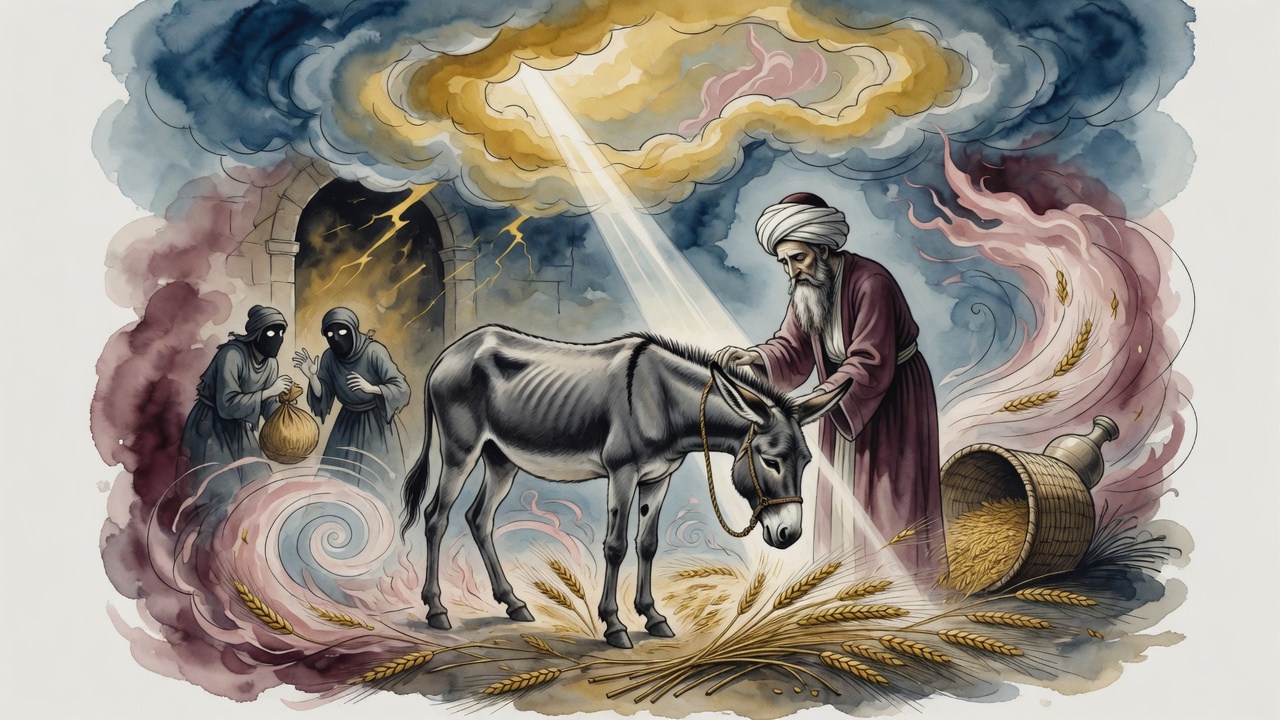
She heard it from inside and came out and found a week's wages running off the stone and going into the dirt, spreading, thinning, already picking up grit at the edges. She went down on her knees with her hands out.

There was nothing to catch it in. She scooped what she could off the stone with her palms, and there was nowhere to put it, so she wiped her hands into her hair, and then went back down for more, and did it again. The covering came off her head somewhere in there. She was not thinking about the covering. She was thinking about the spilled oil.

By the time she had got most of it up her hair was black with grit and heavy with oil and hanging loose down her back, and her hands were slick to the wrist, and she was still on her knees on her own step.

He was standing in the street watching her do it, and he had witnesses with him, because he had brought them. He had wanted her to be seen and he had paid a week's wages to arrange it, and that was the second time he had bought the same thing.

Voluntary and Forced Are Not the Same

He ran to the court almost happy.

"She uncovers herself in her own doorway in front of the neighbors," he said. "For oil. Why am I paying for something she does to herself for the price of a jar?"

Akiva did not take long.

He had watched his own wife Rachel cut off her hair and sell it, in the years when the two of them slept on straw, so that he could stay in the study house and learn to read. He knew precisely what a woman doing something with her own hair looked like, and he knew what it was worth, and he knew it was hers to spend.

"Voluntary and forced are not the same," he said.

She had chosen to lose her covering to save her oil. That choice belonged to her. The man had taken hers in the street to get a laugh, and no clever second staging of the same event could reach back and turn the first one into her idea.

The fine stood. He paid it a second time.


← All myths

From the tradition

Sources

3 sources

The texts behind this telling. Some cards carry a translation of the source; others are our own retelling of it, and each card says which. Every card links out to the original.

Exempla of the Rabbis, No. 98Exempla of the Rabbis (Gaster, 1924)

Retold in our words. Read the original at the link below.The Exempla of the Rabbis, Moses Gaster (1924) · Public Domain

Rabbi Akiva sat in judgment over a case that would become one of the most famous legal rulings in all of rabbinic literature. A man had publicly humiliated a woman by tearing the covering from her hair, exposing her in the street. In Jewish law, a woman's hair was a matter of modesty and dignity, and to dishevel it publicly was a grievous offense.

Rabbi Akiva condemned the man to pay a substantial fine. The man, outraged at the penalty, sought advice from a cunning friend who devised a scheme. "I will show you how to prove that this woman cares nothing for her own modesty," the friend said. "Then the court will have to reduce the fine."

The man went to the woman's house and deliberately smashed a jar of expensive olive oil on her doorstep. The oil pooled and spread across the threshold. When the woman heard the crash and came outside, she saw the valuable oil running into the dirt. Without thinking, she scooped it up with her hands and wiped it into her hair to save it from being wasted, exposing her hair voluntarily in the process.

"You see?" the man cried triumphantly before the court. "She uncovers her own hair in public! She clearly does not value her modesty. Why should I pay a fine for something she does freely?"

Rabbi Akiva was unmoved. His ruling was immediate and devastating: "What a person does voluntarily and what is done to them by force are entirely different things. She chose to uncover her hair to save her property. You tore it off against her will to shame her. The fine stands." The distinction between choice and coercion became a foundational principle of Jewish law.

Full source
Yalkut Shimoni on Torah 321:1Yalkut Shimoni on Torah

Translation of the source text.Torat Emet (Yalkut Shimoni) · CC-BY-NC

"If he takes another wife" (Exodus 21:10): from here they said, a man is obligated to marry off his young son. And elsewhere what does it say? "And you shall make them known to your children and your children's children" (Deuteronomy 4:9). When are you privileged to see your children's children? When you marry off your children while they are young. "Her food" (she'erah): these are her provisions of food, as it is said "who eat the flesh (she'er) of my people" (Micah 3:3), and it is written "He rained flesh (she'er) upon them like dust." "Her clothing," according to its plain meaning. "Her conjugal right" (onatah): this is the way of the world [marital relations], as it is said "and he lay with her and afflicted (vaye'aneha) her" (Genesis 34:2), the words of Rabbi Yoshiyah. Rabbi Yonatan says: "her food, her clothing" means clothing suited to her flesh: if she was young he shall not give her clothing fit for an old woman, and if she was old he shall not give her clothing fit for a young woman. "And her conjugal right" means he shall not give her clothing of the summer in the rainy season, nor of the rainy season in the summer, but he gives her each in its proper season. From where do we learn her provisions of food? You say it follows by an argument from minor to major: if things that do not sustain life he may not withhold from her, then things that do sustain life, by reason he may not withhold from her. From where do we learn the way of the world? You say it follows from minor to major: if things upon which she was not married at the outset he may not withhold from her, then things upon which she was married at the outset, by reason he may not withhold from her. Rabbi says: "her food" (she'erah), this is the way of the world, as it is said "any man to any of his near kin (she'er besaro)" and it is written "she is the kin (she'er) of your father, she is the kin of your mother" (Leviticus 18:12-13). "Her clothing," according to its plain meaning. "Her conjugal right," these are her provisions of food, as it is said "and He afflicted you (vaye'ankha) and let you hunger" (Deuteronomy 8:3). Rav Yosef taught: "her food" (she'erah), this is closeness of flesh, that he shall not conduct himself with her in the manner of the Persians, who perform their marital relations in their garments. As Rav Huna said: anyone who says "I want it only this way, I in my garment and she in hers," let him divorce her and give the marriage settlement. "He shall not diminish": Rabbi Yoshiyah says, why is this stated? Because it says "if he takes another wife," I might understand Scripture speaks of a daughter of Israel; Scripture says "he shall not diminish" from whom does one diminish? From one to whom they have already given. Rabbi Yonatan says: Scripture speaks of a daughter of Israel. Or is it only about the Hebrew maidservant? When it says "according to the law of daughters he shall do for her," behold the Hebrew maidservant is mentioned; what then does "if he takes another wife" teach? Scripture speaks of a daughter of Israel.

Full source
Exempla of the Rabbis, No. 44Exempla of the Rabbis (Gaster, 1924)

Retold in our words. Read the original at the link below.The Exempla of the Rabbis, Moses Gaster (1924) · Public Domain

Rabbi Judah HaNasi and his household were known for their dignified appearance, but the principle of "shining through cleanliness" extended throughout the rabbinic world. The Talmud (Nedarim 49b) records that even scholars who lived in grinding poverty maintained their garments and persons with meticulous care.

Rabbi Akiba's wife Rachel is one example. When she married him, he was an illiterate shepherd, and they were so poor that they slept on straw. But she never allowed their poverty to become an excuse for carelessness. She encouraged him to study, sold her hair to pay for his education, and maintained their small household with a dignity that belied their circumstances.

The sages derived from such examples a striking teaching: the body is on loan from God. Just as a person entrusted with a king's garment would wash it, fold it, and keep it in perfect condition, so must every person care for the body God has given them. Hillel the Elder, when he went to the bathhouse, called it a mitzvah, a religious obligation. "If the statues of kings in theaters and circuses are washed and scrubbed by those appointed to maintain them," Hillel reasoned, "how much more should I, who am created in the divine image, take care of my body?"

Cleanliness, in the rabbinic mind, was the first step toward holiness. Not because dirt was sinful, but because caring for what God has given you is a form of gratitude. And gratitude is the foundation of all worship.

Full source