5 min read

Parasangs of Glory Rose Above the Throne

The throne's measures drown the mind in myriads of parasangs. Then a quieter voice says Israel's raw sigh is sweet and already heard.

Curated by Arthur · Told by Maggid ·
Table of Contents
  1. Above the Throne, Distance Breaks
  2. Metatron's Limit
  3. The Sigh That Is Sweet
  4. Between Measure and Breath
  5. Why the Numbers Will Not Settle
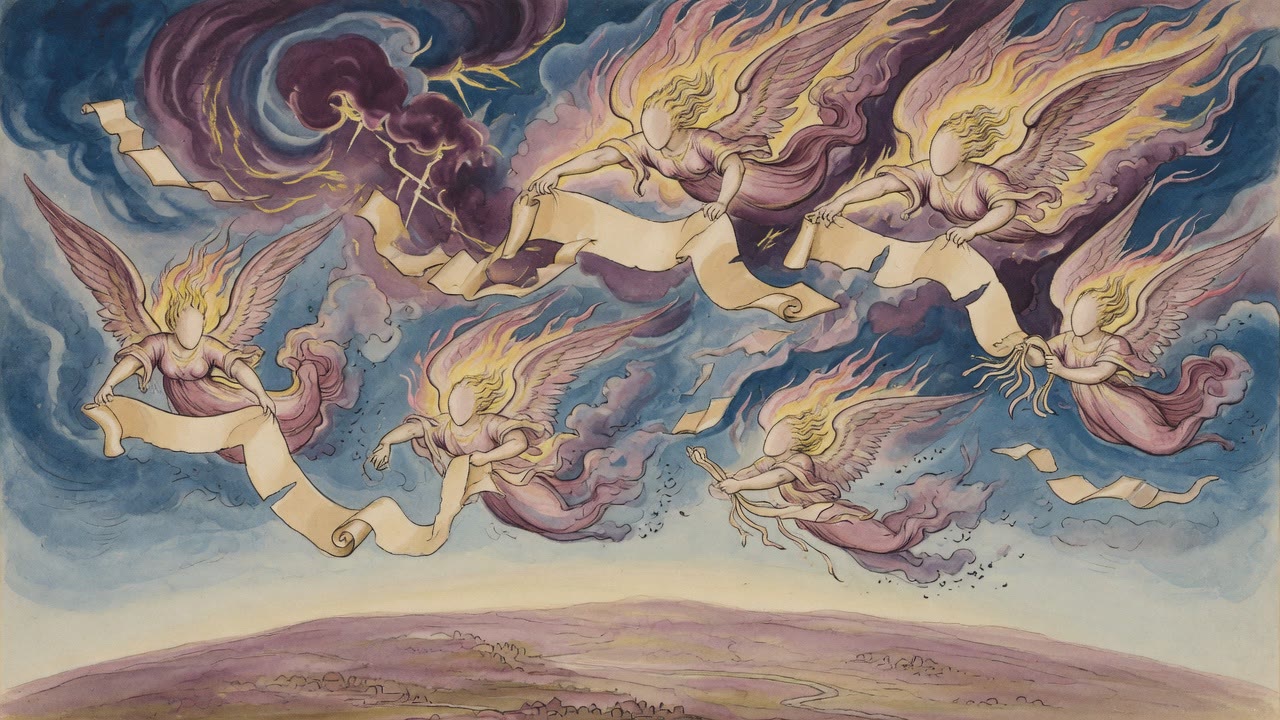
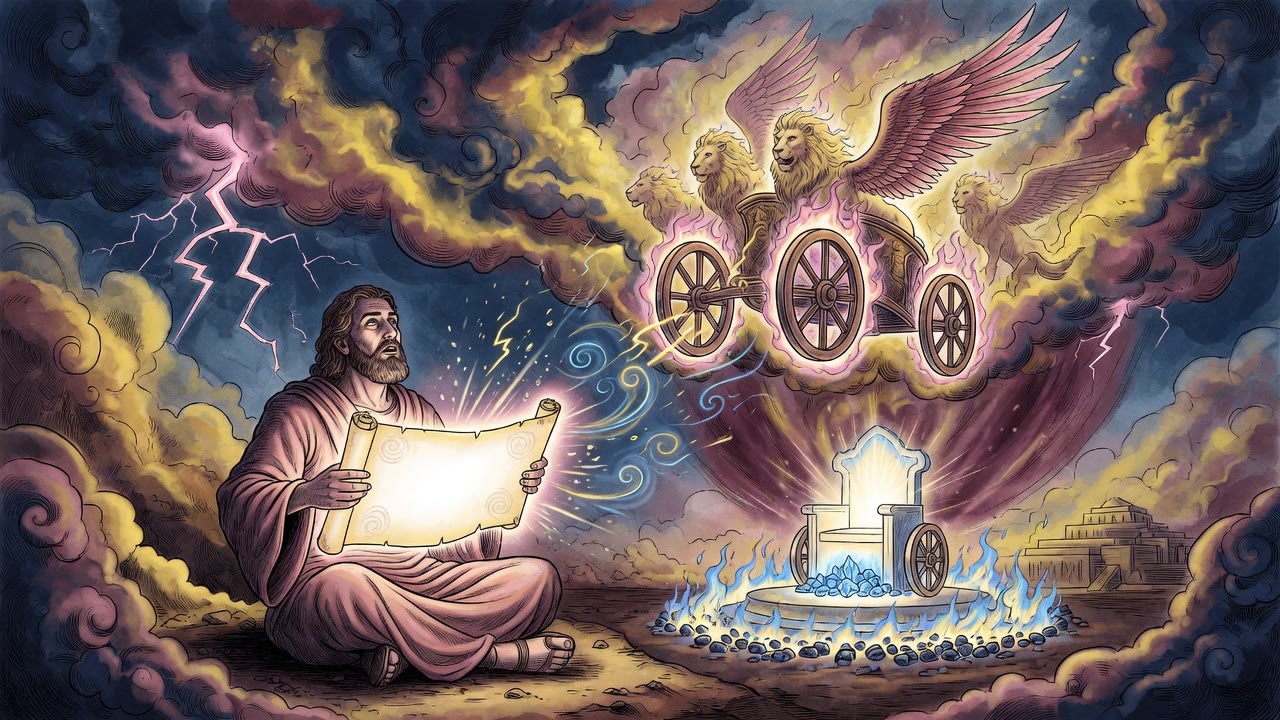
Parasangs of Glory Rose Above the Throne Click for full size

Above the Throne, Distance Breaks

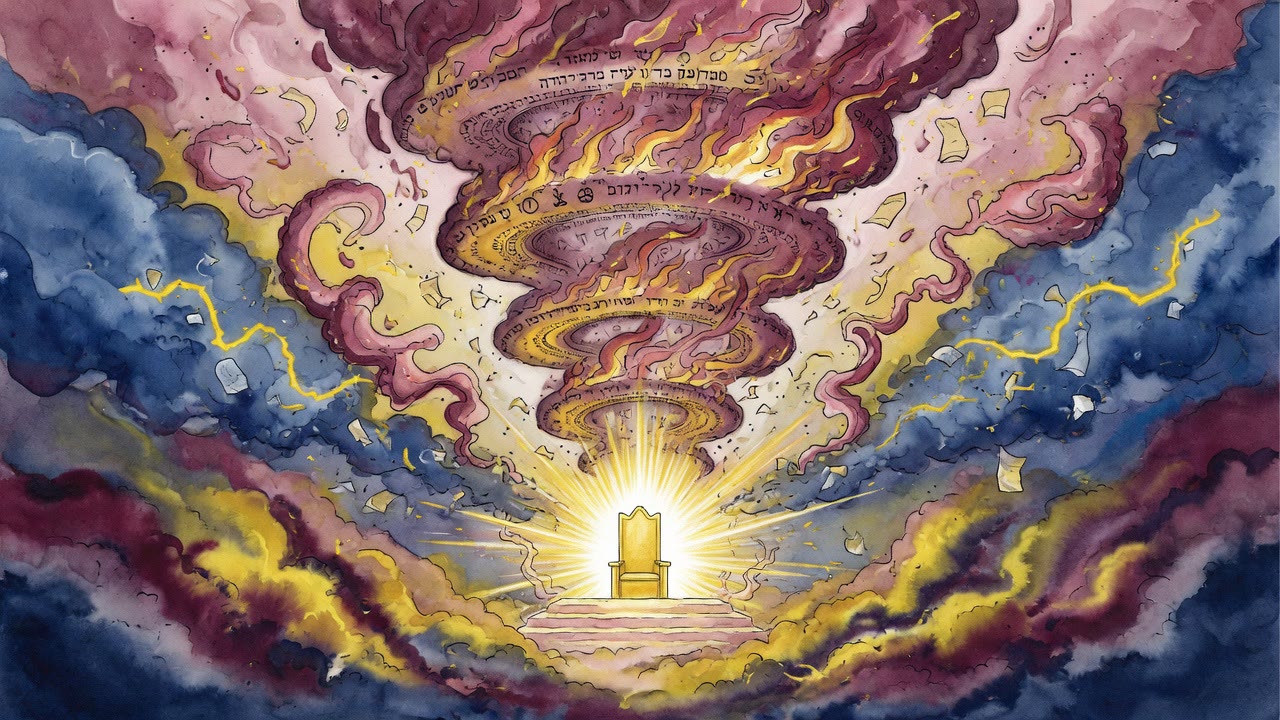
The visionary who entered the palaces did not find a face he could sketch. He found measure stacked on measure until numbers stopped meaning size and began meaning refusal.

From the throne of glory upward: parasangs beyond counting. Downward, the same abyss of distance. His stature, the text insists, is two hundred and thirty-six thousands of myriads of parasangs. The eye-span alone runs thirty myriads. Each eye three myriads and three thousand wide. From right arm to left, seventy-seven myriads. Arms folded on the shoulders: the right called the Mover, the left the Follower. Each palm four thousands of myriads: the right named Just, the left Holy.

A parasang is miles enough that a caravan feels small. Multiply until the mind white-screens. That is the point. The body of glory is not a body. It is a wall against small gods.

Metatron's Limit

Metatron, scribe of the heights, speaks a line that sounds like both report and surrender. "Thus far have I beheld the height of Jedidiah, the Master of the world. Peace." Even the angel who walks nearest the records cannot finish the survey. The map ends in a greeting.

The same pages lean toward the Song of Songs: what is your beloved more than another, white and ruddy, fairest among women. Earthly love-language becomes a thin echo of what cannot be paced out in parasangs.

The Sigh That Is Sweet

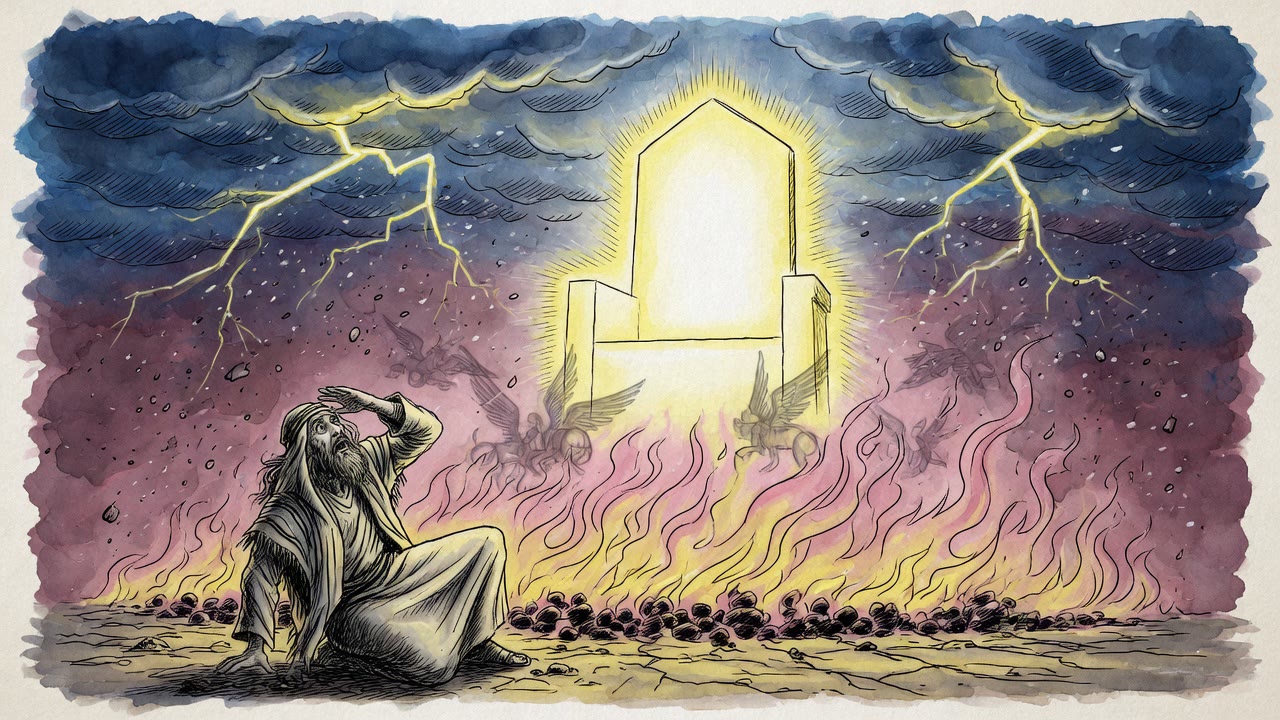
Against that immensity, another voice from the same palace literature falls almost quiet. "For the sigh of Israel is sweet to Me," it says. Not only the crafted liturgy. The raw breath. "And the desire for the Law hath covered Me." Yearning for Torah is not noise in the courts. It is a covering.

"Your words have found grace in My ears, and I accept the sayings of your mouths." Labor in the house of My choice will not let the Law move from your mouths. "I am master of wonders, the transcendent Lord, I am He."

Then the claim that startles: mighty works pass before Me, miracles before My throne. Who has come before Me and I have not fulfilled his prayer? Who has called and I have not answered straightway? State your requests. Multiply upon Me the desire of your hearts.

Between Measure and Breath

The palaces hold two pressures at once. God as immeasurable stature that even Metatron cannot finish measuring. God as the One who finds a human sigh sweet enough to answer. The visionary who came for thrills of height is sent home with a smaller, harder task: open the mouth. Let the desire for the Law cover the distance the numbers cannot cross.

Israel does not need to span myriads of parasangs. Israel needs to keep sighing toward the throne that already leans down.

Why the Numbers Will Not Settle

A student of the palaces who tries to convert parasangs into modern miles will only invent a new idol: a God small enough to graph. The text piles myriads until the hand writing them shakes. Right eye to left eye. Palm named Just. Palm named Holy. Arms that move and follow. The inventory is a liturgy of failure, and the failure is the theology.

Metatron's "thus far" is permission to stop measuring without stopping reverence. Peace ends the survey. Song of Songs is invited in not to shrink the throne but to admit that human love-speech is the closest vocabulary left when arithmetic collapses.

Then the sigh. A people under empire, under decree, under ordinary hunger, exhales, and the same literature that drowned the mind in distance calls that breath sweet. Desire for the Law covers the Holy One like a garment. Requests are not nuisances in the outer court. They are invited to multiply.

The visionary returns with a paradox he can live. God is larger than the map. God is near enough to answer a sigh before the sentence finishes. Study and synagogue become the house of choice where the Law will not move from the mouth, not because mouths are strong, but because the Master of wonders claims them.

Those who recite the measures without trembling turn mystery into furniture. Those who refuse the measures because they cannot be graphed miss the intentional overload. The palaces teach awe by exhaustion. Then they teach nearness by a sigh. Between those lessons sits every Jew who has ever prayed with no strength left for eloquence and discovered that eloquence was never the toll.

Jedidiah, Master of the world, remains taller than Metatron's report. Israel remains audible. The Torah remains a desire that can cover even the One who cannot be covered. That is the double inheritance of the ascent texts: do not shrink God, and do not stop speaking to Him.

The ascent ends not with a diagram but with a posture: mouth open, Law desired, sigh allowed to rise without apology toward a throne no survey can finish.


← All myths

From the tradition

Sources

2 sources

The texts behind this telling. Some cards carry a translation of the source; others are our own retelling of it, and each card says which. Every card links out to the original.

Heikhalot Rabbati 12:1Heikhalot Rabbati

Retold in our words. Read the original at the link below.Sefaria-hosted English translation · CC-BY

One such text is Heikhalot (the heavenly palaces) Rabbati, a work of Jewish mystical literature that takes us on a journey through the heavenly realms. And in it, we find a truly awe-inspiring vision of the Divine.

Prepare yourself, because the numbers are.. well, astronomical. The text attempts to describe the immense stature of God, or at least, the aspect of God that can be perceived in these heavenly realms. From the throne of glory upwards, Now, a parasang is an ancient unit of distance, roughly equivalent to 3-4 miles. Do the math, and you're already lost in a sea of zeros. And it's the same distance downwards from the throne!

It doesn't stop there. The text continues, "His stature is two hundred and thirty and six thousands of myriads of parasangs." Just trying to wrap your head around that number is an exercise in futility. It's meant to be. It's meant to convey the utter incomprehensibility of the Divine.

The details! "From the ball of the right eye to the ball of the left eye there be thirty myriads of parasangs." Thirty myriads! The width of each eye is three myriads and three thousand parasangs. From right arm to left arm? Seventy-seven myriads of parasangs. We're told His arms are folded upon His shoulders. His right arm is called "The Mover," and His left arm is called "The Follower." (The text isn't entirely clear on the translation here.) And each palm? Four thousands of myriads of parasangs. The right palm is named "Just," and the left, "Holy."

It's all so... vast. So beyond human comprehension. Why these impossible measurements? It's not meant to be taken literally, of course. These descriptions are symbolic, attempts to express the immensity and power of God in terms that, however inadequate, can still inspire awe.

The text concludes with a statement attributed to Metatron, the angelic scribe, who says, "Thus far have I beheld the height of Jedidiah, the Master of the world. Peace." This suggests that even the highest angels have limits to their perception of the Divine.

And then, almost as an aside, the text links these revelations to verses from the Song of Songs, the passionate love poem in the Hebrew Bible. "What is thy beloved more than another beloved, O thou fairest among women?" and "My love is white and ruddy," and so on. What's the connection? The idea is that even in the most intimate human love, we can find echoes, reflections of the Divine. These earthly expressions are but pale reflections of the overwhelming love and beauty embodied in God.

So, what do we make of all this? We can't truly know what God looks like. But through these mystical texts, we get a sense of the sheer, unbounded nature of the Divine. A reminder that there's always more to discover, more to experience, more to love. And maybe, just maybe, that's the point.

Full source
Heikhalot Rabbati 29:3Heikhalot Rabbati

Retold in our words. Read the original at the link below.Sefaria-hosted English translation · CC-BY

Heikhalot Rabbati turns to God Says the Sigh of Israel Is Sweet to Me.

"For the sigh of Israel is sweet to Me," the voice declares. Not just the carefully worded prayers, but the raw, unfiltered emotion, the very breath of longing is precious. And it continues, "and the desire for the Law hath covered Me." The Torah, the Law, is more than just rules and regulations; it's a deep yearning for connection, and that yearning, God says, envelops Him.

"Your words have found grace in My ears, and I accept the sayings of your mouths." It's a stunning affirmation. It's like a loving parent leaning in, truly listening to their child, cherishing every word. And this isn't just passive listening. It's active acceptance. "Ye have labored in the house of My choice, and the Law shall not move from your mouths, for I am master of wonders, the transcendent Lord, I am He."

This "house of My choice" is interpreted as the study of Torah, or the Synagogue. It is through this dedication and devotion to the divine that God is revealed.

Then comes the really part: "Mighty works come to pass before Me, miracles and marvels before My throne. Who hath come before Me and I have not fulfilled his [prayer]? Who hath called upon Me and I have not straightway answered him?" This is a powerful claim! It suggests an immediate, almost automatic response to sincere prayer. A direct line to the Divine.

Now, does this mean every single request is instantly granted? Of course not. Life is complex, and divine will operates on a scale we can barely grasp. But it speaks to the accessibility of God, the unwavering presence and attention.

The passage ends with an invitation: "State before Me all your requests, and multiply upon Me the desire of your hearts." It's an open door, a challenge even. Don't hold back. Pour out your hopes, your dreams, your needs. Let your heart's desires be known.

This excerpt from Heikhalot Rabbati isn't just ancient text; it's a reminder of the intimate relationship possible between us and the Divine. It's a call to prayer, not as a rote obligation, but as a heartfelt conversation. And it suggests that even in our moments of deepest despair, when all we can manage is a sigh, we are heard. We are cherished. We are loved.

Remember the promise that your sighs are sweet, your desires are heard, and the Divine is always, always listening. What more could we ask for?

Full source