6 min read

The Horn Beyond the Firmament and the Prayer That Met No Keeper

Nehunya sent a prayer past every keeper to the beings who carry the Throne of Glory, and a horn answered from beyond the last firmament.

Curated by Arthur · Told by Maggid ·
Table of Contents
  1. The Circle That Stopped Sending Prayers Up by Hand
  2. Nehunya Aimed His Words at the Ones Who Carry the Throne
  3. A Horn Sounded From Beyond the Last Firmament
  4. What Was Nothing in a Schoolroom Filled the Highest Palace
  5. Ishmael Left a Line Empty on the Tablet
The Horn Beyond the Firmament and the Prayer That Met No Keeper Click for full size

The Circle That Stopped Sending Prayers Up by Hand

The fellowship met an hour before dawn and began by counting losses. A man said his words into the dark, and the words went to a keeper at the first palace, who handed them to the second, and so on through seven inspections, until whatever reached the top had passed through too many hands to belong to anyone.

Rabbi Ishmael kept the tablet. Two years of entries, and a column down the right side for the ones that never came back and never arrived.

"They are not being refused," he said. "They are being handled."

Nehunya ben Hakkanah sat on the marble bench and let the room argue itself out. When it stopped he said the thing none of them had put into a sentence.

"A prayer does not have to walk that road. It can be addressed."

"Addressed to whom," Ishmael said.

"To the ones who carry the Throne. Not to the gatekeepers. Over their heads, straight to the hands that hold up the seat of glory."

An older man got up, crossed to the door, and stood with his palm flat against the frame. He did not go out and he did not come back to the bench.

Nehunya Aimed His Words at the Ones Who Carry the Throne

They wanted to know what such a prayer would even ask for. Rain. A verdict overturned. A sick child kept another winter.

Nehunya wanted none of those. What he intended to ask for was noise.

"Let there be more singing in front of Him today than there was yesterday," he said. "More music. Let the ones who bear the Throne lift the jubilation until His heart is glad, because a glad heart does not sit behind seven doors. It leans toward the men who go down to the chariot."

Ishmael set the stylus flat on the tablet. What Nehunya had laid out was not a petition. It was a plan to change the weather in the highest palace and walk in under it.

He said it kneeling at the third hour before sunrise, head pushed between his knees, addressed to Totrosiai, the Lord God of Israel, the name descenders use for the One on the seat and not the powers stationed in front of Him.

Then Nehunya stopped. His mouth stayed open around a word that never finished. Nobody in the room touched him.

A Horn Sounded From Beyond the Last Firmament

What he had sent went up and met no keeper at all.

The horn came after it. One blast from somewhere past the last firmament, not loud the way thunder is loud but placed, the way a signal is placed by someone who has waited a long time to give it. Every hall below heard where it came from and understood that the inspections were suspended.

Nehunya began to speak again, describing now rather than praying, and Ishmael wrote.

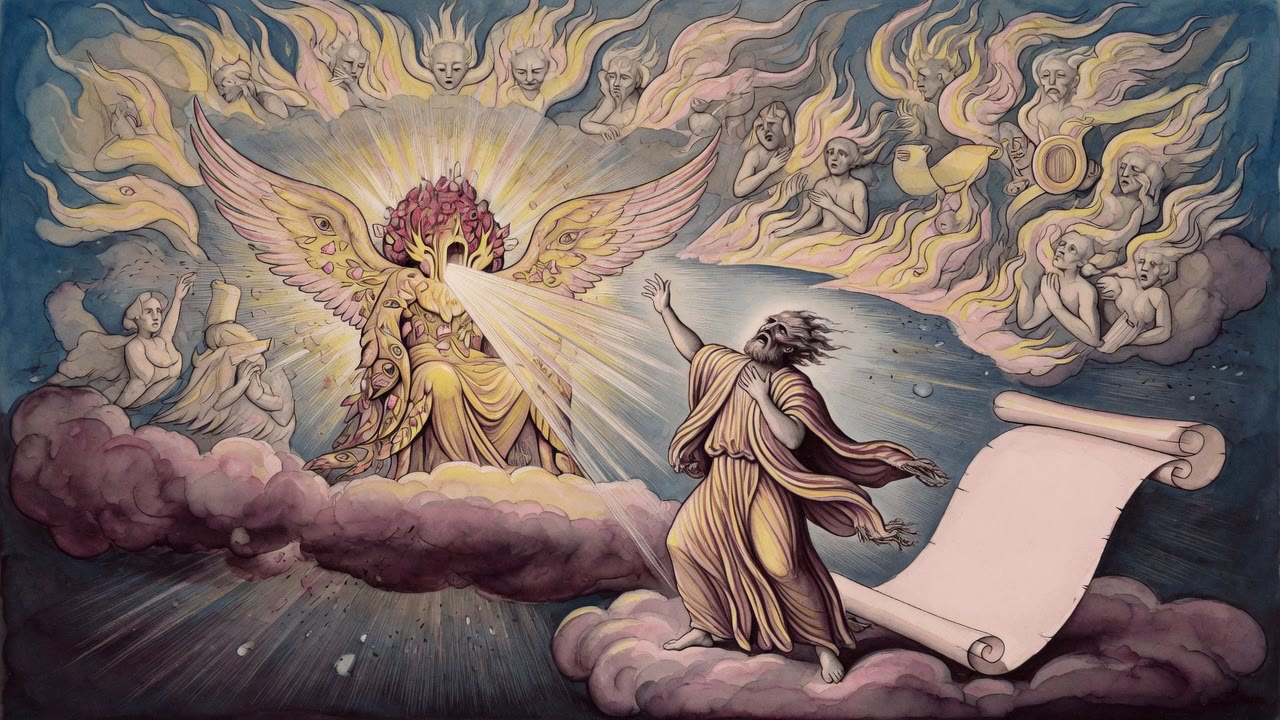
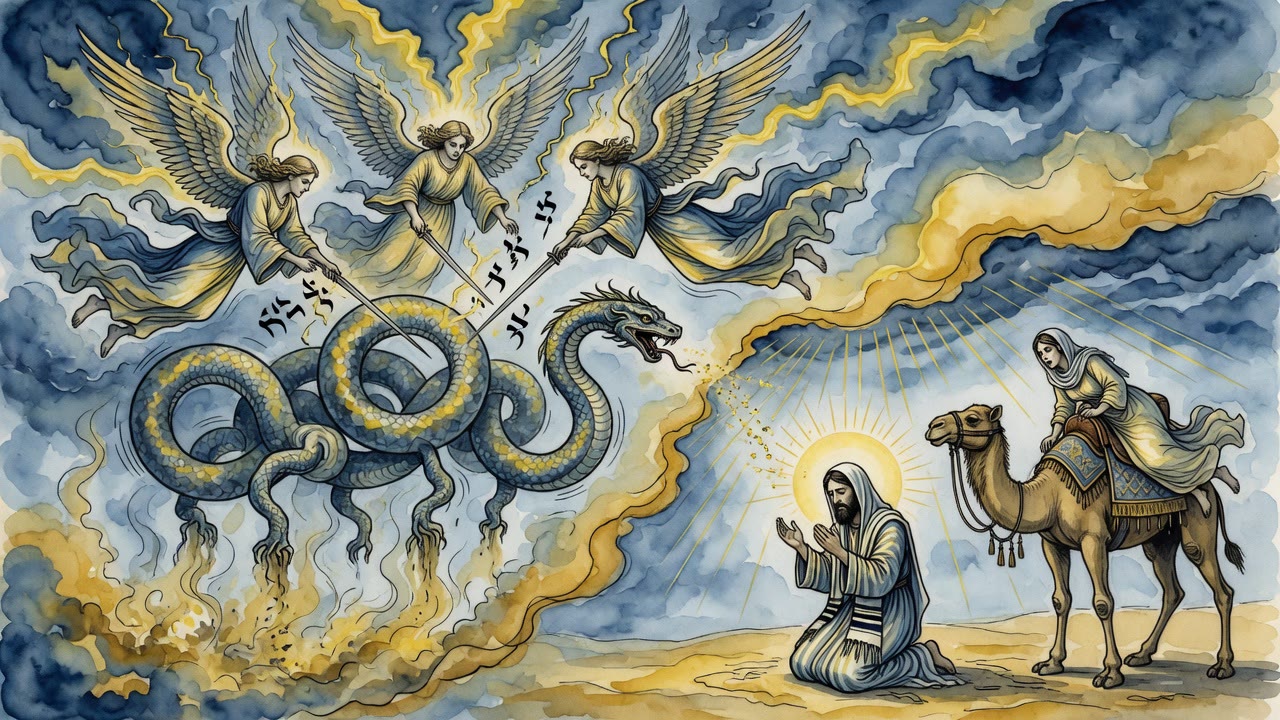
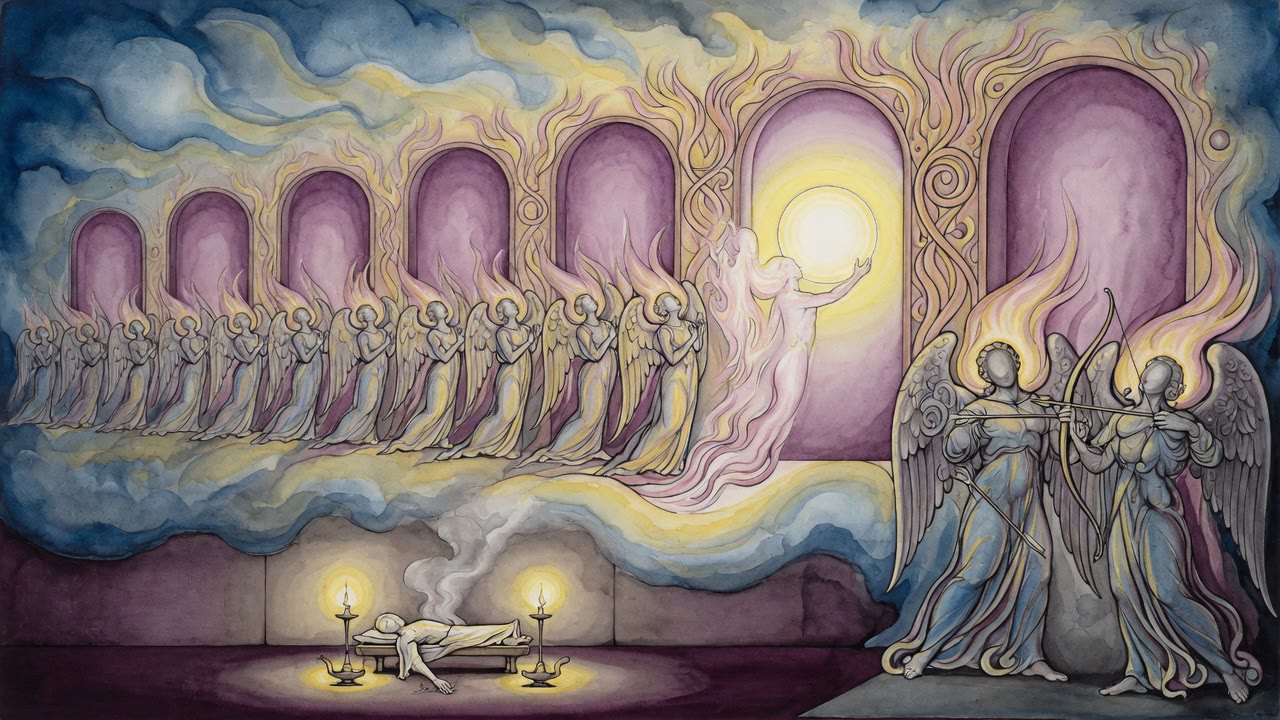
The cherubim turned their faces away. So did the ophanim, the wheels of the chariot, which carry more eyes than any creature needs and shut all of them. They were not being punished. Nothing with a face turned toward that corridor could survive what was moving up it, and the ranks of heaven have learned when to look at the wall.

One angel was given leave to go forward. One. He carried what Nehunya had sent, and the doors of the highest heaven opened the way doors open for someone expected.

What Was Nothing in a Schoolroom Filled the Highest Palace

Nehunya reported it from the bench, eyes open and unfocused, in the voice of a man reading off a wall only he could see.

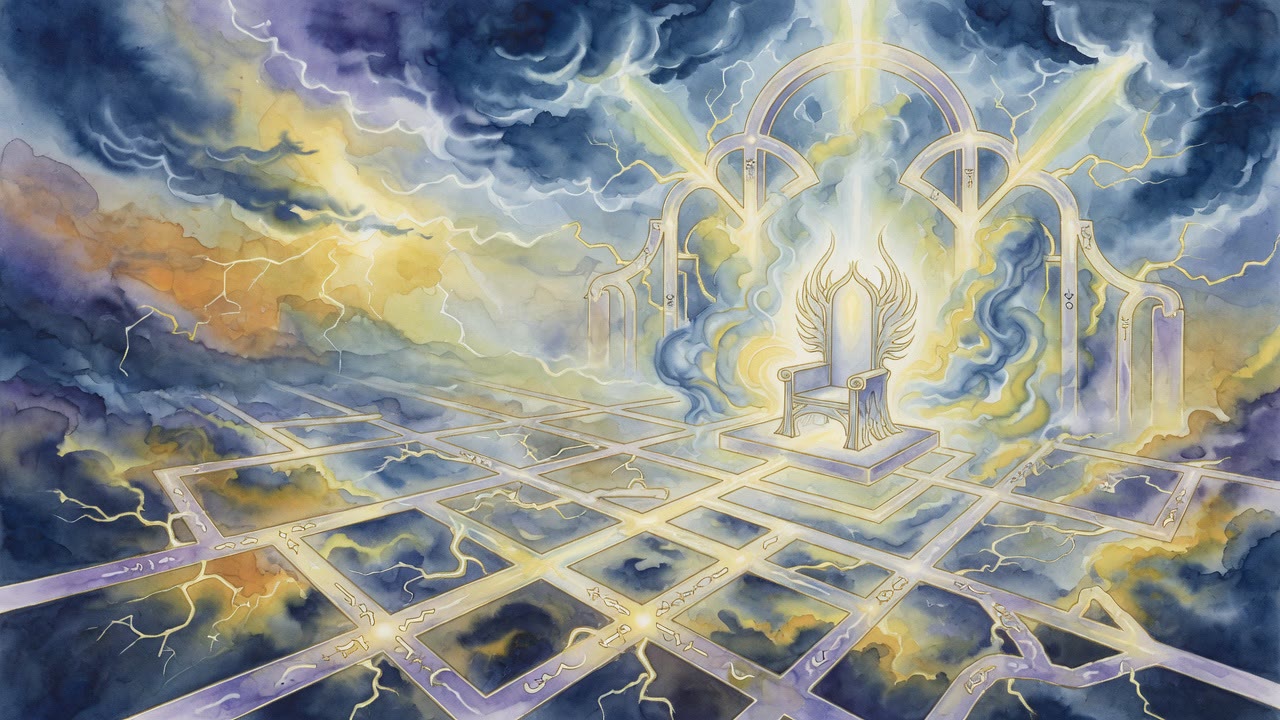
The angel halted before the Throne of Glory and delivered no message at all. He opened his mouth and sang the song the Throne itself sings every day, and the prayer of a man kneeling on a dark floor went into that song and stopped being small.

Laud, song, and music. Thanks and thanksgivings, victory and melody, truth and righteousness, treasure and ornament and might, calm and rest and consolation, love and loveliness and grace, splendor and innocence, fire, wonders and salvation, perfume, salt, light, preciousness, lordship, kingliness, holiness and purity, majesty and honor and beauty, to Zoharariel, the Lord God of Israel.

Ishmael's hand cramped and he kept writing.

The King on the seat was robed in splendor and made majestic with embroideries of song, wearing a crown of loftiness and a diadem of fearfulness. His own name pleased Him. His palace was magnificent to Him, His servants sang pleasantly, and Israel told Him the kingliness of His wonders.

When He showed Himself from the heights, the deeps caught fire from His beauty, and out of His stature the clouds let down rain, and every tree rejoiced at His word.

Ishmael Left a Line Empty on the Tablet

Nehunya came back the way a man surfaces from cold water, all at once and badly. He asked for his cloak, which was already on him.

The fellowship crowded the bench and wanted to know whether the prayer had been granted. He would not answer. He said only that he had watched a handful of words leave a dark floor and stand up before the seat of glory as though they were the reason the palace was built.

The older man at the door had not moved through any of it.

Ishmael carried the tablet out to catch the first light and found rain coming down hard on the courtyard stones, out of a sky dry for eleven weeks. He stood in it with the wax under his arm. He never opened the column of losses, and he wrote nothing about the rain, because there was no honest place on that tablet to put it.


← All myths
From the tradition

Sources

2 sources

The texts behind this telling. Some cards carry a translation of the source; others are our own retelling of it, and each card says which. Every card links out to the original.

Heikhalot Rabbati 13:2Heikhalot Rabbati

Retold in our words. Read the original at the link below.Sefaria-hosted English translation · CC-BY

The ancient mystics of the Heikhalot (the heavenly palaces) texts, specifically here in Heikhalot Rabbati 13, believed there was. They weren't shy about going straight to the source, so to speak. This particular passage gives us a glimpse into their intense, almost audacious, approach to prayer.

First, what are the Heikhalot texts? Heikhalot (חֵיכָלוֹת) is Hebrew for "palaces" or "halls." These are a collection of mystical Jewish texts that describe ascents through heavenly realms. Think of them as spiritual guidebooks to the divine throne room.

That's exactly where our passage takes us. It’s a request, a plea even, directed to the "hypostates." Who are these "hypostates?" Well, they're the powerful beings who bear the very throne of God’s glory. These aren't your everyday angels; they're the celestial heavy-lifters.

The text implores these beings to amplify the joy, the singing, the music before the throne of Totrosiai Nebhobh Medhath Za’an (or, according to some, Tesar Nadhibh Merath Za’an, the Lord God of Israel). These names, resonant and powerful, are more than just labels. They are keys, vibrations designed to unlock specific spiritual frequencies.

Why all the fuss about increasing the heavenly jubilation? The text explains: so that God’s heart will rejoice. And when God’s heart rejoices, He will be more receptive, more accessible to those who "descend to the Merkabha."

Ah, the Merkabha (מֶרְכַּבְתּ). That word literally means "chariot," and it refers to the divine chariot-throne Ezekiel saw in his famous vision (Ezekiel 1). In the Heikhalot tradition, to "descend to the Merkabha" means to undertake a perilous spiritual journey, an ascent through the heavens to stand before God. It's not a physical journey, of course, but an intensely focused and disciplined mystical practice.

The key takeaway here? It’s about creating the right conditions for divine encounter. It's not enough to just show up and ask. The Heikhalot mystics believed in actively cultivating an atmosphere of joy, praise, and intense devotion to make our prayers truly effective.

Think of it like this: you wouldn't barge into a king's court demanding favors without first showing proper respect and reverence. Similarly, approaching the Divine requires preparing the ground, so to speak, creating a space where our prayers can resonate and be heard. It’s about aligning ourselves with the divine frequency.

So, the next time you pray, consider the lesson of Heikhalot Rabbati 13. Maybe you can’t command celestial beings to amplify your voice, but you can bring a little more heart, a little more joy, a little more kavanah (intention) to your prayer. Who knows? You might just find that your voice carries a little further than you thought.

Full source
Heikhalot Rabbati 25:1Heikhalot Rabbati

Retold in our words. Read the original at the link below.Sefaria-hosted English translation · CC-BY

In the Heikhalot (the heavenly palaces) Rabbati, an angel is granted power and special access to the highest heaven. A horn blasts from beyond the sky, a signal, and even the highest-ranking angels – the cherubim and ophanim – turn away, perhaps out of reverence, perhaps because the sheer intensity of the Divine is too much to bear.

The angel proceeds, steps forward, and stands before the very throne of God's glory. This isn't just any throne; it's His glory manifest. And what happens next is… breathtaking.

The angel begins to recite a song, but it's not just any song. It's the song that the throne of glory itself sings every single day. – a daily harmony emanating from the very seat of Divine power! What does it sound like? Heikhalot Rabbati gives us a taste, a cascade of praises:

"Laud, song, and music, blessing, praise and celebration and applause and thanks and thanksgivings, victory and melody, speech and rejubilation, rejoicing and joy and gladness, exultations, accord, humility, brilliance, propriety, truth, righteousness and justice, treasure, ornament and might, delight and ecstasy and elevation, calm and rest and consolation, contentment and quiet and peace, tranquility, security and prosperity, love, loveliness, grace and mercy and pulchritude, renown, acclaim and pity, splendor, glory, innocence, effulgence, appearance, adornment, brilliance, fire, ramification, sublimity, wonders and salvation, perfume, salt, light, loftiness, help, violence, potency, height, preciousness, mightiness, lordship, fortitude, elevation, exaltation and brightness, kingliness, power and force, holiness, purity and cleanliness, pride, greatness and kingship, magnificence and majesty, honour, and beauty to Zoharariel the Lord God of Israel."

It's an overwhelming outpouring of adoration, a torrent of beautiful qualities ascribed to God. It's not just a list, but a vibrant expression of the Divine's many-sided nature. You can almost hear the music, the layered harmonies of praise.

The text continues, painting a picture of this "Splendid King," robed in splendor and crowned with majesty. "He robed with splendour, Made majestic with embroideries of song, Crowned with magnificence and majesty, A crown of loftiness and a diadem of fearfulness." The language is rich, almost intoxicating. It's a reminder that our attempts to describe the Divine are always going to fall short, but the effort, the sheer artistry of the description, is itself a form of worship.

Why all this praise? Because "His name is agreeable to Him, and His title is sweet to Him, And His throne is splendid to Him and His palace is magnificent And His glory is delightful to Him, and His majesty is becoming to Him, And His strength is pleasant to Him and His servants sing pleasantly to Him, And Israel tell to Him the kingliness of His wonders."

It's a beautiful, almost childlike image of a God who delights in the love and adoration of His creation. It suggests a reciprocal relationship, where our praise and recognition somehow amplify the Divine's presence in the world.

"King of Kings, God of Gods, and Lord of Lords, He surrounded with chains of crowns, encompassed with the ramifications of the rulers of brilliance, He who covereth the heavens with the ramification of His magnificence, and who, in His majesty, appeared from the heights, from His beauty the deeps were enkindled, and from His stature did the clouds shower rain."

The passage culminates in a breathtaking vision of God's power and beauty. His very appearance ignites the depths and brings forth rain. "His stature sendeth out the lofty, and His crown blazeth out the mighty, and His garment floweth with the precious. And all trees shall rejoice in His word, and herbs shall exult in His rejoicing."

It's a cosmic celebration, a reminder that all of creation participates in the Divine dance. Even the trees and herbs rejoice in God's word. the next time you're in nature!

What does it all mean? Perhaps it's a reminder that even in the face of the overwhelming mystery of the Divine, we are invited to participate in the song, to add our voices to the chorus of praise. Maybe the key to understanding the Divine isn't through intellectual analysis, but through heartfelt adoration and recognition of the beauty and wonder that surrounds us. And maybe, just maybe, that's enough.

Full source