6 min read

They Sang Without Stopping While the Soul Passed the Seventh Gate

A righteous soul dies at lamplight and is carried up through seven palaces, and at the last gate the guards nock arrows before the seal is lifted.

Curated by Arthur · Told by Maggid ·
Table of Contents
  1. The Ones Who Have a Care for Him
  2. Three Angels Went Ahead of It
  3. The Bows Were Strung at the Seventh Gate
  4. The Name Set the Stones Moving
  5. What the Beasts Were Singing
They Sang Without Stopping While the Soul Passed the Seventh Gate Click for full size

The Ones Who Have a Care for Him

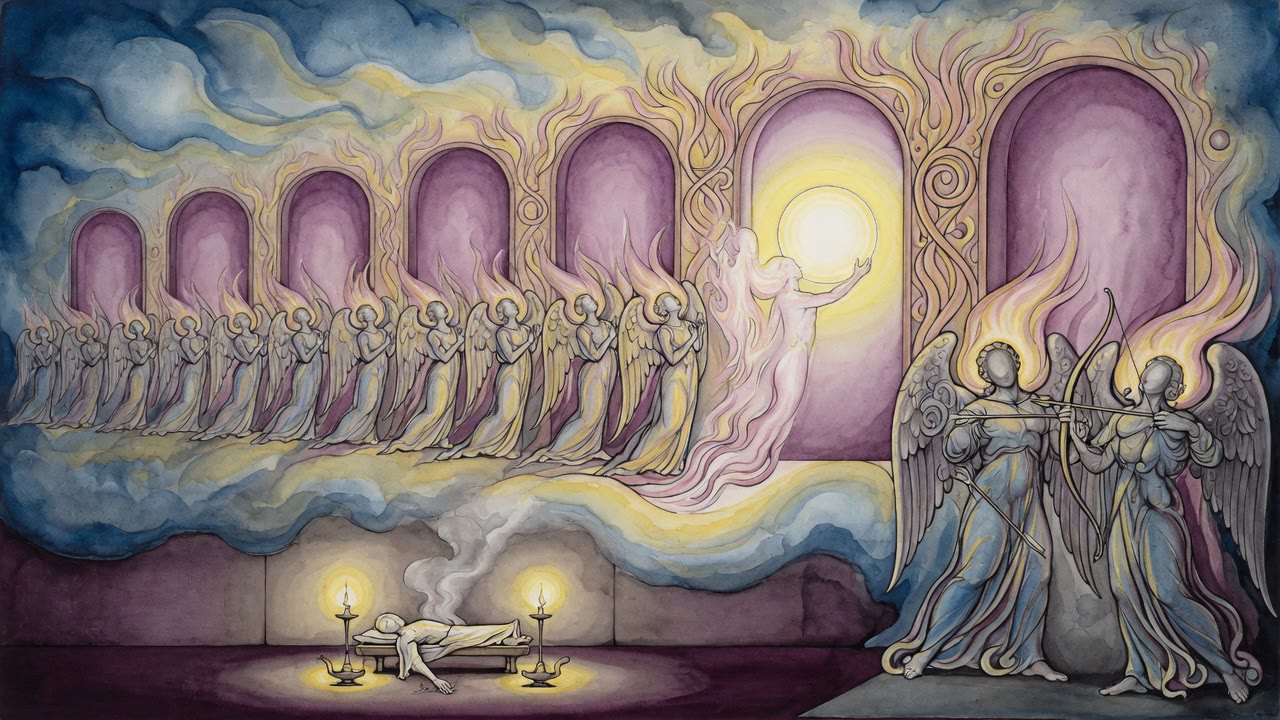
He died at the hour when lamps are lit, and the room did not change. The cup stayed half full on the table. The door stayed open onto the street.

Then others were standing in the room, and none of them looked at the body. They bent instead over the thing that had risen out of it, which had the shape of a man and no weight, and one of them took it under the arm the way a person steadies someone long sick.

"Come up," he said.

They gave no names. They were the ones who have a care for him, and their whole labor is this: to gather a righteous soul at the end and carry it into the chambers of the palace of the seventh heaven. They went out through the roof without opening it.

Three Angels Went Ahead of It

Palaces. That is the word for what they climbed through, though nothing in those halls held still. Doorposts stood higher than a city gate.

At every doorway there were keepers, and their breath came out hot enough to blister a wall. Each of them wanted the same thing before the door moved. Not a name. A right.

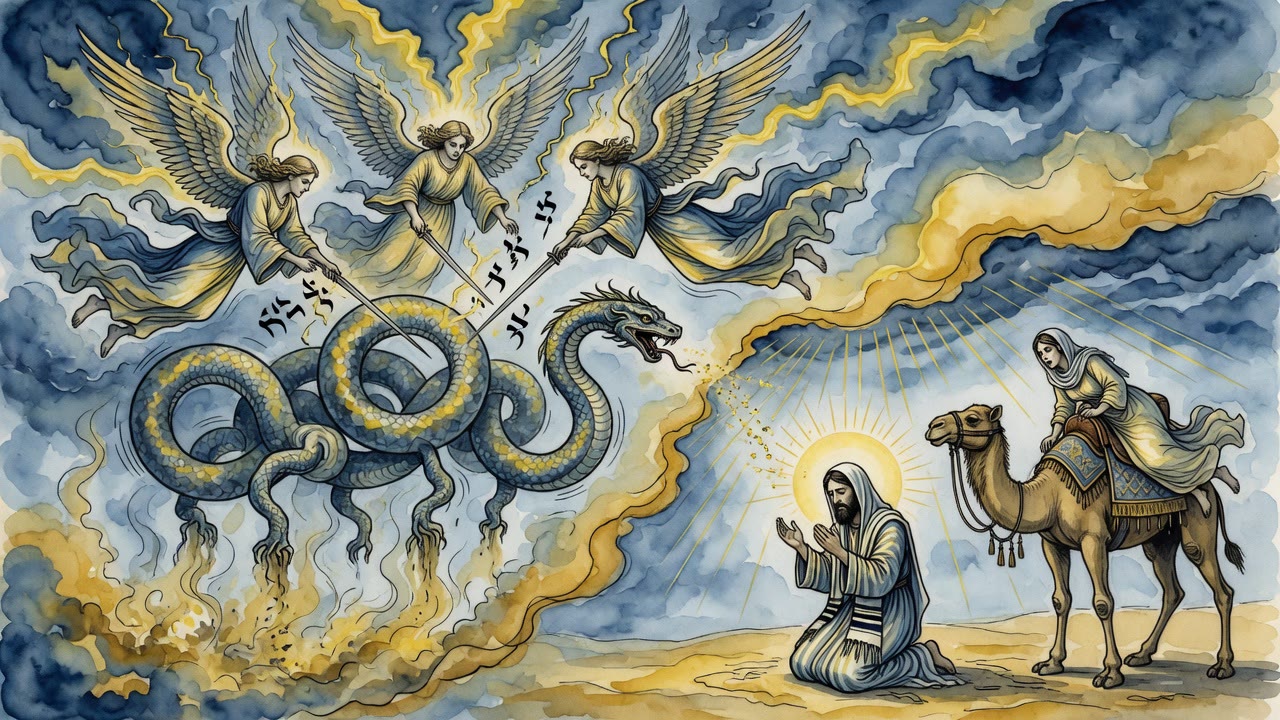
Somewhere past the middle of the climb, three took the front and walked ahead of the soul: Dumiel, Kazpiel, and Gabhriel. They go before anyone who deservingly descends to the Merkavah (מרכבה), the chariot that carries the throne. Men who train their whole lives for that road call it a descent even while they are climbing, and they arrive with seals gripped in their fists.

The soul had no fists. It had nothing but the life behind it.

The Bows Were Strung at the Seventh Gate

The seventh palace did not open.

Its guardians filled the gateway with their faces already angry, as though the argument had started long before anyone arrived. Bows strung. Swords out of the sheaths and turning slowly, catching light the way water catches it.

The escorts stopped. The soul stood where it was put and said nothing.

Then the guardians saw who walked in front, and something went out of them. They covered their faces. The bows came unstrung one at a time, and the sound of it ran down the whole rank like a rope going slack. The swords went back into the sheaths.

The doors still held. Nothing had been settled by fear alone. Dumiel raised the great seal and the fearful crown, and the writing on them could be read from the far end of the hall: "God of heaven, Master of earth, the Lord God of Israel."

The Name Set the Stones Moving

Then somebody spoke The Name.

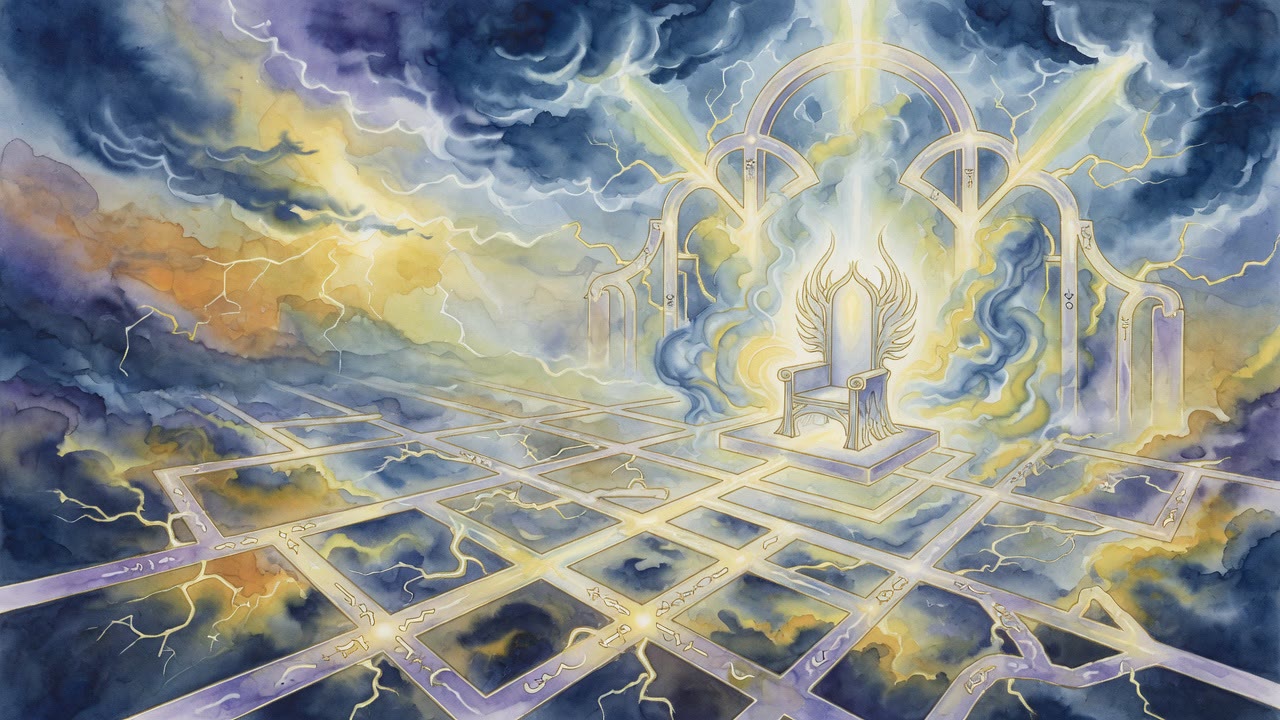
Light broke off it and went everywhere, gilding and silvering the walls, and the stones in the gate woke up. Topaz turned. Onyx turned. Sapphire, carbuncle, and emerald began to move in their settings as if something beneath them had shifted its weight, and the pure marble gave back a brightness with no source.

By that Name heaven and earth had been made. By it every kind of created thing is held together, bound, suspended, and sealed shut, and the seventh palace opened on the sound of it.

What the Beasts Were Singing

Music came out through the doors before anything else. Every instrument that has ever been struck or blown or plucked, and voices under them, and the whole procession went in front of the soul.

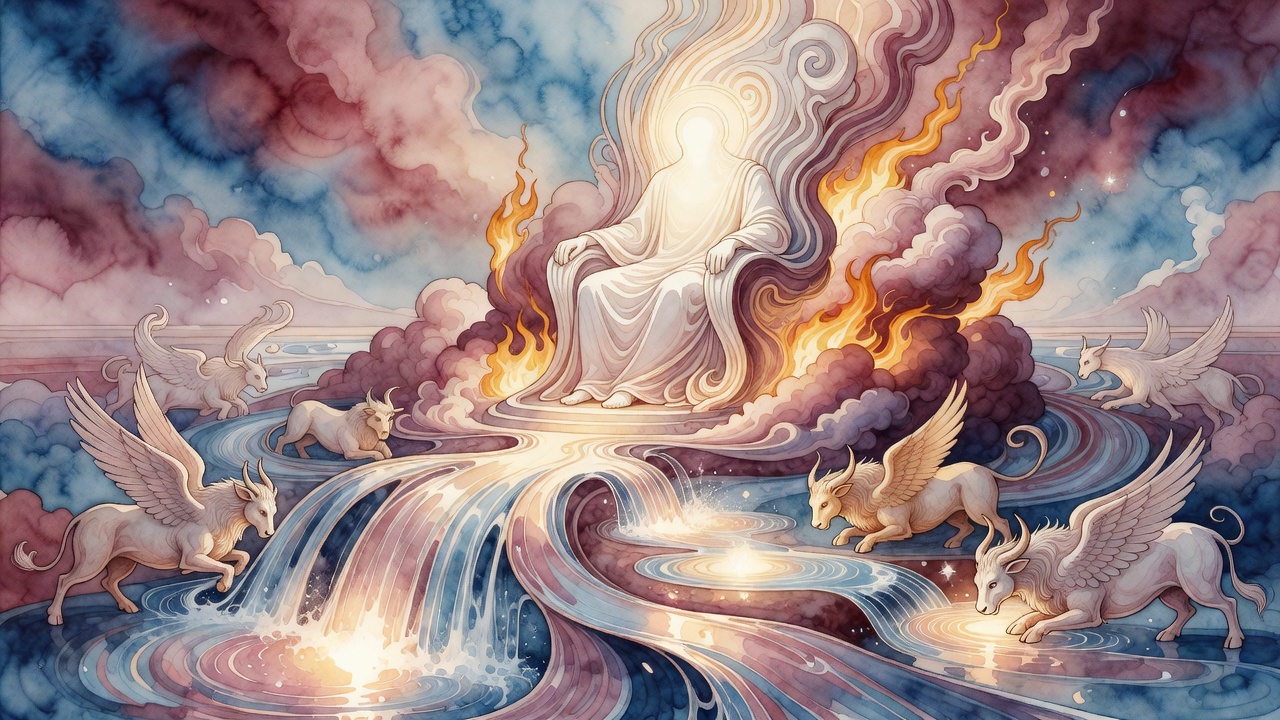
They carried it past the cherubim. It passed the ophanim. It passed the holy beasts, who would not break off their singing to look.

A shout went across the servants who bear up the throne. "Be proud, be proud ye lofty! Lift yourselves up, lift yourselves up ye splendid! Strengthen, strengthen yourselves, ye strong! Exalt, exalt yourselves, ye haughty!" They straightened where they stood, because loftiness and strength belong to the King of the World, and the ones who carry His throne are meant to wear some of it.

They set the soul at the right hand of the throne of glory. There are hours when a soul standing in that place stands over against Tazsh, the Lord God of Israel, and there is no nearer place to stand.

From there it could see everything done before the throne, and know everything still coming to the world below. Who would be cast down and who exalted. Who weakened and who made strong. Who crushed with poverty and who made rich. Who would die that year and who would live. From whom an inheritance would be taken and to whom it would be handed, who would be granted the Law for his portion and who would be given Wisdom.

Under all of it the hymn kept going, and it had been going long before the ledger was ever opened.

"Honour and faith are His who liveth forever," the beasts sang. "Understanding and blessing are His who liveth forever. Grace and mercy are His who liveth forever. Preciousness and salvation are His who liveth forever."

Below, in the town it had left that morning, a man was being made rich and a woman was being made poor, and both of them were coming out of one hand. The soul opened its mouth to sing along and found nothing left to name that the song had not already claimed: beauty and victory, secret and intelligence, strength and humility, song and praise, laud and loveliness.

So it stood at the right hand with its mouth open and learned the words instead. Nobody told it when the hymn would finish. The singing had started before the earth had a name for itself, and the beasts showed no sign of stopping.


← All myths
From the tradition

Sources

4 sources

The texts behind this telling. Some cards carry a translation of the source; others are our own retelling of it, and each card says which. Every card links out to the original.

Heikhalot Rabbati 1:2Heikhalot Rabbati

Retold in our words. Read the original at the link below.Sefaria-hosted English translation · CC-BY

The Heikhalot (the heavenly palaces) Rabbati, a fascinating and complex text from the early Kabbalistic tradition, offers a glimpse into just that – a vision of heavenly ascent and divine encounter.

The soul, having lived a life of righteousness, is ushered into the celestial realms, carefully guided and protected. It’s an incredible journey, a pilgrimage to the very heart of divine presence. But who is doing this guiding?

It is those who "have a care for him." Who are they? We aren’t explicitly told here, but the implication is that these are angelic beings, benevolent forces dedicated to the well-being of the righteous. Their task is profound: to gather the soul and bring it to the "chambers of the palace of the seventh heaven."

The seventh heaven… this is no ordinary destination. It's the highest of the heavens in many Jewish mystical traditions, the dwelling place closest to God's throne. And what happens when the soul arrives? It’s caused to stand on the right hand of the throne of glory. What an honor!

But the journey doesn’t end there. The text goes on: "for there be times when he standeth over against Tazsh the Lord God of Israel." Tazsh is a fascinating, somewhat enigmatic figure. The name itself is likely a coded or symbolic designation for God. To stand "over against" God… it speaks to a profound intimacy, a directness of relationship that is almost beyond comprehension.

And what does the soul see in this privileged position? Everything. The text emphasizes the soul’s ability "to see all that which is done before the throne of His glory and to know all that which is destined to come to pass in the world."

Think about the implications. This isn't just about witnessing the divine court. It's about understanding the very fabric of reality, the unfolding of destiny. The soul gains insight into the cosmic balance: "Who shall be cast down, who exalted; Who shall be weakened, who made strong; Who shall be crushed with poverty, who made rich; Who shall die, who shall live."

These are the fundamental questions of human existence, the very issues that occupy our thoughts and prayers throughout our lives. And here, in the presence of the divine, the righteous soul gains access to the answers.

The passage culminates in a final, powerful declaration: "From whom shall inheritance be taken, To whom shall inheritance be given; Who shall be granted the Law for his portion And who be given Wisdom." This speaks to the ultimate distribution of divine blessings. Who will receive what? Who will be granted the wisdom of the Torah, the very blueprint of creation?

The Heikhalot Rabbati offers us a tantalizing glimpse into the afterlife, a world of celestial palaces, divine encounters, and profound understanding. It leaves us pondering: what kind of legacy are we building, and what awaits us on our own journey home?

Full source
Heikhalot Rabbati 22:2Heikhalot Rabbati

Retold in our words. Read the original at the link below.Sefaria-hosted English translation · CC-BY

Not just in spirit, but…well, that's what the Heikhalot (the heavenly palaces) Rabbati tries to describe. It's an ancient mystical text, part of the Heikhalot literature, a collection of writings detailing visionary ascents through heavenly palaces. And let me tell you, getting through those palaces sounds intense.

Specifically, Not just anyone can waltz in. You need the right…credentials, let’s call them. According to this vision, even the mighty angels Dumiel, Kazpiel, and Gabhriel, powerhouses in their own right, precede the person "who deservingly descendeth to the Merkabha.” Merkabha, by the way, refers to the Divine Chariot, Ezekiel's vision of God's throne-chariot described in the Book of Ezekiel. To “descend to the Merkabha” implies mastering the mystical secrets and practices needed to experience this divine vision.

These gatekeepers of the seventh palace? They’re not exactly rolling out the welcome mat. The text says their faces are initially…angry. Yikes! They're armed, ready for a fight. Bows are strung, swords are drawn. But when they see who's approaching, accompanied by these powerful angels, a transformation occurs.

They cover their faces, seemingly in awe or perhaps submission. The bows are unstrung, the swords returned to their sheaths. But even then, it’s not enough. There’s still one more hurdle.

To gain entry, the person ascending needs to display "a great seal and a fearful crown." What exactly is this seal? What is this crown? The text specifies the inscription: "God of heaven, Master of earth, the Lord God of Israel." It’s a declaration, a statement of divine sovereignty.

Only then, with the proper credentials and divine endorsement, is the path truly open. And what awaits beyond? It’s breathtaking.

The angels usher the person before the very throne of glory. And here’s where the real magic happens. Instead of more stern-faced guards, music fills the air. All sorts of instruments are played, songs are sung. It's a full-blown heavenly concert, leading the way. They bring the person up, not just into the palace, but right beside the cherubim, beside the ophanim (another type of angelic being), beside the holy beasts – those creatures Ezekiel saw surrounding the Divine Chariot.

And what does the person see? The Heikhalot Rabbati tells us they behold "wonders and powers, loftiness and greatness, holiness and purity, fear, humility, and justice." It’s a vision of the divine in all its many-sided glory. It’s an overwhelming experience of the very essence of God.

What are we to make of all this imagery? Is it a literal description of a place? Or is it a metaphor for the deepest levels of spiritual experience? Perhaps it’s both. Maybe the journey to the seventh palace, as described in the Heikhalot Rabbati, is a map, a map of the soul's potential to ascend, to encounter the Divine, and to be transformed by the experience. It invites us to consider: What "seal" do we carry? What "crown" do we wear as we navigate our own spiritual journeys? And what wonders might await us if we dare to seek them?

Full source
Heikhalot Rabbati 11:4Heikhalot Rabbati

Retold in our words. Read the original at the link below.Sefaria-hosted English translation · CC-BY

The ancient text Heikhalot (the heavenly palaces) Rabbati, one of the foundational works of Merkabah (chariot) mysticism, gives us a glimpse – a shimmering, almost overwhelming vision. It's a journey into the divine throne room, a realm of unimaginable light and power.

A place where just mentioning The Name, that ineffable, unspeakable name of God, ignites a cascade of light. Not just any light, but light that illuminates and dawns, gilds and silvers, sets precious jewels like topaz, onyx, sapphire, carbuncle, and emerald into motion. And pure marble, too, gleaming with an unearthly radiance.

Why all this dazzling imagery? Heikhalot Rabbati tells us it's because this place holds a profound secret. It's the very name by which heaven and earth were brought into being. More than that, it’s the key to how all the different parts of creation – all the categories – are held together, bound, suspended, and sealed. It’s the cosmic glue, the divine architecture, all wrapped up in one…word? Sound? Vibration? The text leaves us breathless.

Then comes the call.

"Be proud, be proud ye lofty! Lift yourselves up, lift yourselves up ye splendid! Strengthen, strengthen yourselves, ye strong! Exalt, exalt yourselves, ye haughty!"

It’s a powerful, almost ecstatic proclamation. Who is being addressed here? The text makes it clear: It’s a call to the beings who dwell in this celestial realm, the servants of God, those who bear up His throne. They are commanded to embrace their own magnificence, to recognize their strength and splendor.

Why? Because, the text emphasizes, loftiness, strength, haughtiness, and splendor ultimately belong to The King of the World and all His servants. It is fitting, even proper, that those who serve the Divine Majesty should reflect that very majesty in their own being.

This isn't about arrogance, though. It’s about recognizing the divine spark within, the reflection of God's glory that resides in all of creation. It's a call to embody that divine potential, to stand tall in service of something greater than ourselves.: The Heikhalot texts are all about ascent, about the soul's journey through the heavenly realms. This passage in Heikhalot Rabbati (11) suggests that the journey isn’t just about reaching the divine, but about becoming more divine ourselves.

Full source
Heikhalot Rabbati 28:1Heikhalot Rabbati

Retold in our words. Read the original at the link below.Sefaria-hosted English translation · CC-BY

You're not alone. Our ancestors wrestled with this too, and some of their most beautiful attempts to capture the unimaginable can be found in texts like Heikhalot (the heavenly palaces) Rabbati.

Heikhalot Rabbati, which translates roughly to "The Greater Palaces," is part of a body of mystical literature exploring the ascent of the soul through the heavenly realms. These texts aren't just about describing what's "up there," though. They're about cultivating a profound connection with the Holy One, Blessed Be He.

One particularly striking passage, section 28, offers a litany of praise, a cascade of attributes ascribed to the Eternal One. It's less a description, and more a… well, an explosion of adoration.

"Honour and faith are His who liveth forever; understanding and blessing are His who liveth forever…"

Notice the rhythm? The echoing phrase? It's almost hypnotic, designed to draw you in, to bypass the rational mind and touch something deeper.

"Greatness and might are His who liveth forever; knowledge and utterance are His who liveth forever…"

We move from abstract concepts, greatness, might, to more tangible ones: knowledge, utterance. It's a reminder that God isn't just some distant, unknowable force. God is also intimately involved in the world, in our very ability to speak and understand.

"Magnificence and majesty are His who liveth forever; assembly and trustworthiness are His who liveth forever; brilliance and effulgence are His who liveth forever…"

The words themselves are almost overwhelming in their beauty. Brilliance and effulgence! You can almost see the light radiating outwards. And then, "assembly and trustworthiness." Another pairing of the grand and the intimate. God is majestic, yes, but also trustworthy, a being we can rely on.

"Grace and mercy are His who liveth forever; purity and goodness are His who liveth forever; preciousness and salvation are His who liveth forever…"

Here, we touch upon the themes of redemption and divine love. Grace, mercy, salvation. these are not just abstract theological concepts. They are the very foundation of our relationship with the Divine.

"Crown and glory are His who liveth forever; doctrine and encouragement are His who liveth forever; kingdom and power are His who liveth forever…"

The imagery of kingship is strong here. But remember, this isn't about earthly power. It's about the ultimate authority, the source of all being. And yet, even within this framework of kingdom and power, we find "doctrine and encouragement." A reminder that God's rule is not one of fear, but of guidance and support.

"Beauty and victory are His who liveth forever; secret and intelligence are His who liveth forever; strength and humility are His who liveth forever…"

Ah, the dance of opposites! Beauty and victory, strength and humility. This isn't a contradiction, though. It's a reflection of the many-sided nature of the Divine. God is both powerful and humble, both beautiful and victorious.

"Jubilation and righteousness are His who liveth forever; applause and holiness are His who liveth forever; splendour and wonder are His who liveth forever…"

Can you feel the joy building? Jubilation, applause, splendour, wonder! The language is reaching a fever pitch, a crescendo of praise.

"Song and praise are His who liveth forever; laud and loveliness are His who liveth forever."

And finally, we arrive at the simplest, most direct expression of all: song and praise, laud and loveliness. It's a reminder that, ultimately, our connection with the Divine is about love, about beauty, about the simple act of offering our gratitude.

Perhaps it's this: that language may always fall short of capturing the fullness of the Divine, but the very act of trying, of offering our words, our thoughts, our hearts. that is itself a form of connection. It is itself a form of prayer. And maybe, just maybe, that's enough.

Full source