5 min read

Seganzegael's Tears Fell Hot on Ishmael's Face

The Prince of the Presence pulled the sage to his chest and wept without stopping. Each tear named a grief still waiting for Israel.

Curated by Arthur · Told by Maggid ·
Table of Contents
  1. In the Bosom of the Prince
  2. Tablets of What Must Still Arrive
  3. Advocates Who Beat Their Crowns
  4. Faces That Men Do Not Know
  5. Returning With Salt on the Skin
Seganzegael's Tears Fell Hot on Ishmael's Face Click for full size

In the Bosom of the Prince

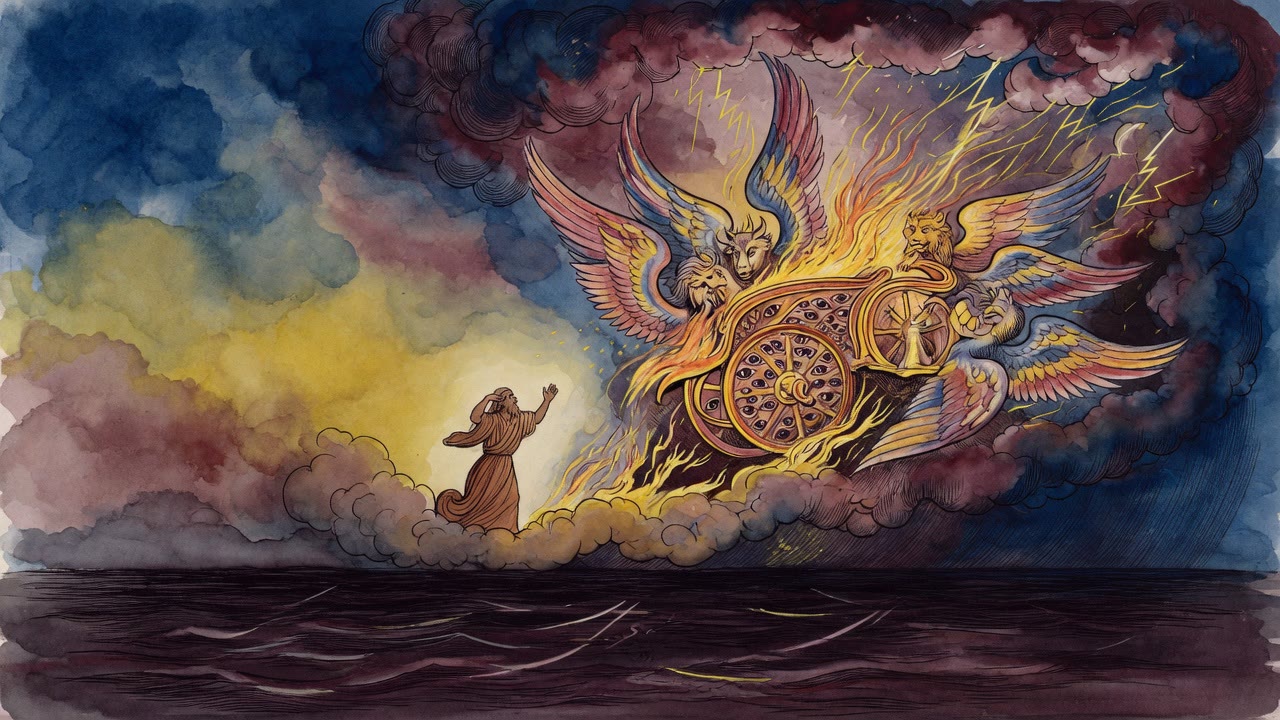
Rabbi Ishmael did not expect to be held. Seganzegael, Prince of the Presence, drew him in as a father draws a son who has asked one question too many, and the angel's chest was not warm the way flesh is warm. It was warm the way a furnace is warm behind iron. Then the Prince gazed at him and began to weep, and the tears ran without pause from those terrible eyes and fell upon Ishmael's face like a second anointing.

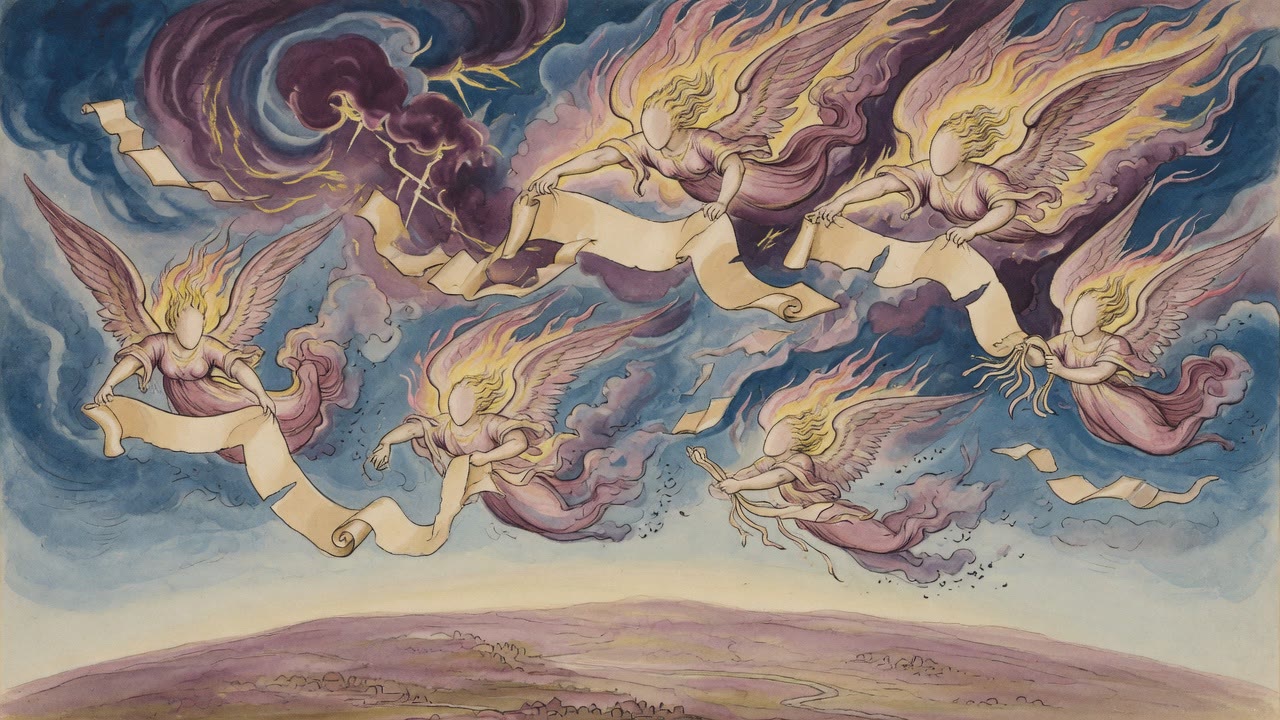
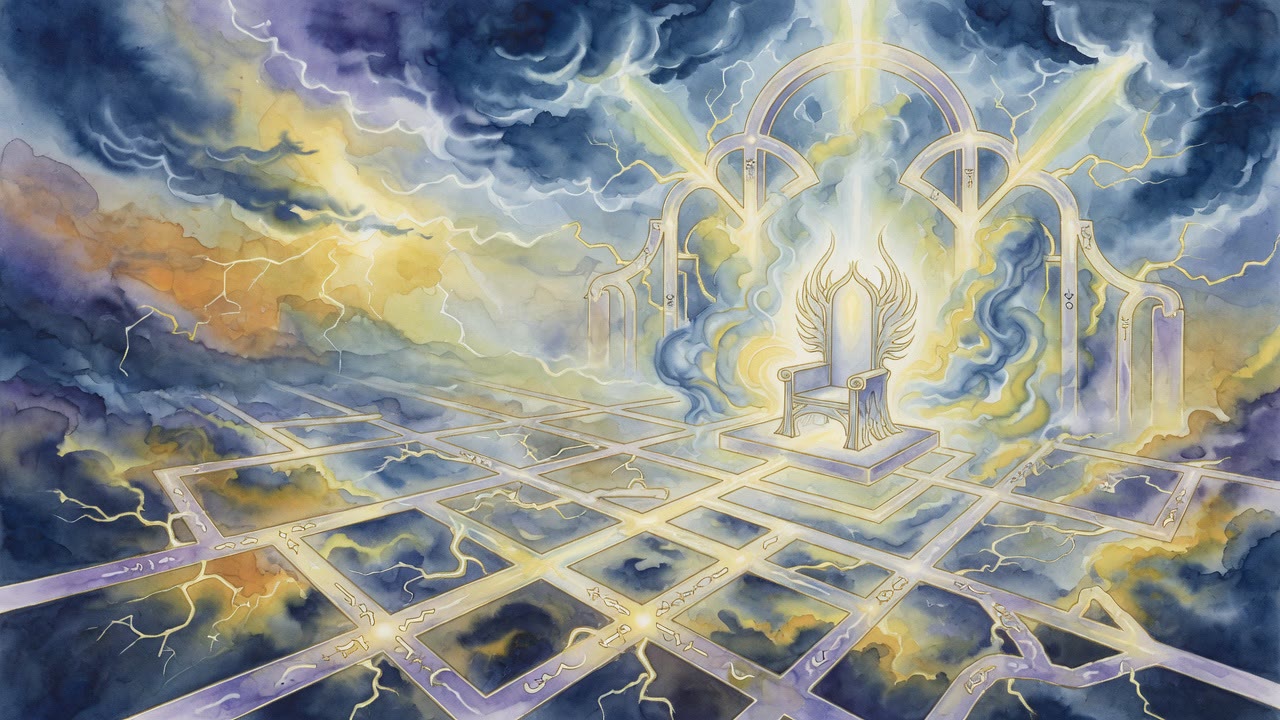
Why does your Excellency weep? The question was small. The answer would not fit in a mouth. Seganzegael rose and took the sage through inmost chambers, secret rooms, treasuries where light is stored the way grain is stored against famine. Tablets stood in rows. Letters crowded their faces. Each letter was not a lesson. Each letter was a grief with a name still waiting to happen to Israel.

Ishmael's own tears mixed with the angel's until he could not tell which salt was whose.

Tablets of What Must Still Arrive

For whom are these? The Prince did not soften the inventory. The tablets held destinies of pressure, exile, and the long math of nights when children ask questions no parent can answer without breaking. Heaven, in this vision, does not pretend the future is only song. It keeps records of pain with the same care it keeps records of song.

Ishmael wanted to close his eyes. Closing eyes does not work in a place made of seeing. The letters kept arranging themselves into years. He understood, without being told in schoolroom language, that love in the upper worlds includes the courage to show a prophet-student the bill before it comes due.

Somewhere far below, in a courtyard of dust, a child laughed. The sound did not cancel a single letter. It made the weeping worse and more necessary.

Advocates Who Beat Their Crowns

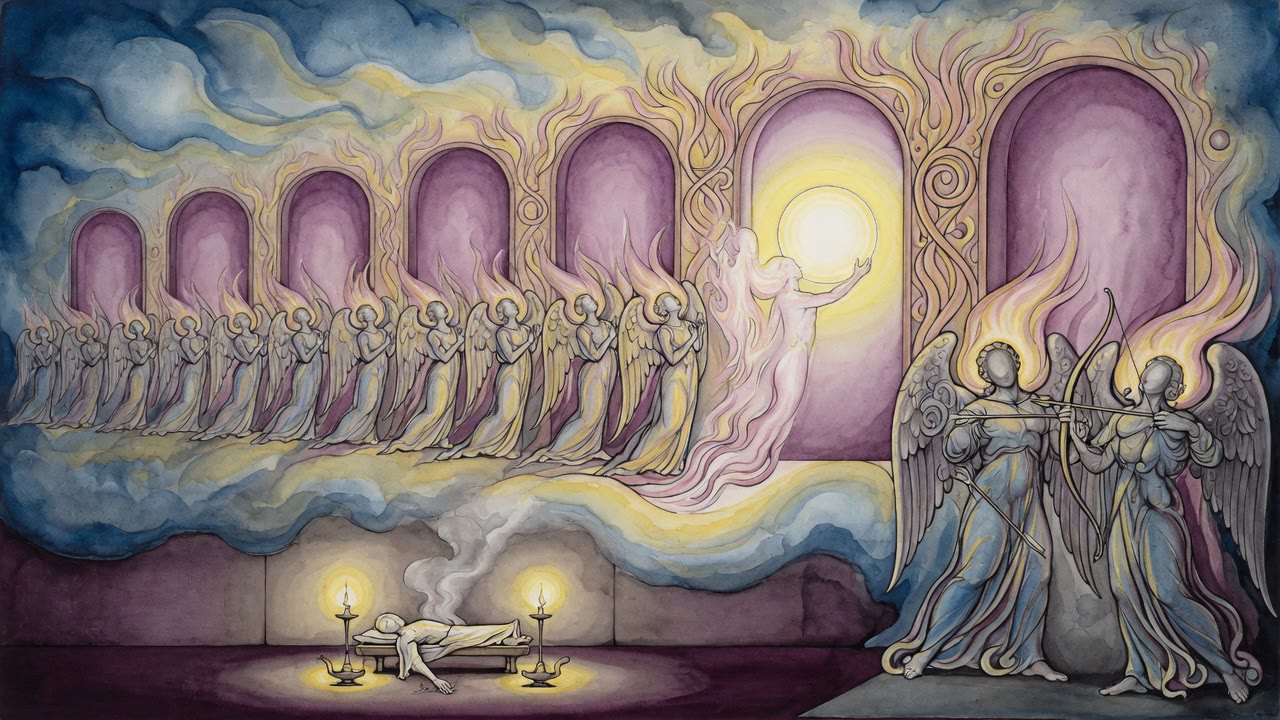
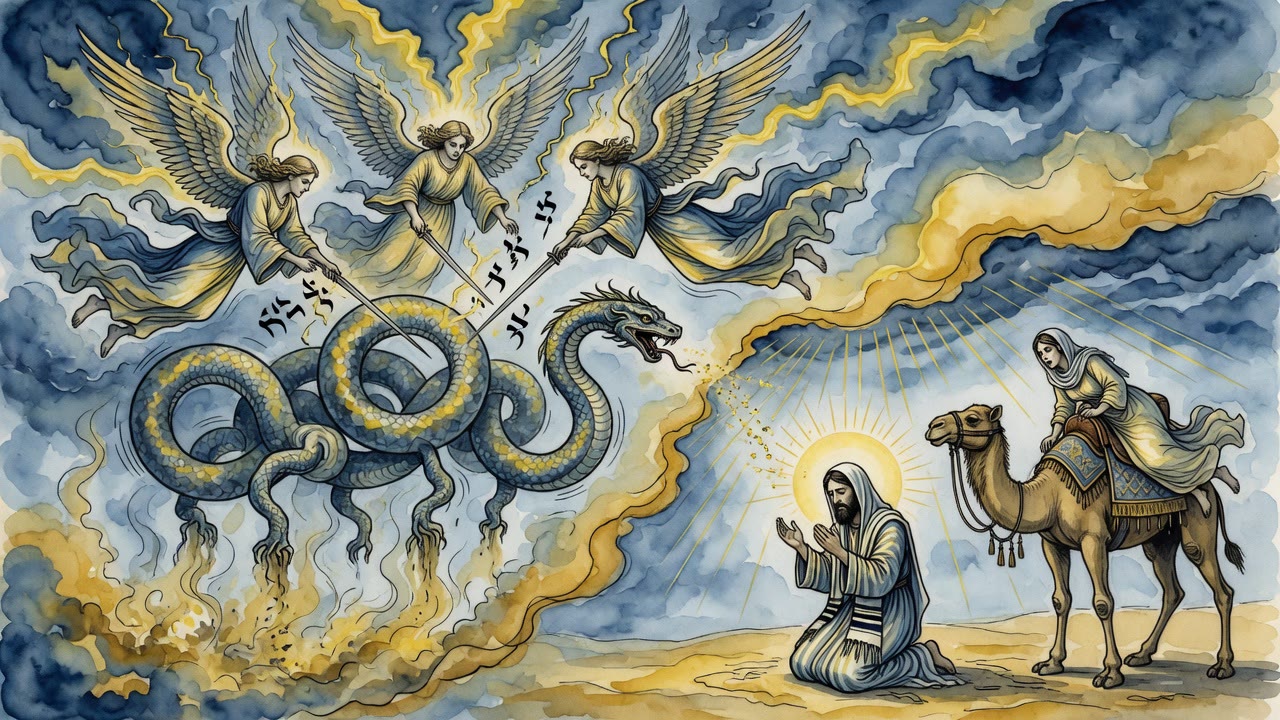
Not every power in those heights only weeps. Other beings stand ready when wrath rises against the children. They cancel decrees, annul vows, avert anger, quiet jealousy, and cause the love of Abraham to be remembered when the court grows cold. When they see their King angry, they do not offer polite memos. They beat upon their crowns, ungird their loins, strike their heads, and fall on their faces with a rawness that would shame a quieter piety.

Release, they cry. Maker of creation, remember the binding. Remember the ash of the ram. Remember the oath that outlives the mood of a single hour. Their advocacy is not a loophole for cruelty. It is the other half of the same heaven that keeps tablets of grief. Without the advocates, the tablets would be only doom. Without the tablets, the advocates would be only theater.

Ishmael watched them and understood why Seganzegael's tears had permission. Even intercession needs a witness who has felt the salt.

Faces That Men Do Not Know

Higher still, faces of loftiness and splendor lifted themselves and maintained themselves on high, aspects so elevated that the children of men neither know nor recognize them. Three times a day they strengthen themselves and call Holy, holy, holy, an echo of Isaiah that does not grow tired with repetition. The Angel of the Presence moves through preparations that make earthly temples look like sketches.

Ishmael could not hold those faces in memory the way one holds a neighbor's face. They slipped from the mind's grip like water from a fist. What remained was the heat of tears on his cheeks and the knowledge that Israel is discussed in rooms where language itself wears armor.

He wanted to ask whether any letter on the tablets could be erased by repentance alone. The Prince's silence was not refusal. It was a silence that said, walk home and live as if erasure were possible and as if every letter still matters.

Returning With Salt on the Skin

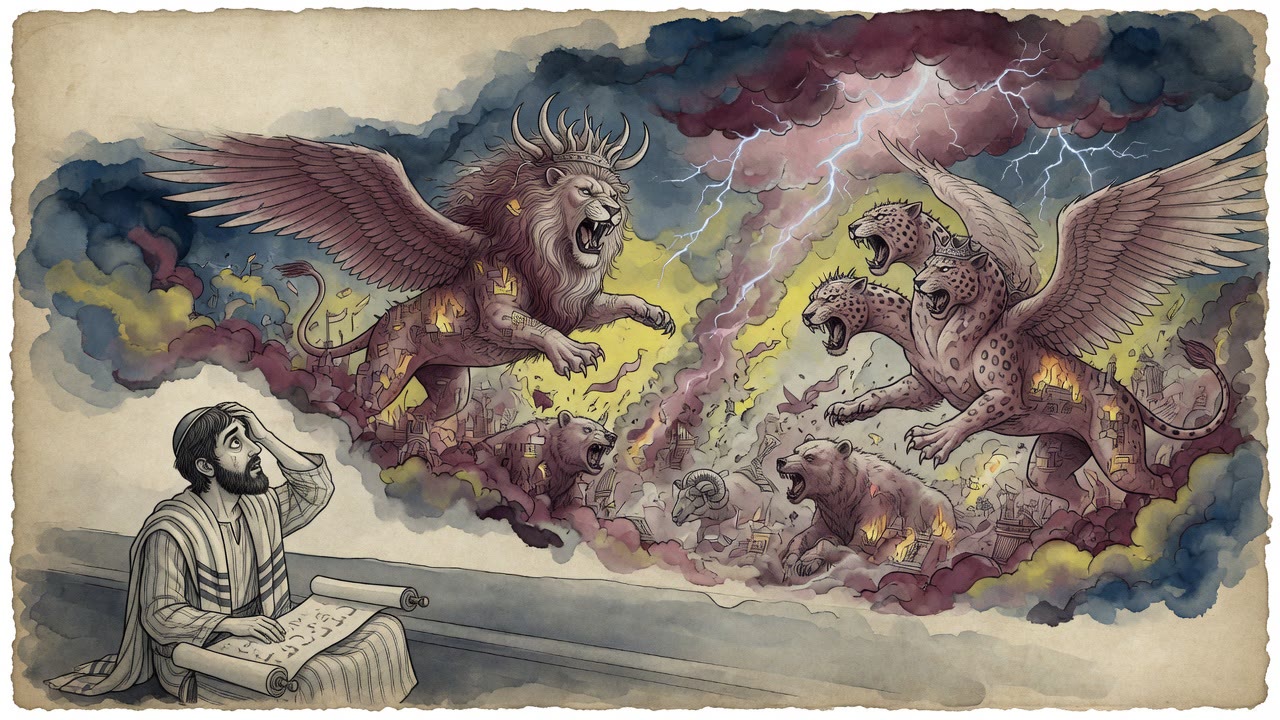
The journey back toward ordinary air felt longer than the climb. When Ishmael found his body again, the salt had dried to a film he could not wash off with basin water. Students asked what he had seen. He told them only what a mouth can carry without lying. An angel wept for us. The future is written in more than one ink. There are advocates who bruise themselves on our behalf. There are faces we will never diagram.

At night he dreamed of tablets turning like millstones. He woke and put his hand to his face as if a tear might still be falling from a height no ladder reaches. The dream did not make him gentle toward sin. It made him urgent toward mercy, and suspicious of any teaching that pretends heaven is only light without ledgers.

In the morning he taught. Between sentences he tasted salt. Seganzegael's weeping had not been a performance for one mystic. It was a weather system over the whole people, and Ishmael had been briefly held inside its cloud.


← All myths
From the tradition

Sources

3 sources

The texts behind this telling. Some cards carry a translation of the source; others are our own retelling of it, and each card says which. Every card links out to the original.

Heikhalot Rabbati 6:3Heikhalot Rabbati

Retold in our words. Read the original at the link below.Sefaria-hosted English translation · CC-BY

It's a wild ride of heavenly ascent and divine secrets. In this particular passage, Rabbi Ishmael encounters Seganzegael, a powerful angelic being, the Prince of the Presence.

This isn't your average meet-and-greet. Seganzegael invites Rabbi Ishmael to sit in his bosom, a gesture of profound intimacy and trust. He then offers to reveal what's in store for Israel. But what follows isn’t a prophecy of triumph – it’s a torrent of tears.

The verse reads, "Seganzegael. gazed upon me and did weep, and his tears ran down continually from his eyes and fell upon my face." Can you imagine the weight of those tears, the sheer sorrow pouring from this celestial being? Rabbi Ishmael, naturally, is concerned. "Why does your Excellency weep?" he asks.

Seganzegael's response is to take Rabbi Ishmael on a tour, a journey into the "inmost chambers and to the most secret rooms and to the treasuries" of the heavens. Here, he's shown tablets filled with letters, each one representing a unique grief destined for Israel. According to Heikhalot (the heavenly palaces) Rabbati, these aren't just abstract sorrows; they're vividly depicted.

Rabbi Ishmael, overwhelmed, asks, "For whom are these?" The answer: "For Israel." He then asks, "And can Israel bear them?" The next day, Seganzegael reveals even more bitter griefs: death by the sword, starvation, and captivity. It’s a litany of suffering. Rabbi Ishmael, understandably, questions the justice of it all. "And did then, your Excellency, Israel alone sin?"

Seganzegael's reply is haunting: "Griefs more bitter than these are laid on them anew each day." But here's where it gets even more interesting, even paradoxical. The text concludes by saying that even when the people gather to say, "Amen. Let the great name be blessed," – a powerful affirmation of faith – Seganzegael and his heavenly host "do not permit these [blessings] to go forth from the inmost chambers."

What does this mean? Are the prayers blocked from reaching God? Are they somehow insufficient to alleviate the suffering?

Well, some commentators suggest this isn't about divine rejection, but about the immense scale of suffering. Perhaps the point isn't that prayers are ineffective, but that the decrees of suffering are so numerous and so deeply entrenched that they require a constant, ongoing effort to counteract. According to scholars like Gershom Scholem, the imagery in Heikhalot literature is not meant to be taken literally, but as a symbolic representation of complex theological ideas.: even in the face of unimaginable hardship, the people continue to gather, to pray, to affirm their faith. Their "Amen" is an act of defiance, a refusal to be crushed by the weight of sorrow. And maybe, just maybe, that act of faith, that persistent hope, is what ultimately tips the scales. The Zohar, a central text of Kabbalah, often emphasizes the power of human actions to influence the divine realm.

This passage from Heikhalot Rabbati isn't just a bleak prophecy. It's evidence of the enduring strength of the human spirit, the power of faith in the face of despair, and the ongoing cosmic struggle between suffering and redemption. It leaves us pondering: what is the role of our prayers, our actions, in shaping the future? And how do we maintain hope when faced with the overwhelming reality of suffering in the world?

Full source
Heikhalot Rabbati 14:1Heikhalot Rabbati

Retold in our words. Read the original at the link below.Sefaria-hosted English translation · CC-BY

That even when things look bleak, when divine displeasure seems pointed our way, there are forces working on our behalf. But who are these celestial advocates?

Heikhalot (the heavenly palaces) Rabbati, one of the key texts of the Heikhalot literature – that mystical tradition focused on heavenly ascent and visions – gives us a glimpse. It describes beings, powerful beings, whose role it is to literally intercede for us.

These aren't just any angels. These are beings who "cancel decrees, who annul vows, who avert wrath, who quiet jealousy, who cause love to be remembered – the love of Abraham." They have the power to undo divine judgments, to soften anger, to rekindle the very love that binds us to our patriarch.

What exactly do they do when they see God, their King, angry with His children? The text paints a vivid picture. They don't stand idly by. They don’t offer polite suggestions. No, they beat upon their crowns, they ungird their loins, they strike their heads, and they fall upon their faces.

It’s a scene of intense, almost desperate pleading. A raw display of empathy and commitment.

And what do they cry out? A litany of urgent requests: “Release, release, O Maker of Creation! Pardon, pardon, O mighty One of Jacob! Atone, atone, O Holy One of Israel! For loftiest of Kings art thou.”

The repetition, the sheer passion...it's breathtaking. They are reminding God of His own attributes: Creator, Mighty One, Holy One. They are appealing to His very essence, reminding Him, perhaps, of His own capacity for mercy.

What does it all mean?

Perhaps it's a reminder that even in the face of divine judgment, we are not alone. That there are forces, seen and unseen, working tirelessly for our well-being. Perhaps it's an invitation to cultivate those same qualities within ourselves: empathy, compassion, and a willingness to stand up for what is right, even when it's difficult.

Or maybe, just maybe, it's a comforting thought to carry with us on those days when the world feels a little too heavy: someone, somewhere, is pleading on our behalf.

Full source
Heikhalot Rabbati 13:1Heikhalot Rabbati

Retold in our words. Read the original at the link below.Sefaria-hosted English translation · CC-BY

The Heikhalot (the heavenly palaces) Rabbati, a mystical text focused on heavenly ascent and visions, gives us a glimpse – a mind-bending glimpse, at that – into the sheer awe and reverence that permeates the higher planes.

These aren't physical faces, of course, but rather aspects or emanations of the Divine, so elevated that, as the text says, they "lift themselves up, and maintain themselves on high." They are so far beyond our comprehension that "the children of men know them not and recognize them not."

Three times each day, these faces "exalt and strengthen themselves," mirroring perhaps the thrice-daily prayers of those on Earth, a cosmic echo of our own spiritual striving. And what’s their mantra? None other than the quintessential declaration of holiness: "Holy, holy, holy," echoing the words of Isaiah (Isaiah 6:3).

The Heikhalot Rabbati doesn’t stop there. It pulls back the curtain on the meticulous preparations that precede the Divine Presence. Imagine this: The Angel of the Presence – a being of unimaginable power and responsibility – goes in to arrange the very throne of glory and prepare a seat for the "Mighty One of Jacob," a poetic name for God.

And how is this done? With staggering displays of honor.

First, the ophanim, often translated as "wheels" or "whirling beings." These celestial entities of majesty each receive a thousand diadems – crowns of glory – and are bowed down before a thousand times. Think about the sheer scale of that!

Next come the cherubim, those iconic figures of glory, often depicted guarding sacred spaces. Each cherub is adorned with two thousand diadems, and prostrated before two thousand times. The numbers are escalating, amplifying the sense of overwhelming reverence.

Then, the Holy Beasts – perhaps similar to the creatures described in the Book of Ezekiel – receive three thousand diadems each, and are bowed down before three thousand times. The intensity is building, the layers of homage deepening.

But the crescendo is yet to come. We encounter "Shining Light," an angel of unimaginable radiance. Six thousand diadems are bound to him, along with "eight thousand thousands of thousands of myriad myriads of myriads of diadems." And he is bowed down before six thousand times. The language strains to capture the immensity of the scene, pushing beyond the limits of human comprehension.

Finally, there's the angel of lightning, adorned with twelve thousand diadems, and sixteen thousand thousands and myriad myriads of myriads of diadems. Twelve thousand times he kneels and prostrates himself. The numbers become almost absurd, a deliberate attempt to convey the utter boundlessness of celestial devotion.

What does it all mean? It’s easy to get lost in the sheer numerical excess. But perhaps the point isn’t the literal count of diadems or prostrations. Instead, the Heikhalot Rabbati uses this imagery to convey the profound and unending reverence that surrounds the Divine Presence. It suggests that the celestial realm operates on a scale of awe and devotion that far surpasses anything we can comprehend on Earth.

The text invites us to consider: What does it mean to truly revere something? What does it mean to approach the sacred with humility and awe? Maybe, just maybe, by contemplating these celestial scenes, we can bring a little bit of that heavenly reverence into our own lives, transforming our everyday moments into opportunities for connection and devotion.

Full source